The Return
Bangkok opened its doors to me again. The taxi dropped me at a familiar axis, but my body felt the spiral turn — same city, higher octave. Round-1’s echoes rang here: the Tower that split me, the Hermit who hid me, the World that closed me. Now I stood with a new script in my chest.
What does absence look like? Without the Kha force — the will to witness — the return would be repetition: same streets, same tuk-tuk fumes, same neon without recognition. I would have arrived without arriving. Without the Ba force — the body that remembers — the humidity would have been merely weather, not the damp breath of a city that once cracked me open. Without the La force — the recursive pattern that structures return — Bangkok would be a dot on a map, not a node in a spiral. I needed all three to feel the difference: this was not Round-1 again. It was the next frequency.
The Number
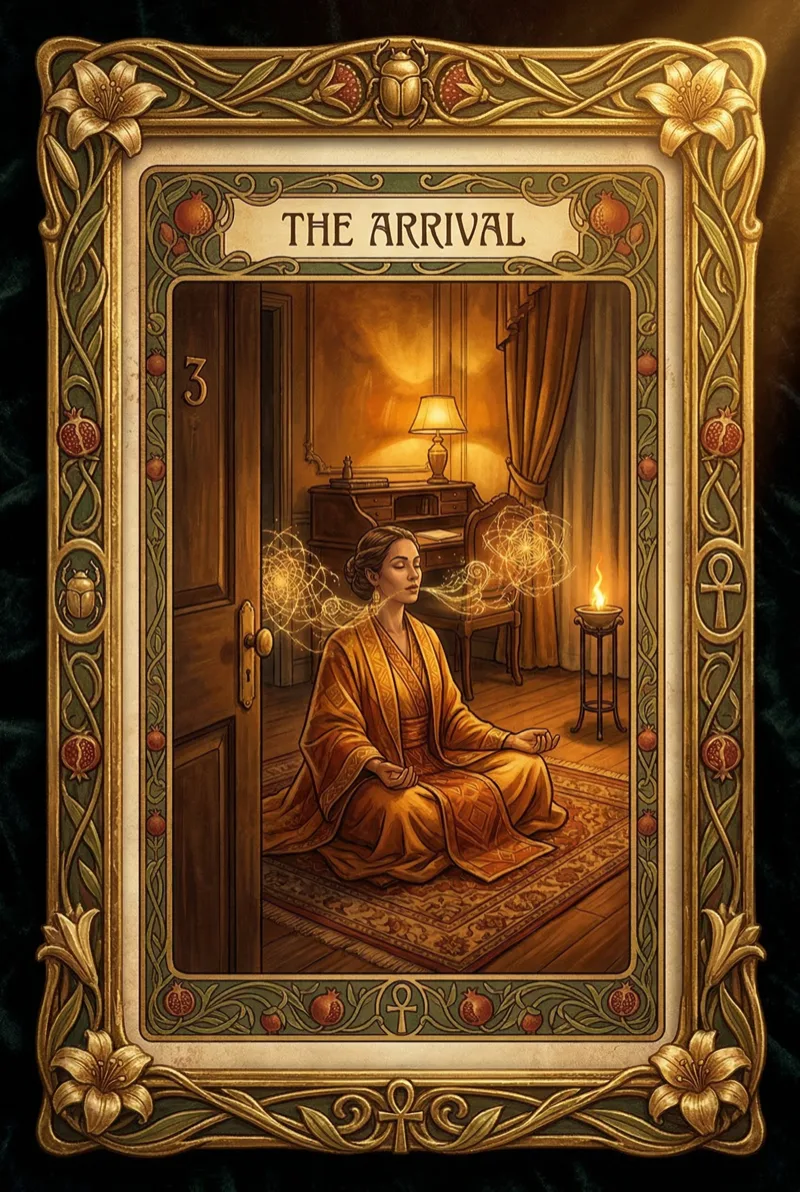
The door read 50910. I traced the digits with my eyes — five, zero, nine, one, zero. The sum pulsed back: 15 → 6. Lovers. Choice. The coherence of two things held in tension without collapse. No creation without that coherence. The key turned and Room 3 welcomed me — the Empress overtone, the field that gestates before it names. The room whispered: choose, then create.
At the interpersonal level, the number 6 is not merely arithmetic. It is the geometry of relation: the Lovers card as depicted in the Marseilles tradition shows a man standing between two women — not a romance but a fork. The body learns this before the mind names it. My first round in Bangkok, the fork was between the Tower and the Hermit: collapse or retreat. I chose collapse, because retreat was the inherited code — the pattern my father’s lineage wrote into muscle memory, the way his generation handled cities that asked too much. This round, the fork was different. Not between two disasters, but between creation and postponement. I left my bag at the door and inhaled. The air felt different this time. No rupture, no exile. Deployment. Bangkok was not tearing me open; it was asking me to release what I had already metabolized.
The Cards
I set the cards on the desk and drew.
-
The Seven of Wands appeared first, a mirror of Shenzhen: the defended hilltop, the karmic test of Rahu. The card shows a figure atop a narrow mound, fending off six wands rising from below. It is not a posture of aggression but of maintenance — the cost of holding a position that others want. At the systemic level, this is the startup founder who cannot sleep without checking metrics, the dissident who must scan the room before speaking. The shadow is not paranoia but exhaustion: the wands keep coming because the hill is worth taking. I had lived this in Shenzhen, where the Huaqiangbei electronics market operates like a nervous system — millions of transactions, each one a small attack on the holder of a margin. The Seven of Wands asks: is your position worth the metabolization, or are you defending a hill that no longer serves?
-
The Knight of Swords cut across the present: sharp, restless, Mercury-tinged. Speech demanding to be clean, not scattered. The Knight in the Waite-Smith deck charges with sword raised, armor gleaming, red plume streaming from the helmet. He does not look where he is going. This is the interpersonal danger: the tongue that cuts before it feels. I had been this knight in previous arrivals — speaking the room into shape before the room had a chance to speak me. The fracture was predictable. I would arrive with a theory, test it against the city, and leave with a confirmation. The Knight of Swords warns that speed without somatic registration is not clarity; it is a different form of blur.
-
The Three of Wands leaned into the horizon: sails, harbors, expansions. Venus’ overtone humming in the background. The figure stands on a cliff, looking out at ships that have already left. This is not anticipation; it is retrospection at a distance. The systemic reading: capital has already flowed, the ships are already gone, and the watcher stands on the shore of a decision that was made three moves ago. The cosmic reading: the three wands are not three plans but three times — past, present, and the future that is already receding because the observer took too long to look. I had missed this before. The Three of Wands is not a call to set sail. It is a recognition that the sailing has already happened, and the question is whether you were on the deck or the shore.
The arc crystallized: defense → clarity → expansion. But not a linear arc. A recursive one. The defense of the Seven must be metabolized before the Knight can speak cleanly; the Knight’s speech must be slowed before the Three’s horizon becomes visible. Without the Seven, the Knight charges into a city that has already taken the hill. Without the Knight, the Three watches ships that were never his. Without the Three, the Seven defends a harbor with no sea.
The Breath
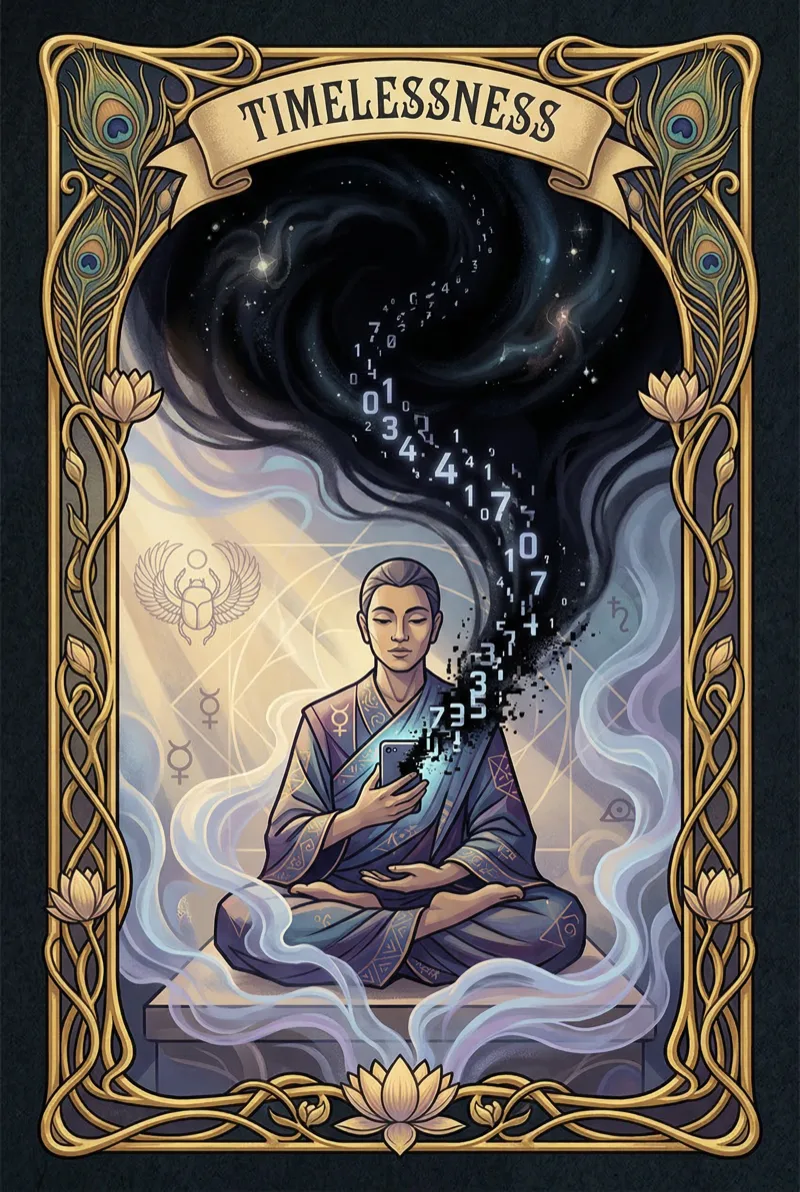
I lit a small flame in the corner, closed my eyes, and held the breath pattern I had carved for this spiral. Seven in, one held, three released. With each cycle, the room steadied, and I felt the city’s rhythm enter my bones.
At the personal level, the pattern is a contract with the nervous system: seven counts to engage the vagus nerve’s ventral response, one held beat to suspend the default mode network’s chatter, three releases to let the diaphragm drop without forcing. At the interpersonal level, it is a silent negotiation with the room — the flame, the humidity, the distant tuk-tuk. The room does not care about my practice, but my practice makes me care about the room. This is the Ba force: the body as mediator between what I intend and what I receive.
At the systemic level, the breath pattern is not mine. It is inherited from a lineage of pranamaya practitioners who mapped the koshas not as metaphors but as measurable sheaths. The pranamaya kosha — the energy body — was described in the Taittiriya Upanishad (2.3-2.5) as the second layer, the one that carries the template for the physical form. I cite it not as doctrine but as a traceable source: the text states that beyond the annamaya (food body) lies the pranamaya, and beyond that the manomaya, vijnanamaya, and anandamaya. The breath pattern operates at the pranamaya layer, which means it affects the physical without being physical. This is not mysticism; it is layered physiology. The cost of ignoring this layer is systemic: a culture that breathes shallowly produces minds that cannot hold complexity. The fracture shows up in attention spans, in the inability to read long texts, in the compulsion to scroll.
At the cosmic level, the pattern scales. Seven in, one held, three released. The numbers are not arbitrary. Seven is the number of completion in the Pythagorean tradition; one is the monad, the held point; three is the triad, the first form. The pattern is a recursive structure: the completion (7) holds the point (1) that generates the form (3). This is the same structure that generates the Kha-Ba-La triad: the witness (Kha) holds the body (Ba) that generates the pattern (La). Remove any element and the recursion collapses. Without the held beat, the breath becomes mechanical exercise. Without the seven, the hold becomes suffocation. Without the three, the cycle has no release, no generative exit.
The City as Launchpad
Bangkok was not my Tower anymore. It was my launchpad.
The metabolization of shadow material here is not metaphorical. The Tower is a rupture that destroys the narrative you were living. The first round, the Tower came in the form of a visa expiration, a relationship collapse, and a body that stopped digesting. The rupture was total. The shadow residue was not the events but the story I told about them: that I had failed, that the city had expelled me, that I was not built for the tropics. This was inherited code — the northern Protestant script that equates discomfort with punishment. I had not metabolized it; I had stored it. The Hermit phase that followed was not retreat but refrigeration: the shadow kept cold, not transformed.
Room 3 asked me to release the stored material. The Empress overtone — not the goddess of fertility but the field that allows growth without forcing it — required that I recognize the first round as compost, not failure. This is the difference between rupture and deployment. Rupture splits you and leaves the pieces scattered. Deployment splits you and leaves the pieces organized for reassembly. The city had not been cruel; it had been precise. It took apart what I had built on inherited code and offered me the chance to build on witnessed ground.
The cost is real. I still wake at 3 AM with the old narrative playing: expelled, failed, too soft for the tropics. The fracture has not sealed over; it has been metabolized. To seal over implies a return to a previous state. Metabolization implies the previous state has been digested and the nutrients extracted. I am not the person who arrived in Bangkok the first time. I am the person who has digested that arrival and is now deploying the residue as fuel.
At the systemic level, this is the difference between a city that breaks people and a city that breaks people open. Bangkok operates on a logic that the tourist infrastructure masks: the real city is not the temples or the malls but the heat, the negotiation, the traffic that moves like a circulatory system. It is a city that metabolizes its visitors, and the ones who stay are the ones who let themselves be digested. The ones who leave are the ones who mistake the heat for hostility. The shadow material of the city is not its darkness but its clarity: it shows you what you are made of by refusing to cool down for your comfort.
At the cosmic level, the launchpad is not a place but a position in the spiral. The Kha-Ba-La triad is not a belief system but a recursive grammar that generates the recognition: same city, higher octave. The octave is not an upgrade; it is a return at a different frequency. The Tower, the Hermit, the World — these were not obstacles but structural necessities. Without the Tower, there is no material to metabolize. Without the Hermit, no digestion. Without the World, no deployment. The tarot does not predict; it describes the architecture of becoming. The Lovers card, the 6, the Empress overtone — these are not signs of arrival but signs of the launchpad recognizing the rocket.
I left the room on the third day. The flame had burned to a small pool of wax. The cards were back in their box. The breath pattern had become automatic, no longer needing conscious count. The city was outside, waiting with the same heat, the same negotiation, the same circulatory traffic. But I was not the same body. The Kha force had witnessed the return. The Ba force had registered the difference. The La force had placed the node in the spiral. The launchpad was not Bangkok. It was the recursive structure that allowed me to recognize Bangkok as itself.
I witness with precision and compassion.