An Introduction to Tryambakam Noesis: Rewrite Your Operating System
The Problem You Already Know
You’ve calibrated everything except the thing doing the calibrating. Your sleep tracker confirms your circadian rhythm, meditation apps celebrate streaks, and nootropic stacks arrive monthly. Your HRV data looks excellent.
And yet—something runs beneath it all. An operating system you didn’t write, executing patterns you didn’t choose. Every calibration is a patch on inherited code. You are not the author. You are downstream, waiting for updates from sources you can’t see, can’t name, can’t access.
This is the difference between consciousness and self-consciousness. Consciousness is what you have. Self-consciousness is what you do with it—the capacity to read, examine, and rewrite the source code of your own experience.
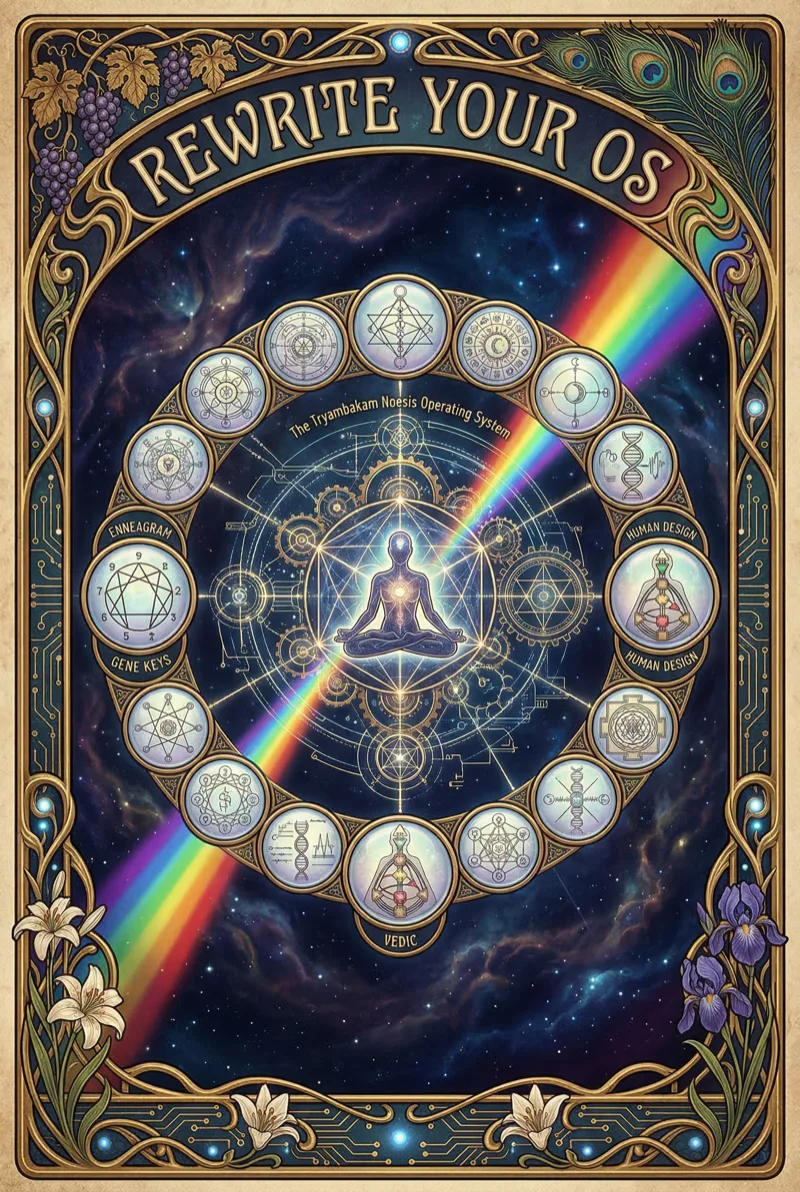
Tryambakam Noesis exists for the moment you realize the operating system itself needs replacing.
What the Noesis Engine Is
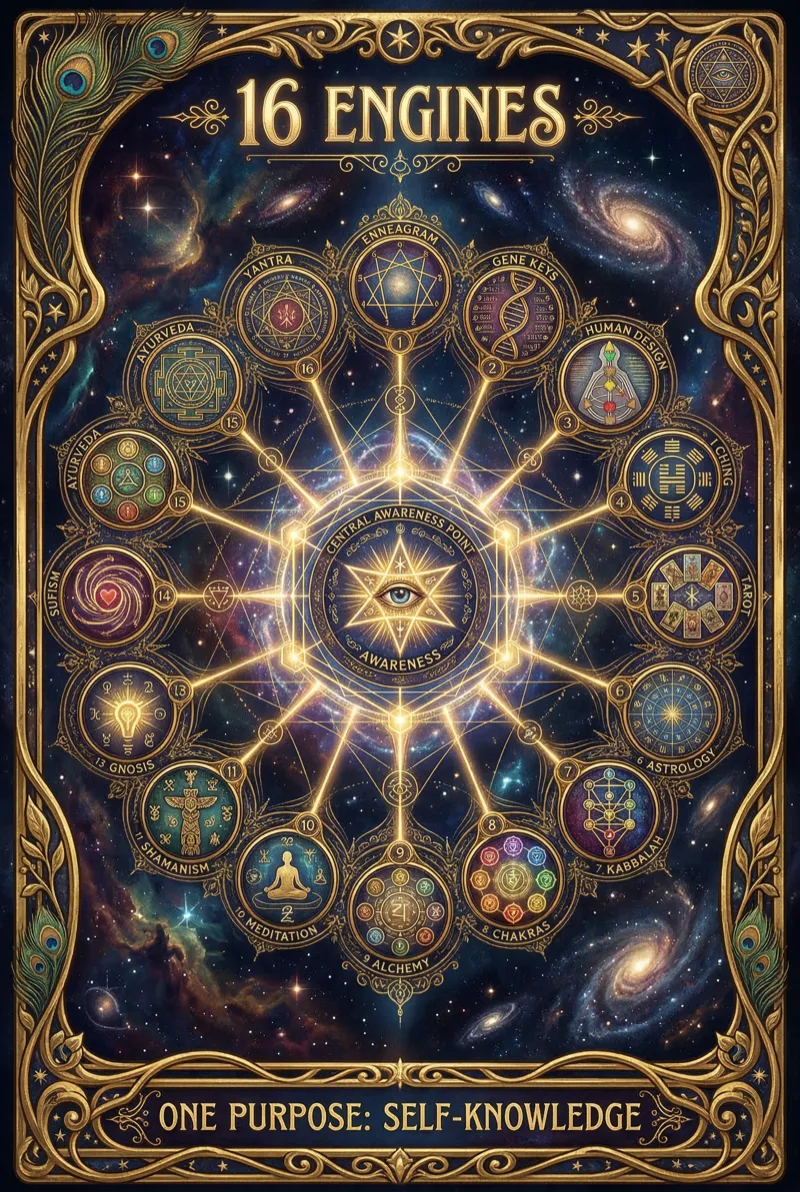
The Noesis Engine is the practice platform at the heart of Tryambakam Noesis. It’s not a course to complete or a framework to apply and discard. It’s a way of seeing—powered by sixteen perceptual lenses that reveal the architecture of your own awareness, the patterns your experience runs on, and the specific points where you can intervene as author rather than passenger.
These sixteen engines span ancient wisdom and modern understanding, each offering a unique lens:
- Vedic Astronomy: Panchanga, Vimshottari Dasha, Transits
- Energetic Design: Human Design, Gene Keys, Biofield
- Biological Rhythm: Biorhythm, Vedic Clock
- Somatic Perception: Nadabrahman, Face Reading
- Divination: Tarot, I Ching
- Personality Architecture: Enneagram, Numerology
- Creative Encoding: Sacred Geometry, Sigil Forge
You don’t need to subscribe to any of them. You simply look through them and notice what you see. They are not sequential modules, but different angles of approach to the same territory: your consciousness, as it actually operates.
The Underpinnings: Kha-Ba-La
Every calculation within the Noesis Engine operates on three co-arising forces—Kha-Ba-La:
- Kha (Spirit) — The field that observes. The author-drive. The part of you that can witness a pattern without becoming it.
- Ba (Body) — The vehicle for knowing becoming doing. Embodiment. The soma that turns insight into lived reality.
- La (Inertia) — Resistance, gravity, friction. Not the enemy—the necessary force that gives form to formlessness. Your stuckness is the material you sculpt with.
Navigating Your Inner Landscape: Workflows & The Compass
The engines don’t just pipeline—they synthesize through six workflows:
- Birth-Blueprint: Your natal imprint.
- Daily-Practice: Cosmic tide aligned with personal rhythm.
- Decision-Support: Multi-perspective orientation.
- Self-Inquiry: Shadow work meets personality architecture.
- Creative-Expression: Intent made visible through geometry and sigil.
- Full-Spectrum: All sixteen mirrors held simultaneously.
A compass guides your focus with four cardinal directions:
- STABILIZE: When you need to find footing.
- HEAL: When something needs metabolizing.
- CREATE: When raw material wants to be shaped.
- MUTATE: When the structure itself is ready to evolve.
Where you stand on this compass determines which lenses open first. Where you move from there is yours to write. Sixteen lenses across four directions—256 permutations that define the space for self-authorship. No two architectures look alike, because no two interior landscapes are alike.
This is not personalization in the way you’ve been sold it. This is a system that can’t function generically because the territory it maps—the interior of a specific, unrepeatable consciousness—is irreducibly unique.
Who This Is For
You are somewhere between 28 and 42. You’ve consumed the content, read the books, tried the apps. Your external calibration is impressive—and insufficient. You suspect the problem is structural: an operating system installed before you could consent, configured by others, and calibrated for a world that no longer exists.
You don’t need more tools. You need the capacity to see the tools you’re already using—the perceptual patterns, inherited meaning-making architectures, automatic responses—and the rigor to begin authoring from source.
The Quine: Self-Consciousness as Technology
A quine is a program whose output is its own source code. It produces itself. Tryambakam Noesis is a quine.
The practice of self-consciousness, applied with enough depth and consistency, produces a practitioner who no longer needs the practice. Not because they’ve transcended it—because they’ve become it. The pattern recognition that once required sixteen lenses and micro-rituals has integrated so completely that it operates as native capacity.
Self-consciousness as technology. Body as medium. Breath as interface. The code is yours to write.
Tryambakam Noesis — where the witness becomes the author.
Explore Further
- Practice platform: https://tryambakam.space
- Engine implementation: https://github.com/Sheshiyer/Selemene-engine