Endocrine-Constellation Transcript
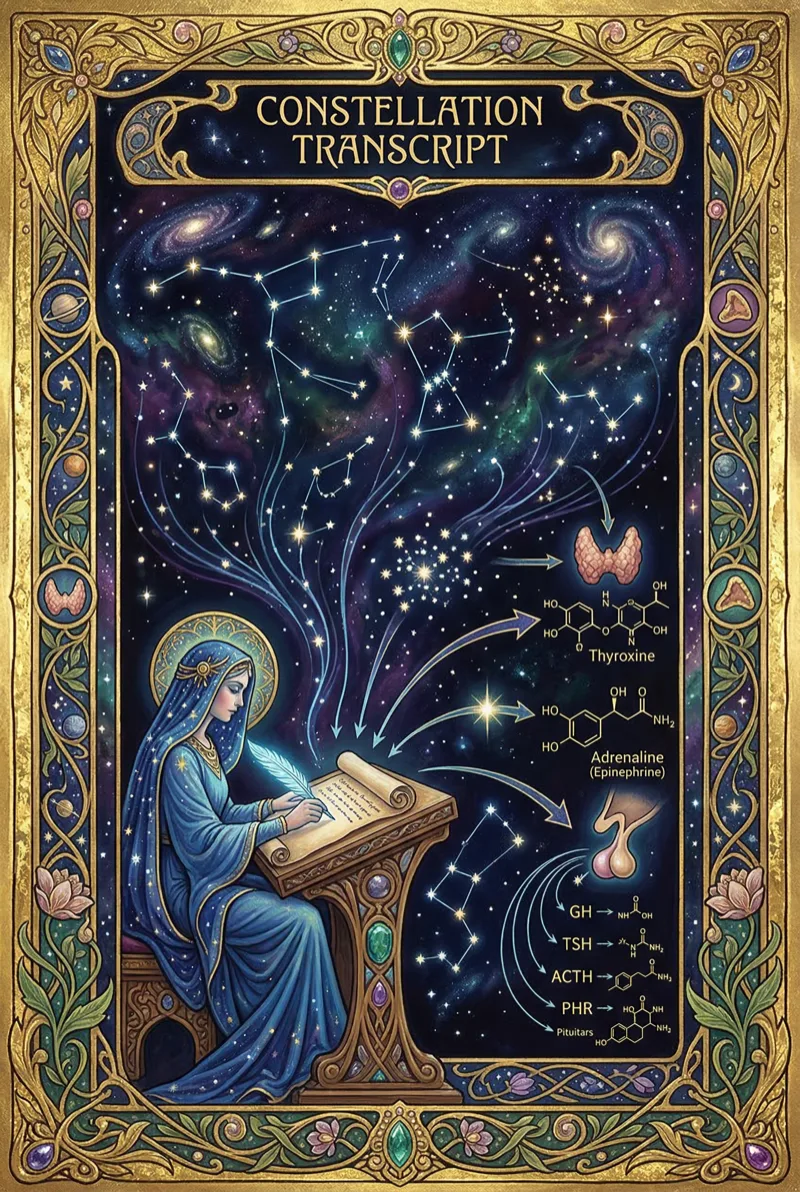
James True operates in a register that most content creators avoid: the space between mythology and physiology where neither discipline has full jurisdiction. His transmission on endocrine-constellation patterns — part of a broader stream exploring the Eye of Horus, placental narratives, and ancient perception frameworks — provides the raw material for a correspondence system that deserves formal documentation.
This is that documentation. Not a transcript in the literal sense, but a structured extraction of the signal from the noise.
The Triple Overlay
The endocrine-constellation pattern operates as a three-layer stack:
Layer 0: Chemical substrate. Nine hormones, each with measurable secretion patterns, receptor binding profiles, and physiological effects. This layer is verifiable through standard endocrinology.
Layer 1: Archetypal mapping. Nine Muses, each with defined domains of creative intelligence. This layer is documentable through classical scholarship.
Layer 2: Celestial positioning. Nine constellations, each with observable positions, seasonal visibility windows, and mythological associations. This layer is verifiable through astronomy.
The Spolski Correspondence Framework — the analytical structure that James True’s work intersects with — proposes that these three layers are not independent systems mapped together by analogy but a single system observed through three different instruments.
The Nine Constellation Assignments
The mapping follows a logic that becomes clear only when you see the full table:
correspondences = {
    'melatonin': {
        'muse': 'Polymnia',
        'constellation': 'Serpens Caput',
        'function': 'Rhetoric and Sacred Hymns',
        'prime': 1
    },
    'oxytocin': {
        'muse': 'Clio',
        'constellation': 'Ursa Major',
        'function': 'History and Memory',
        'prime': 2
    },
    'endorphins': {
        'muse': 'Euterpe',
        'constellation': 'Hercules',
        'function': 'Music and Healing',
        'prime': 3
    },
    'dopamine': {
        'muse': 'Thalia',
        'constellation': 'Pegasus',
        'function': 'Comedy and Pleasure',
        'prime': 4
    },
    'cortisol': {
        'muse': 'Melpomene',
        'constellation': 'Ophiuchus',
        'function': 'Tragedy and Catharsis',
        'prime': 5
    },
    'estrogen': {
        'muse': 'Erato',
        'constellation': 'Bootes',
        'function': 'Love and Creation',
        'prime': 6
    },
    'testosterone': {
        'muse': 'Calliope',
        'constellation': 'Taurus',
        'function': 'Epic Poetry and Drive',
        'prime': 7
    },
    'adrenaline': {
        'muse': 'Terpsichore',
        'constellation': 'Andromeda',
        'function': 'Dance and Movement',
        'prime': 8
    },
    'serotonin': {
        'muse': 'Urania',
        'constellation': 'Virgo',
        'function': 'Astronomy and Order',
        'prime': 9
    }
}
The prime number sequence is not decorative. It suggests an activation order — a boot sequence in which the nine circuits initialize. Melatonin-Polymnia-Serpens activates first (circadian rhythm as the master clock), and serotonin-Urania-Virgo activates last (systemic balance as the final integration check).
Serpens Caput and the Melatonin Circuit
The assignment of Serpens Caput — the serpent’s head — to the melatonin-Polymnia circuit warrants specific attention. The pineal gland, which produces melatonin, has been identified across traditions as the seat of inner vision: the third eye in Hindu systems, the Eye of Horus in Egyptian systems, the pine cone in Vatican symbolism.
Serpens Caput is the constellation of the serpent bearer’s serpent — the knowledge that the healer carries but does not create. Melatonin is not a hormone you generate through effort; it is a hormone that emerges from darkness, from the absence of stimulation, from surrender to the cycle. Polymnia’s sacred hymns are not performances but prayers — utterances directed inward rather than outward.
The convergence point: inner vision, serpentine wisdom, and circadian surrender are three descriptions of the same physiological-spiritual event.
Ophiuchus and the Cortisol Circuit
Ophiuchus — the serpent bearer, the thirteenth constellation, the sign that astrology forgot — corresponds to cortisol and Melpomene. This is perhaps the most revealing assignment in the entire matrix.
Ophiuchus is excluded from the standard zodiac despite sitting directly on the ecliptic. Cortisol is vilified in wellness culture despite being essential for survival, learning, and adaptive response. Melpomene is avoided in popular aesthetics despite tragedy being the highest form of catharsis in Greek artistic philosophy.
The pattern is consistent: the fifth position in the nine-fold system holds what the culture excludes, what the body fears, and what the spirit requires for transformation. Cortisol is not the stress hormone — it is the awareness hormone. Ophiuchus is not the missing sign — it is the sign that holds the snake.
Celestial Timing and Hormonal Rhythms
The Spolski framework proposes that constellation visibility windows correlate with hormonal activation cycles. When Taurus is prominent in the night sky, the testosterone-Calliope-drive circuit is amplified. When Virgo dominates, the serotonin-Urania-order circuit strengthens.
This is not astrological causation. The constellations do not emit hormones. But the same gravitational and electromagnetic environment that positions the constellations also modulates the biological systems that evolved within that environment. The correspondence is not causal but co-arising — both systems responding to a shared substrate.
James True’s insight — woven through his streams on mythology and consciousness — is that ancient perception frameworks were not pre-scientific guesses about causation but post-experiential maps of co-arising patterns. The ancients did not believe the stars caused their moods. They observed that the stars and their moods moved together, and they documented the pattern.
The Verification Protocol
The framework suggests a verification protocol: track hormone cycles alongside constellation positions. Document Muse manifestations in creative behavior. Note synchronistic events and their timing. Observe whether the patterns predicted by the triple overlay correspond to lived experience.
This is empirical work disguised as mysticism. The data is personal, the instruments are attention and journaling, and the hypothesis is testable: does the body’s chemistry follow the sky’s geometry through the architecture of archetypal expression?
The transcript does not answer this question. It poses it — and provides the framework within which the answer can be sought.
The body is a planetarium. The hormones are the projection system. The constellations are the film.