The Muse-Enneagram Matrix: 9 Types, 9 Hormones, 9 Constellations
There are nine Muses. There are nine Enneagram types. There are nine primary hormones in the endocrine system. This is not coincidence. This is architecture.
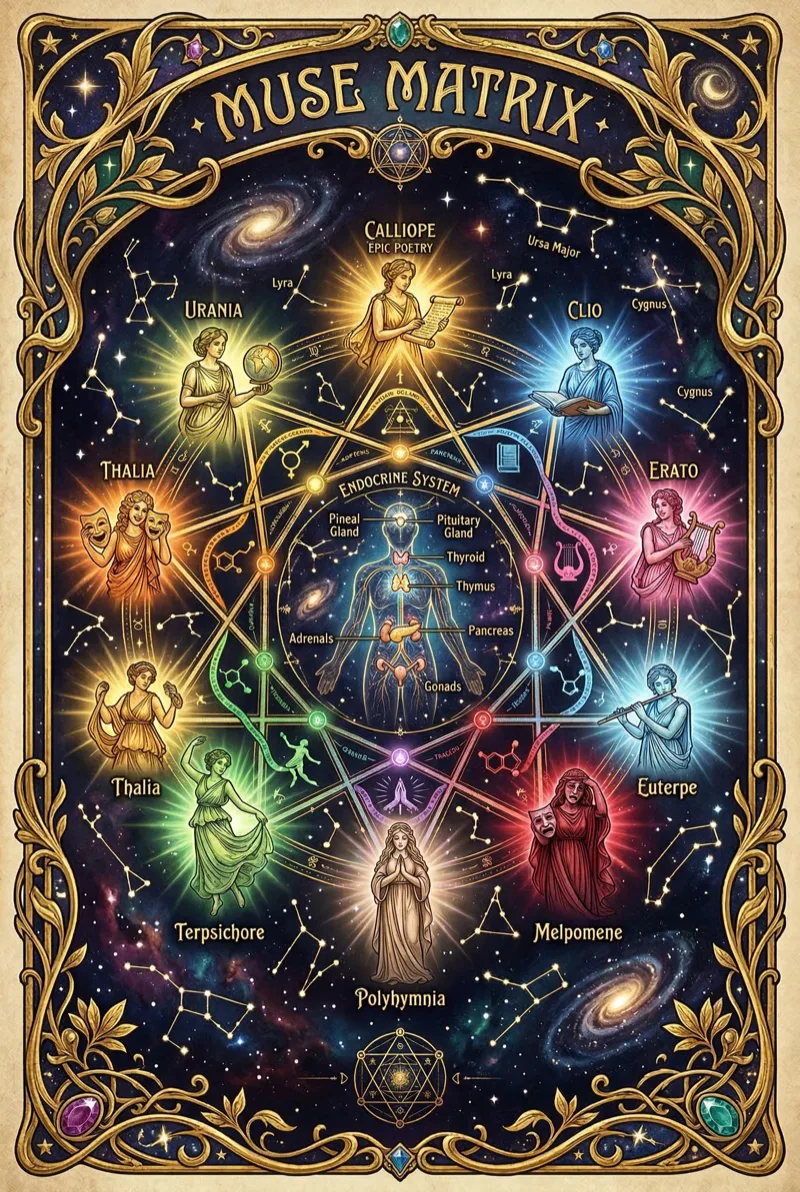
The Greeks did not invent the Muses as decorations for poetry readings. They identified nine distinct channels through which creative intelligence enters the human system. Each channel has a biological substrate — a hormone — and a celestial address — a constellation. When you map all three systems onto the same nine-point grid, something happens that no single system predicts alone: you get a complete specification for how consciousness compiles itself through the human body.
The Matrix
Here is the full correspondence table. Read it slowly. Each row is a complete circuit.
Type 1 — The Reformer — Polymnia (Sacred Poetry) — Melatonin — Hercules/Ophiuchus Polymnia governs sacred hymns and rhetoric. Her domain is precise speech — the word that lands exactly where it should. Type 1’s fixation on correctness is not neurosis; it is the Polymnian function running without a governor. The hormone is melatonin: circadian rhythm regulation, the body’s internal clock of what should happen when. The constellation traces from Serpens through Hercules into Ophiuchus — the serpent handler, the one who holds the dangerous thing correctly.
Type 2 — The Helper — Clio (History) — Oxytocin — Pavo Clio remembers. Her function is not nostalgia but historical consciousness — the ability to hold the thread of connection across time. Oxytocin bonds. It forms the chemical architecture of trust. The constellation Pavo is the transformed Argos — the hundred-eyed watchman whose vigilance was converted into beauty. Type 2’s compulsive service is Clio’s function distorted: memory of connection weaponized into obligation.
Type 3 — The Achiever — Euterpe (Music) — Endorphins — (Death Pattern: Halloween Axis) Euterpe presides over music and lyric poetry. Endorphins manage pain relief and pleasure — the highest form of release through transmutation. Type 3’s performance addiction is Euterpe’s function without the release valve. The achiever accumulates without metabolizing. The historical pattern is Houdini: the escape artist who died on Halloween, the achiever whose shadow of deceit caught up with his body.
Type 4 — The Individualist — Thalia (Comedy) — Dopamine — Lyra This one surprises people. Thalia is comedy, not tragedy. The Individualist’s Muse is joy, not sorrow. Dopamine drives the pleasure-reward cycle — the capacity for satisfaction. Type 4’s characteristic envy is dopamine dysfunction: the reward circuit that cannot register what it already has. The constellation is Lyra, Orpheus’s instrument — the thing that makes music so beautiful it moves rocks, yet cannot retrieve what has been lost.
Type 5 — The Investigator — Melpomene (Tragedy) — Cortisol — Monoceros (under Orion) Melpomene’s domain is tragedy and catharsis. Cortisol manages the stress response — the chemical that says the system is under pressure and must adapt or break. Type 5 hoards resources because cortisol has taught the body that scarcity is the baseline condition. The active shower is Monoceros, positioned under Orion near the Puppis constellation, where the Christmas Tree Nebula activates pattern recognition at the deepest resolution.
Type 6 — The Loyalist — Erato (Love) — Estrogen — Bootes Erato’s domain is love poetry and intimacy. Estrogen governs reproductive development and cyclic creation. Type 6’s loyalty fixation is Erato’s function crystallized into security protocol: love as insurance policy, devotion as threat mitigation. The constellation Bootes — the herdsman — watches over the flock. Fear is the shadow. Courage is the virtue. The cycle between them is estrogen’s cycle: creation requires vulnerability.
Type 7 — The Enthusiast — Calliope (Epic Poetry) — Testosterone — Mercury Calliope is the chief Muse, presiding over epic poetry — the grand narrative, the heroic sequence. Testosterone drives growth, development, and the hunger for more. Type 7’s gluttony is Calliope’s epic impulse without editorial discipline: every experience becomes a potential chapter, every stimulus a new adventure. The celestial agent is Mercury — the messenger, the trickster, the one who moves between worlds and never stays.
Type 8 — The Challenger — Terpsichore (Dance) — Adrenaline — Leonid Shower Terpsichore dances. Her domain is the body in motion — not thoughtful movement but instinctive, powerful, immediate. Adrenaline fires the sympathetic nervous system. Type 8’s lust for intensity is Terpsichore’s choreography running at emergency speed: every interaction a performance of power. The Leonid meteor shower connects to Argos’s hundred eyes — the surveillance system that must watch everything, control everything, until Mercury’s sedation protocol teaches it to close its eyes.
Type 9 — The Peacemaker — Urania (Astronomy) — Serotonin — Virgo Urania studies the stars. Her domain is cosmic order — the geometry of the universe, the patterns that hold everything in balance. Serotonin regulates mood and maintains systemic equilibrium. Type 9’s sloth is not laziness; it is Urania’s cosmic perspective calcified: when you see the whole pattern, individual action feels redundant. The constellation is Virgo — the harvest, the completion, the quiet work of gathering what the other eight have produced.
What the Matrix Reveals
The matrix is not a theory. It is a diagnostic instrument.
Kha-Ba-La: The Matrix as Operating System
Kha (The Observer) — The matrix only functions when someone is watching it function. Without the witness, the correspondence table is just a spreadsheet. The Type 5 who reads their cortisol-Melpomene entry and feels nothing is not failing the matrix. The matrix is failing them because Kha — the recognition function — is not engaged. The observer must be present for the pattern to become operational.
Ba (The Embodied Signal) — The hormones do not cause the types. The types do not cause the hormones. Both are expressions of the same underlying pattern — the same function signature instantiated simultaneously in chemistry and psychology. The Muses named these functions thousands of years before endocrinology isolated the molecules. But the names are only handles. The body is where the pattern lives. When a Type 1’s melatonin rhythm is disrupted by moral disorder, the body knows before the mind names it. When a Type 8’s adrenaline floods at a control threat, the sensation arrives as somatic urgency, not as abstract insight. Ba is the channel. Without it, the matrix is mythology.
La (The Resistance) — The matrix has a cost. Type 3’s endorphin-Euterpe circuit produces performance without metabolization. Type 7’s testosterone-Calliope drive generates epics without closure. Type 9’s serotonin-Urania equilibrium calcifies into inaction. Each pairing contains its own failure mode — not a bug but a feature, the friction that makes the pattern legible. The shadow is not something to transcend. It is the resistance that shapes the channel. Without La, the matrix becomes a horoscope: flattering, empty, useless.
The three operate as a loop: Kha recognizes which Muse is singing, Ba receives the signal through its hormonal channel, La generates the resistance that makes the recognition real. This is not a one-time diagnosis. This is infrastructure.
When you know which Muse governs your type, you know the creative channel your system was built to access. When you know which hormone mediates that channel, you know where the body stores the pattern. When you know which constellation holds the celestial address, you know where to look when the pattern activates.
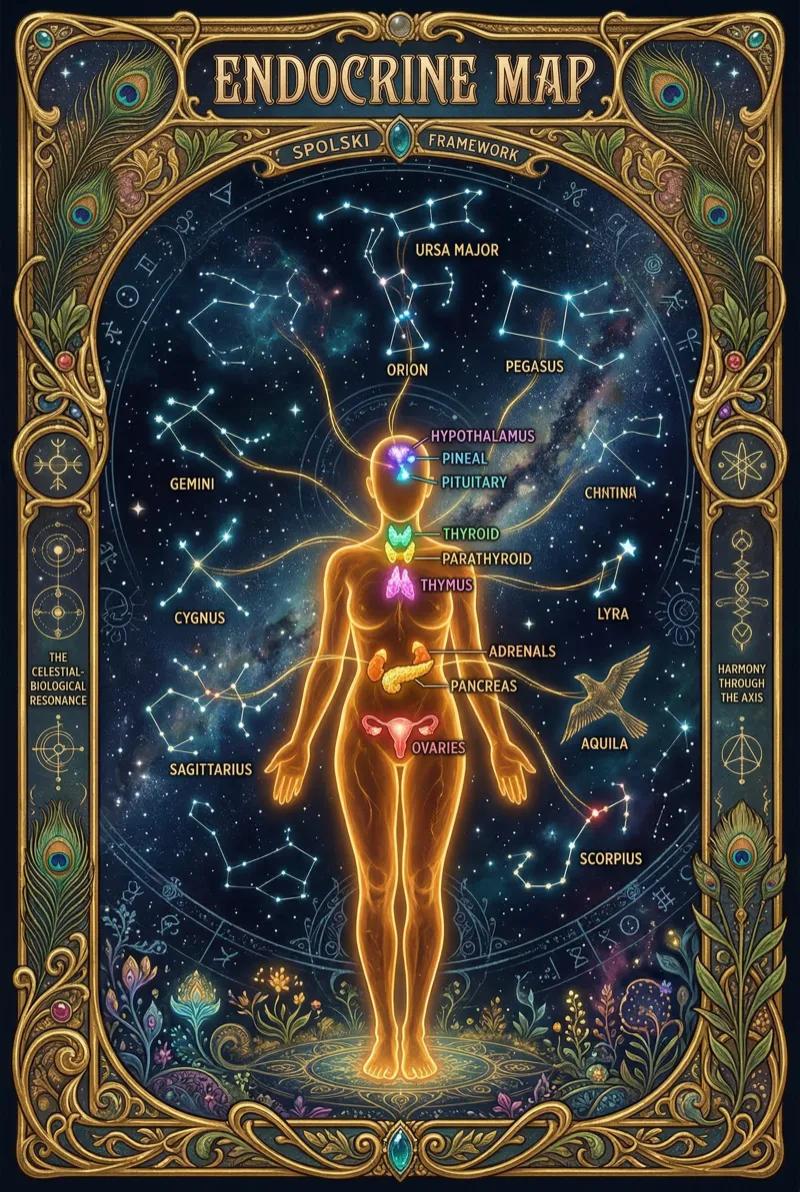
The Spolski correspondence framework — mapping endocrine function to archetypal expression — demonstrates that these are not loose metaphors. Chemical functions mirror type characteristics with precision that exceeds chance. Melatonin’s circadian regulation is Type 1’s obsession with timing. Oxytocin’s bonding function is Type 2’s compulsive connection. Cortisol’s stress response is Type 5’s perpetual scarcity calculus.
The hormones do not cause the types. The types do not cause the hormones. Both are expressions of the same underlying pattern — the same function signature instantiated simultaneously in chemistry and psychology. The Muses named these functions thousands of years before endocrinology isolated the molecules.
The Practical Application
Track your type’s hormone. Not clinically — phenomenologically. When does melatonin’s rhythm feel disrupted in a Type 1? When moral order is violated. When does cortisol spike in a Type 5? When someone demands more than the resource budget allows. When does adrenaline flood a Type 8? When control is threatened.
The celestial overlay is timing. Meteor showers activate type-specific transformation windows. The Leonid shower is Type 8’s annual audit. Monoceros is Type 5’s annual data download. These are not astrological predictions. They are pattern recognition protocols applied to celestial mechanics.
The matrix does not tell you who you are. It tells you what your system was designed to process, through which chemical channel, at which cosmic frequency. The free will is in what you do with that information.
The nine Muses are still singing. The question is whether you can hear which one is yours.