“I didn't draw a circle to cast a spell. I became the spell by walking its edge.”
Crescent geometry on an island famous for its full moon.
The irony wasn’t lost. Koh Phangan — pilgrimage site for thousands seeking the full moon’s promise of illumination, communal ecstasy, electric connection. But the card that activated wasn’t the Sun. It was the Moon. And the Moon doesn’t illuminate. It refracts.
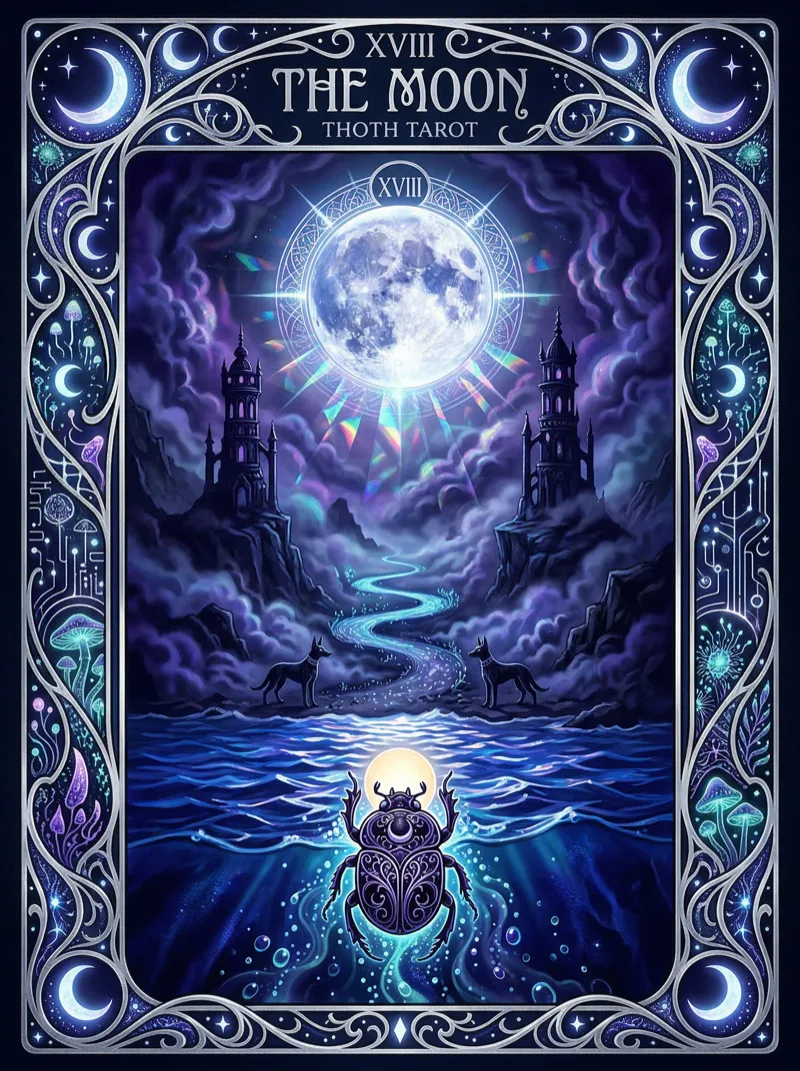
In the Thoth deck, the Moon shows a corridor between two towers, a scarab pushing the sun disk through the underworld. The water at the bottom teems with hidden life. Nothing on this card is what it appears. The towers aren’t protection — they’re the pylons of a gate you must pass through. The corridor isn’t leading somewhere — it’s testing whether you can walk when you can’t see clearly.
The manomaya kosha — the mental sheath — is the Moon’s native territory. This is where projection lives. Where the mind generates narrative from fragments, where meaning is manufactured faster than reality can deliver raw data. The Moon doesn’t lie. It reveals how much of what you see is you — your filters, your assumptions, your inherited patterns of interpretation.
Koh Phangan delivered this lesson through geometry. The crescent — not the full circle. Partial light. The invitation wasn’t to see more. It was to notice how much you’re already adding to what you see.
Refraction is not distortion. A prism doesn’t corrupt white light. It reveals the spectrum that was always contained within it. The Moon refracts your perception to show you its hidden spectrum — the wavelengths of assumption, expectation, and inherited meaning-making that color every raw experience before consciousness can receive it unfiltered.
The question isn’t whether the Moon deceives. The question is whether you can distinguish between what the Moon shows and what you project onto its silver screen.
Structural mapping: The refraction described above is the Kha-Ba-La triad in operation. Kha is the witness that can notice the projection without becoming it — the capacity to see the filter and the filtered simultaneously. Ba is the body in Koh Phangan, the sensory apparatus that receives the bent light before the mind narrates it. La is the inherited pattern itself, the gravity of assumption that gives form to the formless light. Without La, there is no refraction to observe. Without Ba, there is no receiving surface. Without Kha, there is no distinction between the Moon and the story you tell about it.
I carried geometry.