Your body is not a temple. It is an electrochemical instrument with approximately seven octaves of signaling bandwidth, most of which you have been trained to ignore. I learned this after tracking my own nasal temperature differential for two weeks. The right nostril ran hot at dawn. The left was nearly cold. The HRV trace confirmed what the thermometer suggested: my autonomic system was biased before I made a single decision.
The fascial web conducts ionic currents. The nasal mucosa differentially engorges with blood on a ninety-minute cycle. The heart emits a magnetic field detectable several feet from the torso. These are not metaphors. They are measurable biophysical events that preceded language by about 3.8 billion years. The problem is not that the data is unavailable. The problem is that you have been taught to treat the body as a meat vehicle driven by a mind that lives elsewhere. This is a category error. The body is the substrate. The nervous system is the runtime. And the bioelectric field is the protocol layer where both compile into experience.
This post specifies three operations. Each bridges an ancient energetic technology with a contemporary biophysical measurement. None require belief. All require execution. The Alchemical framework provides the structural grammar: Nigredo is the deconstruction of the inherited assumption that the body is merely chemical; Albedo is the revelation of the bioelectric field as operational reality; Citrinitas is the solar integration of methodology; Rubedo is the state where the protocols are no longer needed because the instrument has been calibrated.
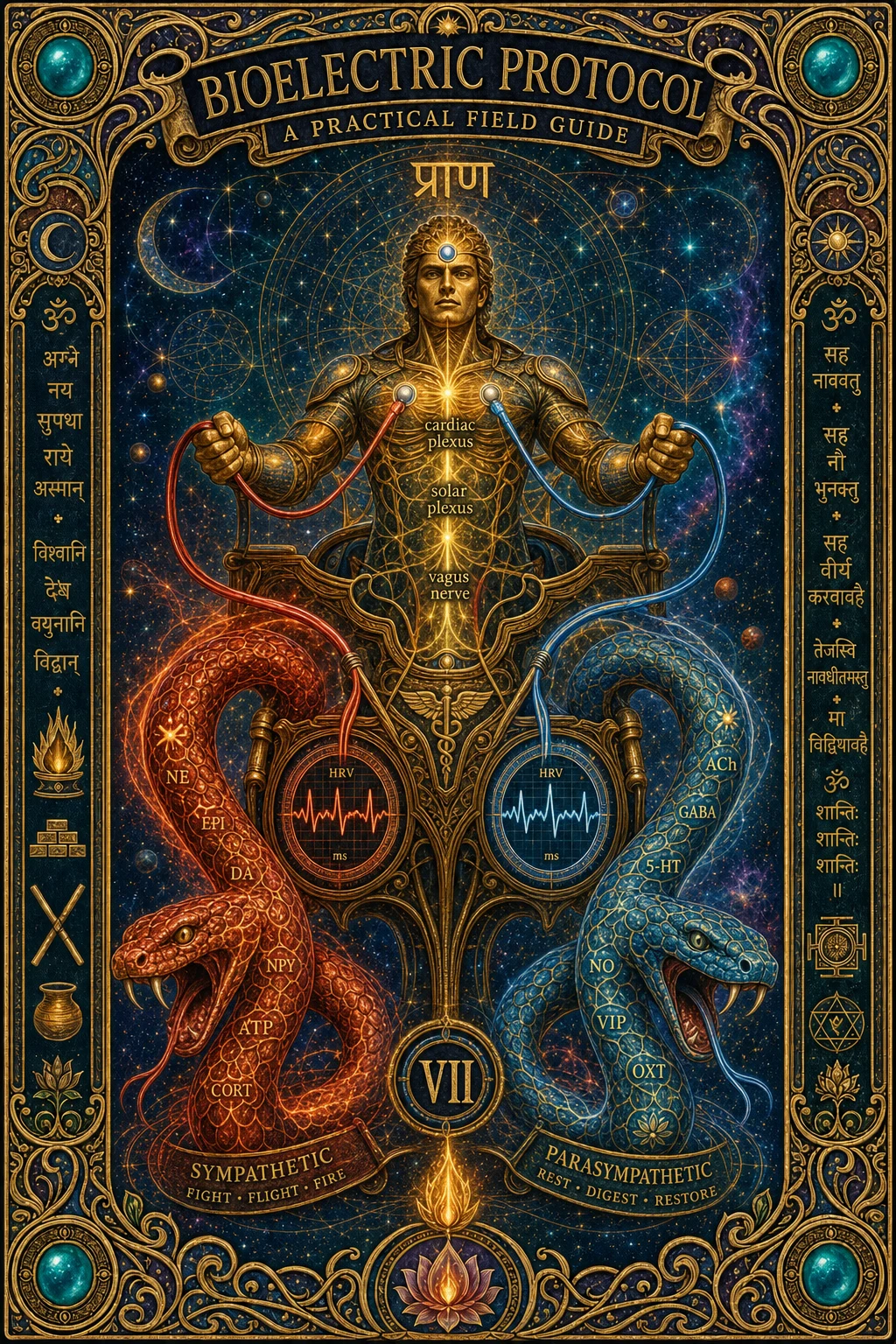
The Chariot (VII)
The card shows a driver standing between two sphinxes — one black, one white. In this reading, the sphinxes are the sympathetic and parasympathetic branches of the autonomic tree. The driver does not command the sphinxes; the driver reads their state. The reins are not leather straps. They are EKG leads, GSR contacts, and the direct sensation of breath moving through one nostril or the other. The Chariot is not about conquest. It is about holding differential charge without shorting the circuit. The driver who does not know which sphinx is active will be pulled apart. The driver who pretends there is only one sphinx will crash into a tree. The chariot itself is the prāṇamaya kośa — the energy sheath — and it is not a poetic abstraction. It is the measurable voltage gradient between your skin and the earth.
Protocol 1: Nadi Shodhana as Bioelectric Calibration
The nostrils are not symmetrical breathing holes. They are paired electrodes with differential vascular tone. Sympathetic tone climbs when the right nostril leads. Parasympathetic tone deepens when the left nostril leads. This is not subtle. It is visible on a thermogram, audible in respiratory rate, and palpable as unilateral airflow. The Haṭha Yoga Pradīpikā (2.7–10) describes this as solar/lunar balancing. A modern bioimpedance meter describes it as a shift in unilateral nasal resistance and a corresponding change in galvanic skin response. Both descriptions are accurate. Neither is complete without the other.
Nadi Shodhana exploits this wiring directly. By manually switching the dominant nostril, you overwrite the autonomic bias that has accumulated since your last sleep cycle. The practice is not complicated. Close one nostril. Inhale through the other. Switch. Exhale. Inhale. Switch. Exhale. The ratio matters less than the precision of the switch. You are not “balancing energies.” You are manually calibrating a bifurcated autonomic circuit that has been running in open-loop mode since you stopped paying attention to your own breath.
What you are reading with this practice is the Ba — the body as substrate. The Kha is the moment of noticing: which nostril is open, which is closed, whether the switch felt smooth or sticky. The La is the friction. Most people discover their left nostril is nearly glued shut in the morning, or their right nostril dominates during arguments. That resistance is not a blockage to be cleared. It is data. It is the accumulated inertia of a nervous system that has been running the same pattern for decades. This is Nigredo: the calcination of the assumption that your body is a passive vessel. The fire is real. The ash is the old model.
Protocol 2: Grounding as Voltage Reference
The earth’s surface carries a stable negative electrical potential. Your body, after eight hours in synthetic shoes and twelve hours under fluorescent light, carries an excess of positive charge. When you make skin contact with the ground — grass, soil, concrete, salt water — electrons migrate from earth to body until equilibrium is reached. This is not earthing as a lifestyle accessory. This is basic circuit theory.
Robert Becker demonstrated in the 1970s that electrical currents guide tissue regeneration in salamanders and, by extension, in humans. The nāḍī network, the fascial web, the peripheral nervous system — all require a stable voltage reference to transmit signals accurately. Without it, the noise floor rises. Inflammation signaling becomes chaotic. Sleep architecture fragments. The protocol is to place bare feet on the ground for twenty minutes. That is the full instruction.
The Kha is the noticing: does the body settle, does the breath deepen, does the mind stop generating synthetic emergencies? The Ba is the skin-to-earth contact, the electron transfer, the shift in EEG alpha power that has been documented in multiple small studies. The La is the resistance to doing it. The La is the voice that says the ground is dirty, the shoes are expensive, the schedule is too tight. That voice is not your enemy. It is the sound of a system that has been unreferenced for so long it no longer recognizes the ground. This is Albedo: the lunar illumination of a structure that was always present but invisible in darkness. The earth was always there. Your capacity to contact it was what had atrophied.
Protocol 3: HRV Coherence as Phase-Locking
Heart rate variability is not a comfort index. It is a measure of how efficiently your autonomic nervous system modulates cardiac output in response to respiratory and baroreceptor feedback. High HRV means the system is responsive. Low HRV means it is rigid, often from chronic sympathetic engagement. HRV coherence is a specific state: respiratory sinus arrhythmia is maximized, the heart accelerates on inhalation and decelerates on exhalation with minimal phase lag, and the power spectrum shows a clean peak around 0.1 Hz. This is not relaxation. It is ordered complexity.
The heart becomes the primary oscillator for the entire bioelectric network, setting the frequency reference that the brain, the gut, and the immune system phase-lock to. The HeartMath Institute has published empirical data showing that sustained coherence correlates with improved cognitive performance, emotional regulation, and immune markers. You can verify this yourself with a fifty-dollar Bluetooth HRV monitor and five minutes of paced breathing at six cycles per minute.
The Kha is the operator reading the coherence trace. The Ba is the cardiac tissue generating the rhythm. The La is the habitual breathing pattern that fights the six-per-minute cadence — the chest-breath, the shallow sip, the held exhale. Every exhale that does not fully complete is a small refusal to let the system reset. The protocol is to breathe at five to six cycles per minute, feeling the heart follow, until the meter confirms phase-lock. Then stay there. This is Citrinitas: the solar integration of methodology. The transmutation of silver — the emotional quality of the practice — into gold: the structural perfection of a calibrated instrument.
Kha, Ba, La: The Triad as Failure Modes
What happens when one is absent? Without Kha — without the observer — the practices become mechanical superstition. You switch nostrils while planning dinner. You stand on the ground while scrolling. You breathe to the meter while your attention is elsewhere. The body executes the protocol but nobody is home to read the result. This is how energetic practices become choreography. The movements are correct. The circuit is open.
Without Ba — without the body as substrate — the practices become dissociative fantasy. The observer notices everything except the physical sensations that would ground the observation in reality. This is the meditator who can describe their consciousness in exquisite detail but cannot feel their own feet. The Kha is present. The La is absent. But the Ba — the meat, the resistance, the actual nostril — has been abandoned.
Without La — without the friction — the practices become too easy, which means they are not working. If Nadi Shodhana feels effortless, you are not noticing the resistance. If grounding feels like a spa treatment, you are not encountering the inertia of a system that has been insulated from the earth for decades. If HRV coherence locks immediately, you are either a highly trained athlete or you are not reading the meter correctly. The La is the difficulty that proves the practice is real. Remove it and you are performing empty theater.
The Four Scales
At the personal scale, these protocols are calibration tools for a single nervous system. You notice, you execute, you read the meter. At the interpersonal scale, the bioelectric field becomes relational. Two people in sustained proximity will entrain respiratory and cardiac rhythms. The nasal cycle of one can influence the autonomic tone of the other. A parent and infant, a drummer and dancer, a healer and a patient — these are not mystical connections. They are phase-locked oscillators exchanging electrochemical information.
At the systemic scale, the institutions that manage health have no billing code for nasal cycle imbalance, no reimbursement for earthing, and no diagnostic category for HRV coherence deficit. The medical model treats the body as a chemical machine with occasional electrical malfunctions. It does not treat the body as an electrical instrument with chemical consequences. It is structural inertia — La at institutional scale — that resists reclassification because the existing taxonomy determines funding, training, and liability.
At the cosmic scale, the earth’s Schumann resonance — approximately 7.83 Hz, with harmonics — provides a planetary frequency reference that all living systems evolved to track. The heart’s coherent state oscillates near this frequency. The alpha band of the human EEG centers on it. You are not separate from the earth’s electromagnetic field. You are a node in it. The protocols are not making you more spiritual. They are reconnecting your local oscillator to the planetary reference that has been there since before you had a nervous system to ignore it.
The Cost of Ignorance
There is a fracture in the modern body. The inherited code says the mind is in charge and the body is a servant. The electrochemical reality says the body is an instrument and the mind is one of its readouts. The cost of this fracture is measurable: chronic inflammation, disrupted sleep, autonomic dysregulation, the slow erosion of the body’s capacity to repair itself. The protocols do not fix this. They compile it. They make the fracture visible as a galvanic skin response spike, a collapsed HRV trace, a left nostril that refuses to open. What is seen can be addressed. What is addressed can be metabolized. The shadow is not the darkness. The shadow is the unexamined circuit still running its inherited pattern.
This is Rubedo: the Stone is not an object but a state of operational coherence. The perfect balance of solar and lunar energies within the substance. The protocols are not a lifestyle. They are a diagnostic sequence. Run them, read the output, make the correction, and move on. The body is already electrical. You are just learning to read the meter. The system succeeds when you no longer need it — when the Chariot driver has learned to read the sphinxes so well that the reins become unnecessary. The Quine is complete when the instrument plays itself.