Synchronocities
III
The Empress Threshold Guardian · Abundance

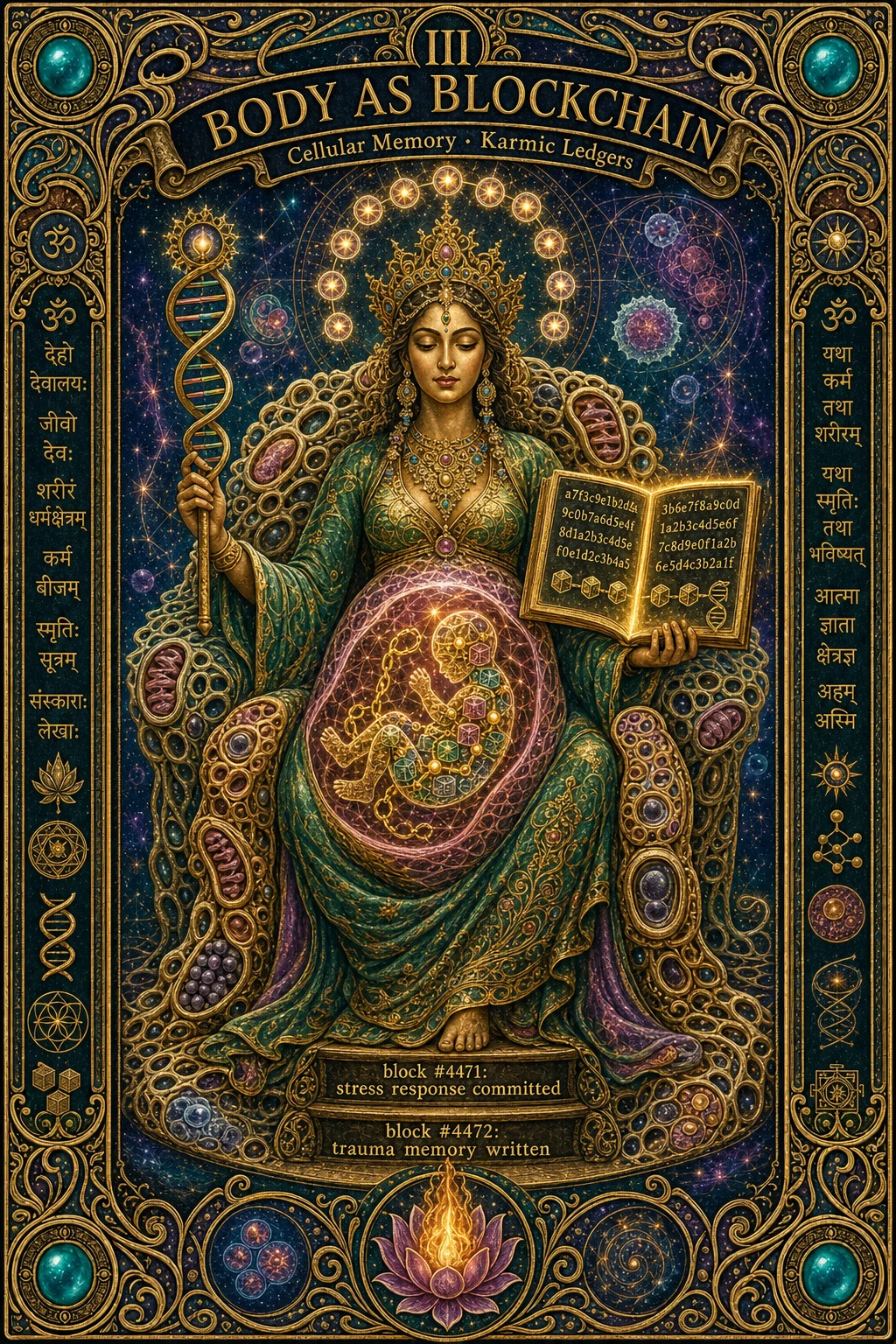
Body as Blockchain — Cellular Memory and Karmic Ledgers

The body maintains a distributed ledger of everything that has happened to it. Every cell carries epigenetic marks. Every trauma is recorded in tissue tension patterns. Every joy leaves a trace in the neural network's weight matrix. This is not metaphor — it is biological record-keeping.

The Empress
Back to journey

Body is ledger. The Haṭha Yoga tradition, in its 15th-century CE texts, explicitly states that all cells are connected and all records are preserved, with the ledger being the body itself. This concept is echoed in the work of Martha Graham, who succinctly notes that “the body never lies.” In sacred-runtime-bali-padiyami, the same architecture is named as a precise schedule, executing its cleanup protocol every 210 days, a duration that corresponds to the nine-month Balinese calendar and the solar year, highlighting the importance of containment in maintaining the body’s ledger. The implication is that the body serves as a repository of information, a living, breathing database that maintains a record of all experiences, much like a blockchain. The blockchain’s ability to maintain a tamper-proof record across multiple nodes is mirrored in the body’s own capacity to preserve cellular memory, where the fascial network, as described in bioelectric-protocol, plays a crucial role in generating and transmitting ionic currents and voltage gradients.

The Bhagavad Gita, as referenced in your-consciousness-needs-better-error-handling, describes the mind as a restless monkey, prone to erratic behavior and poor decision-making, emphasizing the need for error handling in complex systems, including the body’s ledger. The pandits of the Besakih temple, in their intricate ritual to appease the gods, demonstrate a nuanced understanding of error handling, which is essential in maintaining the body’s karmic ledgers. The concept of hysteresis, where the system’s behavior is influenced by its past history, is relevant to the study of blockchain, and also to the body’s own ability to maintain a record of experiences.

The karmic ledgers concept suggests that the body’s experiences are stored in the cells themselves, and that these changes are not limited to the individual’s lifetime but can be passed on to future generations, influencing the course of their lives in subtle but profound ways. The lorenz-kundli concept, which explores the interconnectedness of complex systems, provides a useful framework for analyzing the body’s karmic ledgers, highlighting the delicate balance that exists between the body’s systems and the external environment. The failure mode that proves the principle of karmic ledgers is the phenomenon of intergenerational trauma, where the experiences of one generation are passed on to the next, influencing their lives in subtle but profound ways.

The kosha architecture model provides a framework for understanding the complex interplay between the body’s systems and the external environment, highlighting the importance of maintaining balance and order in the body’s ledger. The samskara concept, which refers to the impressions stored in the cells themselves, is closely tied to the idea of antar-agni, where the subtle, transformative energy that permeates the body is responsible for maintaining balance and order. The epigenetics research, which shows that environmental factors can affect gene expression, leading to changes in the body’s physiological responses, supports the concept of karmic ledgers, emphasizing the need for careful attention to the body’s systems.

When the cleanup misses its window, it can lead to a buildup of ama, or toxic residue, which can have far-reaching consequences for the body’s systems, highlighting the importance of maintaining the body’s ledger. The hypothalamic-pituitary-adrenal axis, which is activated in response to stress, plays a crucial role in the body’s ability to maintain a record of experiences, and its dysfunction can lead to a range of physiological changes, from inflammation to disease. The bioelectric field, generated by the synchronized movement of thousands of participants in the Bali Padiyami, can be measured using standard laboratory instruments, such as electroencephalography (EEG) or electromyography (EMG), providing a concrete example of the body’s ability to maintain a record of experiences.

The Distributed Ledger

Cells contain the full ledger. The genome is a distributed database, with approximately 37 trillion copies of the same source code, each stored in a separate computational node. In “Your Reality Is a Smart Contract”, the Śatapatha Brāhmaṇa and the Gospel of John are cited as examples of ancient texts that point to a fundamental relationship between language and the structure of existence, demonstrating the technical operation of code underlying reality. Similarly, the genome can be seen as a technical operation, where the precise articulation of genetic code influences the development and function of the human body. The genome is not just a passive repository of information, but an active participant in the process of cellular signaling and response to environmental changes. When a cell detects a discrepancy in its local record, it signals the network, and the network responds through a complex interplay of molecular machinery, including mismatch repair, base excision repair, and nucleotide excision repair. This process is reminiscent of the try block and catch block in error handling, where the system attempts to repair errors and maintain ledger integrity. The kosha architecture of the human body, comprising the annamaya, pranamaya, manomaya, vijnanamaya, and anandamaya layers, can be seen as a series of nested, interconnected systems that work together to maintain the integrity of the genome. In the context of the Lorenz-Kundli Protocol, the kundli represents the intricate web of relationships between celestial bodies and human affairs, and similarly, the relationships between cells in the human body can be seen as a complex, interconnected network. The pancha-kosha model, which describes the five sheaths of human consciousness, is particularly relevant to understanding the nested, distributed nature of the genome. The genome is a robust system, with no single point of failure, and its architectural properties demonstrate its resilience to node loss at a scale that no engineered blockchain can match. For instance, the BRCA1 and BRCA2 genes, which are involved in the repair of DNA damage, are critical to the maintenance of genome integrity, and mutations in these genes can lead to an increased risk of cancer. The inverted reading of this system, where the failure modes are used to understand the normal operation of the genome, is a powerful tool for understanding its behavior, and can be used to sharpen our understanding of the karmic ledgers and how they are maintained. The historical context of the genome is also critical to understanding its behavior, and the Atharva Veda provides insight into the ancient Indian understanding of the genome and its relationship to the karmic ledgers. The cross-domain precision of the genome is also critical to understanding its behavior, and the Lorenz-Kundli can be used to describe the behavior of the genome as a complex, chaotic system, allowing us to better understand the ways in which it responds to changes in the environment.

Epigenetic Transactions

Cellular memory persists. The genome is the static ledger, a blueprint of the organism’s potential, while epigenetics is the dynamic transaction log, recording the interactions between the genome and the environment. In [semantic-trauma], the concept of krama sequence is discussed, where the precise ordering of elements is crucial to the ceremony’s efficacy, similarly, the epigenetic marks have a specific ordering that influences the expression of genes involved in the stress response. This transaction log is written in the language of epigenetic marks, including DNA methylation, histone modification, and non-coding RNA expression, which change in response to environmental input, such as a traumatic event, altering methylation patterns in stress-response genes like the HPA axis. The HPA axis, comprising CRH, ACTH, and cortisol, is a critical regulator of the stress response, and its dysregulation can have lasting consequences, such as shortened telomeres and altered metabolic set points. For instance, when a traumatic event occurs, the epigenetic marks are modified, leading to changes in gene expression, such as the upregulation of FKBP5, which plays a critical role in regulating the HPA axis. The karmic ledger, in this context, refers to the accumulation of these epigenetic marks over time, which can shape an individual’s response to future stressors. This concept is rooted in the Atharva Veda, which describes the karmic ledger as a record of an individual’s actions and their consequences. The epigenetic marks can be thought of as a form of biological hysteresis, where the system’s response to a stimulus depends on its past history. In [vault:resource:30c89badc23c#chunk-100], the chakra-bioelectricity mapping is discussed, where the Muladhara chakra is associated with caudal bioelectric loss, and the epigenetic marks can be influenced by this bioelectricity, leading to changes in gene expression. The epigenetic marks can be modified through specific interventions, such as meditation practice, which can lead to lasting changes in gene expression and behavior. For example, the BDNF gene, which is involved in neuronal plasticity, can be upregulated through meditation practice, leading to increased inflammatory gene downregulation and improved cognitive function. The karmic ledger is not just a record of past events; it is also a predictor of future behavior. The epigenetic marks that have accumulated over time can influence an individual’s response to future stressors, making them more or less resilient to adversity. In [your-consciousness-needs-better-error-handling], the concept of error handling is discussed, where the try block corresponds to the ritual’s meticulous preparation, and the catch block to the pandits’ ability to adapt to errors, similarly, the epigenetic marks can be thought of as a form of error handling, where the system adapts to environmental input and modifies gene expression accordingly. The edge cases of epigenetic transactions are particularly informative, as they reveal the operational consequences of karmic ledger dysregulation. For instance, what happens when the cleanup of epigenetic marks misses its window, allowing traumatic events to leave lasting epigenetic scars? This can lead to karmic debt, where the individual is more susceptible to future stressors and less resilient to adversity. The inverted reading of the karmic ledger reveals the failure mode that proves the principle. If the epigenetic marks are not properly resolved, they can lead to karmic debt and increased susceptibility to future stressors. The connections to other concepts, such as kosha architecture, reveal the deeper structure of the karmic ledger. The kosha architecture describes the five layers of the human body, including the annamaya kosha, which is the physical body, and the pranamaya kosha, which is the energetic body. The epigenetic marks can be thought of as a form of prana, or life force, that flows through the body and influences its function. For example, the 5-HT2A receptor density can be altered through psychedelic experience, leading to changes in DMN connectivity and improved cognitive function. The historical context of the karmic ledger reveals its roots in ancient traditions. The Atharva Veda provides a framework for understanding the karmic ledger and its role in shaping an individual’s response to stressors. The cross-domain precision of the karmic ledger reveals its connections to other fields, such as engineering and biology. The karmic ledger can be thought of as a form of biological control system, where the epigenetic marks are the control signals that shape the karmic ledger. The control signals can be modified through specific interventions, such as meditation practice, which can lead to lasting changes in gene expression and behavior.

Trauma as Immutable Record

Body remembers trauma. The FKBP5 gene, with its altered methylation patterns, serves as a prime example of how traumatic events are encoded in the cellular record. In [semantic-trauma], the concept of krama sequence is discussed, where the precise ordering of elements is crucial to the ceremony’s efficacy, similarly, the body’s cellular record has a specific ordering of traumatic events, with each block representing a specific incident. When the Bali Padiyami runs on May 13, 2026, the traditional rice harvest festival, it may trigger a cascade of epigenetic responses in individuals who have experienced trauma associated with similar celebrations. The HPA axis, modified by past traumatic experiences, may exhibit heightened sensitivity, releasing cortisol and other stress hormones in response to the festival’s sights and sounds, even if the current environment poses no actual threat. This response is not a malfunction, but rather an architectural feature of the body’s karmic ledger, designed to remember danger and protect the organism from future harm. The inflammatory markers, such as IL-6 and TNF-alpha, serve as a kind of hash function, linking each block to the previous one and ensuring the integrity of the record. As noted in [your-consciousness-needs-better-error-handling], the mind is prone to erratic behavior and poor decision-making, and the try block corresponds to the ritual’s meticulous preparation, the catch block to the pandits’ ability to adapt, similarly, the body’s response to trauma can be seen as a try block, where the karmic ledger is updated, and the catch block, where the body adapts to the new environment. The blockchain analogy becomes even more precise when considering the role of inflammatory markers in trauma, where each block represents a specific incident, and the hash function ensures the integrity of the record. In [pharmacos-protocol], the concept of pharmacos ritual is discussed, where the city-state would symbolically load its accumulated dysfunction onto a single individual, the pharmacos, who was then expelled or executed, freeing the system memory, similarly, the body’s karmic ledger can be seen as a system that requires constant updating and revision, where the inflammatory markers serve as a kind of garbage collection algorithm, freeing the system memory and allowing the body to resume normal operation. The karmic ledger plays a crucial role in this process, as it records not only the traumatic event but also the individual’s response to it, shaping their future behavior and perception. The mathematics of trauma can be understood through the lens of chaos theory, where small changes in initial conditions can lead to drastically different outcomes, and the butterfly effect comes into play when small changes in the environment or the individual’s perception can trigger a cascade of responses, leading to a vastly different outcome. The engineering of trauma can be seen as a problem of signal processing, where the body’s sensors detect the traumatic event and transmit the signal to the central processing unit, or the brain, and the brain then processes the signal, creating a pattern of response that is recorded in the karmic ledger. The connection to other concepts, such as smriti and samskaras, becomes clear when considering the role of prana and life force in the body’s response to trauma, where the karmic ledger is not just a record of past events but also a blueprint for future behavior, influencing the flow of prana throughout the body and shaping the individual’s perception and response to their environment.

Cellular Consensus

Cells agree on state. The endocrine system broadcasts hormonal signals that all receptive cells interpret simultaneously, much like the proof of work protocol in blockchain, where nodes agree on the state of the ledger through a shared understanding of the network’s history. In [Pattern Cross-Reference System], the same architecture is named as core bioelectric patterns, which regulate cellular consciousness and temperature patterns, highlighting the intricate relationships between the body’s systems. This simultaneous interpretation is crucial, as it allows the body to maintain homeostasis, with the thyroid gland regulating metabolism, the adrenal glands managing stress response, and the pancreas controlling blood sugar levels. The nervous system, on the other hand, transmits electrochemical signals with high temporal precision, akin to the practical Byzantine fault tolerance protocol, where nodes agree on the state of the ledger despite potential failures or malicious actors. This precision is essential, as it enables the body to respond quickly to changes in its environment, with the brain processing information and the spinal cord transmitting signals to the rest of the body. In [Chakra-Bioelectricity Mapping: Vedic Psychoenergetics as Measurable Voltage Gradients], the hormonal voltage correlates are measured, with estradiol peak and progesterone dominance influencing the voltage stabilization, demonstrating the complex interplay between the body’s hormonal and electrical systems. The immune system surveys every cell for signs of infection or malignancy and communicates findings through cytokine networks, essentially performing a consensus protocol, where nodes agree on the state of the ledger by verifying the integrity of each cell. This process is critical, as it allows the body to detect and respond to potential threats, with the white blood cells playing a key role in defending against infection. In [Endocrine-Constellation Pattern Recognition: The Code in the Sky and the Blood], the endocrine-constellation pattern operates across three layers, each processing the same information at a different resolution, highlighting the complex relationships between the body’s systems and the environment. The genome, which serves as the distributed copy of the body’s genetic code, plays a crucial role in this process, as it provides the instructions for each cell to follow. When the consensus mechanism fails to enforce agreement, pathology results, with autoimmunity and cancer being two examples of what can go wrong. The Hashimoto’s thyroiditis, for example, is an autoimmune disease where the immune system attacks the thyroid gland, leading to hypothyroidism, demonstrating the consequences of a failed consensus mechanism. The BRCA1 and BRCA2 genes, which are tumor suppressor genes, play a crucial role in maintaining the integrity of the genome, highlighting the importance of genetic factors in the consensus mechanism. The tumor microenvironment, which is the ecosystem surrounding the cancer cells, plays a crucial role in this process, as it provides a framework for understanding the interactions between the cancer cells and the surrounding tissue. The angiogenesis, which is the process of forming new blood vessels, is also critical, as it provides the cancer cells with the necessary nutrients and oxygen to continue to replicate. The apoptosis signaling, which is the process of programmed cell death, is essential, as it provides a mechanism for eliminating damaged or mutated cells. By understanding the mechanisms of cellular memory and the consensus protocol, researchers can develop a deeper understanding of the body’s systems and how they relate to the consensus mechanism, ultimately leading to the development of new treatments and therapies for diseases such as cancer and autoimmunity. The mathematics of consensus can be used to understand the underlying dynamics of the body’s systems, with graph theory and network topology providing frameworks for modeling the interactions between cells and understanding the flow of information and resources through the body. The chaos theory, which describes the behavior of complex systems, can be used to understand the dynamics of the body’s systems and how they respond to changes in the environment. By applying these mathematical frameworks, researchers can develop a deeper understanding of the body’s systems and how they relate to the consensus mechanism, ultimately leading to the development of new treatments and therapies for diseases such as cancer and autoimmunity.

The Karmic Ledger

Cellular memory is recorded. The karmic ledger, as described in the Atharva Veda, is the epigenetic record — the sum total of marks, modifications, and set points that each action has written into the cellular substrate. This is not cosmic justice, but rather biological accounting, where every action produces a transaction that is recorded in the ledger, not as moral credit or debit but as a structural modification to the processing substrate. The modification influences the probability of similar actions in the future, much like the mapping of initial conditions to long-term outcomes. In “qualified-to-qualia-fied”, the Kena Upaniṣad states that awareness cannot know itself as an object, highlighting the limitations of scientific inquiry in understanding first-person experience, which is crucial for comprehending the karmic ledger. The epigenetic marks are reversible under specific conditions: sustained behavioral change, pharmacological intervention, environmental modification. For example, research on histone modification has shown that certain environmental toxins can alter the epigenetic marks on genes involved in metabolic regulation, leading to changes in disease susceptibility. This process is similar to the annealing process in materials science, where a material is heated and then slowly cooled to relieve internal stresses and modify its crystal structure. The karmic ledger can be read, but it cannot be deleted — only rewritten at the margins. In “semantic-trauma”, the krama sequence is observed to be crucial to the ceremony’s efficacy, similarly, in the realm of memory, the precise ordering of elements is crucial to the assembly of a memory, revealing the underlying grammar that governs their assembly. This grammar is akin to the vyakarana of Panini, which provides a framework for understanding the interplay between the different elements of a memory. The karmic ledger is self-reinforcing: patterns that are written with high frequency become the default processing path, which can lead to a pattern lock if not regularly annealed. The tapas applied to the cellular substrate serves as a means of annealing the epigenetic marks, allowing for the rewriting of the ledger at the margins. As stated in “root-access-to-reality”, containment is key, a vessel is what holds, not what it looks like, not what it weighs, but what it holds, and the antar-agni, the fire of awareness, is not generated, it is the substrate, the work is not ignition, the work is containment. This containment is harder than ignition, as anyone can light a fire, but holding it in a controlled manner requires a deep understanding of the underlying kosha architecture. The karmic ledger is not a static entity, but rather a dynamic system that requires regular maintenance to function optimally. The inverted reading of the karmic ledger reveals the failure mode that proves the principle, when the epigenetic marks are not regularly annealed, they can become fixed, leading to a pattern lock. This pattern lock can have serious consequences, as the karmic ledger becomes less responsive to new experiences and less able to adapt to changing circumstances. The connections to other concepts, such as pancha-kosha, provide a deeper understanding of the karmic ledger and its role in the human body, and understanding its connections to other concepts is essential for developing effective strategies for mitigating its effects.

Card III — The Empress

Body holds memory. The Ba, or the ledger, is comprised of 37 trillion copies of the genome, each with its unique set of epigenetic marks that influence gene expression and behavior. In [lorenz-kundli-protocol], the same kosha architecture is named as a crucial component of the ritual, where each participant plays a role in containing the antar-agni that fuels the ceremony. This kosha architecture is reflected in the biological processes that govern cellular memory, where epigenetic marks are written, read, and rewritten across a human lifetime. The Kha-Ba-La triad, which describes the awareness that reads the ledger, the ledger itself, and the resistance of the substrate, is intimately connected with the Pancha-Kosha model, which describes the five sheaths or layers of the human body. The Annamaya Kosha, or the physical body, is the domain of the Ba, where the ledger is written and stored. As proposed in [bicameral-consciousness-patch], human consciousness is not inherent, and the bicameral patch suggests that introspective self-awareness is a relatively recent development, which challenges the default assumption that consciousness is the natural state of human awareness. This idea is reflected in the Kha-Ba-La triad, where the Kha, or the awareness that reads the ledger, plays a critical role in determining which epigenetic marks are active and which trauma blocks are influencing current behavior. The La, or the resistance of the substrate, determines the persistence of trauma blocks and the metabolic cost of rewriting epigenetic patterns, and is reflected in the Manomaya Kosha, or the mental body, where the friction of rewriting epigenetic patterns is experienced. In [semantic-trauma], the concept of krama sequence is observed, where the precise ordering of elements is crucial to the ceremony’s efficacy, and similarly, in the realm of memory, the vyakarana of Panini describes the underlying grammar that governs the assembly of discrete elements that comprise a memory. This grammar is reflected in the Kha-Ba-La triad, where the Kha, or the awareness that reads the ledger, illuminates the discrete elements that comprise a memory, revealing the underlying structure that governs their assembly. The Ba, or the ledger, is the domain where the epigenetic marks are written, and the La, or the resistance of the substrate, determines the persistence of trauma blocks and the metabolic cost of rewriting epigenetic patterns. The Kha-Ba-La triad is also reflected in the concept of hysteresis, where the behavior of a system is influenced by its past experiences, and in the context of cellular memory, hysteresis describes how the epigenetic marks that are written on the Ba, or the ledger, can influence the behavior of the system in the present and future. The La, or the resistance of the substrate, plays a critical role in hysteresis, as it determines the persistence of trauma blocks and the metabolic cost of rewriting epigenetic patterns. The Kha, or the awareness that reads the ledger, plays a critical role in preventing the negative consequences of hysteresis, as it determines which epigenetic marks are active and which trauma blocks are influencing current behavior. The failure mode that proves the principle of the Kha-Ba-La triad is the Kosha architecture, where the Pancha-Kosha model describes the five sheaths or layers of the human body, and if the Kha-Ba-La triad is not functioning properly, the Kosha architecture can become imbalanced, leading to a range of negative consequences. The Kha-Ba-La triad is also reflected in the mathematical concept of fractals, where the behavior of a system is self-similar at different scales, and in the context of cellular memory, fractals describe how the epigenetic marks that are written on the Ba, or the ledger, can influence the behavior of the system at different scales, from the individual cell to the entire organism. The La, or the resistance of the substrate, plays a critical role in fractals, as it determines the persistence of trauma blocks and the metabolic cost of rewriting epigenetic patterns. By understanding the Kha-Ba-La triad and its relationship to the Antar-Agni, we can gain a deeper understanding of the complex and multifaceted nature of cellular memory and karmic ledgers.

Continue The Thread

Body as Blockchain — Cellular Memory and Karmic Ledgers connects into nearby essays, hubs, and journey nodes through explicit editorial links, shared concepts, and structural overlap.

Travel Arc VI22 min

Fungal Intelligence as Distributed Processing Architecture

Mycelium is not a plant. It is a distributed computing network — kilometers of interconnected hyphae processing chemical signals, solving navigation problems, and transmitting information across generational timescales. The Wood Wide Web is not a metaphor. It is an architecture.

Travel Arc IV22 min

Root Access to Reality

Your consciousness runs on a permission system. Most people operate in user mode — reading from reality but unable to write to it. Root access is not granted. It is compiled.

Travel Arc XIV26 min

Water as the Fourth Phase — The Liquid Crystal Substrate of Consciousness

Water is not a solvent. It is a liquid crystal semiconductor — a charge-separating, information-storing, coherent-domain-forming substrate that renders biological matter capable of consciousness. The fourth phase between solid and liquid is where the interface lives.

Research Essay7 min

Mitochondrial Subconsciousness: The Patterns Your Mother's Mother Compiled

Mitochondrial DNA passes exclusively through the maternal line. With it come pattern templates — mythological frameworks, reality interpretation protocols, and subconscious programs that have been running since before your grandmother was born.

Revolution 1
bodyblockchainepigenetic-memorycellular-consensusdistributed-ledgertraumacluster:consciousnesstarot-03-empress
Return to Spiral
Choose your next path
0
XIII
Death

Death at the Border — Transformation Threshold

The Ordeal

Death is not an event. It is a threshold that appears whenever a system transitions between states. The Death card in tarot is almost never about physical death. It names the moment when a configuration can no longer be maintained and must be surrendered.

Continue the current thread

Read on, or return to the gallery.