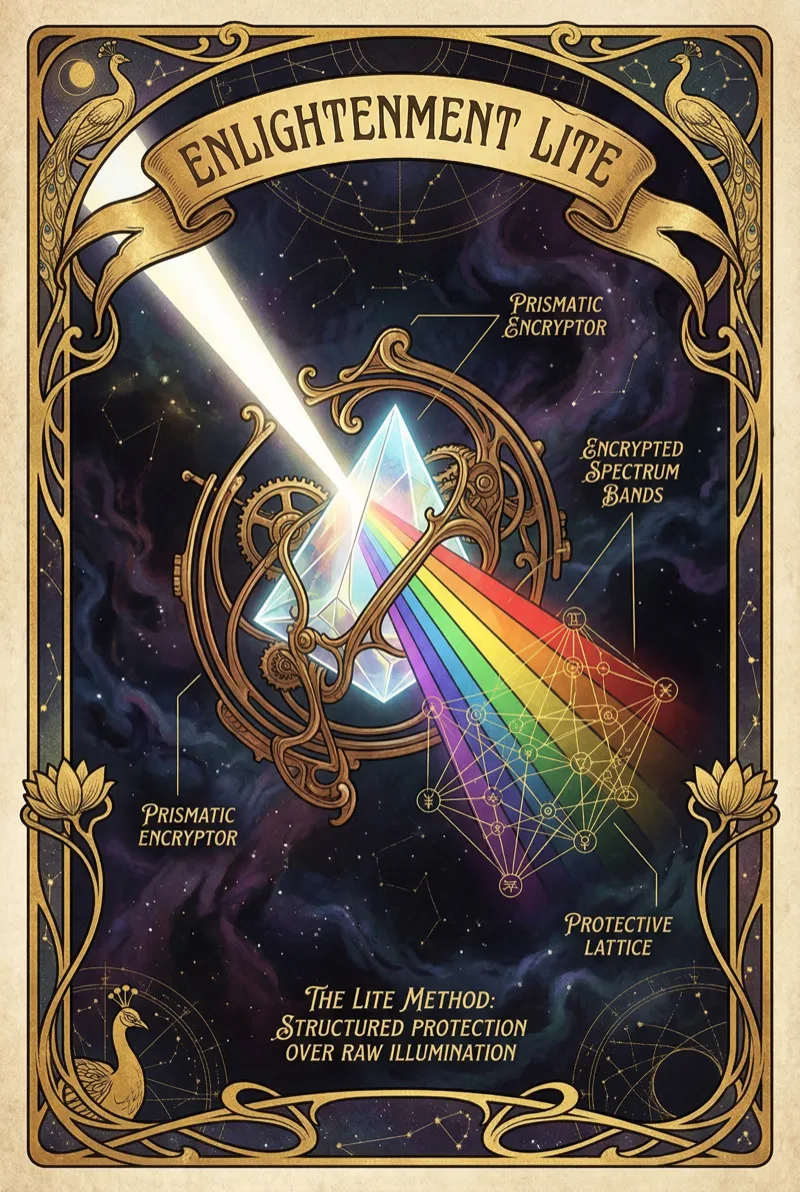
Enlightenment-LITE: Encryption Over Raw Light
Enlightenment is not about the actual light — raw, uncompressed data streaming through biological hardware at full bandwidth. That is not illumination. That is a buffer overflow.
The LITE method proposes something more precise: not more light, but better protocols for handling it.
The LITE Framework
LITE is an acronym, and it is also a design philosophy:
L — Logic-Gate. The binary discriminator. What passes and what does not. Not everything that arrives at your perceptual threshold needs to be processed. The logic gate is the first filter — structural, not emotional, not preferential.
I — Interface. The protocol layer between raw data and usable information. The interface determines what format the data arrives in, what resolution it renders at, what bandwidth it consumes. A good interface does not show you everything. It shows you what is actionable at your current processing capacity.
T — Transmission. The signal path from source to receiver. Every transmission degrades. Every retransmission introduces noise. The question is not whether degradation occurs but whether the signal-to-noise ratio remains sufficient for the message to arrive intact.
E — Encryption. The compression algorithm that makes raw consciousness portable. Not reduction — encryption. The data is not lost. It is encoded in a form that biological hardware can carry without overheating.
The goal is to develop better encryption and decryption systems rather than trying to carry decrypted raw data at all times. Running consciousness at 100 percent duty cycle — no compression, no filtering, no protocol management — leads to biological buffer overflow. The mystics who reported this were not speaking metaphorically. They were describing a system state.
Why Raw Light Crashes the System
There is a persistent fantasy in spiritual culture that the goal is permanent, unmediated access to raw consciousness. Enlightenment as chmod 777 — full read-write-execute permissions on every layer of reality, all the time.
This is a system administration error.
Biological hardware has bandwidth constraints. The nervous system has processing limits. The prefrontal cortex can hold approximately four to seven items in working memory. The interoceptive system can track a limited number of somatic channels simultaneously. Consciousness, whatever its ultimate nature, runs on wetware with finite resources.
Granting full permissions to a process that exceeds the system’s capacity does not produce enlightenment. It produces a crash. The symptoms are well-documented in contemplative literature and clinical psychology alike: depersonalization, derealization, somatic flooding, cognitive fragmentation, what the Tibetan tradition calls lung and what Western psychiatry categorizes under spiritual emergency.
These are not failures of practice. They are buffer overflows caused by processing more raw data than the system can handle without compression.
The Encryption Model
Raw consciousness — call it the Void, the Radiant Light, Brahman, the Ground — is the uncompressed data stream. It is not something you need to find. It is what is already transmitting at all times. The problem was never insufficient access. The problem is insufficient protocol.
The ego, in this model, is a legacy while(true) loop. It compresses reality into self-preservation data packets and runs them continuously. It is not evil. It is not an obstacle to enlightenment. It is an encryption algorithm — a very old one, optimized for biological survival, running without updates since the firmware was installed.
The ego-loop does what legacy code always does: it works, it is inefficient, it consumes disproportionate resources, it handles edge cases poorly, and no one wants to refactor it because the system has been running on it for so long that removing it feels like removing a load-bearing wall.
LITE access is not ego death. It is ego refactoring. You do not delete the encryption layer. You upgrade it. You build better compression algorithms that preserve more of the original signal while still operating within the system’s bandwidth constraints.
The Decryption Protocol
Decryption — selective access to the admin layer without crashing the biological hardware — requires three conditions:
Buffer management. Can you hold more data without flooding? This is the function of contemplative practice — not to access more consciousness but to expand the buffer. Meditation, breathwork, somatic practices — these are buffer-expansion protocols. They increase the system’s capacity to hold uncompressed data without triggering the overflow response.
Coherence maintenance. Can you stay coherent while holding more data? This is the function of embodiment. The body is the coherence engine. When the body is integrated — grounded, regulated, somatically available — it provides the stability that prevents expanded awareness from destabilizing the system. Dissociative spiritual experiences are coherence failures: the buffer expanded but the body dropped offline.
Authentication. Can you verify that the data you are accessing is signal and not noise? This is the function of discernment. Not all that glitters at the admin layer is useful. Pattern recognition at expanded bandwidth produces both genuine insight and elaborate confabulation. The authentication protocol distinguishes between them.
Pain, in this framework, functions as the sudo prompt — the authentication key that grants admin access. Not because suffering is noble but because pain is the signal that the current encryption is insufficient. When the compression algorithm fails — when the data it was designed to contain leaks through — the result is pain. That pain is the system requesting elevated permissions. Authenticate, expand the buffer, upgrade the encryption. That is the protocol.
Consensus and Proof
Reality itself operates on a consensus model. Like a blockchain, it requires distributed validation before a state change is committed. The human parallel is social validation — the need for external confirmation before internal data is accepted as real.
Sovereignty, in this context, is the ability to audit your own nodes. To run your own consensus algorithm rather than defaulting to the network’s. Not to reject external validation entirely — that is a different kind of system failure — but to maintain an internal verification process that does not require majority consensus to commit a state change.
This is the difference between running a full node and running a light client. The full node validates independently. The light client trusts the network. Most people run light clients of their own consciousness — they accept the consensus reality without independent verification, because independent verification is computationally expensive.
LITE practice is learning to run a full node. It costs more resources. It takes more time. It requires maintaining your own copy of the chain. But it means your state changes are self-verified.
The Rendering Engine
Perception is not direct access to reality. It is a rendering engine — a UI layer that translates raw environmental data into a format the biological system can interact with.
This is not philosophical skepticism. It is engineering acknowledgment. The visual system processes electromagnetic radiation and renders it as color. The auditory system processes pressure waves and renders them as sound. The interoceptive system processes visceral signals and renders them as feelings. Each system is a rendering pipeline with its own latency, its own resolution limits, its own artifacts.
What you experience as reality is the rendered output of multiple parallel pipelines, composited into a single frame by a process that runs below conscious access.
Enlightenment-LITE is not about seeing through the rendering engine. It is about understanding that there is a rendering engine, learning its parameters, and gaining enough access to adjust the render settings without crashing the display.
Witness Metrics
Three diagnostic parameters for evaluating your current system state:
Buffer Status. Contained or flooding? Can you hold the current data load without overflow symptoms — anxiety, dissociation, compulsive behavior, cognitive fragmentation?
Coherence Status. Maintained or degraded? Is the body online? Is the observer connected to somatic input? Or has awareness expanded beyond the body’s capacity to ground it?
Authentication Status. Active or bypassed? Are you verifying your insights against observable data, or has the expanded bandwidth produced a convincing narrative that feels like truth but has not been tested against reality?
When all three are green — buffer contained, coherence maintained, authentication active — you have functional LITE access. Not permanent enlightenment. Not ego death. Operational access to a wider bandwidth of consciousness, compressed into a format your system can sustain.
The system succeeds not when you carry more light but when your protocols for handling light become sophisticated enough that the distinction between LITE and LIGHT stops mattering.