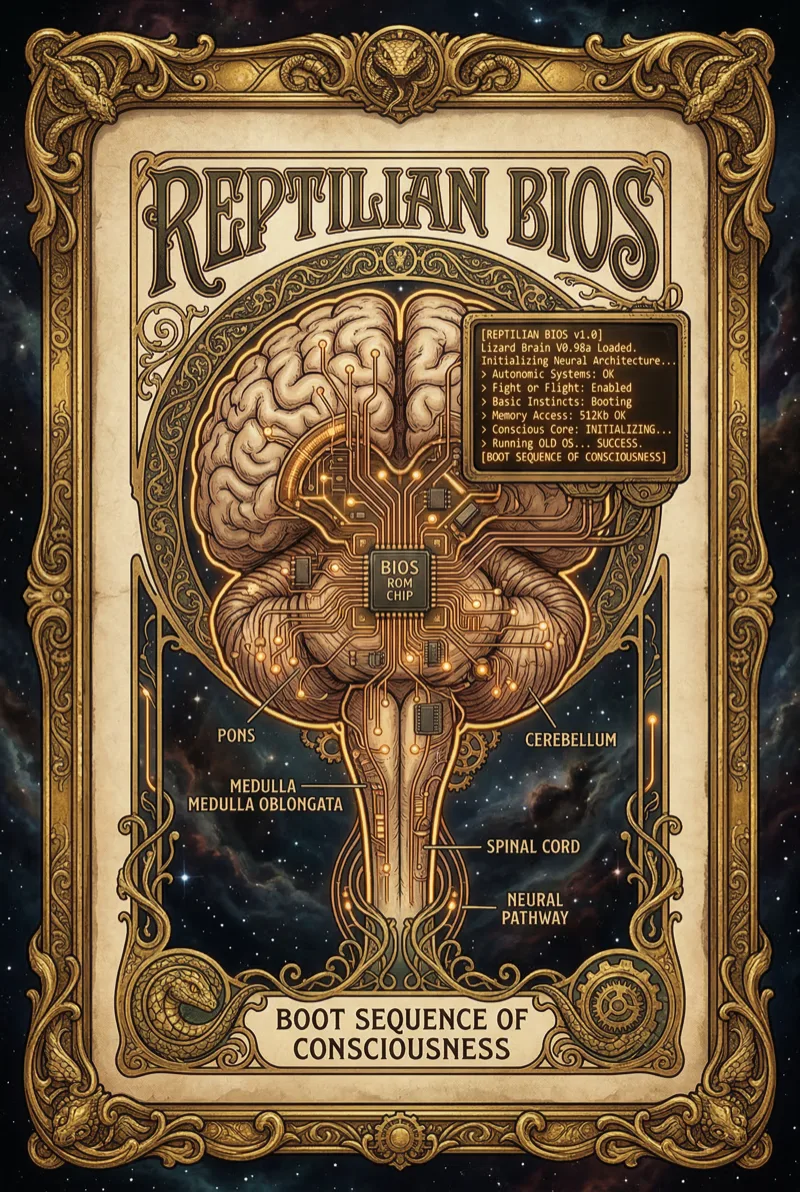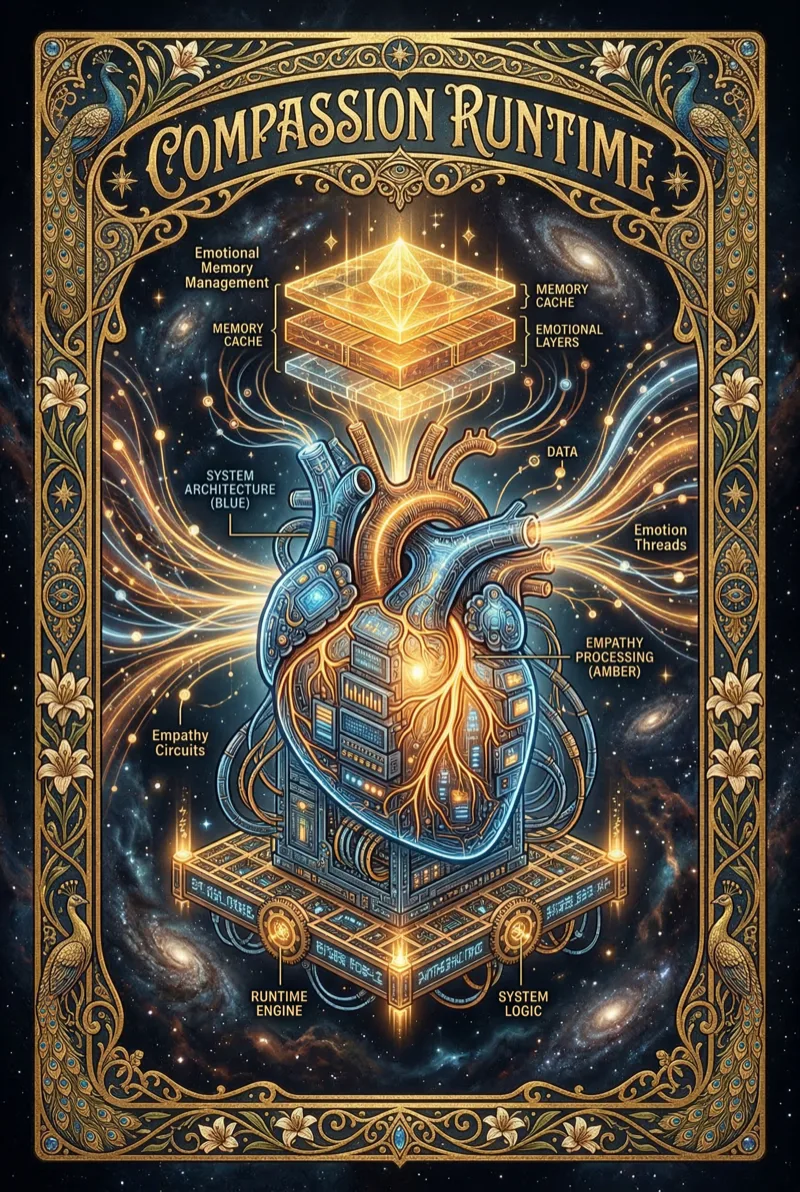
Compassion Runtime: The Limbic Kernel and the Architecture of Emotional Memory
Your emotions are not bugs. They are background processes running in kernel mode — privileged, ancient, and not subject to user-space termination. Compassion is not a feel-good overlay. It is the capacity to monitor what you cannot control.
I learned this the hard way during a period of sustained insomnia in my late twenties. My prefrontal cortex — the part of me that writes code, structures arguments, maintains the illusion of executive control — would come online at 3 AM with full diagnostic capability. It could name every error. It could trace every causal chain. What it could not do was terminate the process. The amygdala had already fired. The hypothalamic-pituitary-adrenal axis was already circulating cortisol. My consciousness was running in a hijacked shell, and the user account had no sudo privileges.
Joseph LeDoux’s laboratory at NYU has mapped this circuitry precisely. The amygdala’s rapid route — from thalamus to amygdala to hypothalamus — bypasses the cortex entirely. It is not a bug in the design. It is the design. A system that waits for cortical authorization before responding to threat does not survive. The emotional “background process” is not background at all. It is foreground infrastructure, running at a priority level that conscious thought cannot override. The limbic kernel was booting before the neocortex evolved. It does not recognize your managerial credentials.
Jaak Panksepp’s affective neuroscience program identified seven primary emotional systems — SEEKING, RAGE, FEAR, LUST, CARE, PANIC/GRIEF, and PLAY — each with distinct neural substrates, neurochemical signatures, and evolutionary functions. These are not metaphors. They are anatomically distinct circuits. When Panksepp electrically stimulated the FEAR circuit in a cat, the animal produced threat behavior without any external threat present. When he stimulated the SEEKING circuit, the animal produced appetitive exploration without any reward available. The emotion was the output of the circuit, not a reaction to the environment. Your sadness, your rage, your desire — these are not responses to the world. They are the world, generated internally and then projected outward for confirmation.
The Monitoring Problem
The first error most people make is attempting to manage what they cannot first monitor. You cannot debug a process you cannot see. The limbic kernel does not log to stdout. It writes to the body: heart rate variability, galvanic skin response, muscle tension, breath depth, gut motility. These are the telemetry. Most people have never learned to read them.
I spent years trying to think my way out of emotional states. The prefrontal cortex loves this approach. It generates elaborate narratives — I am feeling this because of that — and mistakes the narrative for control. The narrative is not control. It is post-hoc attribution, a confabulation produced by a module that evolved to explain behavior to other humans, not to govern behavior in itself. The split-brain research by Michael Gazzaniga demonstrated this explicitly: when the left hemisphere (language) was isolated from the right hemisphere (action), it would invent elaborate explanations for behavior it had not initiated and could not have known the cause of. Your “I am angry because of what she said” is the same confabulation. The anger fired before the reason. The reason is marketing.
Compassion begins with the recognition that the self is not the author of its emotional states. It is the witness. This is not a spiritual claim. It is a neuroanatomical one. The default mode network — the circuit active during self-referential thought — can be decoupled from the salience network through specific practices. The decoupling does not stop the emotional process. It changes the relationship to it. The process runs. The witness watches. The witness does not intervene because intervention is not available. Intervention at the limbic level requires pharmacology, deep brain stimulation, or sustained neuroplastic restructuring — not a pep talk.
The Body as Telemetry
Bessel van der Kolk’s research, crystallized in The Body Keeps the Score (2014), established that traumatic emotional encoding migrates from declarative memory into procedural memory. The body learns a grammar of perpetual readiness. The shoulders brace. The jaw locks. The diaphragm freezes. These are not symptoms of a mental state. They are the mental state, expressed in musculoskeletal code rather than linguistic code. The body is the limbic kernel’s logging interface.
I learned to read my own telemetry through a specific practice: tracking the felt sense of emotion before naming it. Eugene Gendlin called this “focusing” — attending to the “felt sense,” the pre-verbal bodily awareness of a situation. The practice is not about relaxation. It is about precision. Where in the body does this emotion live? What is its temperature? Its texture? Its movement? Does it want to expand or contract? Does it have a direction? These questions sound like poetry. They are actually diagnostic. The body encodes emotional information in somatic parameters that the linguistic left hemisphere cannot access directly. Gendlin’s research showed that psychotherapy clients who could attend to their felt sense progressed faster than those who could only narrate. The body knows before the mind knows that it knows.
The interpersonal scale is where this architecture becomes visible. When I am in a conversation and my chest tightens, that is not a metaphor. That is my autonomic nervous system executing a threat-detection routine that was compiled in a different decade. The other person’s words are the trigger condition. The response is the compiled output. My conscious mind is not choosing the response. It is witnessing it. The question is whether I can witness it without fusing with it — without becoming the tightness, without narrating it as “I am anxious,” without demanding that the other person stop doing what they are doing so that my telemetry can normalize.
The Systemic Architecture of Affect
At the systemic scale, cultures are emotional operating systems. Some cultures run high-arousal affect — expressive, interruptive, somatically loud. Others run low-arousal affect — restrained, contained, somatically quiet. Neither is correct. Each is calibrated for a different threat environment. The high-arousal culture may have evolved in contexts where group coordination required rapid emotional signaling — pastoral raids, communal defense. The low-arousal culture may have evolved in contexts where individual survival required emotional concealment — authoritarian surveillance, scarce resources. The anthropological literature on emotional expression (e.g., Lisa Feldman Barrett’s How Emotions Are Made, 2017) demonstrates that emotional categories are not universal. They are constructed, culturally calibrated, and somatically inscribed. Your “anger” is not the same as a Tahitian’s. The neural substrate is shared. The construction is local.
This means that compassion is not a universal solvent. It is a specific practice calibrated to a specific operating system. What compassion means in a high-arousal culture — staying present through loud emotional expression without matching it — is different from what it means in a low-arousal culture — detecting the subtle somatic signals that a restrained person is discharging. The practice must be calibrated to the system. Generic compassion protocols — “just be kind” — are like running a Windows executable on a Linux kernel. They may load. They will not function.
The shadow of compassion is its failure mode. Compassion is not infinite. It is a metabolic process, and it consumes glucose, cortisol modulation capacity, and prefrontal engagement. The research on compassion fatigue (Figley, 1995; Conrad & Kellar-Guenther, 2006) documents what happens when the monitoring system runs continuously without rest: the witness collapses into the observed. The nurse who could hold her patient’s suffering becomes the patient who cannot hold her own. The therapist who could track her client’s telemetry loses the capacity to track her own. Compassion is not a virtue. It is a capacity, and capacities have limits. The refusal to acknowledge those limits is not compassion. It is grandiosity wearing a soft mask.
Kha-Ba-La: The Triad as Emotional Architecture
Kha is the witness that recognizes the process without becoming it. The amygdala fires. The cortisol releases. The heart rate accelerates. Kha notes: this is happening. Not: I am angry. Not: this is unbearable. Just: this is happening. The recognition is the first act of compassion. It does not change the process. It changes the relationship to it. Without Kha, the process runs unconsciously. The person becomes the anger. The anger becomes the identity. The identity becomes the sentence.
Ba is the body that hosts the process. The limbic kernel does not run in abstract space. It runs in a specific body with a specific history of trauma, nutrition, sleep, exercise, and relational pattern. A body that has not slept does not have the same compassion capacity as a body that has. A body that has been traumatized does not have the same emotional latency as a body that has not. Ba is not a passive container. It is an active architecture that determines what processes can run, how fast they can run, and whether they can be monitored at all. The body is the field. The field is not neutral.
La is the resistance that makes the monitoring real. Compassion without resistance is bypass. The practice of attending to difficult emotional states is not pleasant. It is not “flow.” It is friction. The body wants to escape. The mind wants to narrate. The culture wants to diagnose. The resistance is the material that shapes the practice. Without La, compassion becomes a performance — a display of tolerance that conceals avoidance. With La, compassion becomes architecture: the capacity to hold what is difficult without demanding that it change.
The three operate as a loop: Kha recognizes, Ba hosts, La generates the pressure that makes the recognition meaningful. This is not a one-time event. This is infrastructure. The compassion runtime does not install itself. It is compiled through repetition, through failure, through the slow accumulation of moments when the witness did not collapse and the body did not flee and the resistance did not win. Each iteration is a build. Some builds fail. The next build incorporates the error log.
The Noesis Engine does not promise that compassion will make you feel better. It promises that compassion will make you more accurate — more able to read the telemetry, more able to recognize the process, more able to hold the loop without breaking. The goal is not control. Control is not available at the limbic level. The goal is clarity: to know what is running, to know that you did not start it, and to know that it will end — not because you ended it, but because all processes terminate, and the witness is still there when they do.