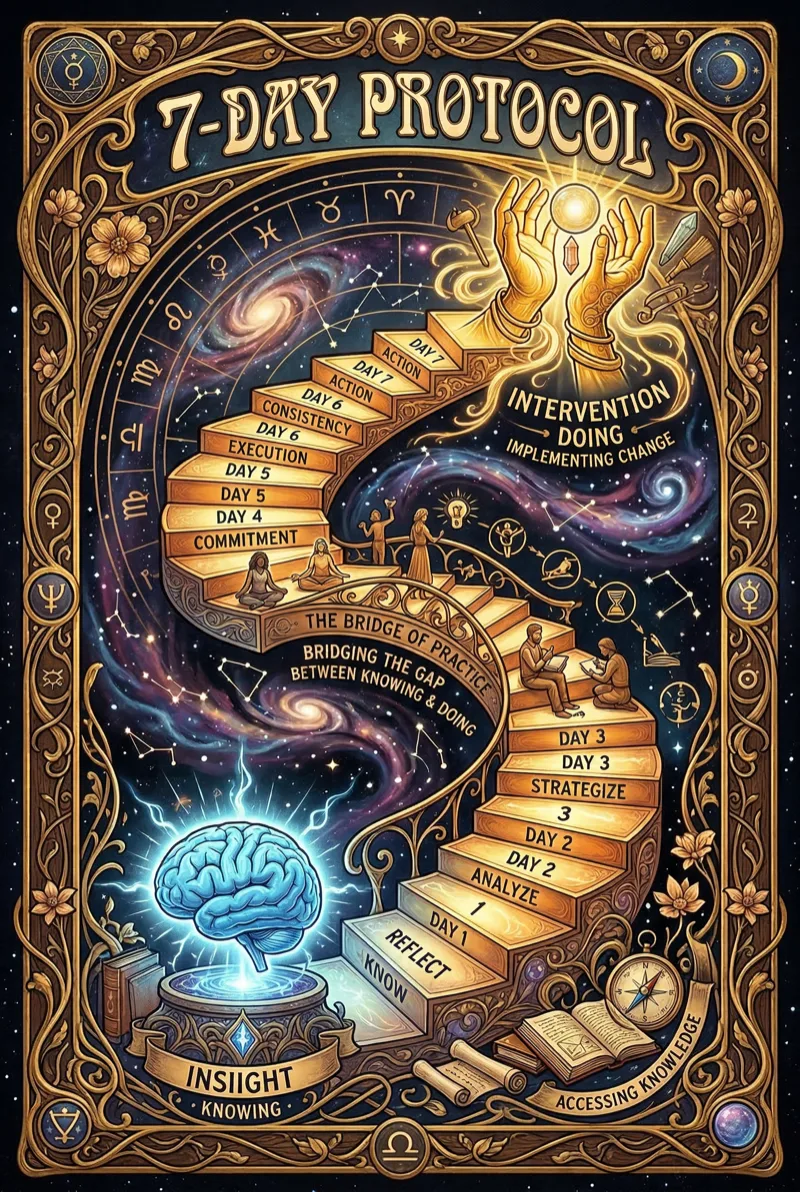
From Insight to Intervention: A 7-Day Protocol
You can name every pattern you run.
You can explain why you do what you do with clinical precision. You can trace the origin story, identify the trigger, map the cascade.
And you still do the thing next Tuesday.
This is the insight trap — and it is more sophisticated than denial.
The Fault Line
Insight without intervention is a temporary emotional event. It feels like progress. It is not.
Recognition without intervention is sophisticated paralysis. You have upgraded from unconscious repetition to conscious repetition — which is an improvement in exactly one dimension and zero functional outcomes.
The body does not care how articulate your self-analysis is. It runs the pattern anyway. The nervous system operates at signal speed — approximately 80 milliseconds. Your insight operates at story speed — approximately 800 milliseconds. By the time your understanding of the pattern has loaded, the pattern has already executed its full sequence.
This is not a willpower problem. It is an architecture problem. You are intervening at the wrong layer of the stack.
The Protocol
Not a philosophy. A protocol. Seven days. One pattern. Micro-interventions scaled small enough to actually repeat.
Day 1 — Name It
One repeating loop. One sentence. Not a paragraph of context, not a therapeutic narrative. One sentence.
“When criticized, I go silent and build a case in my head for 72 hours.”
“When someone needs more than I budgeted for, I reduce my availability.”
“When I sense disapproval, I perform competence until the room shifts.”
If you cannot name it in one sentence, you have not identified the pattern yet. You have identified the story about the pattern. The pattern is the invariant shape. The story is the variable content. Strip the content. Keep the shape.
Day 2 — Mark the Earliest Signal
This is body work, not mind work.
Where does the pattern announce itself before you are inside it? A stomach drop. A jaw clench. A thought tempo shift — suddenly thinking faster or slower than the situation warrants. A relational cue — noticing you have already started composing your defense before the other person finishes speaking.
The signal fires at roughly 80 milliseconds. The story that explains the signal takes 800 milliseconds. If you are catching it at story, you are 720 milliseconds late.
This is where the body becomes the primary instrument. Not as metaphor. As literal diagnostic technology. The soma reads the field before the narrative constructs its explanation. The body knows before the story arrives.
Day 3 — Define One Micro-Interruption
Small enough to repeat every day for a week. Not a life change. Not a revelation. A physical interruption of the pattern’s momentum.
Stand up. Change rooms. Put your hand on your sternum. Take one breath where the exhale is twice the inhale. Say one sentence out loud that is not the default script. Place both feet flat on the floor and press down.
The intervention needs to be body-first, because the pattern lives in the body. A new thought inserted into an old somatic groove just gets metabolized by the groove. The groove wins. It always wins against cognition alone.
The micro-interruption is not designed to stop the pattern. It is designed to insert a gap — a checkpoint between signal and automatic response. That gap is where authorship lives. Even a half-second gap changes the architecture.
Days 4-6 — Track What Changes
Run the micro-interruption every time you catch the signal from Day 2. Note three things:
Did you catch the signal earlier, later, or at the same point in the cascade?
Did the interruption change the cascade, or did the pattern route around it?
Did anything unexpected surface — a different emotion, a physical sensation, a memory?
Track these in writing. Not because writing is therapeutic but because the observer that tracks in writing is forced to separate signal from state from story. The act of logging is itself an intervention — it recruits the witness function at the moment the automatic response is trying to execute.
Day 7 — Review
This is the diagnostic step. No logging. Just reading.
Lay out the week’s data and ask three questions:
Did the loop weaken? The signal still fires, but the cascade completes with less intensity or takes longer to lock in. The gap between signal and response widened.
Did the loop relocate? Same pattern, different trigger, different context. You interrupted it in one domain and it surfaced in another. This is not failure — it is the pattern revealing its true scope. It was never about the specific trigger. It was about the structural groove.
Did the loop disguise itself? You think it is gone. It adapted. It found a new expression that does not match your original description but produces the same cost. This is the most sophisticated outcome and the most diagnostic.
Patterns do not disappear. They weaken, relocate, or disguise. Knowing which one happened is the difference between integration and self-deception.
What Is Actually Happening in This Protocol
Day 2 is the body reading the signal — raw somatic input before interpretation. That is the carrier doing its work.
Day 3 is conscious interruption of inertia’s groove. You are not fighting the resistance. You are inserting a micro-gap between the signal and the automatic response.
Day 7 is the full diagnostic triad in motion: Did inertia reassert itself? Did clarity lose resolution? Did the body stop tracking?
When all three are working — when you can observe, act on the observation, and distinguish structural resistance from obsolete resistance — the pattern does not run you. You run the pattern. Or more precisely: you author the relationship to it.
The Lived Result
Nobody reports a breakthrough. They report something quieter.
“I caught it earlier this time.”
“The gap between signal and reaction got longer.”
“I noticed the pattern tried to relocate and I saw it move.”
That is not a failure of the protocol. That is the actual resolution of change. It is granular, iterative, and accumulates below the threshold of narrative satisfaction.
You will not feel transformed. You will notice, over weeks, that the pattern fires and you are there — present at the moment of selection rather than arriving after the cascade has completed.
That presence at the point of selection is authorship. Not control — you do not delete the pattern. But you are no longer absent when it runs. And that changes everything downstream.
The system succeeds when you no longer need it.
Run it for seven days. One pattern. One sentence. One signal. One interruption. Seven days of data.
Then read the data and let the architecture speak for itself.