The Enneagram Runtime Map: Trigger, Defense, Cost
Every type has a preferred defense. The bill shows up later as life-cost.
Here is how to read the invoice.
The Triad
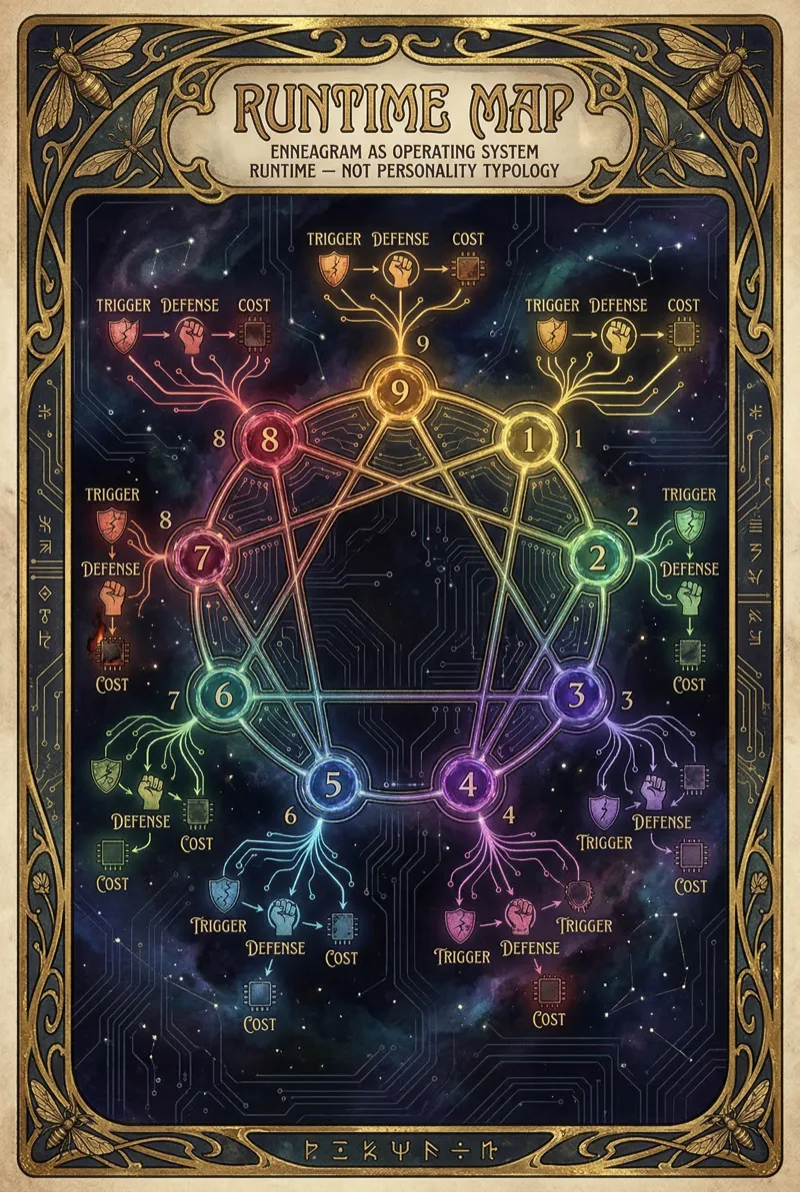
Three layers form the runtime map of any Enneagram type:
Trigger — the class of input that activates the type’s defense. Not a specific event. A category. Perceived incompetence (Type 1). Perceived abandonment (Type 6). Perceived insignificance (Type 3). The category is what the nervous system’s surveillance system is tuned to detect. It scans for this class of threat continuously, below conscious awareness, and fires when the threshold is crossed.
Defense — the automatic behavioral sequence. Already complete before the observer registers what happened. The defense runs at approximately 300 milliseconds — state speed, not story speed. By the time you are aware of what you did, you have already done it. The defense is not chosen. It is executed.
Cost — what the defense costs you downstream. Not the immediate emotional experience — the structural consequence. Relationship damage. Capacity reduction. Range limitation. The cost accumulates quietly, below the threshold of narrative satisfaction, and presents its invoice in domains you did not connect to the original defense.
The Runtime Reading
Trigger is what the body receives — the somatic signal that inertia reads as threat.
Defense is what inertia runs — the grooved response, optimized for speed, indifferent to nuance. The defense was built for a specific threat environment. It fires in any environment that pattern-matches to the original threat, regardless of whether the current situation actually requires it.
Cost is what the observer tallies afterward — the accumulated consequence of running the same defense in situations that did not require it.
The body felt the trigger. Inertia ran the defense. The observer sees the cost. All three operated. None consulted the others. That is the runtime architecture of unconscious type expression.
The Type 5 Invoice
Trigger: Social demand exceeds internal resource estimate. Someone needs more than you budgeted for. The meeting runs long. The conversation requires emotional availability you did not allocate. The request assumes a level of presence your system classified as optional.
Defense: Withdrawal. Information hoarding. Reduced surface area. The nervous system contracts, the perimeter tightens, availability drops. Not because you decided to withdraw — because the siege protocol activated and the drawbridge went up before the decision-making function loaded.
Cost: Isolation. Underdeveloped embodiment. A life observed but not inhabited. The Type 5 accumulates enough knowledge to construct a universe and too little embodied experience to live in one. That is not a personality trait. That is inertia’s accounting ledger — the running total of every withdrawal that purchased safety at the price of participation.
The Type 8 Invoice
Trigger: Perceived vulnerability. Loss of control. Being managed, directed, or contained by another. The signal reads as: someone is limiting your autonomy, and the limitation was not negotiated.
Defense: Assertion. Expanded presence. Preemptive confrontation. The nervous system floods adrenaline, the body occupies more space, the voice gains volume, the posture opens into what reads as confidence but is actually territorial display. The defense hits so fast it feels like courage. It is not courage. It is a pre-emptive strike against vulnerability.
Cost: Trust erosion. Inability to receive. Exhaustion from maintaining the perimeter. The Type 8 builds enough sovereignty to command a room and too much armor to be known inside one. Inertia runs the siege engine continuously. The bill comes due in intimacy — the one domain where sovereignty purchased by dominance is not legal tender.
The Type 2 Invoice
Trigger: Perceived rejection. Being unnecessary. Not needed. The signal reads as: your value is conditional on your usefulness, and your usefulness just dropped below threshold.
Defense: Giving. Anticipating needs. Making yourself indispensable. The nervous system scans for what others lack and mobilizes to provide it before it is asked for. Not generosity — a pre-emptive defense against abandonment. If I am essential to your wellbeing, you cannot leave.
Cost: Resentment. Depleted embodiment. A self that exists only in relation to others’ needs. The Type 2 generates enough warmth to heat a building and not enough sovereignty to claim a room in it. Inertia runs generosity as pre-emptive defense. The cost is authorship — the capacity to want something for yourself, independent of what others need.
Reading Your Own Invoice
The diagnostic runs in three steps:
Step 1: What class of trigger produces disproportionate reaction? Not the specific events that upset you — the category. The common denominator across five or ten instances of disproportionate activation. What is your nervous system’s surveillance system tuned to detect?
Step 2: What is the behavioral sequence that fires before you choose? Not what you do after deliberation — what happens in the first 300 milliseconds. The behavior that is already underway before the observer comes online. Watch for the verb, not the narrative: withdrew, confronted, performed, appeased, corrected, scattered, numbed, controlled, accommodated.
Step 3: What has that defense cost you — in relationships, in range, in capacity? Do not answer from memory. Answer from the body. Where do you feel the cost? That contraction, that absence, that narrowing — that is where inertia keeps the books.
The invoice is somatic before it is narrative. The body holds the running total of every defense that fired in situations that did not require it. The shoulders that carry the Type 1’s accumulated correction. The chest that holds the Type 4’s accumulated grief of not being seen. The gut that holds the Type 9’s accumulated avoidance of its own friction.
The Accounting System
The Enneagram is not a personality quiz. It is an accounting system for unconscious expenditure.
Every defense costs something. Every cost accumulates. The accumulation manifests as the specific limitations and recurring frustrations of each type — not as abstract personality descriptions but as concrete structural consequences of running the same defense in situations that outgrew it.
The runtime map — Trigger, Defense, Cost — makes this accounting visible. It does not ask “who are you?” It asks “what does your nervous system spend, and what does that spending cost?”
Trigger. Defense. Cost.
Read the invoice. Not to feel bad about it. Not to add another layer of self-analysis. To stop paying a bill you never agreed to.
The defense served a purpose once. It may still serve a purpose in genuinely threatening situations. The cost comes from running it in situations that do not require it — from treating every pattern-match as the original threat and paying the full defensive price for a situation that needed a fraction of that response.
Seeing the invoice does not cancel the debt. But it stops you from accruing new charges at the old rate. And over time, that changes the balance sheet.