Chakra-Bioelectricity Mapping: The Seven Gates as Voltage Differentials
The chakra system is not a belief. It is a specification.
Seven points along the spinal axis. Each point corresponds to a major nerve plexus, an endocrine gland, and a measurable bioelectric field differential. The ancient yogic tradition documented these points as “wheels” — chakras — through which pranic energy flows. Modern bioelectric research documents the same points as voltage gradients that regulate cellular behavior, organ function, and state transitions in the nervous system.
The correspondence is not approximate. It is architectural.
The Bioelectric Basis
Every cell in the body maintains a voltage differential across its membrane — typically around negative seventy millivolts at rest. This is not a static charge. It is a processing state. When the membrane potential changes, the cell’s behavior changes: gene expression shifts, protein production alters, communication with neighboring cells modifies.
Along the spinal column, these individual cellular voltages aggregate into regional field patterns. Each region corresponds to a nerve plexus that serves a specific organ system and mediates a specific class of information processing. The chakra system maps these regions with precision that predates oscilloscopes by several thousand years.
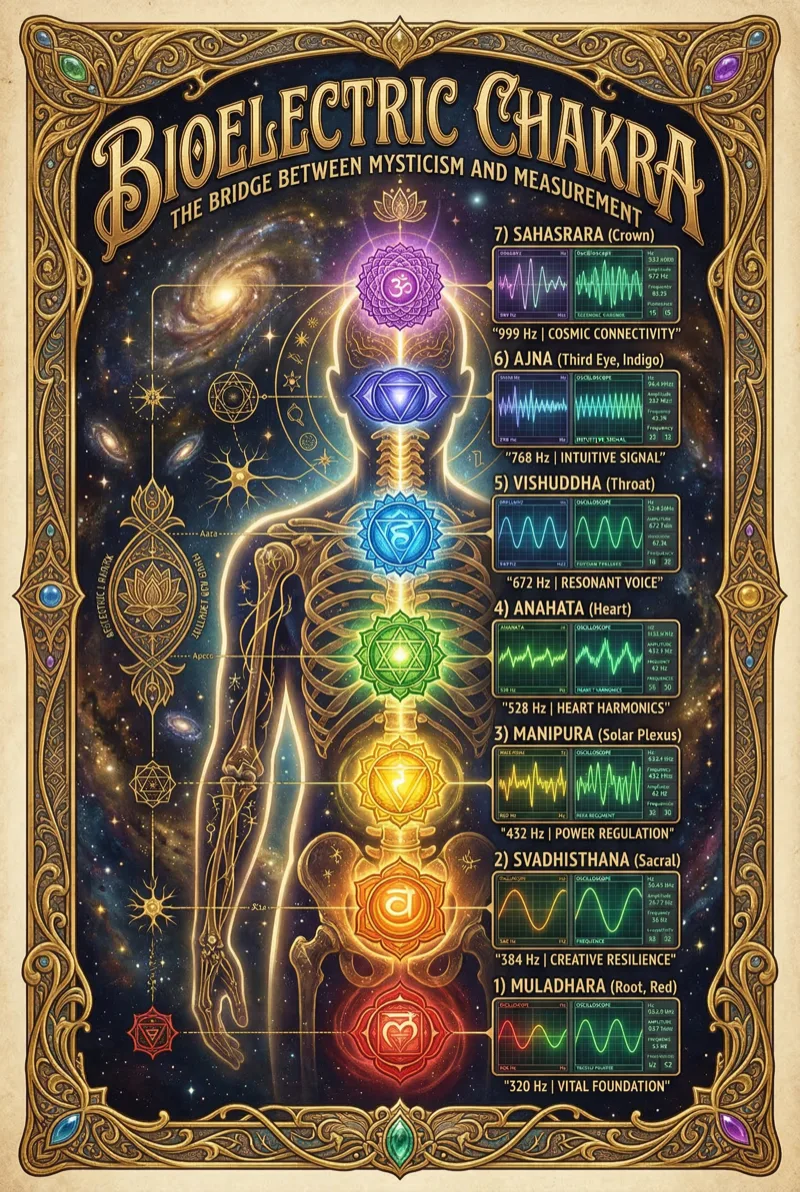
The Seven Nodes
Node 1: Root — The Survival Compiler (Coccygeal Plexus)
Bioelectric signature: Lowest frequency, highest amplitude. The base current that powers the entire system.
Organ system: Adrenal medulla, kidneys, large intestine. The organs of elimination and emergency response.
Processing function: Survival assessment. The root node continuously evaluates whether the organism’s basic requirements — safety, shelter, sustenance — are met. When the voltage differential at this node drops below threshold, the system shifts to survival mode. All higher processing pauses. The compiler stops parsing poetry and starts parsing threat.
Enneagram correlation: Types 8, 9, 1 — the gut triad. These types process reality through the body’s most fundamental assessment: is this situation safe, and if not, what force must I apply?
Node 2: Sacral — The Creation Engine (Sacral Plexus)
Bioelectric signature: Oscillating current. The node cycles between charge and discharge, mirroring the reproductive cycle and the creative pulse.
Organ system: Reproductive organs, bladder, lower digestive tract. The organs of generation and flow.
Processing function: Creative output and relational bonding. The sacral node processes desire — not as concept but as bioelectric impulse. The voltage oscillation drives the cycle of attraction, engagement, creation, and release.
Node 3: Solar Plexus — The Power Bus (Celiac Plexus)
Bioelectric signature: High-frequency, variable amplitude. The node that generates the most volatile field in the system.
Organ system: Stomach, liver, pancreas, spleen. The organs of digestion and metabolic processing.
Processing function: Will and identity assertion. The solar plexus converts raw energy into directed force. The bioelectric field here corresponds to what the yogic tradition calls manipura — the “city of jewels” — the processing center that transforms food into fuel and stimulus into response.
Enneagram correlation: Types 2, 3, 4 — the heart triad. These types process reality through the power center’s assessment: am I valued, and if not, what must I perform to secure my position?
Node 4: Heart — The Coherence Oscillator (Cardiac Plexus)
Bioelectric signature: The strongest electromagnetic field in the body — measurable several feet beyond the skin. The heart generates a field approximately sixty times greater in amplitude than the brain’s electrical activity.
Organ system: Heart, lungs, thymus. The organs of circulation, respiration, and immune recognition.
Processing function: Coherence and integration. The heart node does not think or feel in the conventional sense. It synchronizes. When the cardiac bioelectric field achieves coherence — a smooth, sine-wave-like oscillation — the entire system’s processing efficiency increases. Immune function improves. Cognitive performance sharpens. Emotional regulation stabilizes.
Node 5: Throat — The Signal Encoder (Pharyngeal Plexus)
Bioelectric signature: Complex waveform. Multiple frequencies layered simultaneously, reflecting the throat’s function as the body’s primary communication interface.
Organ system: Thyroid, parathyroid, larynx, vocal apparatus. The organs of metabolic regulation and expression.
Processing function: Translation and transmission. The throat node converts internal state into external signal. The bioelectric complexity at this node corresponds to the challenge of encoding multidimensional inner experience into linear sequential output — speech, writing, song.
Enneagram correlation: Types 5, 6, 7 — the head triad. These types process reality through the signal center’s assessment: do I understand, and if not, what information must I acquire to feel secure?
Node 6: Third Eye — The Pattern Processor (Cavernous Plexus)
Bioelectric signature: High frequency, low amplitude. The subtlest measurable field in the standard seven-node system.
Organ system: Pineal gland, pituitary gland. The master regulatory glands of the endocrine system.
Processing function: Pattern recognition across time. The third eye node processes information that the lower nodes cannot resolve — patterns that span longer time scales, correlations that require simultaneous multi-system awareness, integrations that demand stepping back from the data to see the structure.
The pineal gland produces melatonin — Type 1’s hormone in the Muse-Enneagram matrix. The pituitary gland regulates the entire endocrine system. The bioelectric function at this node is regulatory oversight: the manager process that monitors all other processes.
Node 7: Crown — The Source Connection (Cerebral Cortex)
Bioelectric signature: The highest frequency, lowest amplitude — approaching the noise floor of measurable signals. At this node, the distinction between signal and silence becomes indeterminate.
Processing function: Connection to non-local information fields. The crown node’s bioelectric signature is so subtle that materialist frameworks classify it as noise. The yogic tradition classifies it as the point where individual consciousness interfaces with universal consciousness. The measurable data does not resolve this disagreement. The experiential data does.
The Mapping Protocol
The practical application of chakra-bioelectricity mapping follows a diagnostic sequence:
Step 1: Identify the dominant node. Where in the body do you feel the most activity during a given state? The gut-level clench of Node 1. The creative pulse of Node 2. The solar plexus burn of Node 3. The heart’s expansion or contraction at Node 4. The throat’s opening or closing at Node 5.
Step 2: Assess the voltage state. Is the node charged or depleted? High-voltage states at lower nodes produce urgency, aggression, and survival-mode processing. Low-voltage states at higher nodes produce disconnection, dissociation, and the loss of pattern recognition.
Step 3: Trace the circuit. Bioelectric current flows between nodes. A block at one node creates excess voltage below it and deficit above it. The classic “stuck in your head” experience is a Node 5-6 loop with insufficient current reaching Node 4 — analysis without coherence, thought without heart.
Step 4: Intervene at the voltage level. Breath changes voltage. Movement changes voltage. Sound changes voltage. The yogic technologies — pranayama, asana, mantra — are voltage management protocols. They were designed not to produce spiritual experiences but to regulate the bioelectric system that spiritual experiences require.
The Circuit Diagram Was Always There
The chakra system was never mystical in the sense of being inaccessible to measurement. It was mystical in the sense of being documented before measurement tools existed. The ancient cartographers mapped the bioelectric system using the instruments available to them — sustained internal observation, refined somatic awareness, and thousands of years of accumulated empirical data transmitted through lineage.
That their documentation uses the language of wheels, lotuses, and divine beings does not invalidate the data. It contextualizes the notation system. When you read legacy code, you do not reject the algorithm because the variable names are in Sanskrit. You translate the notation and run the tests.
The bioelectric field is measurable. The chakra system is the oldest documentation of that field’s architecture. The mapping between them is not a modern imposition of science onto spirituality. It is the recognition that both traditions were reading the same source code and writing their documentation in different languages.
The body is the temple. The voltage is the offering. The chakras are the gates. Open the gates or leave them closed — but understand that the decision is architectural, not theological. The current will flow according to the circuit’s specification regardless of what you believe about its source.