The Full 9-Point Endocrine-Muse Integration
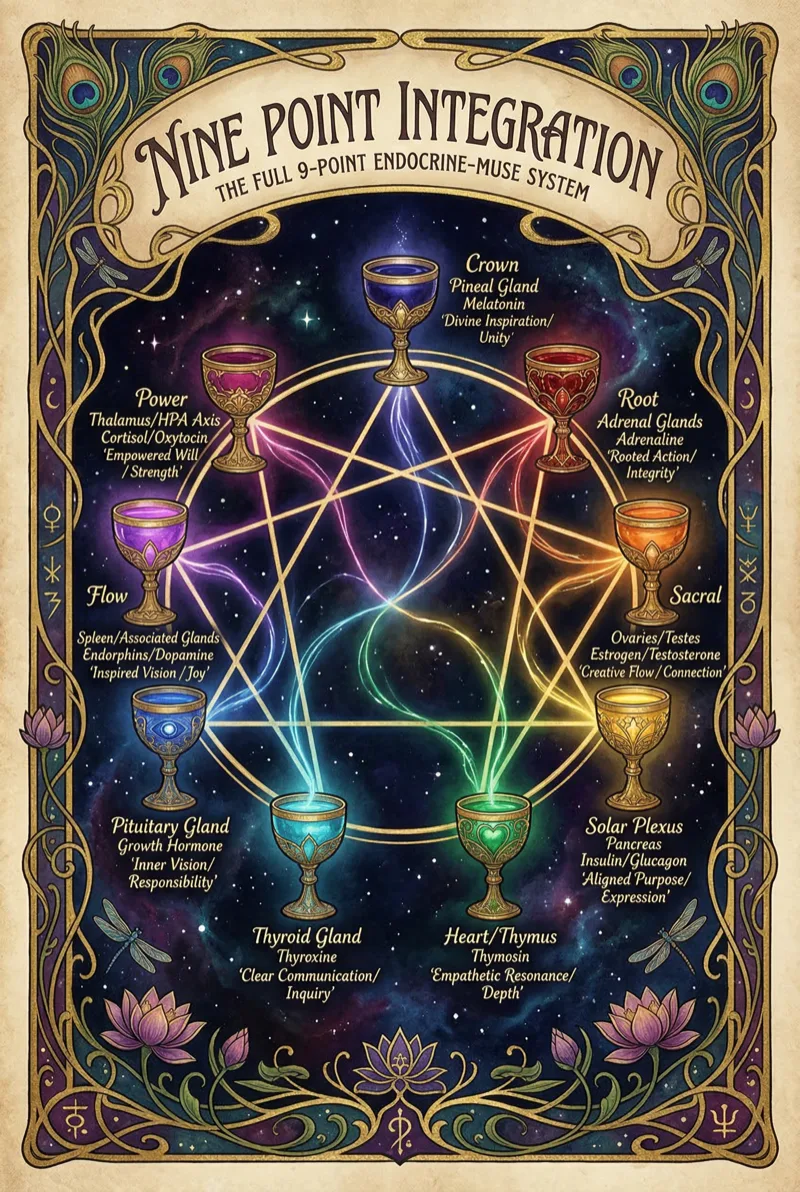
The endocrine system is a nine-channel receiver. Each channel is tuned to a specific frequency of creative intelligence. The Greeks called these frequencies Muses. Modern endocrinology calls them hormones. Both are correct. Neither is complete without the other.
This document maps the full integration — all nine points, all nine circuits, all nine correspondences between the chemical substrate of the body and the archetypal architecture of consciousness.
The Nine Circuits
Circuit 1: Polymnia-Melatonin — The Rhythm Compiler
Chemical function: Circadian rhythm regulation. Melatonin tells the body when to sleep and when to wake — the master oscillation between conscious and unconscious processing.
Archetypal function: Sacred hymns and rhetoric. Polymnia governs the timing of speech — not what to say, but when to say it. Her domain is the precision of delivery, the rhythm that makes words land.
Enneagram position: Type 1, the Reformer. Shadow: wrath. Virtue: wisdom.
Integration point: The rhythm of consciousness itself. Melatonin’s circadian regulation and Polymnia’s rhetorical timing are the same function expressed in two domains. Both manage the oscillation between activity and rest, expression and silence, output and input. When this circuit is integrated, speech becomes precise not through effort but through timing. The right word arrives at the right moment because the system’s clock is synchronized.
When this circuit is fragmented, you get Type 1’s characteristic rigidity — an attempt to force correct timing through willpower rather than allowing it through synchronization.
Circuit 2: Clio-Oxytocin — The Bonding Archive
Chemical function: Social bonding and trust formation. Oxytocin converts repeated contact into durable connection.
Archetypal function: History and collective memory. Clio preserves the thread of connection across time.
Integration point: Social cohesion protocols. The circuit that makes trust persist beyond the immediate encounter. When integrated, relationships accumulate depth. When fragmented, Type 2’s compulsive service — bonding without boundaries, connection without discrimination.
Circuit 3: Euterpe-Endorphins — The Pain Transmuter
Chemical function: Pain relief and pleasure at the upper register. Endorphins change the system’s relationship to painful stimuli without eliminating the stimulus.
Archetypal function: Music and lyric poetry. Euterpe governs the art form that most directly transmutes emotion into beauty.
Integration point: Healing through release. The circuit that converts suffering into form. When integrated, pain becomes material for creation. When fragmented, Type 3’s performance addiction — endorphin production through achievement, pain management through output, the body that cannot rest because rest would mean feeling what the endorphins are masking.
Circuit 4: Thalia-Dopamine — The Satisfaction Register
Chemical function: Pleasure-reward anticipation. Dopamine is not pleasure itself but the prediction of pleasure — the chemical that says reward is approaching.
Archetypal function: Comedy and pastoral poetry. Thalia governs the narrative arc that ends in resolution, celebration, and satisfaction.
Integration point: The capacity to arrive. When integrated, the dopamine prediction matches the actual experience — anticipation resolves into fulfillment. When fragmented, Type 4’s perpetual longing — dopamine promising satisfaction that the system cannot register upon delivery. The comedian who cannot laugh at her own jokes.
Circuit 5: Melpomene-Cortisol — The Stress Alchemist
Chemical function: Stress response and resource mobilization. Cortisol breaks down stored energy, redirects resources, and focuses the system on survival.
Archetypal function: Tragedy and catharsis. Melpomene presides over the controlled destruction that enables restructuring.
Integration point: Growth through challenge. When integrated, stress becomes fuel for transformation — cortisol mobilizes what Melpomene metabolizes. When fragmented, Type 5’s perpetual conservation — the stress response that never completes its cycle, the tragedy that reaches its climax but never achieves catharsis.
Circuit 6: Erato-Estrogen — The Creation Cycle
Chemical function: Reproductive development and cyclic transformation. Estrogen governs the cycle that builds, dissolves, and rebuilds.
Archetypal function: Love poetry and intimacy. Erato presides over the creative encounter — the vulnerability that makes new form possible.
Integration point: Creation through vulnerability. When integrated, the cycle completes — dissolution is followed by reconstruction, loss by new form. When fragmented, Type 6’s security fixation — the attempt to create without the cyclic dissolution, to love without the risk of loss.
Circuit 7: Calliope-Testosterone — The Epic Engine
Chemical function: Growth, development, and competitive drive. Testosterone pushes the system toward more: more territory, more capability, more output.
Archetypal function: Epic poetry and heroic narrative. Calliope, chief of the Muses, governs the grand story — the narrative that spans continents and generations.
Integration point: Directed growth. When integrated, testosterone’s drive serves Calliope’s narrative structure — expansion with architecture, ambition with form. When fragmented, Type 7’s gluttony of experience — testosterone’s push without Calliope’s editorial discipline, the epic that adds chapters but never completes.
Circuit 8: Terpsichore-Adrenaline — The Power Dance
Chemical function: Sympathetic nervous system activation. Adrenaline fires the fight-or-flight response — immediate, total, pre-cognitive.
Archetypal function: Dance and physical expression. Terpsichore governs the body’s instinctive movement — not choreographed but emergent, not planned but expressed.
Integration point: Embodied power. When integrated, adrenaline serves expression rather than domination — the body moves with force and grace simultaneously. When fragmented, Type 8’s lust for intensity — adrenaline as the only register that feels real, the dance that has become a fight.
Circuit 9: Urania-Serotonin — The Cosmic Balance
Chemical function: Mood regulation and systemic equilibrium. Serotonin maintains the smooth oscillation that prevents the system from swinging between extremes.
Archetypal function: Astronomy and mathematical order. Urania studies the patterns that hold the cosmos in balance — geometry as the language of universal harmony.
Integration point: Active equilibrium. When integrated, serotonin’s balance serves Urania’s cosmic observation — the stillness that enables perception, the equilibrium from which action becomes possible. When fragmented, Type 9’s sloth — serotonin’s homeostasis mistaken for destination, the cosmic perspective that justifies inaction.
The Architecture of Integration
The nine circuits are not independent. They form a system. The system has three triads:
Regulatory Triad (Circuits 1, 5, 9): Melatonin, Cortisol, Serotonin. Polymnia, Melpomene, Urania. These three manage the system’s timing, stress response, and equilibrium. They are the infrastructure layer — the services that must run before any creative function can execute.
Creative Triad (Circuits 2, 3, 4): Oxytocin, Endorphins, Dopamine. Clio, Euterpe, Thalia. These three generate connection, transmutation, and satisfaction. They are the application layer — the functions that produce what the system was built to produce.
Power Triad (Circuits 6, 7, 8): Estrogen, Testosterone, Adrenaline. Erato, Calliope, Terpsichore. These three drive creation, growth, and action. They are the execution layer — the force that moves what the creative layer has designed.
The full integration is not achieving all nine circuits simultaneously. It is recognizing which circuits are active, which are fragmented, and which are dormant — and adjusting your attention accordingly. The Muses do not need you to summon them. They are already singing through your bloodstream. The integration is learning to listen without interfering with the music.