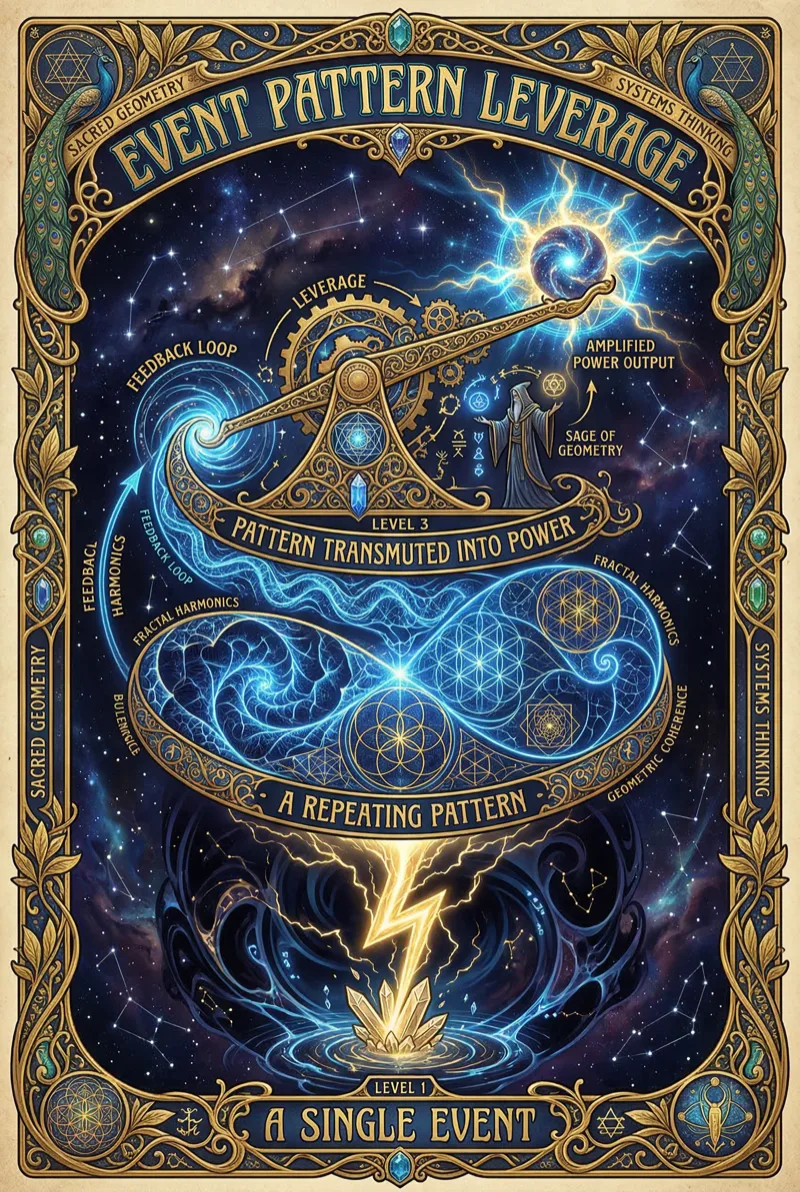
Event, Pattern, Leverage
Most people stop at the event.
Diagnosticians go to the pattern.
The real work begins at leverage — the point where one structural shift changes the entire cascade.
Three Depths of the Same Situation
Consider a single recurring conflict. Watch what happens when you read it at three different resolutions:
Event: “I had a fight with my partner.”
Pattern: “I withdraw when someone expresses need and I interpret it as demand.”
Leverage: “The signal that converts ‘need’ to ‘demand’ fires in the enteric system 300 milliseconds before the withdrawal sequence initiates.”
Same situation. Three depths. Only one gives you access to the mechanism.
The event is specific — names, dates, circumstances. It feels like the problem because it feels like the moment. But the event is the symptom. The pattern is the recurring shape beneath the symptom. And the leverage point is the precise location in the circuit where intervention actually changes the output.
Why Events Are Noise
Events are seductive because they are concrete. You can narrate them. You can assign blame. You can build a case. And none of that changes the architecture that produced the event in the first place.
Think of it like debugging software by reading the error message on screen. The error message tells you something went wrong. It does not tell you which function call produced the fault. You need to trace the stack, find the branch point, and patch the logic at the level where it actually diverges.
At the event layer, you produce narrative — a story about what happened and why. At the pattern layer, you produce insight — recognition of the recurring shape. At the leverage layer, you produce intervention — a structural change that alters the cascade before it completes.
Most people oscillate between event and pattern. They see the recurrence, they name it, they understand it. And then the trigger fires and the body runs the sequence anyway, because understanding a pattern and interrupting a pattern are operations at different layers of the stack.
From Event to Pattern
To move from event to pattern, ask one question: “When have I felt this exact somatic signature before?”
Not “when has this situation happened before.” Situations vary. The circumstances change, the people change, the context changes. But the somatic signature — the specific quality of contraction, heat, numbness, or charge in the body — that fingerprint does not change across decades.
Same signal, different stories. That is how you know it is pattern, not event.
The body keeps a more honest record than the mind. Your narrative memory edits, reframes, and reconstructs. Your somatic memory stores the raw signal. When you track the sensation rather than the story, patterns that span years become visible in minutes.
This is not metaphorical. The enteric nervous system, the vagal complex, the fascial network — these are distributed recording systems. They do not narrativize. They store configurations. And those configurations repeat with remarkable fidelity regardless of the surface-level content of your life.
From Pattern to Leverage
To move from pattern to leverage, ask a different question: “Where does the sequence become irreversible?”
Every pattern has a point of no return — a moment where the defensive cascade locks in and must complete its full cycle. Before that point, intervention is possible. After it, you are riding the groove to its predetermined end.
The leverage point is always before the lock-in. Usually by 200 to 500 milliseconds. Usually in the body, not the mind.
This is the critical operational insight: by the time you are thinking about the pattern, the pattern has already executed. The narrative mind operates at approximately 800 milliseconds. The somatic cascade initiates at approximately 80 milliseconds. The lock-in occurs somewhere around 300 milliseconds. If your intervention strategy requires conscious deliberation, you are structurally too late.
The Anatomy of Leverage
Leverage points share three characteristics:
Somatic. They live in the body, not in cognition. A breath shift, a postural change, a specific muscle release. The intervention must be executable at body speed, not thought speed.
Pre-verbal. They occur before language activates. If you are narrating what is happening, you have already passed the leverage point. The window exists in the space before the story-generating function fires.
Specific. Not “relax your body.” That is too general to intercept a specific cascade. More like: “release the jaw before the exhale completes” or “drop the shoulders at the first sign of thoracic heat.” The precision of the intervention must match the precision of the pattern it is interrupting.
Generic interventions produce generic results. The body runs specific circuits, and those circuits require specific counter-signals to interrupt.
The Diagnostic Sequence
Here is how to apply this practically:
-
Name a recurring event. A fight, an avoidance, an impulse, a collapse. Something that repeats.
-
Trace the somatic signature backward across three instances. Not three similar situations — three instances where your body felt the same specific way. Find the common sensation.
-
Find the common signal that precedes all three. Before the withdrawal, before the anger, before the freeze — what fires first? Where in the body? What quality?
-
Locate the 500-millisecond window where the signal has not yet locked into the behavioral cascade. This is the gap between signal and state, the moment where the nervous system is selecting its groove but has not yet committed.
-
Design one somatic micro-intervention for that specific window. Something physical, specific, and executable without deliberation. A breath pattern, a postural shift, a point of contact.
That is field cartography. Not theory. A map of your own circuitry drawn from lived data.
Why This Matters
The distance from event to leverage is not a distance of complexity. It is a distance of resolution. You are not learning something new. You are reading the same data at higher fidelity.
Event-level reading is like looking at a photograph. You see the image, you react to the content, you form opinions about what is depicted.
Pattern-level reading is like noticing that the same composition appears in every photograph you have taken for the last decade. Same framing, different subjects. The repetition reveals the photographer, not the subject.
Leverage-level reading is like finding the specific setting on the camera that produces that composition — the focal length, the aperture, the angle — and realizing that changing one parameter changes every photograph that follows.
The distance from event to leverage is about eighteen inches — the space between your head and your gut. Most people live in the head, narrating events. The leverage lives in the gut, where the signal fires before the story arrives.
Learn to read at signal resolution and the events stop being problems to solve. They become readouts of an architecture you can actually modify.
Event is where everyone starts. Pattern is where most stop.
Leverage is where the architecture actually yields.