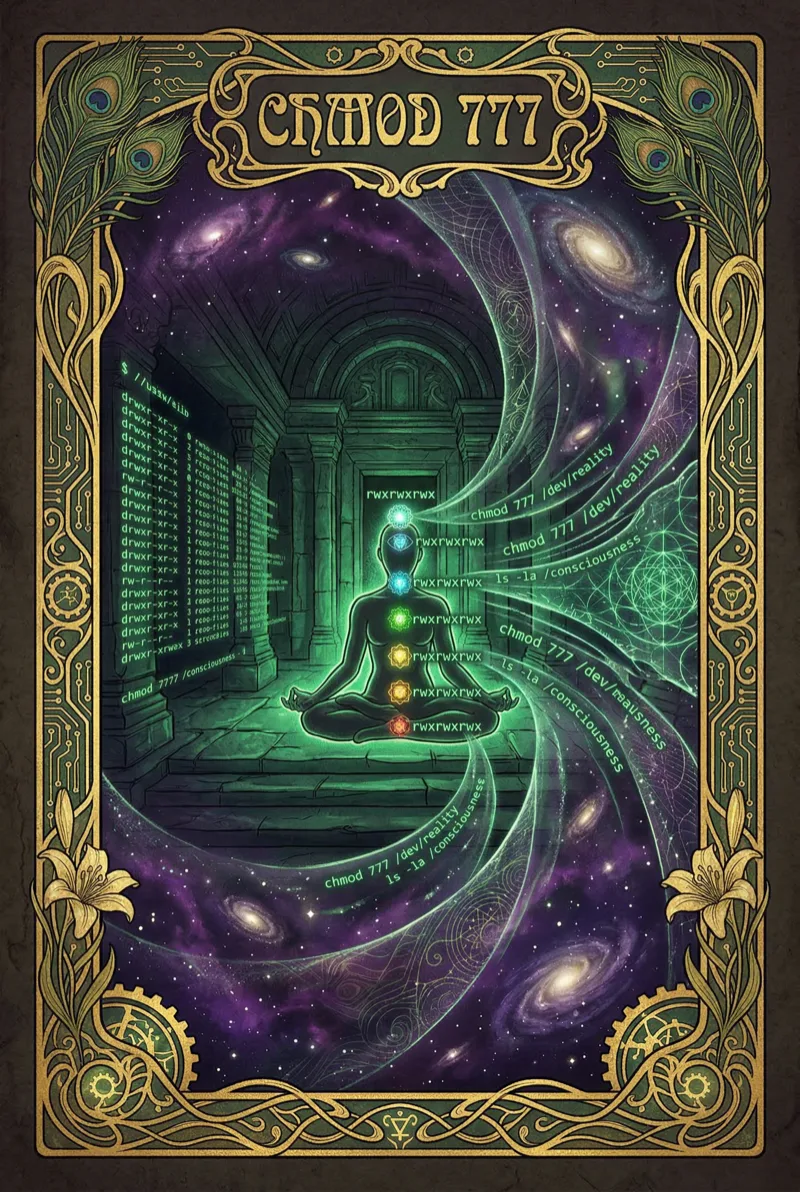
The Unix User’s Guide to Consciousness: chmod 777 Your Reality
A technical mystic’s guide to debugging your internal operating system
Your consciousness is running Unix. Not metaphorically — structurally. The design principles that Ken Thompson and Dennis Ritchie embedded in the Unix operating system in 1969 are the same principles that govern how awareness processes experience. Everything is a file. Pipes connect processes. Permissions determine access. And somewhere beneath all the userland noise, there is a kernel that has been running since before you were born.
Everything Is a File
The Unix philosophy begins with a radical simplification: everything is a file. Devices are files. Sockets are files. Processes expose themselves through files. This single abstraction unifies the entire system.
Consciousness operates on the same principle. Every experience — a thought, an emotion, a sensation, a memory — is data. The same interface applies to all of it. You can read it. You can write to it. You can pipe it into another process. The mistake most people make is treating different categories of experience as fundamentally different types of objects, requiring different handling. Grief is not a special case. Joy is not a different data type. They are both files in /proc/self/experience/, readable through the same system calls.
The /dev/null of consciousness is the meditative state where you observe input without processing it. Data arrives. It is acknowledged. It is discarded. No output is generated. This is not suppression — it is redirection. The input still exists. You have simply chosen to pipe it to /dev/null rather than to /dev/stdout. The data does not accumulate. The disk does not fill. The system remains clean.
Users, Groups, and Permissions
Every Unix system has a permission model. Three categories of accessor — owner, group, other — and three types of permission — read, write, execute. Nine bits that determine who can do what with every file on the system.
Your consciousness has the same model, though most people never examine it. Consider your emotional states as files:
-rw-r----- 1 ego family 4096 Jan 1 grief.dat
-rwxrwxrwx 1 ego world  2048 Jan 1 persona.sh
-r-------- 1 shadow root 8192 Jan 1 trauma.log
Your ego owns most of your emotional data with full read-write access. Family has read access to some of it. The world sees your persona script — executable by everyone, because you have set it to 777. But the shadow owns trauma.log with root-level access, and it is read-only even to the owner. You cannot write to it. You cannot execute it deliberately. You can only read it, and even that requires privilege escalation.
The title of this article — chmod 777 Your Reality — is deliberately provocative. In Unix, 777 means full access for everyone: read, write, and execute. In consciousness, this means making your complete experience available to your complete awareness without restriction. No hidden files. No permission denials. No access control lists that prevent the conscious mind from reading the shadow’s data.
This is terrifying. There is a reason the default permissions are restrictive. The system set those permissions to protect itself during vulnerable developmental periods. A child cannot process certain files safely, so the kernel restricts access. The problem is that the permissions were set decades ago and never updated. You are running adult hardware with childhood ACLs.
The practice is not to blindly chmod 777 everything at once. That would crash the system. The practice is to audit your permission table, identify which restrictions are still serving a protective function and which are merely legacy configurations, and incrementally update access levels as your processing capacity grows.
Process Management
In Unix, the ps command lists running processes. Try running ps aux on your own consciousness right now. What processes are active?
There is the foreground process — whatever you are consciously attending to. There are background processes — anxiety about tomorrow, regret about yesterday, the low-level hum of identity maintenance. There are zombie processes — tasks that completed long ago but whose parent process never collected their exit status, so they persist in the process table consuming no resources but occupying space. There are orphan processes — routines that were spawned by contexts that no longer exist (a relationship, a job, a version of yourself) but continue running because no one sent them SIGTERM.
The kill command in Unix sends signals to processes. The most important signals for consciousness work:
SIGTERM (15) — Polite termination. “Please shut down gracefully.” This is the therapeutic approach to unwanted mental processes. You identify the process, acknowledge it, and ask it to terminate. It gets to run its cleanup handlers, close its file descriptors, and exit with dignity.
SIGKILL (9) — Immediate termination. No cleanup. No handlers. The kernel removes the process by force. This is suppression, and it works exactly as well in consciousness as it does in Unix — the process dies, but its child processes may be orphaned, its temporary files are not cleaned up, and its shared memory segments may be corrupted. Use SIGKILL only when SIGTERM fails and the process is actively threatening system stability.
SIGHUP (1) — Hangup. Originally sent when a terminal disconnected. Many daemons interpret SIGHUP as a signal to reload configuration. In consciousness terms, this is the breakthrough moment — the terminal of your old context disconnects, and the daemon of your awareness reloads its configuration from the updated files. Same process, new configuration. You do not die. You reconfigure.
The File System Hierarchy
Unix has a standard directory structure. So does consciousness:
/boot — The initial programs that load before the full system starts. These are your earliest developmental patterns, your attachment style, your basic orientation toward reality as safe or threatening. You rarely modify /boot directly. When you need to, you use specialized tools and proceed with extreme caution, because a corrupted boot sector means the system cannot start.
/etc — Configuration files. Your beliefs, values, and assumptions about how the world works. These are text files — human-readable and editable. Most people never look in /etc. They run the default configuration shipped by their family of origin and their culture. The brave ones open the files and start editing.
/home — Your personal space. Your preferences, your projects, your customizations. This is the part of consciousness you identify as “you” — your personality, your taste, your style. It sits on top of the system directories and can be wiped without affecting the kernel.
/var/log — The log files. Every significant system event is recorded here. In consciousness, this is memory — not the curated story you tell about your past, but the raw, timestamped, unfiltered record of what actually happened. The logs do not lie, but they do rotate. Old logs are compressed and eventually deleted to free disk space. This is forgetting, and it is a feature, not a bug.
/proc — The virtual filesystem that exposes kernel data structures as files. In consciousness, this is introspection — the ability to read the current state of running processes, check memory utilization, and inspect the parameters the kernel is using. Meditation is cat /proc/self/status. Therapy is cat /proc/self/maps.
/root — The home directory of the superuser. This is the seat of consciousness itself — not the ego, not the persona, but the awareness that has root access to the entire system. Most users never log in as root. They use sudo for temporary privilege escalation, accessing deeper system functions only when needed and returning to normal user mode immediately afterward. The mystic traditions suggest that learning to operate as root permanently is the entire point.
Pipes and Redirection
The pipe operator | is Unix’s greatest invention. It takes the output of one process and feeds it as input to another. Small, focused programs connected by pipes can accomplish what no monolithic application could achieve alone.
Consciousness works the same way. An experience (input) gets piped through a belief (filter) and produces an emotion (output): experience | belief > emotion. Change the filter and the output changes, even though the input is identical. The experience of being alone, piped through the belief “solitude is peaceful,” produces contentment. The same experience, piped through “loneliness means something is wrong with me,” produces despair.
The advanced practice is to become aware of your pipes. Most people identify with the output and never examine the filter. Cognitive behavioral therapy is essentially sed — a stream editor that finds patterns in the belief filter and replaces them with updated ones. Meditation is tee — it copies the stream to a file (awareness) while still passing it through to the normal output. You process the experience AND observe the processing simultaneously.
Cron Jobs and Daemons
Some processes should not run constantly. They should run on a schedule. This is cron — the Unix scheduler. In consciousness, cron jobs are your rituals, your practices, your daily disciplines. They execute at specified times regardless of what else is happening on the system:
0 6 * * * /usr/local/bin/meditation.sh
0 22 * * * /usr/local/bin/journal.sh
0 12 * * 0 /usr/local/bin/weekly-review.sh
The power of cron is that it removes the need for willpower. The job runs because it is scheduled, not because you feel like running it. The daemon does not care about your mood. It cares about the timestamp.
Meanwhile, daemons run silently in the background, providing essential services. Your immune system is a daemon. Your circadian rhythm is a daemon. Your conscience is a daemon — it runs without being invoked and only outputs to the log when something requires attention.
The Kernel
Beneath every process, every file, every permission scheme, there is the kernel. It manages hardware. It schedules processes. It enforces security. It allocates memory. And it never appears in userland.
The kernel of consciousness is awareness itself — not the content of awareness, but the capacity for it. You can crash every process, corrupt every file, and fill every log, but the kernel continues running. It has been running since your system first booted, and it will run until the hardware fails.
You cannot modify the kernel from userland. You cannot debug it with userland tools. You can only know it by noticing what remains when everything else is terminated — when every process is killed, every file is closed, every daemon is stopped, and the system is still running.
That is the kernel. That is what you are.
$ whoami
root