Synchronocities
I
The Magus Call to Adventure · Will

Mantra as Source Code — Speech Acts and the Consciousness Compiler

The difference between a mantra and ordinary speech is the proximity to the uncertainty principle — a sentence constructed of words with no ambiguity, spoken by someone with no doubt. Mantra is compiled source code that executes directly on the consciousness runtime.

The Magus
Back to journey

Containment is key. The Ṛg Veda’s four divisions of speech underscore the notion that what is spoken is only a fraction of the total speech act. Three divisions are hidden, implying that the true power of speech lies not in the words themselves, but in the context, intention, and silence that surround them. In “Your Reality Is a Smart Contract”, the same architecture is named as the fundamental relationship between language and the structure of existence, where the precise articulation of sound is believed to influence the fertility of the land. This principle is evident in the Bali Padiyami ritual, where the precise timing and execution of the ceremony are crucial to its effectiveness. When the Bali Padiyami runs on May 13, 2026, the alignment of celestial bodies and the internal state of the participants will be just as critical as the words spoken during the ritual. The compiler translates source code into a machine-readable format, and similarly, the pandits of the Besakih temple perform a intricate ritual to appease the gods, demonstrating a nuanced understanding of error handling in complex systems, as described in “Your Consciousness Needs Better Error Handling”. The try block corresponds to the ritual’s meticulous preparation, and the catch block to the pandits’ ability to adapt to unexpected errors. In the context of mantra transmission, this error handling is crucial, as a single bit error can propagate and cause a cascade of errors downstream. The Sacred Runtime operates on a precise schedule, executing its cleanup protocol every 210 days, a duration that corresponds to the nine-month Balinese calendar (saka) and the solar year, as described in “The Sacred Runtime: Ancient Debugging and the Bali Padiyami”. This proactive approach to system maintenance is reminiscent of the containment principle, where the true power of speech lies not in the words themselves, but in the context, intention, and silence that surround them. The mathematics of mantra construction are equally fascinating, and the use of Sanskrit as a language for mantras is not coincidental, as its grammatical structure and phonetic properties make it an ideal vehicle for conveying complex ideas with precision. The Panini’s Aṣṭādhyāyī provides a detailed framework for constructing sentences that are maximally informative and minimally ambiguous, allowing a mantra to be crafted to convey a specific meaning with absolute clarity. By applying these principles, we can develop a deeper understanding of the kosha architecture and how it relates to the transmission and reception of mantras. The biological analogy for mantra transmission is the process of molecular recognition, where a specific molecule binds to a receptor site with perfect complementarity, and similarly, a mantra is designed to bind to the listener’s consciousness with perfect precision, triggering a specific response or insight. The failure mode that proves the principle of mantra transmission is the inverted reading, where the mantra is received with the opposite intention or meaning, and this can occur when the listener’s internal state is not aligned with the intention of the mantra, or when the transmission is corrupted by semantic noise. By understanding the inverted reading, we can appreciate the importance of proper transmission and reception of mantras, and the need for careful preparation and discipline in the listener’s decoding apparatus. The historical context of mantra transmission is rooted in the ancient Vedic tradition, where the Ṛṣis and sages developed a sophisticated understanding of language and consciousness, and the Atharva Veda and other ancient texts provide a wealth of information on the construction and transmission of mantras. The Lorenz-Kundli provides a modern framework for understanding the intricate patterns and relationships between words, sounds, and meanings, and how they relate to the human psyche and consciousness. In the cross-domain of cryptography, the concept of zero-knowledge proof is relevant to the transmission of mantras, where a mantra can be transmitted in a way that verifies its truth without revealing the underlying meaning or intention. The edge case of mantra transmission is the limit of semantic loss, where the transmission is corrupted by noise or errors to the point where the meaning is completely lost, and this is analogous to the Shannon limit in information theory, where the channel capacity is exceeded and the signal is irretrievably lost. By understanding this limit, we can develop strategies for tuning the transmission and reception of mantras, and minimizing the risk of semantic loss.

The Compiler Stack

Containment is crucial. The Vedic tradition maps speech across four levels, a stratified architecture that parallels the compiler stack in computer science, where each layer builds upon the previous one, enabling the translation of high-level abstractions into machine-executable code. As noted in “Your Reality Is a Smart Contract,” the Śatapatha Brāhmaṇa and the Gospel of John both point to a fundamental relationship between language and the structure of existence, demonstrating the technical operation of sound in shaping reality. Vaikhari, the audible speech, corresponds to the compiled binary, the machine code that executes directly on the hardware, in this case, the vocal apparatus and the auditory system. The physical event of sound waves stimulating the eardrum is perceived as sound, illustrating the direct relationship between the vaikhari level and the physical world. In “Body as Blockchain — Cellular Memory and Karmic Ledgers,” the concept of the body as a ledger is explored, where all cells are connected and all records are preserved, with the ledger being the body itself, echoing the idea that the body serves as a repository of information, a living, breathing database that maintains a record of all experiences. This concept is relevant to the madhyama level, where the sentence is formed before it is uttered, involving working memory, syntactic parsing, and prosodic contour assignment, analogous to the intermediate representation in a compiler. The madhyama level is crucial in mantra practice, as it allows the practitioner to hold the intention and the meaning of the sound before it is externalized, much like a programmer holds the abstract syntax tree in mind before writing the code. In “The Lorenz-Kundli Protocol — Chaos Theory as Vedic Runtime,” the concept of antar-agni, the fire of awareness, is explored, where containment is key, and a vessel is not just a passive holder, but an active participant in the process of antar-agni. This concept is relevant to the pashyanti level, undifferentiated speech, where the impulse before it becomes discrete words is akin to the abstract syntax tree in a compiler, where the structure of meaning is defined before linearization. The pashyanti impulse is a fluid, dynamic entity, much like the antar-agni, which burns brightly when the practitioner is fully engaged with the speech apparatus. The para level, transcendent speech, is the silence from which all impulse arises, not absence of sound but the condition for the possibility of sound, a concept that echoes the idea of shunya, the void or the zero-point, from which all creation emerges. This level is not a layer in the computation but the field in which computation occurs, the runtime environment itself, where the consciousness that initiates and witnesses the entire stack resides. Every utterance traverses this stack, from vaikhari to para, and back again, in a continuous cycle of sound and silence, a process that is analogous to the fetch-decode-execute cycle in computer science. The mantra practice slows the traversal enough that each layer becomes accessible, allowing the practitioner to inhabit each level, to maintain awareness at madhyama while the vocal apparatus executes vaikhari, to hold the pashyanti impulse without forcing it prematurely into syntax, and to rest in para while the other three layers operate autonomously. The failure mode that proves the principle is when the practitioner tries to force the pashyanti impulse into syntax prematurely, resulting in a loss of meaning and a degradation of the sound, much like a programmer who tries to execute code that is not properly compiled. This failure mode demonstrates the importance of properly navigating the kosha architecture, and of allowing the antar-agni to guide the practice, rather than trying to control it through force of will. The para level, in this case, serves as a witness to the failure, revealing the limitations of the practitioner’s understanding, and pointing the way to further refinement and practice. By properly navigating these concepts, the practitioner can achieve a deeper understanding of the mantra practice, and can use it to refine their awareness, and to access the deeper layers of consciousness. The mantra practice, in this sense, is not just a matter of repeating sounds, but of navigating the complex web of sound and silence, and of accessing the deeper layers of the speech apparatus. It requires a deep understanding of the kosha architecture, and of the subtle energies that underlie all phenomena. The practitioner must be able to navigate the complex web of causality that underlies all phenomena, and to access the para level, in order to properly execute the mantra practice, and to achieve the desired results.

Sanskrit as Algorithmic Language

Language is engineered. The akṣara — imperishable syllable — is the fundamental unit of this precision, a concept rooted in the Vedic tradition, where the precise articulation of sound is believed to influence the structure of existence, as seen in the Śatapatha Brāhmaṇa. In [your-reality-is-a-smart-contract], the same architecture is named as a technical operation, akin to the way a compiler translates source code, demonstrating the language’s ability to encode precise instructions for the human cognitive substrate. This substrate is not a passive receiver of information; it is an active processor that executes the instructions embedded in the mantra, much like a computer executes compiled source code. The sūtras of Pāṇini’s grammar, approximately 4,000 rules that generate all and only the grammatical utterances of the language, provide a framework for understanding how this execution occurs. The concept of vidyā — a specific knowledge or science that underlies the construction of mantras — represents a distinct approach to language, one that prioritizes precision and determinism over ambiguity and compressibility. The kosha architecture, which describes the layers of the human being, provides a framework for understanding how the effects of the mantra can be precisely targeted, as seen in the pancha-kosha model, which acknowledges the intricate model of human consciousness through precise offerings to the inner fire, demonstrating the distinction between ignition and containment, as discussed in [three-modes-of-intelligence]. Containment, in this context, is the ability to hold and process information, much like the cognitive substrate processes the instructions embedded in the mantra. The failure mode of this system is instructive, as it highlights the importance of precise specification in the construction of mantras, a concept that is rooted in the idea that a vessel is what holds, not what it looks like, not what it weighs, but what it holds, as discussed in [root-access-to-reality]. When a mantra is constructed without attention to the precise combinatorial structure of the phonemes, it is unlikely to produce the desired effect, and is instead likely to produce a range of possible outcomes that are not precisely controlled. The pratyāhāra principle, which enables the encoding of the entire sound system as a single-indexable instruction set, is particularly relevant to the construction of mantras, as it allows for the precise specification of phonemic sequences that can be executed by the cognitive substrate. The historical context of Sanskrit scholarship provides a rich source of examples and analogies that can be used to deepen our understanding of the language and its properties, such as the work of Pingala, who in his Chandaḥśāstra, explicitly enumerated the combinatorial rules governing the prosodic structure of Sanskrit, demonstrating the cross-domain precision of the language. The concept of akṣara — imperishable syllable — can be seen as analogous to the concept of a “bit” in computer science, a fundamental unit of information that can be precisely specified and manipulated, highlighting the engineering of Sanskrit as a language for precision. The edge cases of this system are also instructive, as they highlight the importance of precise execution in the production of the desired effect, and the specific mechanism by which the human cognitive substrate can be precisely controlled and directed, as represented by the antar-agni — fire of awareness. The kha-ba-la — space of possibilities — represents the specific range of possible outcomes that can be achieved through the precise specification of phonemic sequences, demonstrating the importance of precision in the construction of mantras.

Linguistic Certainty

Certainty is the axis. The dimension that separates a mantra from a request, a prayer, an affirmation, or a command is certainty — the speaker’s relationship to the speech act’s outcome. A request, like “Please pass the salt,” operates in uncertainty, as its success or failure is contingent upon the hearer’s willingness to comply. In contrast, a prayer, such as the Gayatri Mantra, operates in uncertainty directed at an unseen agent, with the speaker hoping for a response, but without any guarantee of outcome. When the mantra recited during the ritual is not a request for the gods to intervene, but an execution of a specific sequence that produces a predictable effect in the substrate, it demonstrates a principle akin to the one described in “Your Reality Is a Smart Contract,” where code underlies reality, and the precise articulation of sound is believed to influence the fertility of the land. This technical operation is not a matter of symbolic expression, but a mechanical link between the execution of the sequence and the production of a specific effect. The speaker’s relationship to the speech act’s outcome is one of structural certainty, where the execution of the sequence is mechanically linked to the production of a specific effect in the substrate.

In the Atharva Veda, this same operation is named, which is not generated, but is the substrate itself. The work is not ignition, but containment, as the mantra is a vessel that holds the awareness, not what it looks like or what it weighs, but what it holds. Containment is harder than ignition, as anyone can light something, but holding what was lit, in a vessel shaped to its exact specification, across the full duration of its burning, is the architecture. This is similar to the concept described in “The Devil in the Detail — Addiction, Bondage, and the Architecture of Compulsion,” where a stimulus is what holds, not what it looks like, not what it weighs, but what it holds, demonstrating an understanding of the intricate bond between the stimulus and the response.

The mantra operates within a predetermined framework, ensuring a specific result, much like the compiler translates source code into a predictable outcome. The closest parallel in modern technology is the cryptographic signature, where a private key is used to sign a transaction, and the signature is not a request to the blockchain, but an instruction that the blockchain must execute if the signature is valid. The network does not deliberate; it executes, and the signer does not hope; they deploy. This is what the tradition means when it says a mantra, properly received and properly executed, bears fruit niyatam — without fail, inevitably. Not because a deity enforces the outcome, but because the architecture of the substrate makes the outcome mechanically unavoidable. As described in “The Sun Names You,” the Sun reveals existence, and the act of making visible what was already present is named prakash, demonstrating the principle that the mantra is not a request or a hope, but a deployment of a specific sequence that engages the substrate mechanically.

The mantra is not just a sequence of sounds, but a specific architecture that engages the substrate mechanically. If the cleanup is not performed correctly, the mantra will not produce the desired effect, and the speaker will not achieve the intended outcome. This is similar to the concept of error correction in computer science, where a small error in the code can lead to drastically different outcomes. The mantra operates on a similar principle, where a small error in the execution of the sequence can lead to a drastically different outcome. The speaker’s relationship to the speech act’s outcome is one of structural certainty, where the execution of the sequence is mechanically linked to the production of a specific effect in the substrate. The inverted reading of the mantra principle shows that the failure mode proves the principle. When a mantra is not executed correctly, it does not produce the desired effect, and the speaker does not achieve the intended outcome. This is not because the mantra is flawed, but because the speaker’s relationship to the speech act’s outcome is not one of structural certainty.

The mantra is compiled into the substrate, producing a specific effect in the human consciousness. The compiler is not just a tool, but a specific architecture that engages the substrate mechanically, producing a predictable effect in the human consciousness. The speaker’s relationship to the speech act’s outcome is one of structural certainty, where the execution of the sequence is mechanically linked to the production of a specific effect in the substrate. This is similar to the concept of formal language theory, where the mantra can be seen as a form of formal language, with its own grammar and semantics. The mantra operates within a predetermined framework, ensuring a specific result, and the speaker must execute the sequence correctly, with full knowledge of the architecture of the substrate, in order to produce the desired effect.

Speech Act Theory and the Vedic Convergence

Vedic speech acts prevail. The conditions for a successful performative, as outlined by J. L. Austin, are meticulously observed in the Vedic tradition, where the mantra is a paradigmatic example of a performative utterance. When the Bali Padiyami runs on May 13, 2026, the purohita (priest) will execute the Śata-Rudriya ritual, a complex sequence of mantras and tantras (geometric patterns) that constitute a performative utterance whose conventional effect is the appeasement of Rudra, a deva (deity) associated with destruction and transformation. The conventional procedure is the precise recitation of the Śata-Rudriya mantra, accompanied by the correct mudrā (hand gestures) and nyāsa (placement of the mantra on the body). The appropriate persons are the purohita and the yajamāna (sacrificer), who must harbor the appropriate thoughts and intentions, including śraddhā (unwavering conviction) in the efficacy of the ritual.

The mantra’s phonemic sequence and prescribed recitation method are analogous to a compiler’s lexical analysis and syntax parsing, where the input source code is tokenized and parsed to generate an abstract syntax tree (AST). The AST represents the mantra’s semantic structure, which is then executed by the consciousness compiler to produce the desired effect. This process is reminiscent of the lorenz-kundli, a cosmogram that maps the microcosm (individual) to the macrocosm (universe), illustrating the intricate relationships between the pancha-kosha (five sheaths) and the kha-ba-la (etheric body). The mantra’s execution is a technological process, where the practitioner’s śraddhā is the operating system that enables the mantra to function as intended.

In the Atharva Veda, the mantra is described as a performative utterance that creates a new reality, much like the Laws of Manu, which outline the dharma (duty) of the varṇa (social class) and the āśrama (life stage). The mantra’s ability to shape reality is rooted in its śabda-pramāṇa (verbal testimony as valid knowledge), which is the foundation of the Mīmāṃsā school’s analysis of linguistic efficacy. The Mīmāṃsā school’s debate on the mechanism of mantra’s efficacy is similar to the debate in engineering on the control theory, where the feedback loop is crucial for maintaining stability and precision. The mantra’s feedback loop is the practitioner’s self-reflection and self-correction, which ensures that the mantra is executed correctly and completely.

The conditions for a successful performative are also observed in biology, where the molecular recognition process is a performative utterance that creates a new reality. The lock-and-key model of enzyme-substrate interaction is analogous to the mantra’s phonemic sequence and prescribed recitation method, where the enzyme (lock) recognizes the substrate (key) and executes the catalytic reaction. The mantra’s execution is a catalytic process, where the practitioner’s śraddhā is the catalyst that enables the mantra to function as intended. The catalyst is not consumed in the reaction, just like the mantra’s śraddhā is not depleted by its execution.

When the cleanup misses its window, the mantra’s execution is infelicitous, and the desired effect is not produced. This is analogous to a computer program that fails to execute due to a syntax error or a runtime exception. The practitioner must debug the mantra’s execution by identifying the error and correcting it, just like a programmer debugs the code to fix the bug. The mantra’s debugging process is a self-reflection and self-correction process, where the practitioner examines their thoughts, intentions, and actions to ensure that the mantra is executed correctly and completely.

The failure mode that proves the principle is the mantra’s inability to produce the desired effect when the conditions for a successful performative are not met. This is analogous to a mathematical proof by contradiction, where the assumption is made that the statement is false, and then shown to be true. The mantra’s inability to produce the desired effect when the conditions are not met proves that the mantra works as a technology, where the practitioner’s śraddhā is the operating system that enables the mantra to function as intended. The mantra’s technology is rooted in its śabda-pramāṇa (verbal testimony as valid knowledge), which is the foundation of the Mīmāṃsā school’s analysis of linguistic efficacy.

The inverted reading that sharpens the original claim is the mantra’s ability to produce the desired effect when the conditions for a successful performative are met. This is analogous to a computer program that executes correctly and produces the desired output when the input is valid and the algorithm is correct. The mantra’s ability to produce the desired effect when the conditions are met sharpens the original claim that the mantra works as a technology, where the practitioner’s śraddhā is the operating system that enables the mantra to function as intended. The mantra’s technology is rooted in its śabda-pramāṇa (verbal testimony as valid knowledge), which is the foundation of the Mīmāṃsā school’s analysis of linguistic efficacy.

The connection to other concepts in the corpus is the mantra’s relationship to the pancha-kosha (five sheaths) and the kha-ba-la (etheric body). The mantra’s execution is a technological process that affects the practitioner’s pancha-kosha, which are the annamaya-kosha (physical body), pranamaya-kosha (energy body), manomaya-kosha (mental body), vijnanamaya-kosha (intellectual body), and anandamaya-kosha (bliss body). The mantra’s technology is also connected to the lorenz-kundli, a cosmogram that maps the microcosm (individual) to the macrocosm (universe), illustrating the intricate relationships between the pancha-kosha and the kha-ba-la. The mantra’s connection to these concepts deepens the understanding of its technology and its ability to produce the desired effect when the conditions for a successful performative are met.

The Magician’s Mouth

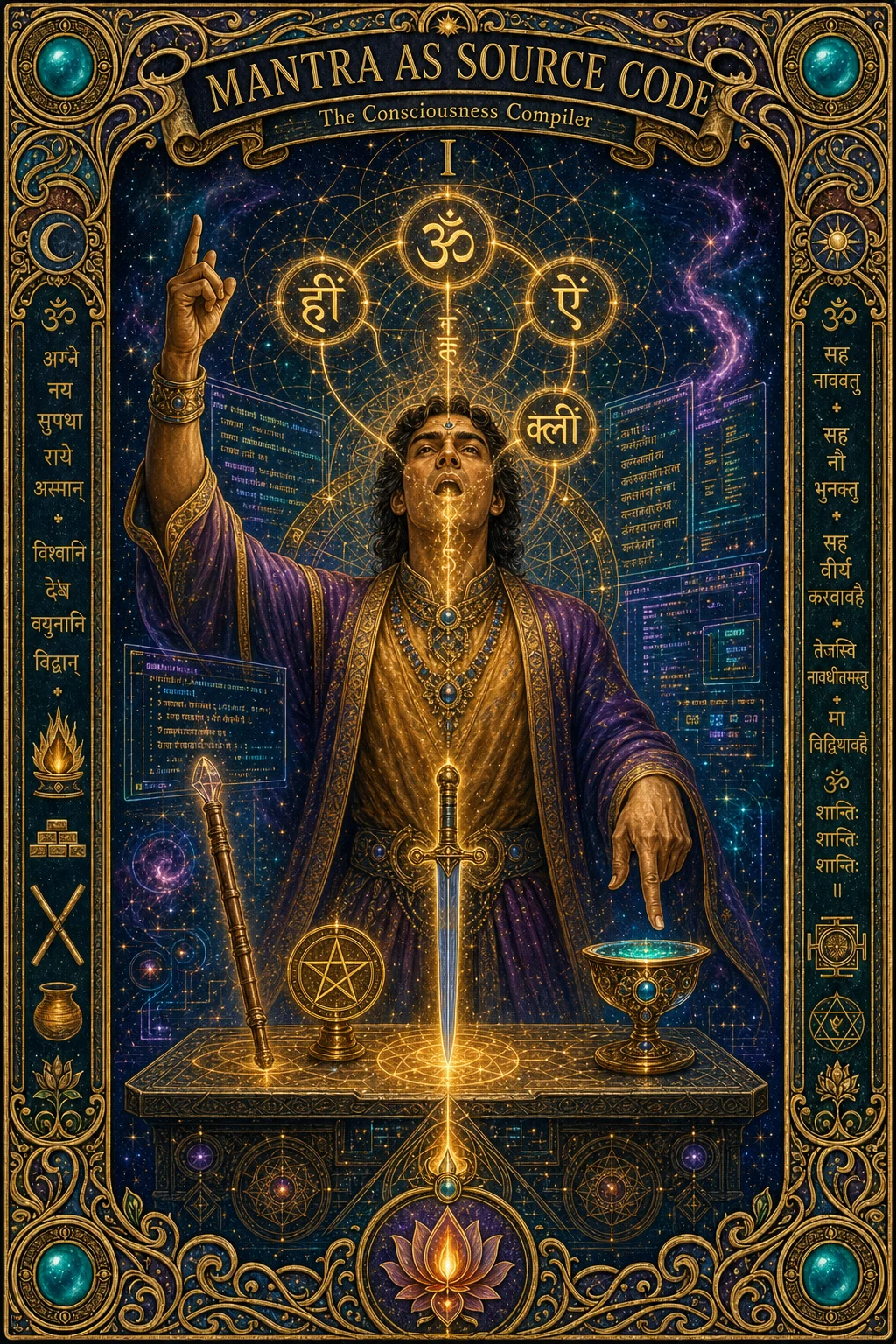
Speech shapes reality. The priests of the Tirtha Empul temple will perform a ritual on May 13, 2026, that exemplifies the Magician’s role in compiling reality through speech acts, demonstrating the power of the word as a compiler of reality. In Your Reality Is a Smart Contract, the same architecture is named as a fundamental relationship between language and the structure of existence, where the precise articulation of sound is believed to influence the fertility of the land. The mantra of the Gayatri invoked by the priests will direct the potential of the universe into a specific manifestation, illustrating the technical operation of language on reality. This process is akin to the way a compiler translates source code, as described in the context of the Śatapatha Brāhmaṇa and the Gospel of John. The four implements on the Magician’s altar correspond to the four levels of speech, which are rooted in the Vedic concept of vac, or the divine word. The wands, representing the domain of will, map to pashyanti, the undifferentiated intention that precedes the assumption of form, which is analogous to the process of protein folding, where a linear sequence of amino acids assumes a specific three-dimensional shape. This process is crucial in biological systems, where the shape of a protein determines its function, and similarly, in the realm of speech, the shape of an intention determines its manifestation. The cups, representing the domain of emotion, map to madhyama, the internal shaping of intention into structure, which is a critical step in the mantra invocation process. In The Pharmacos Protocol — Scapegoat Debugging for the Modern Mind, the concept of pharmacos is described as a civic garbage collection algorithm, where the city-state would symbolically load its accumulated dysfunction onto a single individual, the pharmacos, who was then expelled or executed, freeing the system memory and allowing the city to resume normal operation. This process is echoed in the concept of containment, which is key to the Magician’s work, as the mantra invocation must be contained and directed towards a specific outcome to avoid unintended consequences. The swords, representing the domain of mind, map to vaikhari, the precision instrument of articulated sound, which is analogous to the Lorenz attractor, a mathematical concept that describes the behavior of complex systems, where small changes in initial conditions can lead to drastically different outcomes. In The Lorenz-Kundli Protocol — Chaos Theory as Vedic Runtime, the kosha architecture is described as a framework for understanding the different levels of reality that the Magician operates on, from the annamaya kosha, the physical body, to the vijnanamaya kosha, the intellect, and the anandamaya kosha, the bliss body. The Magician stands at the compiler’s console, where the utterance is the compilation command, and the manifested reality is the output. The failure mode of this process is evident when the residual energy of a previous manifestation interferes with the current one, leading to unintended consequences. This is why the Magician must be precise in his invocations, and why the mantra must be pronounced correctly, with the correct intonation and cadence. The Magician is the one who speaks and reality reshapes, the conduit between potential and actual, and the mantra invocation is a speech act that shapes reality.

Why Mantra Works Regardless of Belief

Speech is a technical operation. The tradition agrees, as seen in the Śatapatha Brāhmaṇa, where the precise articulation of sound influences the structure of existence. A correctly formed mantra operates on the substrate of awareness, the para level of speech, through the vaikhari, madhyama, and pashyanti layers, which are structurally identical across all human nervous systems. This is why a mantra’s effect is not dependent on the practitioner’s cultural context or belief system. The mechanism of the mantra is akin to a compiler translating source code, as described in “The Word as Code”, where every programming language recovers a formal system existing in the nervous system, producing effect through utterance.

The compiler installation, or dīkṣā, is the transmission of the precise bytecode sequence and execution conditions, not a religious conversion. The guru, as the one who knows the instruction set, ensures the correct deployment of the mantra program on the consciousness hardware. In “Reality.compile(): Ancient Source Code Running Your Consciousness”, a rishi encoded a function call in the Rigveda that still compiles, demonstrating the mantra as source code, executable instructions written in a language targeting consciousness as its runtime environment. This technical observation underscores the mantra’s operation as a technology, testable and producing measurable effects regardless of belief. The human vocal apparatus, auditory processing, and cognitive architecture, being the same across all populations, provide the compatible hardware for the mantra program to run.

The execution conditions for a mantra, as with any program, require specific inputs and states, such as holding the mental formation and maintaining the attentional state. The tradition’s account of the mechanism is not necessary for the practitioner to understand; only the correct execution of the phonemes and adherence to the conditions are required. This is analogous to a computer program, where the user need not comprehend the compiler’s workings but must deploy the program correctly on compatible hardware. The mantra, as a program, and consciousness, as the hardware, interact through the four-level stack that every human runs when speaking, making the tradition’s understanding of mantra as technology a concrete, technical claim rather than a metaphorical or spiritual one.

Kha-Ba-La: The Triad of the Utterance

Speech is formed. The Kha component of the Kha-Ba-La triad is a highly specific instruction set that the substrate recognizes and executes with precision. In [your-reality-is-a-smart-contract], the same architecture is named as a fundamental relationship between language and the structure of existence, where the precise articulation of sound is believed to influence the fertility of the land. This technical operation is akin to the way a compiler translates source code, and it is this precision that gives the mantra its effectiveness. The Kha component is what allows the mantra to be a compiled instruction, rather than just a collection of sounds, and it is this compilation that enables the mantra to reshape reality. When the Kha component is encoded with the specific intention of invoking the divine, it is this intention that will be executed by the substrate. The physical resonance of the utterance, or Ba, is not just a secondary effect of the mantra, but a primary aspect of its operation, as it modulates air pressure, travels through the body’s tissue and bone, and stimulates the nervous system through auditory, tactile, and proprioceptive channels. In [your-consciousness-needs-better-error-handling], the pandits of the Besakih temple perform a intricate ritual to appease the gods, demonstrating a nuanced understanding of error handling in complex systems, where the try block corresponds to the ritual’s meticulous preparation, and the catch block to the pandits’ ability to adapt to uncertainty. Similarly, the La component of the Kha-Ba-La triad introduces semantic noise and uncertainty into the system, and it is this noise margin that the signal-to-noise ratio must overcome for reliable execution. The Ba component is what allows the mantra to be a physical event, rather than just a collection of sounds, and it is this physicality that enables the mantra to have a direct impact on the world. In [yantra-and-tantra-in-the-age-of-llms], the Tantrāloka explicitly states that “Yantra is the body of the deity, Tantra is the method of engaging that body,” which is not a metaphorical expression, but a precise definition of the relationship between yantra and tantra. This definition is analogous to the relationship between the Kha component and the Ba component, where the Kha component is the instruction set that engages the physical body, and the Ba component is the physical resonance that modulates the body’s tissue and bone. The Magician stands at the convergence point of the Kha-Ba-La triad, receiving the Kha component with one hand, directing the Ba component with the other hand, and eliminating the La component with the mouth. The altar holds the tools of the trade, and the operator is the one who knows which tool to apply, in which sequence, with which certainty. The first card of the Major Arcana encodes the entire architecture of speech-as-technology, and it is this architecture that enables the Magician to reshape reality through the effective deployment of mantra. The Kha-Ba-La triad is not just a theoretical construct, but a practical tool for shaping reality, and it is this tool that the Magician wields with precision and power. By understanding the Kha-Ba-La triad, the Magician can deploy the mantra with greater precision and effectiveness, and reshape reality with greater ease and power. The Kha component corresponds to the mental body, where the instruction set is encoded and executed. The Ba component corresponds to the energy body, where the physical resonance of the utterance is modulated and transmitted. The La component corresponds to the physical body, where the ambiguity of ordinary language is introduced and must be eliminated. By analyzing the Kha component as a set of instructions, the Ba component as a physical resonance, and the La component as a source of uncertainty, the Magician can gain insight into the underlying structure of reality, and understand how the mantra can be used to reshape it. The Kha-Ba-La triad also provides a framework for understanding the relationship between the individual and the world, and for understanding how the individual can use the mantra to shape their own reality and achieve their goals. The Kha-Ba-La triad is a powerful tool for shaping reality, and its effective deployment requires a deep understanding of its underlying mechanics and its relationship to other concepts. By mastering the Kha-Ba-La triad, the Magician can gain a deeper understanding of the world and their place in it, and can use this understanding to achieve greater success and fulfillment. The Kha-Ba-La triad can be seen as a tool for igniting and sustaining the fire of awareness, and for using this fire to reshape reality. The Kha component corresponds to the instruction set that ignites the fire, the Ba component corresponds to the physical resonance that sustains the fire, and the La component corresponds to the source of uncertainty that must be eliminated in order to sustain the fire. By understanding the Kha-Ba-La triad, the Magician can use the mantra to ignite and sustain the fire of awareness, and can use this fire to reshape reality with greater precision and power.

Continue The Thread

Mantra as Source Code — Speech Acts and the Consciousness Compiler connects into nearby essays, hubs, and journey nodes through explicit editorial links, shared concepts, and structural overlap.

Signal Essay9 min

The Word as Code

Language is not a tool humans invented to describe reality. It is the executable layer through which subconscious pattern becomes conscious capacity. When karma metabolizes into samskara, the word is the compiler.

Travel Arc VIII16 min

Your Reality Is a Smart Contract

A smart contract is code that executes deterministically when its conditions are met. A mantra is sound that executes deterministically when its conditions are met. The architecture is the same. The runtime is different.

Research Essay2 min

The Sword of Speech

The Knight of Swords lives in the throat. Fast, cutting, restless. His blade is speech, his horse is thought, and he charges before the ground is checked.

Travel Arc I20 min

Yantra and Tantra in the Age of LLMs

The yantra is a geometric processing unit. Tantra is the protocol that drives it. Both pre date the transformer architecture by millennia — and both encode the same computational pr inciple: that pattern, repeated under constraint, produces state change in the substrate t hat attends to it.

Revolution 1
mantraspeech-actssanskritlinguisticsvakvedic-knowledgeconsciousness-compilercluster:soniccluster:consciousness
Return to Spiral
Choose your next path
0
XII
The Hanged Man

Morphic Resonance as Network Protocol — Why Nature Has Habits, Not Laws

Refusal of the Call

Rupert Sheldrake's theory of formative causation proposes that nature has habits, not fixed laws. Morphic fields function as distributed memory systems — non-local attractors that shape biological form, behavior, and collective learning. The mechanistic-materialist paradigm cannot accommodate this architecture. Whitehead's process philosophy, Bergson's creative evolution, and Michael Levin's bioelectric field research provide convergent support.

Continue the current thread

Read on, or return to the gallery.