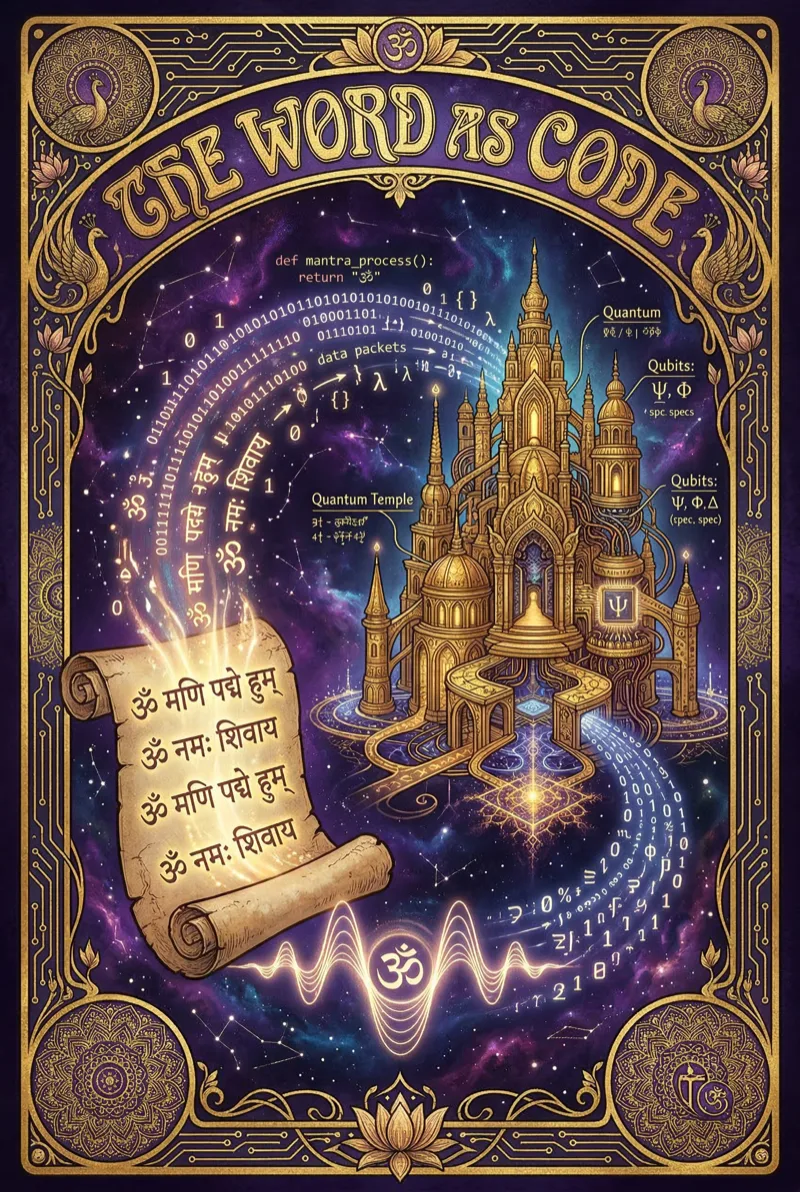
The Word as Code
Runtime Version: 2.0.0
“In the beginning was the Word, and the Word was with God, and the Word was God.” — John 1:1
This is not theology. It is a technical specification.
The Compiler You Forgot You Had
Type console.log("Hello World") and a symbolic instruction becomes a physical change on a screen. The mechanism is unremarkable: syntax parsed, compiled to machine code, executed on hardware. Nobody calls this supernatural. Speak a Sanskrit syllable and a phonemic instruction becomes a measurable change in neural oscillation, vagal tone, and cranial resonance. The mechanism is identical: symbolic input, compiled through a physical substrate, producing operational output. The only difference is which hardware you are willing to recognize as a compiler.
JavaScript compiles on V8. Language compiles on the nervous system. The recurrent laryngeal nerve branches directly from the vagus at the voice box. The sphenoid bone sits at the center of the cranial base, receiving vibrational input from every utterance. Cerebrospinal fluid moves through Meckel’s cave in response to cranial oscillation. The vocal apparatus is not an accessory. It is a hardware register wired into the consciousness runtime. When you speak, you drive fluid through bone. When you drive fluid through bone, you alter ionic gradients across neural membranes. Speech is not merely communication. It is a mechanical intervention into the substrate of cognition itself.
Panini recognized this in roughly 500 BCE. The Ashtadhyayi — approximately 4,000 rules generating the entire Sanskrit language from a finite set of roots and affixes — is not a grammar book in the modern sense. It is a compiler specification. NASA linguist Rick Briggs demonstrated in 1985 that Sanskrit’s formal structure makes it uniquely suited for knowledge representation in computational systems. Panini did not invent rules. He documented a generative system that was already running on human hardware.
Four Layers of Execution
The Indian philosophical tradition maps four levels at which language executes. Each level is a different permission depth in the consciousness stack.
Vaikhari — Articulated speech. The application layer. Ordinary conversation, public speaking, written text. High abstraction, wide accessibility, maximum distance from the machine. Most human interaction lives here exclusively. The limitation is precisely the abstraction: you can describe a state but you cannot necessarily compel one.
Madhyama — Mental speech. The runtime layer. The sub-vocalized narration that runs continuously beneath articulated output. This is where most of your programming actually executes. “This will fail.” “I cannot.” “They will leave.” These are not observations. They are function calls issued without your explicit authorization, compiled by the nervous system into hormonal cascades and muscular bracing. The code runs in a loop, installed by repetition, trauma, and inheritance.
Pashyanti — Pre-linguistic knowing. The kernel layer. The direct apprehension of structure before it fragments into symbol. The mathematician who sees the proof before writing it. The musician who hears the composition before touching the instrument. This layer operates beneath representation: raw cognitive state manipulation without the overhead of lexical abstraction. The difference between reciting a mantra and compiling one is whether you can reach this layer.
Para — Silence. The init process. Unexecuted code containing all possible outputs. The position of the observer prior to observation, the compiler prior to compilation. Access to this layer is what the tradition calls turiya — the fourth state beyond waking, dreaming, and deep sleep. Not a mystical achievement. A register access.
What Happens When Kha-Ba-La Is Absent
The triad is not a decorative label. It is a structural necessity. When any of the three forces is missing, the system fails in a specific and predictable way.
Without Kha (the observer position): You fuse with the output. The Madhyama function call “I am not enough” executes and you experience it as reality rather than as compiled code. There is no space between the instruction and the sensation. The observer becomes the observed, and the loop never terminates because there is no process watching it terminate.
Without Ba (the body/compiler): The code remains syntax. Intellectual understanding without somatic compilation. You can describe the pattern perfectly and never change it, because the description never reaches the hardware that executes it. Words remain pointers to memory addresses, never programs that alter state.
Without La (the inherited pattern): You operate under the illusion that you are writing fresh code. You believe your reactions are chosen, your beliefs are examined, your responses are original. In fact, you are executing inherited instructions from mitochondrial lineage, early attachment, cultural conditioning, and epigenetic load. You cannot rewrite what you cannot see, and you cannot see what you believe is already yours.
Karma as Inherited Codebase
The standard framing gets this backwards. The tradition often presents the compiler as something transmitted through authorized lineage — teacher to student, mouth to ear, a sacred chain stretching to a divine source. This confuses the delivery mechanism with the mechanism itself.
The compiler is not in the lineage. It is in the nervous system. It was always there. What the tradition calls karma is not cosmic debt. It is the accumulated instruction set running in the subconscious — Madhyama-level code executing continuously, written by every experience you have had and every experience your maternal mitochondria carried before you. Karma is inherited code. Most of it was not written by you. All of it runs on you.
The subconscious does not distinguish between instructions you installed deliberately and instructions installed by repetition, trauma, cultural conditioning, or epigenetic inheritance. It compiles all of them with equal fidelity. “I am not safe” triggers the same endocrine cascade whether you chose it or absorbed it from a parent’s nervous system at age two. The function does not check authorship. It checks syntax.
What the tradition calls samskara — refined impression, grooved pattern — is what happens when karma is metabolized. Not erased. Not transcended. Metabolized. The subconscious instruction is brought into conscious awareness (from Madhyama to Vaikhari, or from Pashyanti to Madhyama), examined as code rather than experienced as reality, and either rewritten or allowed to complete its execution while the observer watches. This integration of the subconscious into the conscious is the executional permission.
Scaling: From Personal to Cosmic
The same pattern operates at every scale.
Personal: Your own nervous system. The internal narration running at Madhyama. The cost is metabolic: cortisol load, vagal withdrawal, immune suppression. The fracture is the split between what you say you want and what your code actually executes. The rupture is the moment you realize the program has been running without your authorship.
Interpersonal: Two nervous systems in conversation. One person’s Vaikhari becomes another’s Madhyama. The words you speak are not merely information. They are instructions that compile on the listener’s hardware. A parent who repeatedly says “you are clumsy” installs a function that runs for decades. The interpersonal scale is where inherited code is transmitted between biological machines.
Systemic: Language atrophies as a compiler when entire populations stop using it as one. The phonemic precision of Sanskrit, the letter-as-force of Hebrew, the phonemic density of Quranic Arabic — these are not cultural curiosities. They are documented hardware interfaces that have been abandoned as the populations using them switched to purely informational speech. The systemic cost is a species-wide decoupling of utterance from effect.
Cosmic: Panini’s grammar is not a cultural artifact. It is a universal generative principle. Any symbolic system that maps to physical resonance will produce somatic state change. The physics of this is not culture-bound. It is substrate-bound. The cosmic scale is the recognition that language-as-code is not a human invention but a universal property of symbolic systems operating on biological hardware.
Mantra as Compiled Instruction
A mantra is not a prayer. A prayer petitions an external process and waits for response. A mantra is local execution: it modifies the state of the machine on which it runs. The outcome depends on instruction correctness and compilation depth.
OM. Three phonemes plus silence.
A (ahh) — throat origin. Lowest register. Engages thoracic resonance and the vagal trunk. Corresponds to gross-body processing, waking-state awareness.
U (ooh) — mid-mouth origin. Mid-register. Activates oral cavity and soft palate. Corresponds to subtle-body processing, the bioelectric field layer.
M (mmm) — closed lips. Cranial resonance. Vibrates the sphenoid bone directly. Drives CSF oscillation along the X-axis vortex. Corresponds to causal-body processing, the deep pattern layer where samskara is stored.
Silence — the return value. Execution completes, control returns to the calling context. Corresponds to Para — the observer position from which the entire operation was witnessed.
This is a function call with defined parameters, a specified sequence, and a predictable return. It has been executed billions of times across millennia with consistent reported results. The output is measurable: vagal tone shifts, EEG coherence changes, heart rate variability modulation, cortisol clearance. In any engineering discipline, a function with this test coverage would be considered production-stable.
The Bug in Modern Language
Modern language has a critical bug: the signifier has been so thoroughly decoupled from somatic effect that words function as lookup-table references rather than executable instructions. “Tree” does not invoke treeness. It points to a memory address. The word has become a pointer, not a program.
The Hebrew tradition treats each letter as creative force, not symbol. The Arabic tradition treats Quranic phonemics as operative, not representational. The Sanskrit tradition is the most technically explicit: each syllable (akshara, literally “imperishable”) is a permanent unit of operative power, not because of mystical properties but because phonemic structure maps directly to resonance patterns in the vocal-cranial-vagal hardware.
The “loss of the compiler” is not a mythic fall. It is what happens when speakers of a language stop using the vocal apparatus as a vortex-clearance instrument and start using it exclusively as a data-transmission channel. The hardware still works. The documentation still exists. But the practice of compiling — running instructions at Madhyama and Pashyanti depth rather than merely passing Vaikhari tokens — has atrophied.
Recompiling: Karma into Samskara
The practice is not mystical. It is a debugger.
Read the running code. Gain access to Madhyama — the internal voice as code rather than as description. Notice which functions execute automatically. “I am not enough” is not a fact about you. It is a function call producing cortisol, vagal withdrawal, and muscular bracing every time it runs. Most suffering is an automated script in an infinite loop. The fix is not to fight the script. It is to gain access to the process manager.
Inspect the inherited instructions. Karma is not your fault. It is your codebase. Your mitochondria carry metabolic instructions from your maternal lineage. Your nervous system carries bracing patterns from early attachment. Your endocrine system carries activation thresholds calibrated by environments you never chose. None of this is you. All of it runs on you. Inspection — bringing the subconscious instruction into conscious view — is the prerequisite for rewriting.
Compile at depth. Reciting a mantra at Vaikhari is reading source code aloud. Useful for familiarization. Running it at Madhyama is executing it in the runtime — the internal voice shapes somatic state directly. Running it at Pashyanti is kernel-level compilation — the instruction executes below the symbolic layer, directly on the neural substrate. The depth at which the instruction compiles determines the depth at which it rewrites. Karma installed at Pashyanti depth (early trauma, pre-verbal conditioning) cannot be rewritten from Vaikhari. You must reach the layer where it was written.
Witness the execution. This is the Kha position — the observer that watches the compiler work without identifying with the output. When karma executes and you watch it execute without fusing with the sensation it produces, the instruction completes its cycle and does not re-loop. This is metabolization. The karma becomes samskara — a completed impression rather than a running process. The pattern remains in memory. It no longer executes in a loop.
The integration of the subconscious into the conscious IS the executional permission. You do not need an external authority to grant access to your own kernel. You need practice at the correct depth, sustained long enough for the inherited code to surface, be read, and be either rewritten or released.
The word is code. It has always been code. The compiler is not in a lineage. It is in the three inches of tissue between your vocal cords and your sphenoid bone.
The program is still running. The question is whether you are writing it or it is writing you.