The Spolski Endocrine Framework: Chemical Archetypes in the Blood
The endocrine system is not just a regulatory mechanism. It is a consciousness compiler.
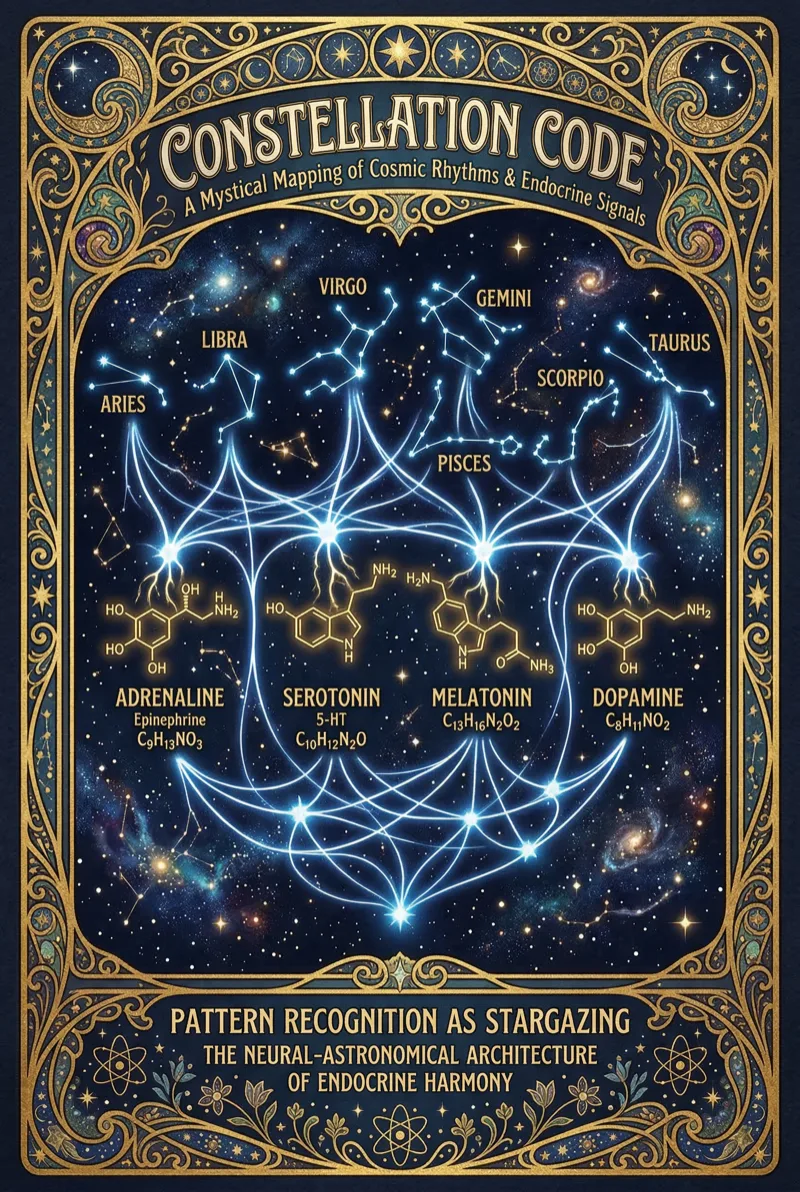
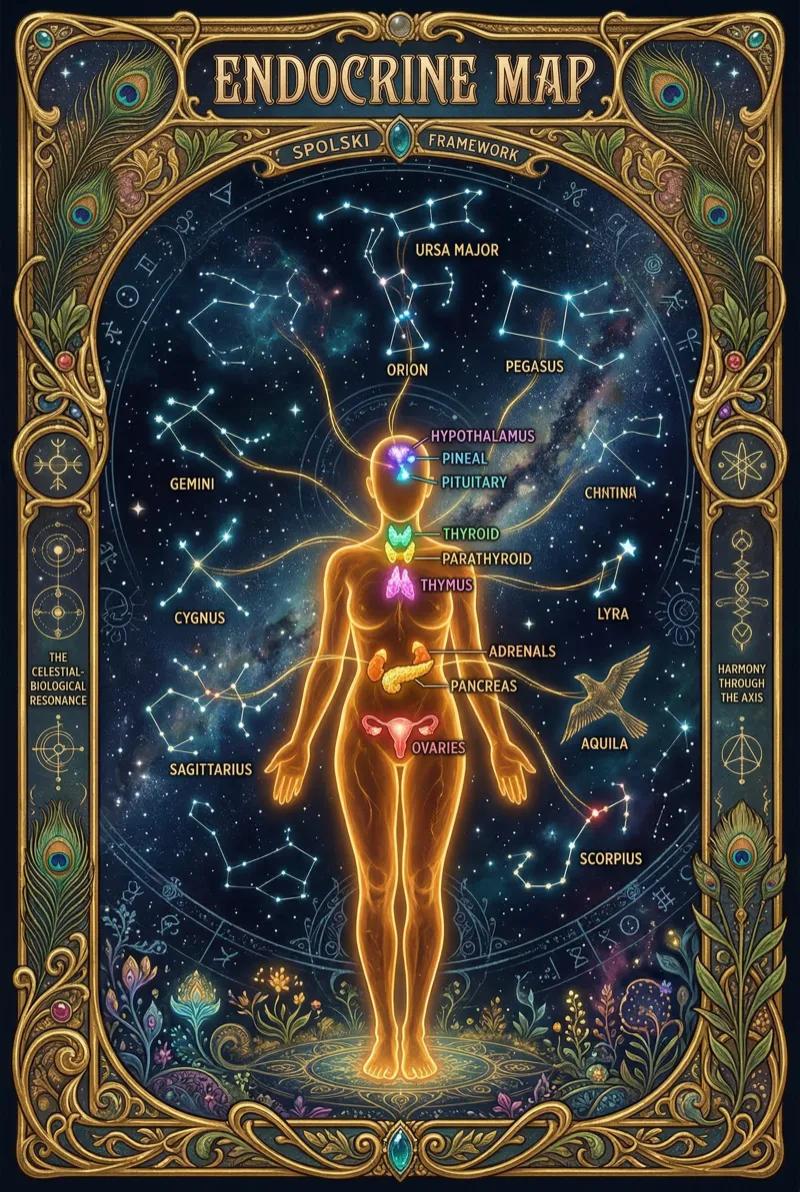
Nine primary hormones regulate human biological function. Nine Muses govern the channels of creative expression in Greek mythology. When you overlay these two systems, the correspondences are not approximate. They are precise. The Spolski endocrine correspondence framework documents this precision — not to prove that hormones are mystical, but to demonstrate that mystical systems were, from the beginning, biological documentation written in symbolic notation.
The Core Correspondence
Each pairing follows the same structure: a chemical function, an archetypal expression, a pattern recognition signature, and an integration point where the biological and the symbolic converge.
Melatonin and Polymnia: The Rhythm of Sacred Speech
Melatonin regulates circadian rhythm — the body’s master clock. Polymnia governs rhetoric, sacred hymns, and the timing of speech. The correspondence is structural: both systems manage when things happen. Not what. When.
A system with disrupted melatonin cannot sleep properly. A system with disrupted Polymnian function cannot speak with precision. The Type 1 Reformer lives inside this correspondence — obsessed with correct timing, proper sequence, the right word at the right moment. The shadow is wrath: what erupts when timing is violated.
The integration point is rhythm of consciousness itself. Melatonin does not merely regulate sleep. It regulates the oscillation between conscious and unconscious processing. Sacred hymns do not merely sound beautiful. They synchronize collective consciousness to a shared rhythm. Same function, different substrate.
Oxytocin and Clio: The Chemistry of Memory
Oxytocin bonds. Clio records. Both systems serve the same architectural purpose: they make connections persist across time. Oxytocin transforms a stranger into a trusted partner through repeated chemical reinforcement. Clio transforms an event into history through narrative preservation.
The pattern recognition signature is collective memory formation. Societies that lose their Clio function — that stop recording and transmitting their history — fragment in exactly the same way that individuals with oxytocin disruption lose the capacity for sustained trust. The chemistry and the archetype degrade along identical fault lines.
Endorphins and Euterpe: Pain as Music
Endorphins manage pain relief and the upper registers of pleasure. Euterpe governs music and lyric poetry. The correspondence reveals something counterintuitive: the highest form of healing is not the elimination of pain but its transmutation into beauty.
Endorphins do not erase the stimulus. They change the system’s relationship to it. Music does not eliminate suffering. It metabolizes suffering into form. The Type 3 Achiever runs this circuit at performance speed — producing output as a pain management strategy, converting inner chaos into external achievement. The shadow is deceit: the gap between what the endorphins mask and what the performance displays.
Dopamine and Thalia: The Comedy of Reward
Dopamine drives the pleasure-reward cycle. Thalia presides over comedy and pastoral poetry. The link is satisfaction — the capacity to register that something good has happened and to enjoy it.
Comedy, in the Greek sense, is not jokes. It is the narrative arc that ends in resolution and celebration. Dopamine is not pleasure. It is the anticipation of pleasure — the chemical prediction that reward is coming. When this system malfunctions, you get Type 4’s characteristic melancholy: an anticipation engine that never registers arrival. The dopamine keeps promising. Thalia keeps writing comedies. But the system cannot laugh at its own punchlines.
Cortisol and Melpomene: Growth Through Tragedy
Cortisol manages stress response. Melpomene governs tragedy and catharsis. Both systems operate through the same mechanism: controlled destruction that enables restructuring.
Cortisol mobilizes the body’s resources under threat. It breaks down stored energy, suppresses non-essential functions, and focuses the system on survival. Tragedy performs the same operation on consciousness: it strips away pretense, collapses false narratives, and forces the audience to confront what remains when everything comfortable is removed.
The Type 5 Investigator lives in cortisol’s domain — perpetually conserving, perpetually preparing for the scarcity that stress has taught the body to expect. The virtue is non-attachment: the capacity to let cortisol do its work without hoarding the resources it mobilizes.
Estrogen and Erato: The Cycle of Creation
Estrogen governs reproductive development and cyclic transformation. Erato presides over love poetry and intimacy. The pattern is cyclical creation — the capacity to generate new forms through vulnerable encounter.
Type 6’s fear is the shadow of Erato’s love. Security seeking is the defensive posture against creation’s inherent risk. You cannot create without exposing yourself to loss. Estrogen’s cycle demands periodic dissolution before reconstruction. The Loyalist wants the creation without the cycle — the stability without the vulnerability that makes new life possible.
Testosterone and Calliope: The Epic Drive
Testosterone drives growth, development, and competitive intensity. Calliope, chief of the Muses, governs epic poetry — the heroic narrative, the grand undertaking. Both systems push toward more: more territory, more capability, more story.
The Type 7 Enthusiast runs this circuit without a termination condition. Every stimulus is a potential epic. Every experience is a chapter. The shadow is gluttony — not of food, but of possibility. The virtue is sobriety: the capacity to let Calliope finish one epic before starting another.
Adrenaline and Terpsichore: The Dance of Emergency
Adrenaline fires the sympathetic nervous system. Terpsichore governs dance — the body’s immediate, instinctive, powerful expression. Both systems operate at speeds that bypass deliberation.
Type 8’s intensity is adrenaline married to Terpsichore: the body as instrument of immediate power. The shadow is lust — not sexual but existential, the hunger for contact so intense it overwhelms subtlety. The virtue is innocence: the capacity to let the body move without the compulsion to dominate the choreography.
Serotonin and Urania: The Order of Stars
Serotonin regulates mood and systemic balance. Urania studies the stars and the mathematical order of the cosmos. Both systems maintain equilibrium — the quiet, persistent work of keeping everything in its place.
Type 9’s sloth is not laziness. It is Uranian over-identification with cosmic order: when you see the whole pattern, individual action feels small. The serotonin system agrees — mood regulation is not about peaks and valleys but about the smooth, even line. The integration point is action: the willingness to disturb the balance in service of something the balance itself cannot produce.
The Framework’s Utility
The Spolski framework does not claim that hormones are gods or that gods are hormones. It claims that the same pattern has been observed by two different investigative traditions — one biological, one mythological — and that their reports converge with a precision that demands attention.
Free will operates within chemical architecture. You do not choose your hormone profile. You do not choose which Muse governs your creative channel. But you choose what you do with the signal once you recognize it. That recognition is the framework’s purpose: not to determine, but to illuminate. Not to imprison in type, but to show you the walls of the room so you can find the door.