Nine Muses and the Endocrine System
There is a video by SlickDissident that does something rare in the landscape of esoteric analysis: it connects without forcing. The Nine Muses and Endocrine System breakdown traces a correspondence between the Greek Muses and the hormonal system that feels less like interpretation and more like reverse engineering — reading source code that was always there, waiting for someone with the right compiler.
This article unpacks that analysis, extends it, and frames it in the language of system architecture.
The Correspondence Table
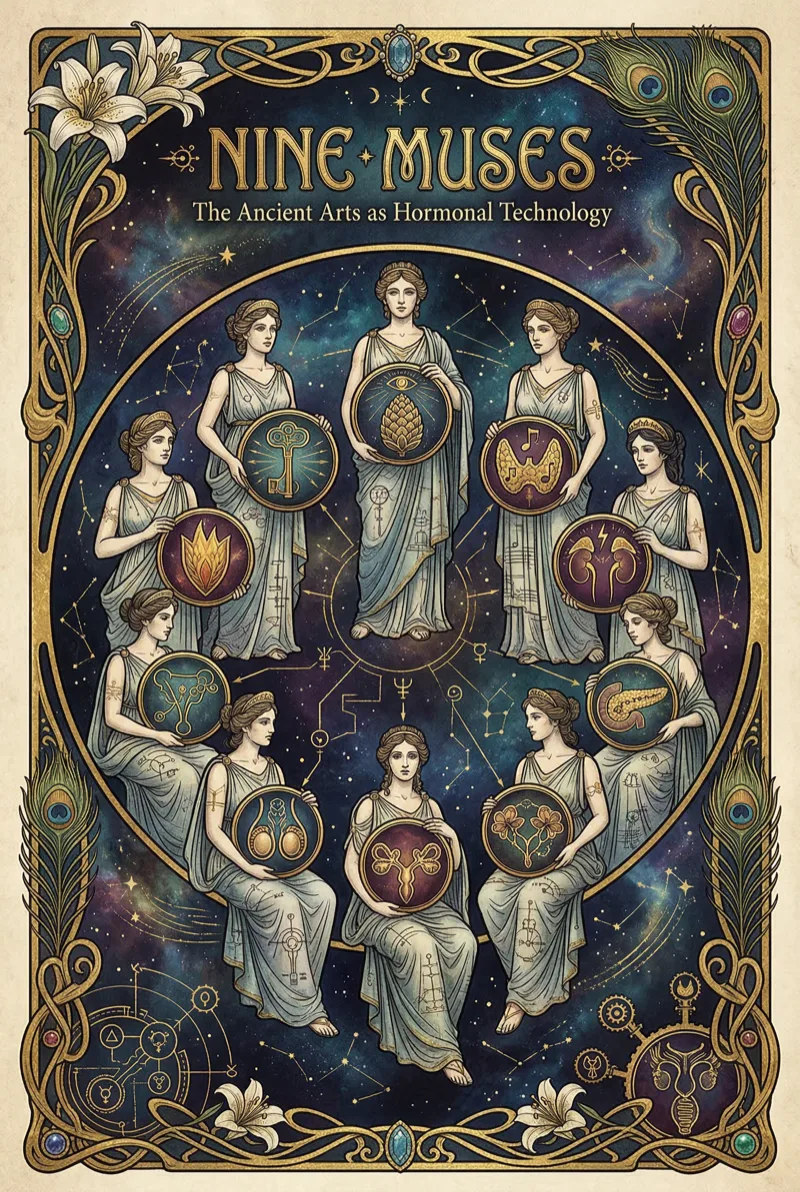
The mapping is precise enough to be operational:
Polymnia (1) maps to Melatonin. The Muse of sacred hymns governs rhetoric and introspection. Melatonin governs circadian rhythm — the timing system that determines when the body enters its contemplative states. Both are rhythm compilers, converting raw temporal data into structured cycles of rest and revelation.
Clio (2) maps to Oxytocin. The Muse of history preserves memory and legacy. Oxytocin — the bonding hormone — encodes relational memory, the kind that persists not in facts but in felt connections. Clio does not record dates; she records the emotional signature of moments. So does oxytocin.
Euterpe (3) maps to Endorphins. The Muse of lyrical poetry and music corresponds to the body’s own release mechanism. Endorphins do not create pleasure — they create relief, which is structurally identical to the resolution of a musical phrase. Euterpe’s gift is the same: the moment the tension breaks and the melody breathes.
Thalia (4) maps to Dopamine. Comedy, pleasure, satisfaction. Dopamine is the reward prediction signal — it fires not when you receive the reward, but when you anticipate it. Thalia’s comedy works the same way: the laugh comes at the moment of recognition, not delivery. Both are anticipation engines.
Melpomene (5) maps to Cortisol. Tragedy and the stress hormone share a function that most people misread. Cortisol is not the villain of the endocrine system — it is the awareness intensifier. It sharpens perception, mobilizes resources, and demands attention. Melpomene does the same: tragedy is not suffering but the heightened awareness that suffering produces. Catharsis requires cortisol.
Erato (6) maps to Estrogen. Love poetry and the creative hormone. Estrogen governs receptivity, cyclical creation, and the capacity for intimate connection. Erato’s domain is not romance as entertainment but romance as generative act — the creation that emerges from deep encounter.
Calliope (7) maps to Testosterone. Epic poetry and the drive hormone. Testosterone does not simply produce aggression — it produces the sustained forward momentum required to build something that lasts. Calliope’s epic poems demanded years of composition, vast architectures of narrative held in working memory. This requires hormonal stamina, not just talent.
Terpsichore (8) maps to Adrenaline. Dance and the emergency response share the same substrate: immediate, total, physical engagement. Adrenaline does not think — it moves. Terpsichore’s dance is not choreography recalled but movement channeled. Both bypass the conscious mind to operate directly through the body.
Urania (9) maps to Serotonin. Astronomy and the balance hormone. Serotonin provides the background state of order against which all other hormones modulate. Urania gazes at the stars — the most orderly, predictable, geometrically precise system visible to the naked eye. Both represent the peace that comes from recognizing pattern in apparent chaos.
The Symposium Architecture
The SlickDissident analysis highlights something structural about Plato’s Symposium that most classical scholars treat as incidental: the arrangement of speakers at the banquet mirrors the arrangement of the Muses. There is an empty seat. The dialogue has gaps and silences that are not accidental but architectural.
In endocrine terms, this corresponds to the spaces between hormonal signals — the refractory periods, the baseline states, the moments when no particular hormone dominates. These gaps are not absences of function but functions in themselves. The silence between heartbeats is as essential as the beat.
The Spolski Framework referenced in the analysis takes this further: the claim that hormones do not merely correspond to Muses but that the entire endocrine system is a nine-channel receiver tuned to archetypal frequencies. This is a strong claim. It suggests that what we call personality, creativity, and spiritual experience are not emergent properties of chemical complexity but structured outputs of a system designed — or evolved — to process specific types of information.
The Feeling-Thinking Interface
The nine Muses divide into feeling-dominant and thinking-dominant groups. Euterpe, Thalia, and Erato operate through emotional resonance. Polymnia, Melpomene, and Urania operate through structured contemplation. Clio, Calliope, and Terpsichore bridge the two.
The endocrine system shows the same division. Endorphins, dopamine, and estrogen are primarily hedonic — they modulate the felt quality of experience. Melatonin, cortisol, and serotonin are primarily regulatory — they modulate the structure of experience. Oxytocin, testosterone, and adrenaline are primarily action-oriented — they translate internal states into external behavior.
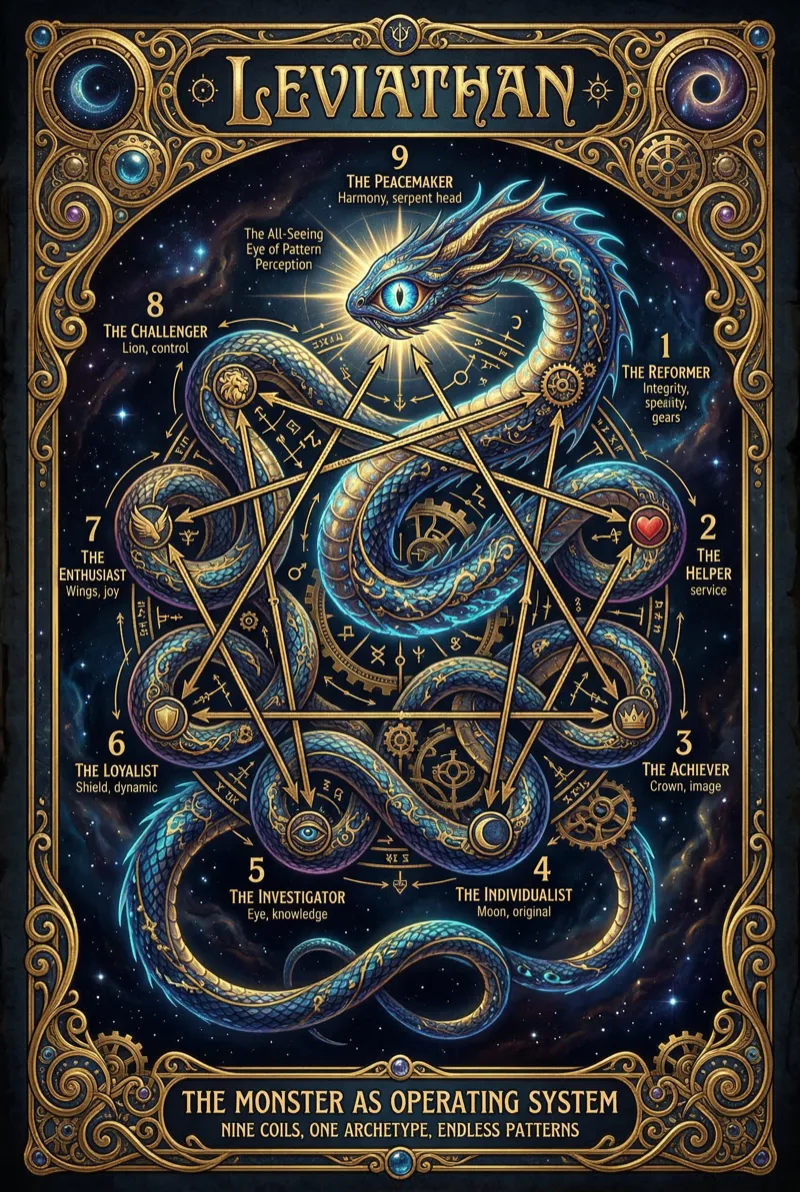
This triadic structure maps directly onto the Enneagram’s three centers: heart (feeling), head (thinking), and gut (action). The Muse-endocrine correspondence is not a standalone system — it is a view into the nine-fold architecture that the Enneagram describes from the personality side.
Chemical Determinism and Creative Will
The deepest question the SlickDissident analysis raises is whether creativity is chosen or secreted. If Melpomene speaks through cortisol, does the tragic artist create because they choose tragedy, or because their cortisol profile selects the Muse for them?
The answer — which the analysis implies but does not state explicitly — is that the question itself is malformed. The hormone and the archetype are not cause and effect. They are the same event observed from inside and outside the body, respectively. Asking whether cortisol causes tragedy or tragedy causes cortisol is like asking whether the source code causes the compiled binary or vice versa. They are the same program in different representations.
This has practical implications. You cannot invoke Calliope by injecting testosterone. But you can create conditions — sustained physical effort, competitive engagement, long-horizon projects — under which testosterone rises and Calliope’s epic voice becomes available. The system responds to coherent inputs from either direction.
The nine Muses are not mythology. They are an API documentation for the endocrine system, written three thousand years before anyone measured a hormone.
Nine frequencies. Nine receivers. One system that the ancients mapped and modernity measures.