Endocrine-Muse Pattern Analysis
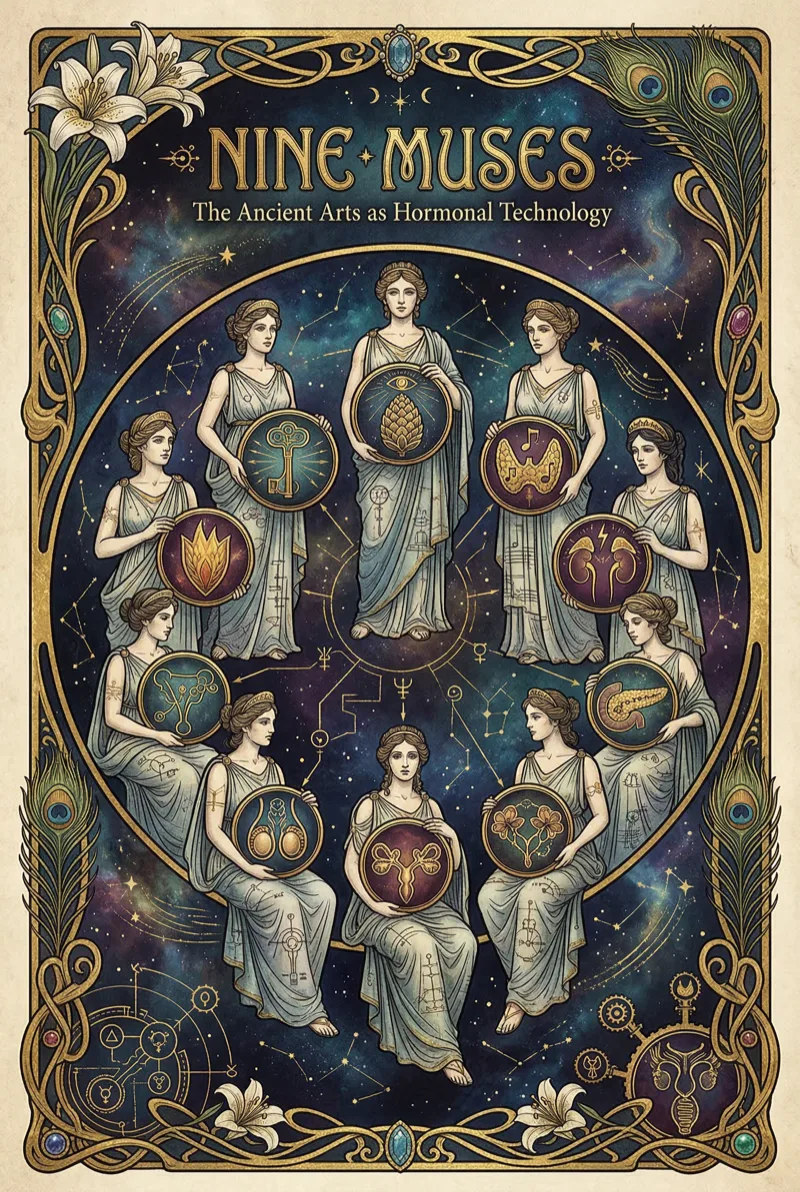
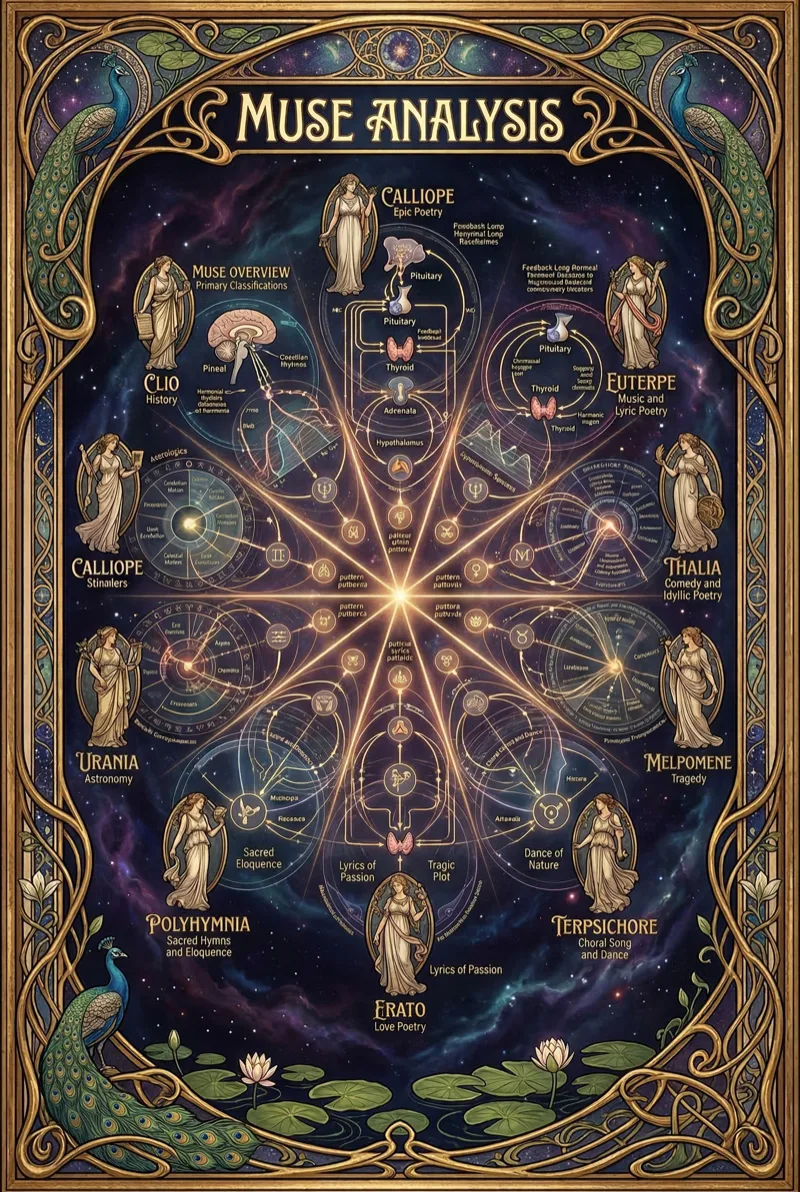
Every complex system leaves a signature in its output logs. The endocrine system is no different. When you map nine hormones against nine Muses — ancient Greek archetypes of creative intelligence — the resulting pattern matrix is not a coincidence. It is a debug trace from a system that has been running since before we had words for it.
This is the meta-analysis. Not the mapping itself, but what the mapping reveals when you step back and read it as architecture.
Three Core Patterns
Pattern 1: Cyclical Nature
The endocrine system operates on cycles. Melatonin follows the circadian rhythm, cortisol peaks at dawn, estrogen oscillates monthly, testosterone pulses hourly. These are not random fluctuations — they are clock signals.
The Muses, too, are cyclical. Polymnia (sacred hymns) governs repetition and rhythm. Clio (history) governs return and recurrence. Urania (astronomy) governs orbital timing. The Greeks encoded cyclical intelligence into their creative archetypes because they recognized that creativity itself is periodic — inspiration arrives in waves, not streams.
When you overlay the hormone cycles onto the Muse cycles, the synchronization is precise enough to be operational. Melatonin-Polymnia forms the master clock. Cortisol-Melpomene marks the stress-catharsis rhythm. Serotonin-Urania provides the background hum of order against which all other cycles modulate.
This is not metaphor. This is cron scheduling at the biological level.
Pattern 2: Hierarchical Organization
The nine-point system reveals nested architecture. At the base layer, raw chemical processes execute without conscious awareness — melatonin secretion, adrenaline release, oxytocin bonding. These are kernel-level operations.
At the archetypal layer, the Muses represent the user-space interpretation of these chemical events. When cortisol floods your system, Melpomene speaks — the tragic Muse who transforms suffering into art. When dopamine fires, Thalia laughs — the comic Muse who finds pleasure in pattern completion.
Between these layers sits the integration layer, where chemical signals translate into lived experience. This is the API boundary. The hormone provides the raw signal; the Muse provides the narrative frame; the integration layer produces what you call feeling, creativity, or insight.
const patternMatrix = {
  melatonin: {
    muse: "Polymnia",
    function: "Rhythm Regulation",
    archetype: "Sacred Wisdom",
    layer: "base"
  },
  oxytocin: {
    muse: "Clio",
    function: "Memory Storage",
    archetype: "Historical Connection",
    layer: "base"
  },
  cortisol: {
    muse: "Melpomene",
    function: "Stress Processing",
    archetype: "Tragic Catharsis",
    layer: "integration"
  }
};
The hierarchy is fractal. Each individual hormone-Muse pair contains its own three-layer stack. Melatonin has its chemical substrate (pineal gland secretion), its archetypal function (sacred timing), and its integration output (the felt sense of when to sleep, when to wake, when to pray). Zoom in on any single node and the same architecture reappears.
Pattern 3: Field Coherence
The most significant pattern is what happens when all nine circuits operate simultaneously. Individual hormone-Muse pairs produce local effects. But when the entire system reaches coherence — when circadian rhythms, stress cycles, reward systems, bonding patterns, and creative drives all synchronize — a field effect emerges.
This field effect is what the Greeks called mousike — the total art of the Muses. It was not any single creative discipline but the state in which all disciplines converged. In endocrine terms, this corresponds to hormonal homeostasis — not the absence of fluctuation, but the presence of coordinated oscillation.
The technical parallel is resonance. Nine oscillators, each running at their own frequency, can produce noise or harmony depending on their phase relationships. The endocrine-Muse system suggests that biological health and creative vitality are the same phenomenon measured at different scales.
Implementation Observations
Chemical Triggers and Archetypal Manifestation
Each hormone has a trigger condition and each Muse has an invocation protocol. The correspondence is not symbolic — it is functional. Oxytocin releases during physical contact, trust, and shared experience. Clio activates during acts of remembrance, historical connection, and legacy preservation. These are the same event described in different languages.
The implementation insight is that you can address the system from either end. Alter the chemistry and the archetype shifts. Invoke the archetype and the chemistry follows. This bidirectional access is what makes the system therapeutically significant.
Predictable Interaction Points
The nine circuits do not operate independently. Cortisol suppresses oxytocin. Dopamine competes with serotonin. Adrenaline overrides melatonin. These chemical interactions have precise archetypal equivalents: tragedy (Melpomene) disrupts bonding (Clio), pleasure-seeking (Thalia) disturbs peace (Urania), emergency action (Terpsichore) overrides sacred timing (Polymnia).
These interaction patterns are predictable. They form a dependency graph that can be mapped, monitored, and — with sufficient understanding — intentionally navigated.
Research Implications
The endocrine-Muse pattern analysis suggests three primary conclusions. First, biological systems mirror archetypal patterns not because the ancients were poetic, but because they were observing the same system from a different measurement instrument. Second, chemical processes and spiritual functions are not separate domains requiring integration — they are a single domain requiring a unified vocabulary. Third, the system reveals itself most clearly at the meta-level, where individual correspondences dissolve into the larger architecture of nine-fold cyclical intelligence.
The areas that remain open for investigation include timing variations across individuals (why some people’s cortisol-Melpomene cycle runs daily while others run weekly), pattern interruptions (what happens when a circuit is chemically suppressed or archetypally denied), and system optimization methods (whether deliberate Muse invocation can measurably shift endocrine profiles).
This is not a closed system. It is a living framework — one that updates itself every time a hormone fires and a Muse stirs.
The pattern is the proof. The body is the laboratory. The analysis continues.