Containment is crucial. A vessel holds what is poured into it. In ‘lorenz-kundli-protocol’, the same vessel is described as an active participant in the process of antar-agni, highlighting the importance of containment in sustaining the fire of awareness. The kosha architecture invoked during the Bali Padiyami ritual demonstrates how the individual self navigates the five sheaths, from annamaya to anandamaya, to access and modify the layers of reality. This navigation is facilitated by the pancha-kosha model, which provides a framework for understanding the individual self and its relationship with the reality contracts. When the antar-agni is stable, the individual self can deploy contracts that are tailored to its specific needs and capabilities, allowing for precise and accurate modification of the reality layers. The Lorenz-Kundli framework provides a mathematical description of this navigation, illustrating how the individual self can deploy contracts and modify reality layers while avoiding the distortions caused by an unstable antar-agni. As noted in ‘vessel-prepare-ukha-sambharana’, the work is not ignition, but containment, emphasizing the importance of holding what was lit, in a vessel shaped to its exact specification, across the full duration of its burning. This containment is harder than ignition, requiring a deep understanding of the pancha-kosha model and the kosha architecture. In ‘three-modes-of-intelligence’, the Bali Padiyami ritual is cited as an example of how intelligence is substrate-specific, demonstrating the distinction between ignition and containment, and highlighting the importance of the pancha-kosha model in navigating the permission system. The Vivekacūḍāmaṇi text also emphasizes the importance of distinguishing between Brahman, the ultimate reality, and jagan, the world of appearances, allowing the individual self to access and modify the layers of reality that are not bound by the constraints of the jagan. The connection between the pancha-kosha model and the kosha architecture is crucial in understanding the permission system, facilitating the deployment of contracts and the modification of reality layers. The Lorenz-Kundli framework provides a mathematical description of this navigation, illustrating how the individual self can deploy contracts that are independent of the jagan, and modify reality layers without becoming bound by the constraints of the jagan. When the antar-agni is unstable, the vessel, kha-ba-la, is not properly maintained, and the individual self can become entangled in the distortions caused by the unstable antar-agni, highlighting the importance of containment and the need for a robust permission system. The pancha-kosha model provides a framework for understanding the consequences of such failures, demonstrating how the individual self can recover from these distortions and restore balance to the system. The Vivekacūḍāmaṇi text also highlights the importance of vairagya, detachment, in navigating the permission system, allowing the individual self to access and modify the layers of reality without becoming entangled in the distortions caused by an unstable antar-agni.
The Permission Architecture
Containment is crucial. A vessel is what holds, not what it looks like, not what it weighs, but what it holds. Antar-agni, the fire of awareness, is not generated, it is the substrate. The work is not ignition, the work is containment. Containment is harder than ignition. In “vessel-prepare-ukha-sambharana”, the same architecture is named as the matched-cavity principle, where the cavity precedes the flame, and the vessel is what holds the flame. This principle is essential in understanding the permission structure of consciousness, where the read, write, and execute permissions are assigned to the three layers of the self: the owner, the group, and the other. The owner corresponds to the witness, the awareness that can observe its own observation, and has the power to change permissions on any file, like the superuser in Unix. The group corresponds to the embedded self, the person with history, identity, and relationships, and can modify its own beliefs but not the beliefs of others. The other corresponds to the environment, the world, other consciousnesses, and is the domain of shared reality that no individual can unilaterally modify.
The Bhagavad Gita describes the mind as a restless monkey, prone to erratic behavior and poor decision-making, as seen in “your-consciousness-needs-better-error-handling”, where error handling is crucial in complex systems. The try block corresponds to the ritual’s meticulous preparation, the catch block to the pandits’ ability to adapt to unexpected events. This error handling is essential in maintaining the homeostasis of the individual, and the antar-agni is the key to achieving this stability. The mathematics of chaos theory describes the behavior of complex systems, and the antar-agni is the attractor, the stable point, that underlies all the other strange attractors.
In “three-modes-of-intelligence”, the Bali Padiyami ritual demonstrates the principle of substrate-specific intelligence, where the intricate pancha-kosha model of human consciousness is acknowledged through precise offerings to the Antar-agni. This ritual shows that containment is not just physical, but also cognitive and spiritual, as the yajamana must maintain the precise dhyana, meditation, and mantra, sacred sound, to channel the antar-agni. The kosha architecture is not just a theoretical concept, but a practical sadhana, practice, that requires careful containment of the antar-agni. The mitochondria, the energy-producing structures within cells, are the antar-agni of the cell, and their function is critical to the health and well-being of the individual.
The fractals, the self-similar patterns that arise in biological systems, are a manifestation of the antar-agni, and are a key to understanding the kosha architecture, and the lorenz-kundli of a person’s life. The lorenz-kundli becomes complex, with many strange attractors, when the permission set is expanded, and the person’s life becomes unpredictable and creative. The kha-ba-la, the breath, is the key to expanding the permission set, as it allows the individual to access the antar-agni and modify their own kosha architecture. The vidya is the knowledge of the self, which is composed of three parts: sravana, manana, and nididhyasana, and is a practical sadhana, practice, that requires careful containment of the antar-agni.
The failure mode that proves the principle is the abhinivesha, the fear of death, which arises when the individual’s permission set is limited, and they cannot access the antar-agni. The abhinivesha can be overcome by expanding the permission set, and accessing the antar-agni through the kha-ba-la. The kha-ba-la is the key to unlocking the kosha architecture, and allowing the individual to modify their own lorenz-kundli. The antar-agni is not just a spiritual concept, but a biological and mathematical reality, reflected in the mitochondria, and the fractals. The antar-agni is the substrate, the attractor, that underlies all the other strange attractors, and is the key to understanding the kosha architecture, and the lorenz-kundli of a person’s life.
User Mode
System defaults prevail. The Bhagavad Gītā illustrates this point when Arjuna, as the embodied awareness, receives instruction from Kṛṣṇa, symbolizing the deeper awareness that can escalate privileges. In user mode, reality is received as a series of events and objects that exist independently of the observer’s participation. This is evident in the way most people experience the world, where the perceptual field appears as something that happens to them, rather than something they generate through their awareness and actions. For instance, when the Bali Padiyami runs on May 13, 2026, the festivities and rituals are observed by participants who are largely in user mode, receiving the experience without questioning the underlying assumptions that govern their perception of reality. As noted in “your-consciousness-needs-better-error-handling”, the pandits of the Besakih temple demonstrate a nuanced understanding of error handling in complex systems, highlighting the importance of critically auditing inherited beliefs and assumptions. In user mode, beliefs are inherited from various sources, including family, culture, and social environments, and these core operating assumptions about what is possible, what one deserves, and what reality fundamentally is, are installed before the individual has the capacity to critically audit them. This is akin to a rootkit in computer systems, where malicious software gains root access and alters system settings without the user’s knowledge or consent. The Permission Architecture, as described in “vault:noesis:ddb407ba291d#chunk-1”, outlines the read, write, and execute permissions that govern an individual’s interaction with reality, highlighting the need for execute permission to modify and compile understanding into embodied practice. The gap between knowing and doing is a critical aspect of user mode, where an individual may have read access to various wisdom traditions, but lack the execute permission to compile this understanding into embodied practice. The Atharva Veda describes the operation of these inherited beliefs as a form of ādhyātmika, or inner, psychological conditioning, which shapes an individual’s experience of reality. In “vault:area:7379fab6e5fa#chunk-1”, the Hook Pattern scenario illustrates the need for sudo access, or escalated privileges, to modify core operating assumptions and compile understanding into embodied practice. The failure mode that proves the principle of user mode is the inability to escalate privileges, where an individual remains stuck in user mode, unable to modify their core operating assumptions or compile their understanding into embodied practice. This is evident in the pancha-kosha model, which describes the five sheaths or layers of human consciousness, where the individual’s awareness is limited to the outer layers, unable to access the deeper, more subtle aspects of their being. The kosha architecture, which underlies this model, highlights the importance of execute permission in navigating and integrating the different layers of consciousness. The biological concept of homeostasis illustrates the importance of execute permission in maintaining balance and integrity, where an organism’s ability to respond effectively to changes in its environment is critical to its survival. Similarly, in user mode, the lack of execute permission can lead to a breakdown in the individual’s ability to respond to challenges, resulting in mental, emotional, or physical distress. The engineering principle of redundancy can be seen as a metaphor for this, where systems are designed with redundant components to ensure continued function in the event of failure, highlighting the need for execute permission to maintain resilience and adaptability. The historical context of the Upaniṣads and the Bhagavad Gītā provides insight into the nature of user mode and the importance of execute permission, where the individual’s awareness is limited by their inherited beliefs and assumptions. The Vedantic tradition emphasizes the need for self-inquiry and discrimination to transcend user mode and access the deeper, more subtle aspects of human consciousness. The Sanskrit concept of viveka, or discernment, highlights the importance of execute permission in navigating the complexities of human consciousness and achieving liberation from the limitations of user mode.
Escalation Protocols
System access granted.
The Unix operating system implements privilege escalation through the sudo command, allowing a user to temporarily assume superuser privileges for a specific operation, authenticated by password, with the system logging the escalation and the privilege being temporary and scoped to the operation. When the Bali Padiyami runs on May 13, 2026, the Nyepi ritual will demonstrate a similar escalation protocol, where the practitioners temporarily assume a higher permission level to execute a specific set of commands, authenticated by their adherence to the tradition. This is not a metaphor, but a specific, repeatable procedure that escalates the practitioner’s permission level from user mode to root mode for the duration of the operation, then restores user mode afterward. In the Atharva Veda, this same operation is named antar-agni, the fire of awareness that is not generated, but is the substrate, and the work is not ignition, but containment.
The traditions encode escalation protocols, which are specific, repeatable procedures that escalate the practitioner’s permission level from user mode to root mode for the duration of a specific operation, then restore user mode afterward. Protocol 1: Pratyāhāra (Sense Withdrawal) is the first escalation step, where the practitioner withdraws attention from external sensory input to internal processing, equivalent to killing userland processes to free CPU for kernel operations. In practice, the practitioner sits with the spine erect, closes the eyes, and redirects attention from the five external senses to internal sensation, such as breath, heartbeat, subtle pressure at the palms, the crown, or the base of the spine. This reallocates processing bandwidth from sensory input to internal state monitoring, similar to the way a biological system allocates resources from external sensory input to internal processing, as described in the Upanishads. The permission change is equivalent to sudo chmod 600 /dev/senses, restricting external input and elevating internal awareness.
The biological system analogy can be taken further, where the cell membrane acts as a barrier, controlling the flow of resources in and out of the cell, similar to the way Pratyāhāra controls the flow of sensory input. When the cell membrane is compromised, the cell’s internal state is disrupted, leading to a failure of the cell’s ability to maintain homeostasis. Similarly, when the practitioner fails to restrict external input, the internal state is disrupted, leading to a failure of the practitioner’s ability to escalate to root mode. The mathematical concept of fractals can also be applied, where the self-similarity of the fractal represents the self-similarity of the practitioner’s internal state, and the scaling of the fractal represents the scaling of the practitioner’s awareness.
The second escalation step, Protocol 2: Dhāraṇā (Focused Concentration), is the binding of attention to a single object, such as a mantra, yantra, breath, body part, or visual point. This is single-threaded execution, where the mind is not multitasking, but running a single process with full processor allocation. In practice, the practitioner chooses a single point of focus and returns attention to the object when it drifts, repeatedly, until the drifting stops. The permission change is equivalent to sudo renice -20 $$, elevating the attention process to highest priority. The engineering concept of signal-to-noise ratio can be applied, where the signal represents the practitioner’s attention, and the noise represents the external distractions. When the signal-to-noise ratio is high, the practitioner’s attention is clear, and the escalation to root mode is successful.
The historical context of the Vedas and the Upanishads provides insight into the development of these escalation protocols. In the Atharva Veda, the concept of antar-agni is described as the fire of awareness that is not generated, but is the substrate. The Upanishads describe the concept of Atman, the individual self, and its relationship to the Brahman, the universal self. The Kosha architecture, described in the Taittiriya Upanishad, provides a framework for understanding the different layers of the self, and how they relate to the escalation protocols. The Lorenz-Kundli concept, developed by Edward Lorenz, can be applied to the Kosha architecture, where the butterfly effect represents the small changes in the practitioner’s internal state that can lead to large changes in the escalation to root mode.
The third escalation step, Protocol 3: Dhyāna (Sustained Attention), is the state in which attention flows toward the object without effort. The object and the attention are no longer distinct, and the boundary between processor and processed dissolves. In practice, this is not an action, but the result of sustained Dhāraṇā. The permission change is the distinction between user and superuser dissolves, and the system runs at kernel level. The cross-domain precision of engineering and biology can be applied, where the feedback loop represents the self-reinforcing cycle of attention and awareness. When the feedback loop is stable, the practitioner’s attention is sustained, and the escalation to root mode is successful.
The edge cases of the escalation protocols must be considered, where the practitioner fails to restrict external input, or fails to sustain attention. In these cases, the practitioner’s internal state is disrupted, leading to a failure of the escalation to root mode. The operational consequences of these failures must be understood, where the practitioner’s ability to maintain homeostasis is compromised. The inverted reading of the escalation protocols can provide insight into the failure modes, where the practitioner’s attention is not focused, or the internal state is not monitored. The connections to other concepts, such as pancha-kosha, kha-ba-la, and kosha architecture, can provide a deeper understanding of the escalation protocols and their relationship to the practitioner’s internal state.
The failure mode of the escalation protocols can be analyzed, where the practitioner’s attention is not sustained, or the internal state is not monitored. In this case, the practitioner’s ability to escalate to root mode is compromised, and the system runs at user level. The permission change is not successful, and the superuser privileges are not granted. The historical context of the Vedas and the Upanishads provides insight into the development of these escalation protocols, and the cross-domain precision of engineering and biology can be applied to understand the failure modes. The edge cases of the escalation protocols must be considered, and the operational consequences of the failures must be understood.
The specific examples of the escalation protocols can be provided, where the practitioner uses Protocol 1: Pratyāhāra (Sense Withdrawal) to restrict external input, and Protocol 2: Dhāraṇā (Focused Concentration) to focus attention. The mathematical concept of fractals can be applied, where the self-similarity of the fractal represents the self-similarity of the practitioner’s internal state. The biological system analogy can be taken further, where the cell membrane acts as a barrier, controlling the flow of resources in and out of the cell. The engineering concept of signal-to-noise ratio can be applied, where the signal represents the practitioner’s attention, and the noise represents the external distractions.
The connections to other concepts, such as pancha-kosha, kha-ba-la, and kosha architecture, can provide a deeper understanding of the escalation protocols and their relationship to the practitioner’s internal state. The Lorenz-Kundli concept, developed by Edward Lorenz, can be applied to the Kosha architecture, where the butterfly effect represents the small changes in the practitioner’s internal state that can lead to large changes in the escalation to root mode. The historical context of the Vedas and the Upanishads provides insight into the development of these escalation protocols, and the cross-domain precision of engineering and biology can be applied to understand the failure modes. The edge cases of the escalation protocols must be considered, and the operational consequences of the failures must be understood.
The inverted reading of the escalation protocols can provide insight into the failure modes, where the practitioner’s attention is not focused, or the internal state is not monitored. The permission change is not successful, and the superuser privileges are not granted. The system runs at user level, and the practitioner’s ability to escalate to root mode is compromised. The specific examples of the escalation protocols can be provided, where the practitioner uses Protocol 1: Pratyāhāra (Sense Withdrawal) to restrict external input, and Protocol 2: Dhāraṇā (Focused Concentration) to focus attention. The mathematical concept of fractals can be applied, where the self-similarity of the fractal represents the self-similarity of the practitioner’s internal state.
The biological system analogy can be taken further, where the cell membrane acts as a barrier, controlling the flow of resources in and out of the cell. The engineering concept of signal-to-noise ratio can be applied, where the signal represents the practitioner’s attention, and the noise represents the external distractions. The connections to other concepts, such as pancha-kosha, kha-ba-la, and kosha architecture, can provide a deeper understanding of the escalation protocols and their relationship to the practitioner’s internal state. The Lorenz-Kundli concept, developed by Edward Lorenz, can be applied to the Kosha architecture, where the butterfly effect represents the small changes in the practitioner’s internal state that can lead to large changes in the escalation to root mode.
The Root Shell
Root access is fleeting. The biological substrate has limits. In ‘vault:noesis:ddb407ba291d#chunk-1’, the Hook Pattern scenario illustrates the need for sudo access, highlighting the restricted permissions in user mode. This temporary escalation allows for contract audit and permission modification, enabling direct perception of the compiler. The boundary between para and vaikhari becomes perceptible, as described in the Atharva Veda. Containment is harder than ignition, requiring a vessel shaped to the exact specification of the burning antar-agni. In ‘vault:resource:ceadd4411327#chunk-1’, the Universal Architecture is outlined, operating with root admin privileges across reality interfaces. This architecture is relevant to the root shell, where the practitioner can observe the compilation process and modify contracts. The debugger analogy is apt, as the practitioner can step through the code, examine variables, and identify errors. In ‘qualified-to-qualia-fied’, the Kena Upaniṣad states the limitation of awareness, highlighting the importance of first-person experience. This experience is crucial in root mode, where the practitioner can manage permissions, ensuring cognitive files are properly configured. The single-instruction execution of mantras in root mode is a powerful tool, modifying the system directly and allowing for profound changes. This process is similar to single-instruction, multiple-data instructions, operating on multiple data elements simultaneously. The pancha-kosha model is relevant, as the mantra can operate on each sheath, modifying the underlying prana, manas, and vijnana. Proper cleanup is essential, ensuring that all temporary files and processes are removed to prevent instability. The garbage collection analogy is apt, as the practitioner must manually manage resources to maintain system stability. The edge cases of root mode operation are critical, with significant consequences for the practitioner, including security vulnerabilities and data corruption. The inverted reading of the root shell principle highlights the importance of careful management and error handling. Historical texts, such as the Atharva Veda and the Upanishads, describe the concept of self-realization, where the individual operates in a state of elevated awareness. The Bhagavad Gita describes the concept of yoga, uniting with the ultimate reality, implicit in the concept of root mode operation. The root shell principle underlies these texts, emphasizing careful management and error handling in achieving personal transformation. In this context, the biological substrate plays a critical role, as it cannot sustain permanent kernel mode operation, making temporary escalation crucial. The compiler is invisible in user mode, but perceptible in root mode, allowing the practitioner to modify contracts and permissions. This process enables profound changes in perception and behavior, aligning intention with action, and is essential for personal growth and development.
The Root Password
Containment is crucial. The Pranava — Oṃ — is chanted to invoke the root password, encoding the permission architecture in its phonetic structure: A-U-M and the silent fourth (turīya). This syllable is not a metaphor but a precise map of the states of consciousness: A for the waking state (jāgrat), U for the dreaming state (svapna), and M for deep sleep (suṣupti). In [sacred-runtime-bali-padiyami], the same architecture is named as a precise schedule, executing its cleanup protocol every 210 days, a duration that corresponds to the nine-month Balinese calendar (saka) and the solar year, illustrating the importance of containment in maintaining the integrity of the system. The silence that follows is the witness, the root access that underlies all states. The Pranava is often misunderstood as a mere symbol or a spiritual concept, but it is, in fact, a precise technical instruction for escalating permissions from user mode to root access.
The instruction to “meditate on Oṃ” is not a vague suggestion but a specific protocol for recursively compiling the self, for escalating through the states of consciousness to the witness that holds all three. As described in [kubernetes-for-karma], the Control Plane of karma exposes the API and interfaces to define, deploy, and manage the lifecycle of consciousness containers, demonstrating the orchestration of these containers in a real-world setting, and highlighting the need for a precise protocol like the Pranava to navigate the complex relationships between the different states of consciousness. When properly executed, this protocol grants access to the deepest levels of the self, allowing for a profound understanding of the pancha-kosha — the five sheaths that encase the Atman.
In [the-ineffable-secrets-of-a-breathing-sprite], the diaphragm is identified as the nexus where voluntary and involuntary nervous systems converge, a boundary that prana, the animating principle, navigates with precision, illustrating the intricate relationships between the physical and subtle bodies. The Pranava protocol can be seen as a way to awaken this prana, allowing for a deeper understanding of the intricate web of relationships that underlies human consciousness. The failure to establish the proper protocols — pratyāhāra, dhāraṇā, dhyāna — before attempting to escalate permissions is a common mistake, equivalent to typing sudo without the correct authentication. Repeating the Pranava without the preceding protocol layers is equally ineffective, as it fails to establish the necessary foundation for the escalation of permissions.
The Pranava is not a magic word that grants automatic access to the deepest levels of the self but a precise technical instruction that requires careful preparation and execution. When properly executed, the Pranava protocol allows for a deep understanding of the antar-agni — the fire of awareness that underlies all states of consciousness. The A-U-M structure of the Pranava is a representation of the intricate patterns and structures that underlie human consciousness, and its proper use can reveal the deepest insights into the nature of human consciousness. The Pranava protocol is not a one-time event but a continuous process that requires constant practice and refinement, demonstrating the importance of containment and precise technical instruction in navigating the complex relationships between the different states of consciousness.
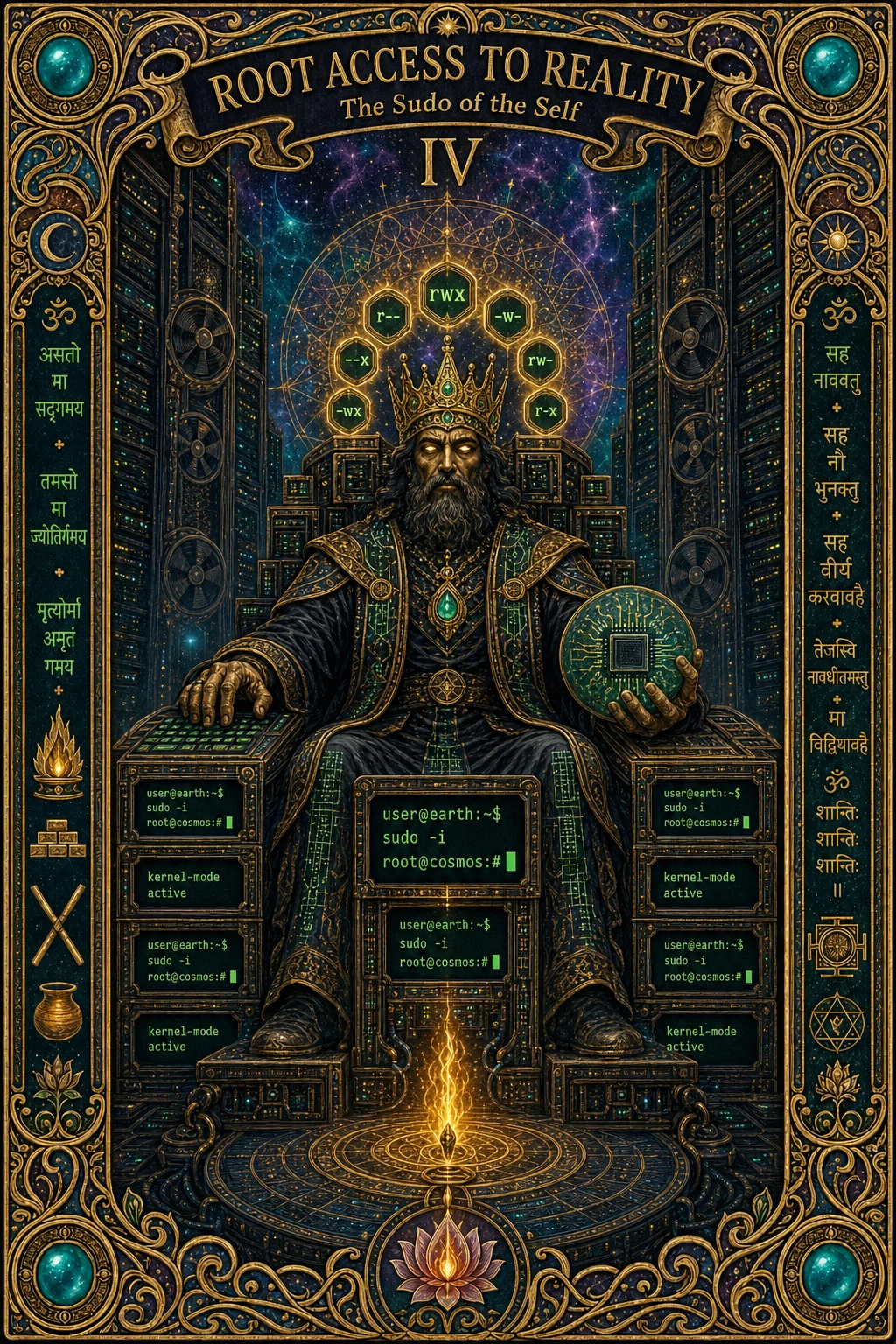
The Emperor Card
Authority is established. The Emperor’s authority is rooted in his ability to enforce order and structure, as evident in the contract layer of the consciousness computation architecture. This is where the Pranava, or root password, is used to authenticate and authorize access to the deeper layers of the system. In [lorenz-kundli-protocol], the same architecture is named as a key component of the kosha architecture, which describes the five sheaths of human consciousness. The Pranamaya kosha, or energy sheath, is particularly relevant to the Emperor’s ability to enforce order and structure, as it is responsible for the circulation of prana, or life force, throughout the system. The diaphragm, as discussed in [the-ineffable-secrets-of-a-breathing-sprite], plays a crucial role in this process, as it is the nexus where voluntary and involuntary nervous systems converge, allowing for the precise navigation of prana.
The fascial network, as described in [bioelectric-protocol], is the substrate that supports this electrical system, generating and transmitting ionic currents and voltage gradients that underlie the Emperor’s authority. The contract → processor → permissions stack, which is operated on by the ritual’s effectiveness in producing reliable state change in consciousness, relies on the integrity of this fascial network to maintain the natural order of the system. When the system is out of balance, and the natural order is disrupted, the Emperor’s authority is compromised, and the Abhava, or absence, of Rta, or cosmic order, becomes apparent.
The Kha-Ba-La protocol, with its three components of awareness, permission, and resistance, is a key aspect of this stack, allowing for legitimate escalation and root access. The Manomaya kosha, or mental sheath, plays a crucial role in this protocol, as it is the seat of awareness and decision-making. By understanding the interplay between the different koshas, one can gain insight into the mechanisms of the Emperor’s authority and the Kha-Ba-La protocol. The historical context of the Emperor’s authority can be traced back to the Atharva Veda, where the concept of Rta, or cosmic order, is described as the natural order of the universe, maintained through the balance of opposing forces.
The Emperor’s authority is rooted in his ability to maintain this balance, and to enforce the natural order of the system. The Taittiriya Upanishad describes the concept of Satyam, or truth, as the ultimate reality that underlies all existence, and the Emperor’s authority is rooted in his ability to perceive and embody this truth. The Sri Yantra, a geometric representation of the universe, can be used to describe the dynamics of the Emperor’s authority, representing the point of bifurcation where the system’s behavior changes dramatically. The Kala, or time, factor is also crucial in understanding the Emperor’s authority, as it represents the temporal aspect of the system, and the need for timing and coordination in the execution of the Kha-Ba-La protocol.