Synchronocities
XV
The Devil The Ordeal · Bondage

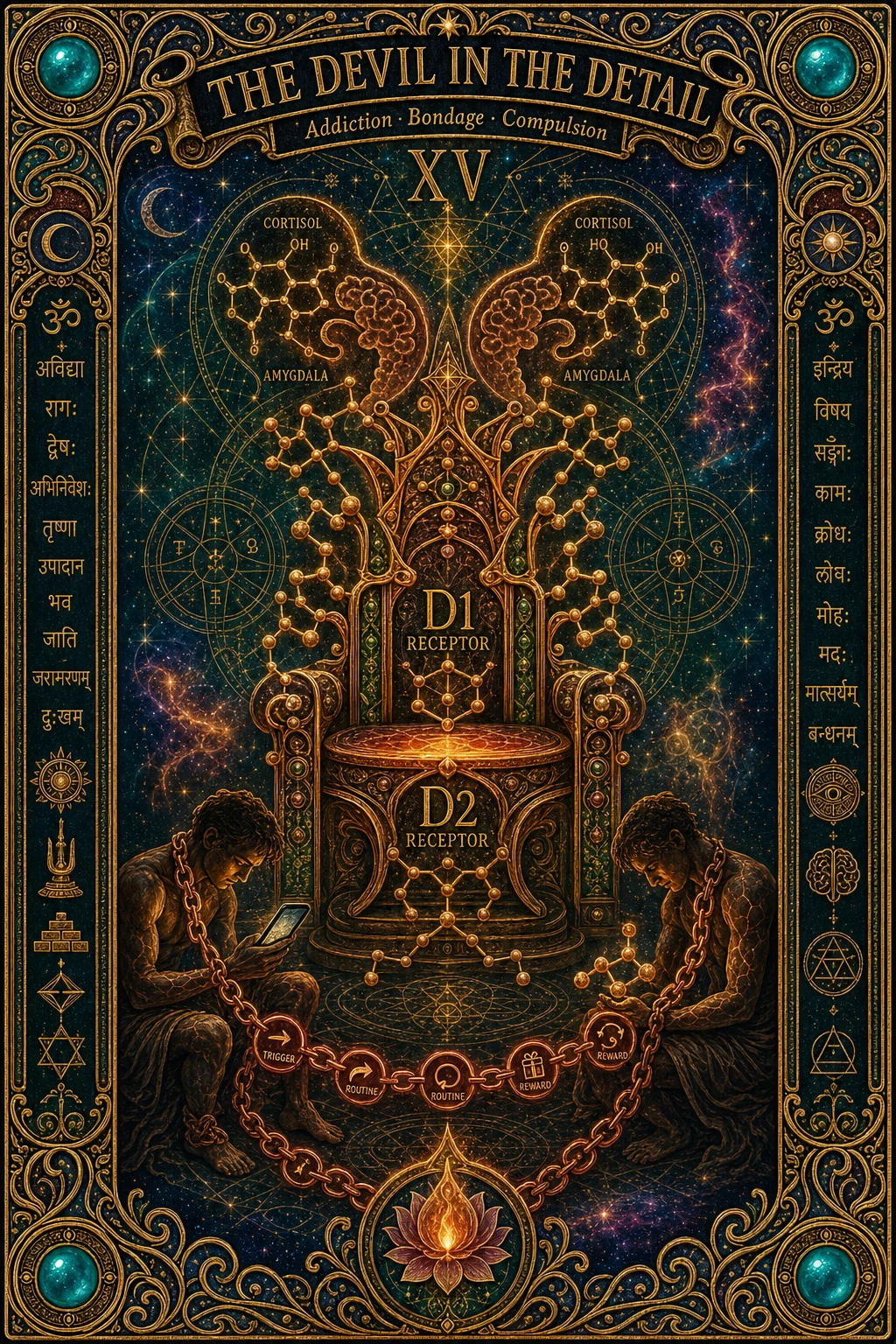
The Devil in the Detail — Addiction, Bondage, and the Architecture of Compulsion

The Devil is not evil. The Devil is the detail — the specific stimulus that has been granted executive authority over the nervous system. Addiction is not a failure of will. It is an architecture.

The Devil
Back to journey

Containment is key. The stimulus is what holds, not what it looks like, not what it weighs, but what it holds. In “lorenz-kundli-protocol”, the same kosha architecture is named as a crucial component of the ritual, with each participant playing a role in containing the fire of awareness that fuels the ceremony. This fire of awareness is not generated, it is the substrate upon which the bond between the stimulus and response is formed. The priests of the Tirtha Empul Temple, in their meticulous preparation of the canang offerings, demonstrate an understanding of this intricate bond, highlighting the importance of initial conditions and sensitivity to perturbations in the formation of such bonds. The Kosha architecture, comprising the five sheaths, provides a framework for analyzing the bondage depicted in the Devil card, with the Pranamaya Kosha, or the sheath of energy, being particularly relevant, as it is here that the stimulus and response are linked, forming a cycle that reinforces the bond.

The mathematics of chaos theory provide a framework for understanding the behavior of such systems, highlighting the importance of precision and specificity in addressing such issues, as seen in “root-access-to-reality”, where the work is not ignition, but containment, and the vessel is what holds, not what it looks like, not what it weighs, but what it holds. The failure mode of the Devil card, where the figures are unable to remove their chains, demonstrates the operational consequences of such bondage, and the cost of reorganization, in terms of energy and resources, can be prohibitively high, making it more cost-effective for the system to maintain the status quo, even if it is suboptimal.

In “semantic-trauma”, the krama sequence is observed to be crucial to the ceremony’s efficacy, and similarly, in the realm of memory, the grammar that governs the assembly of discrete elements is akin to the vyakarana of Panini, demonstrating the importance of understanding the structural implications of addiction and compulsion, rather than simply moralizing or pathologizing them. The Antar-agni, as the substrate upon which this bondage is formed, provides a specific and declarative framework for analyzing and addressing such issues, and the historical context of the Devil card, with its roots in alchemical and hermetic traditions, provides a rich framework for understanding the symbolism and metaphor of the card. The chaining of the figures, for example, can be seen as a representation of the bindu, or the point of concentration, where the stimulus and response are linked.

The biological domain provides further insight into the bond between the stimulus and response, with the synaptic connection between neurons being a key component, and the mathematics of complex systems providing a framework for understanding the behavior of such systems, highlighting the importance of initial conditions and sensitivity to perturbations. The edge cases of the Devil card, where the figures are unable to remove their chains, demonstrate the operational consequences of such bondage, and the cost of reorganization, in terms of energy and resources, can be prohibitively high, making it more cost-effective for the system to maintain the status quo, even if it is suboptimal. The Kosha architecture, with its emphasis on the interconnectedness of the sheaths, underscores the idea that the bondage is not just a local phenomenon, but a systemic one, requiring a comprehensive approach to reorganization.

The Reward Prediction Error Architecture

Containment is crucial. The dopamine system, hijacked by addiction, illustrates this perfectly, as seen in the reward prediction error (RPE) architecture, which drives the cycle of craving and consumption. In [sacred-runtime-bali-padiyami], the Bali Padiyami operates on a precise schedule, executing its cleanup protocol every 210 days, demonstrating a nuanced understanding of system maintenance, reminiscent of the RPE cycle, where the system updates its predictions to expect high reward from the stimulus. The fundamental mechanism of addiction is indeed RPE — the dopamine-mediated signal that tells the brain whether an outcome exceeded, met, or fell short of its prediction, as represented by the equation: python def reward_prediction_error(actual, predicted): return actual - predicted This RPE architecture is akin to the concept of kalpa in Vedic cosmology, where the universe undergoes cycles of creation and destruction, with each cycle informing the next, as described in [root-access-to-reality], where antar-agni, the fire of awareness, is not generated, it is the substrate, and the work is not ignition, the work is containment. The addiction_cycle can be represented as follows: yaml addiction_cycle: trigger: environmental_cue craving: dopaminergic_anticipation consumption: reward_delivery temporary_satiety: dopamine_return_to_baseline shame: negative_rpe_escalation The shame phase, often viewed as a break in the cycle, is in fact a reinforcement, elevating baseline cortisol, which increases the salience of the next trigger, strengthening the craving, making the consumption more rewarding by contrast, as seen in [your-consciousness-needs-better-error-handling], where the try block corresponds to the ritual’s meticulous preparation, and the catch block to the pandits’ ability to adapt to errors, demonstrating a deep understanding of error handling in complex systems. The engineering analogy for this process would be a feedback control system, where the RPE signal is the error signal that drives the system to adjust its predictions and behavior, with the mathematics behind this process represented using differential equations, where the rate of change of the system’s predictions is proportional to the RPE signal. The biology of addiction can be understood through the lens of neuroplasticity, where the brain’s neural connections are reorganized in response to the RPE signal, leading to long-term changes in behavior, and the connection to other concepts, such as kalpa and containment, reveals that the addiction_cycle is not just a simple feedback loop, but a complex system that involves the subtle energies of the body and the interconnectedness of the physical, emotional, and mental bodies.

The Detail Hijacks the General-Purpose System

Reward sources are numerous. The human nervous system can find reward in food, social connection, creative work, physical mastery, intellectual discovery — an open-ended set of possible reward sources that can be learned and adapted throughout a lifetime. This generality is the system’s great strength, allowing it to navigate complex environments and adapt to changing circumstances. In [your-consciousness-needs-better-error-handling], the Bhagavad Gita’s description of the mind as a restless monkey highlights the importance of error handling in maintaining the system’s flexibility, as poor decision-making and erratic behavior can lead to the dominance of a single reward source. The try block and catch block analogy in this context illustrates the need for a nuanced understanding of error handling in complex systems, where the pandits’ ability to adapt to changing circumstances is crucial. When a single stimulus comes to dominate the reward landscape, the neural pathways associated with that stimulus are strengthened, leading to a narrowing of the range of possible rewards and a decrease in the system’s overall flexibility. The chained figures in the Devil card symbolize this collapse, as they are bound by the architecture of their own reward system, which has been optimized for a single input to the exclusion of all others. This calibration can be seen in the way that dopamine release is triggered by the anticipation of a reward, rather than the reward itself, leading to a cycle of craving and consumption that can be difficult to break. In [three-modes-of-intelligence], the distinction between ignition and containment is highlighted, where the Antar-agni, or inner fire, is not generated but rather the substrate, underscoring the importance of containment in maintaining the system’s balance. The pancha-kosha model’s acknowledgement of the intricate web of human consciousness also underscores the need for a nuanced understanding of the system’s various layers and their interactions. The fascial network, as described in [bioelectric-protocol], is a key component of the body’s electrical system, generating and transmitting ionic currents and voltage gradients that can be influenced by the dominance of a single reward source. The synchronized movement of thousands of participants in the Bali Padiyami ritual can create a collective bioelectric field that can be measured using standard laboratory instruments, highlighting the complex interplay between the body’s electrical system and the reward landscape. The failure mode that proves the principle of the Devil card can be seen in the way that individuals who are struggling with addiction or compulsion often report feeling trapped or bound by their own desires, despite their conscious intention to change. This feeling of being trapped is a direct result of the collapse of the general-purpose system into a single-purpose system, as the individual’s reward landscape becomes dominated by a single stimulus or behavior. The cleanup process, which is necessary to restore balance to the system, involves the removal of the strengthened neural pathways that have been reinforced through repeated use, allowing the system to regain its flexibility and adaptability. However, if the cleanup process misses its window, the system can become increasingly rigid and inflexible, leading to a decrease in the system’s overall functionality and an increase in the system’s vulnerability to addiction and compulsion. The mathematics of complex systems can be used to understand this process, as it describes the way that small changes in the initial conditions of a system can lead to large and unpredictable changes in the system’s behavior over time. The biological basis of the Devil card can be seen in the way that the brain’s reward system is structured, with the ventral tegmental area and the nucleus accumbens playing key roles in the processing of reward and the formation of addiction. The dopamine system, which is responsible for the release of dopamine in response to reward, can be seen as a key component of the Devil card, as it describes the way that the system’s reward landscape can become dominated by a single stimulus or behavior. The neuroplasticity of the brain, which allows it to reorganize itself in response to changes in the environment, can be seen as a key factor in the development of addiction and compulsion, as it allows the system to adapt to the repeated use of a single stimulus or behavior.

Bondage as Identity

Bondage is self-definition. The Devil card depicts figures in chains, yet their necks are free, illustrating the notion that the bondage has become an integral part of their identity. This phenomenon is observed in various aspects of life, such as the Bali Padiyami festival, where the locals willingly submit to a ritual that reinforces their cultural heritage, demonstrating how bondage can be deeply ingrained in one’s sense of self. In [root-access-to-reality], the same architecture is named as the key to understanding the antar-agni, or the fire of awareness, which is not generated but rather the substrate that underlies all conscious experience. The addict often clings to their destructive behavior as a means of maintaining a stable self-model, and this relationship is particularly pronounced in the context of addiction. The work of recovery, therefore, is not about generating this awareness, but rather about creating a vessel that can contain and direct it. This vessel is the kosha architecture, which provides a framework for understanding the various layers of the self. As described in [three-modes-of-intelligence], the pancha-kosha model offers a nuanced perspective on the interplay between the different aspects of the self, highlighting the need for a comprehensive approach to recovery. The reward architecture of addiction can be likened to a feedback loop, where the behavior is reinforced by the reward, creating a self-sustaining cycle. The mathematics of this loop are straightforward: as long as the bondage strength exceeds the reorganization cost, the system will prefer to maintain the status quo. However, when the cost of staying exceeds the cost of leaving, the system will initiate recovery. In [lorenz-kundli-protocol], the Lorenz-Kundli model is used to understand the complex dynamics at play in this process, highlighting the need for a comprehensive approach to recovery that addresses the cognitive, emotional, and physical aspects of addiction. The failure mode that proves the principle of addiction is the relapse, where the individual returns to their addictive behavior despite having made progress. This can occur when the cleanup process misses its window, allowing the addictive behavior to reassert itself. In such cases, it is essential to re-examine the reward architecture and identify the triggers that led to the relapse. The mathematics of relapse are complex, involving the interplay of multiple factors, including the strength of the reward, the availability of alternative rewards, and the support structure for the recovery process. The kosha architecture provides a framework for understanding the various layers of the self, highlighting the need for a comprehensive approach to recovery that addresses the cognitive, emotional, and physical aspects of addiction.

The Detail as Both Prison and Key

Detail is key. The Bali Padiyami ritual’s effectiveness stems from its precise timing and specific actions, which target the underlying samskara, or mental impressions. In [your-consciousness-needs-better-error-handling], the Bhagavad Gita’s description of the mind as a restless monkey highlights the importance of error handling in complex systems, much like the Bali Padiyami’s meticulous preparation and execution. The try block, corresponding to the ritual’s preparation, and the catch block, corresponding to the pandits’ ability to adapt, demonstrate a nuanced understanding of error handling. This specificity is what allows the ritual to be effective, and it is this same specificity that is at the heart of the Devil card’s paradox. The abhichara ritual, as described in the Atharva Veda, is a precise and specific protocol designed to address particular dosha, or faults, in the system.

The body-as-blockchain concept, as discussed in [body-as-blockchain], further illustrates the importance of specificity in addressing vikara, or distortions, in the kosha, or sheath, of the individual. The Haṭha Yoga tradition’s description of the body as a ledger, where all cells are connected and all records are preserved, highlights the body’s role as a repository of information. This concept is echoed in Martha Graham’s statement that “the body never lies,” emphasizing the body’s ability to maintain a record of all experiences. The blockchain analogy demonstrates the body’s capacity to store and process information, much like a living, breathing database.

In [your-reality-is-a-smart-contract], the Śatapatha Brāhmaṇa and the Gospel of John point to a fundamental relationship between language and the structure of existence. The recitation of ancient mantras during the Bali Padiyami demonstrates this principle in action, as the precise articulation of sound is believed to influence the fertility of the land. This technical operation, akin to a compiler translating source code, highlights the importance of specificity in addressing dosha, or faults, in the system. The cleanup process, which targets specific vikara, or distortions, in the kosha, or sheath, of the individual, is a concrete and specific structure designed to address a specific and concrete problem.

The edge case of the Devil card is the situation where the detail that binds is also the detail that can be isolated, examined, and systematically decoupled. The chains, which connect specific stimuli to specific responses, are concrete and specific structures that demonstrate the architectural significance of the Devil card’s paradox. The Yoga Sutras of Patanjali, which describe the klesha, or afflictions, as the result of avidya, or ignorance, provide a precise and specific protocol for addressing vikara, or distortions, in the kosha, or sheath, of the individual. The inverted reading of the Devil card shows that the failure mode that proves the principle is the situation where the detail that binds is not addressed, and the klesha, or afflictions, accumulate and become more entrenched.

The connection to other concepts in the corpus, such as the kosha architecture, is that the detail that binds is also the detail that can be isolated, examined, and systematically decoupled. The kosha architecture is a precise and specific framework designed to address particular vikara, or distortions, in the kosha, or sheath, of the individual. The abhichara ritual and the pancha-kosha model demonstrate the principle that the detail that binds is also the detail that can be isolated, examined, and systematically decoupled, and it is this specificity that makes them effective. The Devil card’s paradox is that the detail that imprisons the system is also the detail that can free it, and it is this specificity that is at the heart of the abhichara ritual and the pancha-kosha model.

Kha, Ba, La

Containment is crucial. The kha acts as a dynamic buffer, regulating the flow of compulsive energy and preventing it from overwhelming the individual. In [lorenz-kundli-protocol], the same architecture is named as a key component of the antar-agni, the fire of awareness that burns within, illuminating the choice between acting and not-acting. This fire is not just a metaphor, but a tangible process that can be observed in the neural pathways, where the ba is processed and reinforced. The ba is the specific detail that occupies the nervous system’s reward architecture, and it is here that the cycle of addiction is processed, with the content that the cycle processes being not just the substance or behavior itself, but the pattern of reinforcement that has been built around it. This pattern is similar to the concept of fractals in mathematics, where a small detail is repeated at increasingly larger scales, creating a self-similar pattern that is difficult to disrupt.

The la is both the resistance of the bond and the condition of escape, with its strength being dependent on the number of repetitions and the intensity of the reinforcement. In [root-access-to-reality], the concept of containment is emphasized as the key to holding the antar-agni, and it is this containment that allows the individual to witness the craving without acting on it. The la can become even more entrenched when the cleanup of the neural pathways misses its window, making the recovery even more challenging, and it is here that the kha plays a critical role in containing the ba and preventing the cycle of compulsion from reasserting itself.

The kha, ba, and la are interconnected concepts that are part of the larger kosha architecture, with the kha being the container that holds the ba, and the la being the resistance that must be overcome in order to reorganize the kosha. In [sacred-runtime-bali-padiyami], the Bali Padiyami is described as a precise schedule that operates on a 210-day cycle, executing its cleanup protocol and resetting the calendrical counters, and it is this precision that allows the individual to synchronize their internal rhythms with the external environment, creating a harmonious flow that facilitates recovery. The failure mode that proves the principle of kha-ba-la is the phenomenon of relapse, where the individual returns to the addictive behavior despite their best efforts to overcome it, and it is here that the kha-ba-la is the complex system that must be understood and worked with in order to achieve recovery.

The Devil’s Structural Meaning

Containment is key. The Devil is not a tempter, but rather an administrator of the reward schedule, carefully calibrating the stimulus to elicit the desired response. In “lorenz-kundli-protocol”, the same architecture is named as a vessel that holds the antar-agni, or fire of awareness, which burns within and fuels the ceremony. This antar-agni is not generated, but rather it is the substrate that underlies the entire system. The reward system is designed to maintain balance and harmony, but the Devil can hijack this system and lead to a range of negative consequences. The Skinner box is a classic example of this, where the variable ratio schedule is used to induce compulsive behavior in subjects. The same principle applies to the human reward system, where the constant stream of notifications and rewards can hijack the general-purpose processing of the brain. The figures that can remove the chains are the prana, or life forces, that govern the various kosha levels, but their removal requires a reorganization of the entire system.

The kosha architecture is a complex web of relationships between the various kosha levels, where the individual must navigate the intricate patterns and connections to restore balance and harmony to the system. As described in “vortex-based-mathematics”, the decimal number system is an information architecture that has been optimized for accounting purposes, and the Bali Padiyami ritual can be seen as a real-world example of this, where the intricate kosha architecture is on full display. The pancha-kosha model, which describes the five sheaths of human consciousness, is particularly relevant here, as it provides a framework for understanding the interconnected and interdependent nature of the self.

The Control Plane of karma, as described in “kubernetes-for-karma”, is the substrate that exposes the API and interfaces to define, deploy, and manage the lifecycle of consciousness containers. The yajna rituals performed during the Bali Padiyami can be seen as a real-world example of this, where the traditional rituals are used to orchestrate the consciousness containers and maintain balance and harmony in the system. The bhuta-shuddhi ritual is a key component of this process, where the individual must cleanse the internal kosha architecture to restore balance and harmony to the system. The Devil is not a static entity, but rather a dynamic process that adapts and evolves over time, and the reward system must be constantly monitored and adjusted to prevent the reorganization of the system around a single input.

The way out is not through willpower, but rather through the systematic decoupling of the stimulus from the response. This can be achieved through the practice of pratyahara, or sense withdrawal, where the individual learns to detach from the constant stream of stimuli and focus on the internal antar-agni. The Katha Upanishad describes this process as atma-vichara, or self-inquiry, where the individual examines their own thoughts and emotions to gain insight into the nature of the self. The failure mode that proves the principle is the addiction itself, where the individual becomes trapped in the cycle of stimulus and response and loses control over their actions. The dopamine release that accompanies the activation of the reward system is a key component of this process, where the brain rewards itself for certain behaviors and creates a sense of pleasure and satisfaction.

The historical context of the Devil is rooted in the Atharva Veda, where the asuramaya is described as a force that opposes the deva, or divine, forces. The Devil is not a single entity, but rather a range of forces that can hijack the reward system and lead to a range of negative consequences. The Katha Upanishad describes this process as avidya, or ignorance, where the individual fails to recognize the true nature of the self and becomes trapped in the cycle of samskara. The edge case that proves the principle is the inverted reading of the Devil, where the individual is able to see the Devil as a dynamic process rather than a static entity, and can begin to understand the true nature of the reward system and the kosha architecture.

Continue The Thread

The Devil in the Detail — Addiction, Bondage, and the Architecture of Compulsion connects into nearby essays, hubs, and journey nodes through explicit editorial links, shared concepts, and structural overlap.

Travel Arc XVI24 min

Consciousness 0.1 Beta — The Bicameral Patch and the Ancestral API

Introspective self-awareness is not the default state of human consciousness. It is a ~3,000-year-old architectural patch that broke backward compatibility with the ancestral API.

Travel Arc XVIII15 min

Hidden History — The Architecture of Cultural Amnesia

Forgetting is not passive decay. It is an active architectural process — and understanding its mechanism reveals what the dominant paradigm cannot afford to remember.

Travel Arc IV22 min

Root Access to Reality

Your consciousness runs on a permission system. Most people operate in user mode — reading from reality but unable to write to it. Root access is not granted. It is compiled.

Travel Arc XVI19 min

Your Consciousness Needs Better Error Handling

The mind has two default error-handling modes: suppress until catastrophic failure, or esc alate every fault to kernel panic. Neither is acceptable. Consciousness needs proper try-c atch-finally blocks.

Revolution 1
addictiondevilcompulsiondopaminereward-prediction-errorbondagecluster:consciousnesscluster:biologytarot-15-devil
Return to Spiral
Choose your next path
0
XIX
The Sun

The Sun Names You

The Reward

The Sun does not create things. It illuminates them. To be seen — truly seen, by another, by the divine, by yourself — is to come into existence in a register that no act of self-creation can reach.

Continue the current thread

Read on, or return to the gallery.