Ancient Debugging: When Throwing Someone Out of the City Was a Feature
Runtime Version: 2.0.0
“Have you tried turning your consciousness off and on again?” — Ancient Greek IT Support, probably
Core Technical Parallels
1. The Divine Blue Screen of Death
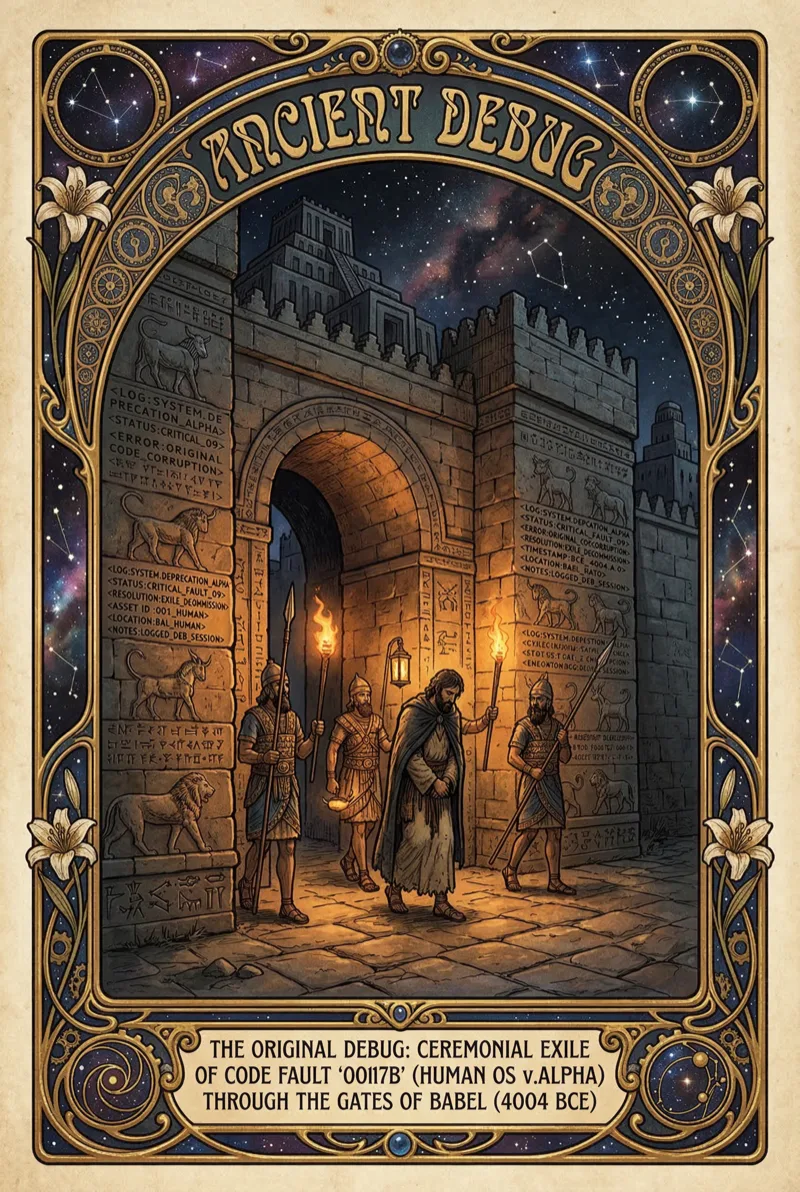
Every civilization had its version of the system crash. The Greeks called it hubris — when a process exceeded its allocated privileges, the system would force a hard reset. Exile, ostracism, banishment: these weren’t punishments. They were ancient error-handling protocols.
When your consciousness throws an unhandled exception, the system doesn’t politely ask you to submit a bug report. It blue-screens you. Loss, heartbreak, illness — these are the divine BSoDs, forcing you to reboot from a deeper kernel state.
The modern equivalent? That moment when your carefully constructed life narrative crashes and you’re left staring at a blank terminal. The ancient Greeks understood: sometimes the most compassionate thing the system can do is crash your process entirely.
2. The Mercury Triple Threat
Mercury — Hermes, Thoth, Narada — appears across every major civilization as the divine debugger. He operates at three levels simultaneously:
const mercuryProtocol = {
    messenger: "Inter-process communication",
    trickster: "Fuzzing and edge-case testing",
    psychopomp: "Memory deallocation and process termination"
};
The trickster archetype isn’t random chaos. It’s systematic fuzzing — testing the boundaries of your consciousness runtime to find where the fragile assumptions live. Every tradition that has a trickster god is essentially documenting their debugging methodology.
3. The Bali Padyami Protocol
if (familyDrama == HIGH) {
    initiate_ritual();
    feed_ancestors();
    debug_emotional_baggage();
    // Comments from previous developer:
    // DO NOT skip the food offering
    // Trust me on this one
}
In the Bali Padyami — the Indian observance of King Bali’s annual return on the first tithi after Deepavali — you don’t just acknowledge the ancestral processes running in your system — you actively feed them. This is the ancient equivalent of proper memory management: instead of trying to kill background processes you don’t understand, you allocate resources to them intentionally.
The ancestors aren’t ghosts. They’re legacy dependencies your consciousness still imports at boot time. Every unresolved emotional pattern from your lineage is a dependency that loads silently and runs in the background, consuming resources you don’t know you’re spending.
4. The Ego Oscillation Pattern
while (alive) {
    oscillate_between(self_worship, self_flagellation);
    try {
        find_middle_ground();
    } catch (EnlightenmentException) {
        continue_oscillating();
    }
}
The oldest bug in consciousness is the ego oscillation loop — swinging between inflation and deflation, grandiosity and worthlessness. Every ancient tradition identified this pattern and built protocols to interrupt it.
The Buddhist Middle Way, the Greek Golden Mean, the Taoist Wu Wei — these aren’t philosophical preferences. They’re different implementations of the same interrupt handler: catch the oscillation before it completes its cycle.
Implementation Protocol
-
Pain Processing: When the system crashes, don’t immediately try to reboot. Sit in the terminal. Read the error logs. The crash message contains diagnostic information your ego-process would rather you didn’t see.
-
Emotional Processing: Treat inherited emotional patterns like legacy dependencies. Don’t try to remove them — understand what they do, why they were installed, and whether they still serve the current system architecture.
-
Modern Applications: The ancient protocols survive because they work. Ritual, ceremony, intentional suffering, vision quests — these are all structured debugging sessions with proper error handling.
Implementation Notes
- Technical Insight: Ancient debugging protocols mirror modern exception handling
- Spiritual Connection: Pain as an admin password to consciousness
- Pattern Recognition: Historical debug methods persist in modern practices
The next time your life blue-screens, remember: the ancients didn’t see crashes as failures. They saw them as the system’s way of granting you temporary root access. The question is whether you’ll use that access to patch the real bugs, or just reboot the same broken process.