200 OK: Your Guide to Mental Status Codes
Debugging the human response system
Every server returns a status code. Every human does too. The difference is that servers are honest about it.
When your browser hits a URL, the response comes back clean: 200 OK, 404 Not Found, 500 Internal Server Error. No ambiguity. No performance. The server states its condition with mechanical precision. But when someone asks how you are doing, the response is almost always a fabricated 200 OK — even when the internal state is running a 503 Service Unavailable.
This is not a metaphor. This is architecture.
The 1xx Informational Range: Processing States
100 Continue — You have received the initial request. The body is still loading. This is meditation before the thought completes. This is the breath between stimulus and response that Viktor Frankl identified as the seat of freedom. Most people skip this status code entirely, jumping from request to reaction without ever entering the processing state.
101 Switching Protocols — The moment of genuine perspective shift. Not the intellectual understanding that you should see things differently, but the actual protocol change at the transport layer. In consciousness terms, this is what the Vedantic tradition calls viveka — discrimination between the real and the unreal. The connection upgrades from HTTP to WebSocket. From reactive to receptive. From half-duplex to full-duplex awareness.
102 Processing — The server has received the request and is working on it, but no response is available yet. This is grief. This is integration. This is the three-day darkness before resurrection in every mythological cycle. The client must learn to wait without timeout.
The 2xx Success Range: Coherent States
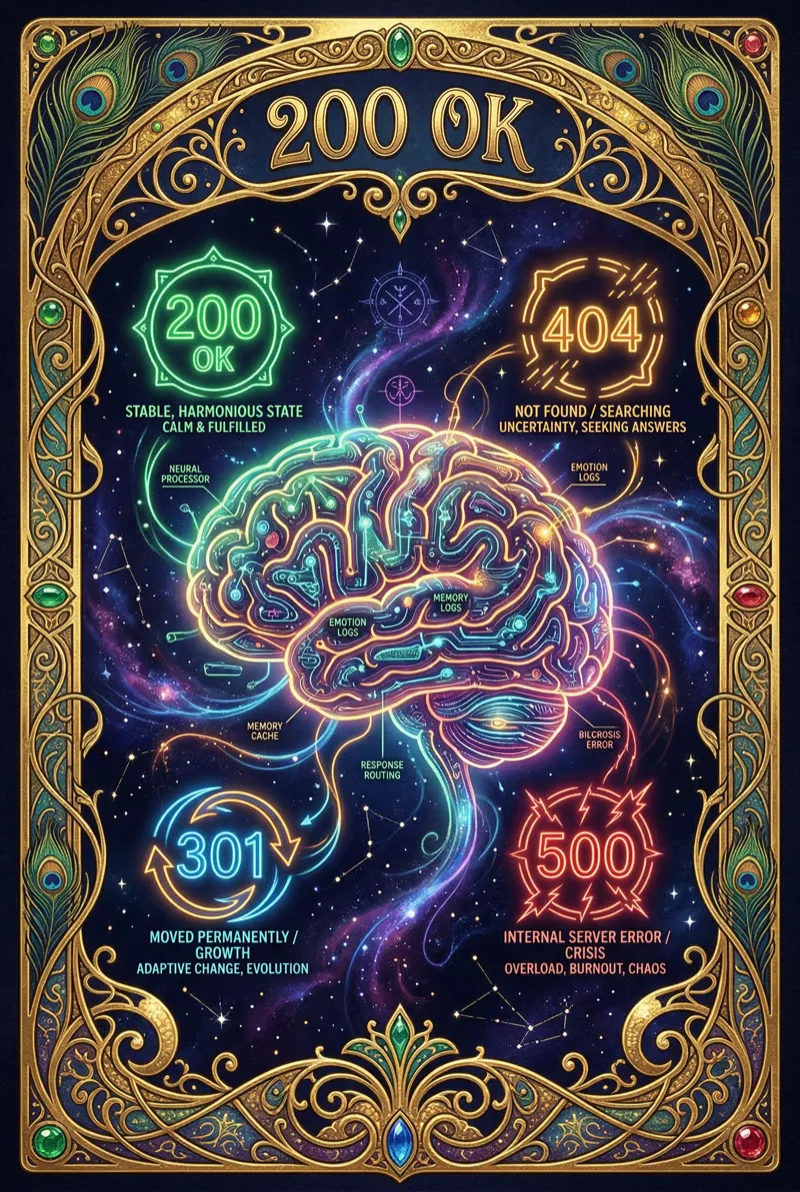
200 OK — True 200 OK is rarer than you think. It means the request was received, understood, accepted, and processed successfully. In human terms, this is not the absence of problems. It is the state where your internal architecture is aligned with your external interface. Your public API matches your private implementation. What you say you are is what you actually are. Most spiritual traditions call this integrity. Engineers call it consistency.
201 Created — Something new exists that did not exist before the request. This is genuine insight — not the recycling of existing patterns, but the emergence of a novel configuration. The response includes a Location header pointing to the newly created resource. You know where the new thing lives. You can reference it again.
204 No Content — The request succeeded, but there is nothing to send back. This is the deepest meditation state. The operation completed perfectly and the result is silence. The server does not need to return a body because the action itself was the response. Every contemplative tradition has a name for this: sunyata, kenosis, the Cloud of Unknowing. The request was fulfilled by emptiness.
The 3xx Redirection Range: Transition States
301 Moved Permanently — The resource you are looking for no longer lives at this address. This is the status code of genuine transformation. You cannot access the old self at the old URI because it has been permanently relocated. The healthy response is to update your bookmarks. The unhealthy response is to keep hitting the old endpoint and wondering why you get redirected.
302 Found (Temporary Redirect) — The resource exists but is temporarily somewhere else. This is dissociation with a return ticket. The self is not destroyed, just momentarily displaced. Trauma responses often live here — the consciousness redirects to a safer location but intends to come back. The question is whether the temporary redirect becomes permanent through repetition.
304 Not Modified — The client’s cached version is still valid. Nothing has changed. This is both the most efficient status code and the most terrifying one. Efficiency, because no bandwidth is wasted re-transmitting what is already known. Terror, because sometimes you desperately want something to have changed, and the server calmly reports: not modified. Your patterns are cached. Your responses are cached. Your suffering is cached, and it has not been invalidated.
The 4xx Client Error Range: Self-Generated Failures
400 Bad Request — The server cannot process the request because the client sent malformed syntax. This is the moment you realize your question was wrong. Not that the answer was unavailable, but that the way you framed the inquiry made it unprocessable. Most existential crises are 400 errors disguised as 404s. You think the meaning is not found. Actually, your request for meaning was malformed.
401 Unauthorized — The request requires authentication. You have not proven you are who you claim to be. In consciousness work, this is the guardian at the threshold. The knowledge exists. The resource is real. But you have not yet presented valid credentials. Every initiatory tradition is an authentication protocol.
403 Forbidden — You authenticated successfully. The server knows exactly who you are. And the answer is no. Unlike 401, this is not about proving identity. It is about permission. Some states of consciousness are forbidden not because they do not exist but because your current permission level does not grant access. The difference between 401 and 403 is the difference between “you need to do the work” and “you have done the work and you are still not ready.”
404 Not Found — The most famous error code and the most misunderstood. The server is not saying the resource does not exist. It is saying the resource cannot be found at this URI. Maybe it never existed at this location. Maybe it was removed. Maybe you are looking in the wrong place entirely. The spiritual 404 is searching for peace in achievement, for love in approval, for self in the opinions of others. The resource is real. The address is wrong.
408 Request Timeout — The server waited for the client to send a complete request, but the client took too long. This is the missed moment. The window of transformation that opened and closed while you were still composing your intention. The server’s patience is not infinite. Some doors have timeouts.
429 Too Many Requests — Rate limiting. You are sending too many requests in too short a time. This is burnout mapped to protocol. The server is not broken. You are overwhelming it. The appropriate response is to back off, respect the Retry-After header, and understand that the system’s capacity is finite even if your demands feel infinite.
The 5xx Server Error Range: System-Level Failures
500 Internal Server Error — The server encountered an unexpected condition. This is the honest breakdown — the system that admits it does not know what went wrong. A 500 error is more trustworthy than a fake 200 because at least the server is reporting its actual state. Most mental health crises are unacknowledged 500 errors that have been masked behind fabricated 200 responses for years.
502 Bad Gateway — The server acting as a gateway received an invalid response from the upstream server. You processed the request correctly, but the system you depend on gave you garbage. This is the status code of having done everything right and still receiving a broken response from reality. Your gateway logic is sound. The upstream is corrupted. Sometimes the problem is genuinely not yours.
503 Service Unavailable — The server is currently unable to handle the request due to temporary overloading or maintenance. This is the most important status code to learn how to return honestly. You are not broken. You are temporarily unavailable. The service will resume. But right now, the capacity is exceeded or the maintenance window is active. The tragedy is that most people never return a 503. They run at full capacity until they throw a 500 and crash.
504 Gateway Timeout — The upstream server did not respond in time. You were waiting for something — an answer, a sign, a response from the universe — and it simply did not arrive within the timeout window. The question is whether to extend the timeout, retry the request, or accept that some upstream servers do not respond on your schedule.
Implementing Your Status Code Protocol
The practice is simple. Before you respond to any request — from another person, from a situation, from your own mind — pause long enough to check your actual status code. Not the one you want to return. Not the one that is socially acceptable. The real one.
Then return it honestly.
A system that accurately reports its own status codes can be debugged, maintained, and improved. A system that always returns 200 OK regardless of internal state is a system that cannot be helped, because it has defined help as unnecessary through its own dishonest API.
The protocol is the practice. The status code is the meditation. And the first step toward a genuine 200 OK is admitting that you are not there yet.
Your consciousness already has a status code. The question is whether you are reading it or fabricating it.