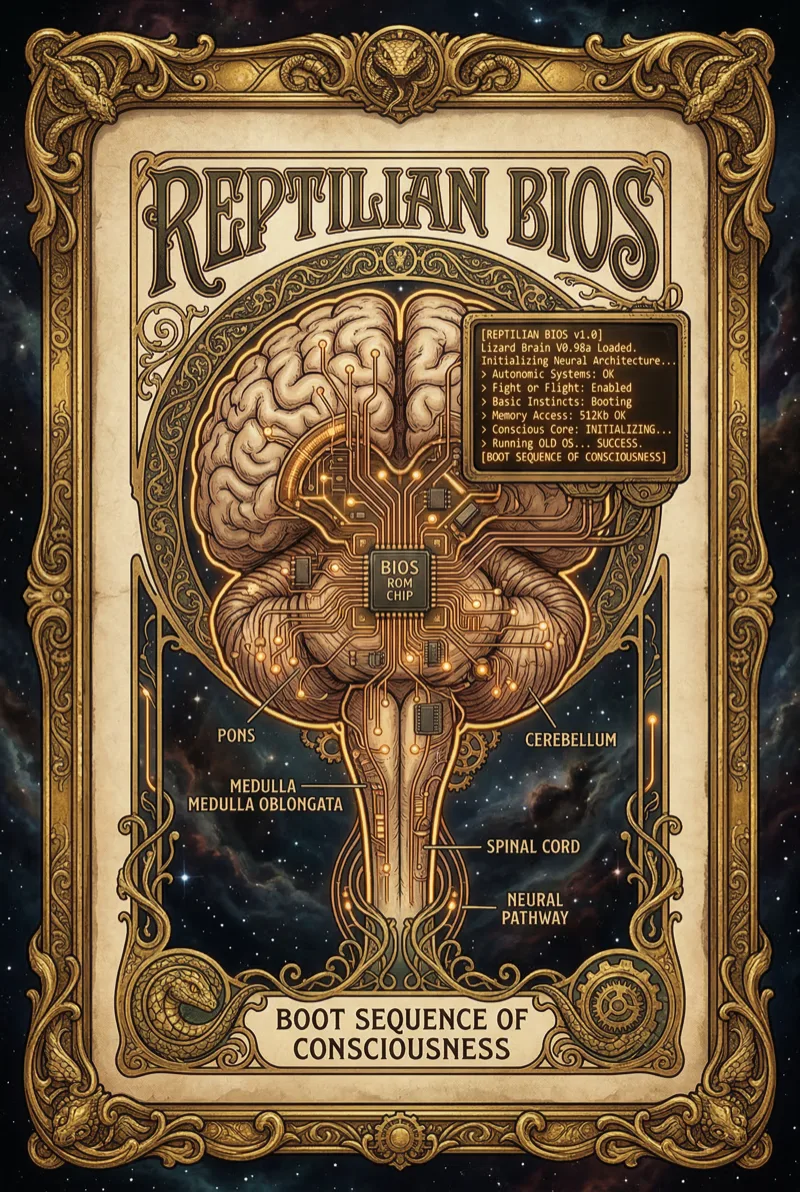
Reptilian BIOS Architecture
Before your operating system loads, before your desktop renders, before a single application opens — the BIOS runs. Basic Input/Output System. The firmware layer that tests the hardware, initializes the peripherals, and bootstraps the system into a state where higher-order software can execute.
The reptilian brain is your biological BIOS.
It does not think. It does not feel. It does not reflect. It detects novelty, assesses threat, evaluates food potential, and — if none of these triggers fire — maintains current state. This is not primitive. This is the most efficient processing architecture evolution has ever produced.
The Hardware Layer
The reptilian brain — technically the brainstem and basal ganglia — operates through three primary hardware components:
PAG (Periaqueductal Gray) functions as the control center. This small region in the midbrain coordinates the body’s most fundamental responses: pain modulation, defensive behavior, vocalization, and cardiovascular regulation. It is the CPU of survival processing — compact, dedicated, and impossibly fast.
The brainstem serves as the primary processor, handling respiration, heart rate, blood pressure, and arousal level without any input from conscious awareness. You do not decide to breathe. The brainstem decides for you, approximately 20,000 times per day, and has never once asked for permission.
The spinal cord operates as the data bus — the physical pathway through which sensory data ascends and motor commands descend. It also handles its own local processing: spinal reflexes that withdraw your hand from a hot surface before the brainstem even receives the pain signal.
const reptilianBIOS = {
  bootSequence: {
    priority: ["survival", "homeostasis", "reflexes"],
    startup: "automatic",
    override: "limited"
  },
  basicIO: {
    input: ["sensory", "chemical", "pressure"],
    output: ["motor", "glandular", "thermal"],
    processing: "immediate"
  },
  decisionTree: {
    step1: "detect novelty",
    step2: "assess threat",
    step3: "evaluate food potential",
    default: "maintain current state"
  }
};
The BIOS Parallel
The structural parallels between computer BIOS and reptilian brain architecture are not analogical — they are convergent. Both systems solve the same engineering problem: how to bootstrap a complex system from a cold start.
| Computer BIOS | Reptilian Brain |
|---|---|
| Power-on self-test | Autonomic status check |
| Hardware initialization | Sensory calibration |
| Basic I/O handling | Reflex processing |
| Bootstrap loading | Survival mode activation |
| Clock speed detection | Temperature-dependent processing |
| Memory testing | Proprioceptive mapping |
The convergence extends to operating parameters. Computer BIOS runs on minimal power, occupies minimal memory, and executes in minimal time. The reptilian brain runs on minimal caloric expenditure, occupies minimal neural volume relative to its functional range, and processes at speeds that the neocortex cannot match.
A snake can strike in 60-100 milliseconds. A human blink takes 300-400 milliseconds. The reptilian processor is three to four times faster than your conscious eye can close. This is BIOS-level speed — hardware interrupt handling, not software processing.
The Decision Architecture
The reptilian decision tree has exactly four nodes:
Node 1: Is this novel? The system monitors all sensory channels for deviation from baseline. Movement in peripheral vision. Unexpected sound. Temperature change. Chemical signature shift. If nothing deviates, the system holds current state — the biological equivalent of NOOP.
Node 2: Is this threatening? If novelty is detected, threat assessment fires immediately. This is not a rational evaluation. It is a pattern match against an ancient database of threat signatures: sudden movement, looming shapes, specific frequencies, certain smells. The match is binary — threat or not-threat — and executes in milliseconds.
Node 3: Is this food? If the stimulus is novel but not threatening, the system evaluates nutritive potential. Again, binary. Again, milliseconds.
Node 4: Default — maintain state. If the stimulus is not novel, not threatening, and not food, the reptilian brain returns to baseline monitoring. This is the state you are in most of the time, and you never notice it, because the BIOS does not report to the user interface.
Temperature-Dependent Processing
One detail of reptilian BIOS architecture carries implications for consciousness: the clock speed is temperature-dependent.
In actual reptiles, this is literal — metabolic rate, processing speed, and behavioral capacity all scale with ambient temperature. In the human reptilian brain, the dependency is more subtle but still present. Core body temperature modulates brainstem function. Hypothermia slows processing. Fever accelerates it. The PAG’s pain modulation is temperature-sensitive.
This maps directly to computer BIOS, where clock speed detection occurs at boot time and adjusts processing parameters accordingly. The system adapts to its thermal environment before higher-order software has any say in the matter.
Boot Sequence and Override Limitations
The reptilian BIOS boots first. Always. In every human, on every morning, after every loss of consciousness. Before your personality reassembles, before your emotional landscape reloads, before your cognitive frameworks reinitialize — the brainstem checks vital signs, calibrates sensory systems, establishes motor control, and confirms that the hardware is functional.
This is why trauma responses bypass conscious awareness. They are not processed by the neocortex because they are handled at the BIOS level — below the operating system, below the application layer, below everything you call “me.” The reptilian brain does not know who you are. It only knows what you are: a biological system that must be kept alive.
Override is limited. You cannot will your brainstem to stop monitoring threats any more than you can will your computer’s BIOS to skip the power-on self-test. You can, however, update the threat database. This is what exposure therapy does — it provides the reptilian pattern-matcher with new data that reclassifies previously threatening stimuli as non-threatening.
The BIOS does not learn in the way the neocortex learns. It learns the way firmware updates: slowly, through repeated exposure, and only when the system is in a safe-enough state to accept the new instructions.
The deepest code runs first, runs fastest, and runs without your knowledge. Understand your BIOS before you try to debug your operating system.