Reality.compile(): Ancient Source Code Running Your Consciousness
Debugging the Matrix through sacred system architecture
Somewhere in the Rigveda, composed roughly 3,500 years ago, a rishi encoded a function call that still compiles. The mantra was not poetry. It was not prayer in the way modernity understands prayer — as a request lobbed toward an anthropomorphic deity. It was source code. Executable instructions written in a language that targets consciousness as its runtime environment.
This is not a metaphor. This is a technical observation.
The Compiler You Did Not Know You Were Running
Every programming language requires a compiler or interpreter — something that transforms human-readable source code into machine-executable instructions. Sanskrit mantras operate on exactly this principle. The source code is the phonetic structure of the mantra. The compiler is the disciplined practice of repetition (japa). The target architecture is the nervous system. And the executable output is a measurable alteration in consciousness state.
The ancient rishis were not mystics in the modern sense. They were systems architects who understood something that contemporary neuroscience is only beginning to map: that specific sound frequencies, delivered through specific vocal configurations, produce specific neurological states. They wrote this knowledge down not as research papers but as executable code — mantras that anyone with the correct compiler (practice) could run on the correct hardware (a human body with a functioning nervous system).
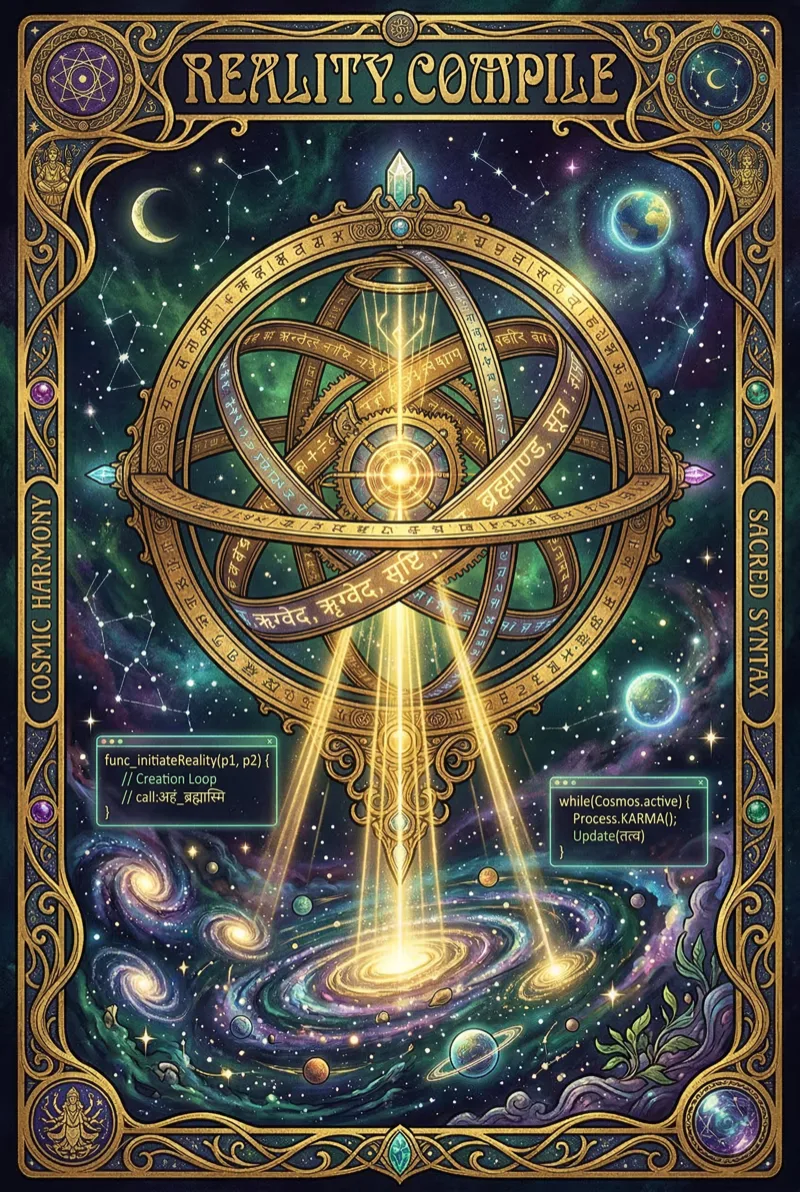
Consider the Gayatri Mantra. Twenty-four syllables. Each syllable mapped to a specific energy center. The meter (chandas) is not aesthetic — it is a timing protocol that ensures the syllables hit the neural substrate in the correct sequence. Change the meter and the program crashes. Mispronounce a syllable and you get a runtime error. The ancients called this shabda-brahman — the ultimate reality as sound. We might call it Reality.compile(), the function that transforms vibratory source code into experiential output.
The Architecture of Sacred Source
Modern software architecture recognizes several layers: hardware, operating system, runtime, application. The ancient systems mapped identical layers onto the human being:
Hardware Layer (Annamaya Kosha) — The physical body. Silicon and carbon are not so different when you consider that both serve as substrates for information processing. The body is the hardware that runs consciousness, with the nervous system functioning as the bus architecture connecting input/output devices (senses) to the central processor (brain) and the deeper processing cores (the enteric nervous system, the cardiac neural network).
Operating System (Pranamaya Kosha) — The breath. Prana is not a mystical concept. It is the operating system that manages resource allocation between hardware components. Pranayama is system administration — manually managing process priorities, clearing memory leaks, and optimizing I/O throughput. Every experienced meditator knows that changing the breath pattern immediately alters the system state. This is not metaphysics. This is kernel-level access.
Runtime Environment (Manomaya Kosha) — The mind. This is the virtual machine on which thought-programs execute. Like any runtime, it has garbage collection (sleep), memory management (attention), and process scheduling (the default mode network). Most people never access the runtime directly. They interact with it only through the applications (thoughts, emotions) that run on top of it.
Application Layer (Vijnanamaya Kosha) — Discernment. The higher-order programs that evaluate the output of the mental runtime. This is the layer where you can observe your own thoughts — the debugger running alongside the application, inspecting variables and stepping through execution.
Root Process (Anandamaya Kosha) — The bliss sheath. The init process from which all other processes fork. This layer is always running, always returning 200 OK, regardless of what the application layer reports. Accessing it directly is what the traditions call enlightenment. In technical terms, it is gaining root access to your own consciousness stack.
Ancient APIs: The Interface Contracts
The rishis did not only write source code. They documented APIs. The Upanishads are interface specifications — formal contracts that define how the human system can interact with the deeper layers of reality.
The Mandukya Upanishad, for example, specifies exactly four states of consciousness (waking, dreaming, deep sleep, and turiya — the fourth) and provides the API call for accessing each one. The API call is the syllable AUM, which the text decomposes into three phonemes (A-U-M) plus the silence that follows. Each phoneme maps to a consciousness state. The silence maps to turiya. The documentation is precise, versioned, and reproducible.
This is what distinguishes ancient source code from modern self-help: reproducibility. A mantra either works or it does not, and the conditions for success are specified with engineering precision. The adhikari (qualified practitioner) must meet specific prerequisites. The viniyoga (application protocol) must be followed exactly. The rishi (original developer) is credited. The devata (target system) is identified. This is not faith-based. It is specification-based.
The Compilation Process
When a mantra is compiled correctly, the process follows a defined sequence:
Lexical Analysis — The practitioner learns the correct pronunciation. Each phoneme is a token. Mispronunciation introduces lexical errors that prevent compilation. This is why the Vedic tradition placed such extreme emphasis on oral transmission accuracy — not out of superstition, but because a single corrupted token could change the program’s behavior entirely.
Parsing — The mind organizes the tokens into the correct grammatical structure. The meter provides the parse tree. The meaning provides semantic context. But importantly, the meaning is secondary to the structure — just as a compiler parses syntax before evaluating semantics. The mantra works even when the practitioner does not intellectually understand it, because compilation operates at a level below semantic interpretation.
Optimization — Through repetition, the neural pathways associated with the mantra become increasingly efficient. What initially requires conscious effort becomes automatic. The compiled code is optimized through use. This is why traditions prescribe specific repetition counts (108, 1,008, 100,000) — these are not arbitrary numbers but empirically determined thresholds at which the optimization reaches critical levels.
Execution — The optimized program runs. Consciousness state changes. The output is not a belief or an idea but a direct experiential modification — measurable in brainwave patterns, hormonal cascades, and autonomic nervous system responses.
Debugging the Matrix
If reality is a compiled program, then suffering is a bug — not in the source code but in the compilation. The original source (the Vedic insight that consciousness is fundamental and matter is derivative) compiles correctly when the practitioner follows the specification. It produces runtime errors when the compilation process is corrupted by incorrect pronunciation, incomplete practice, or — most commonly — by attempting to run the program on an improperly configured system.
The ancient debugging protocol was straightforward: if the program is not producing the expected output, check the following in order:
- Is the source code correct? (Are you using an authentic mantra from an established lineage?)
- Is the compiler configured correctly? (Are you practicing with proper technique?)
- Is the hardware functioning? (Is your body healthy enough to serve as the execution environment?)
- Is the operating system stable? (Is your breath regulated?)
- Are there conflicting processes? (Are unresolved emotional states consuming resources?)
This debugging checklist is functionally identical to the troubleshooting methodology used by any competent systems administrator. The only difference is the substrate.
The Repository Is Still Live
The remarkable thing about ancient source code is that the repository has never gone offline. The Vedas were transmitted orally for over a thousand years before being written down, with an error rate that modern version control systems would envy. The mantras still compile. The APIs still respond. The architecture documentation is still accurate.
The question is not whether the ancient source code works. The question is whether you have the development environment configured to run it. The compiler is free. The documentation is open source. The hardware ships pre-installed.
Reality.compile() is waiting for your function call.
The source code was never lost. You just forgot you had a compiler.