Consciousness Runtime Framework Diagrams
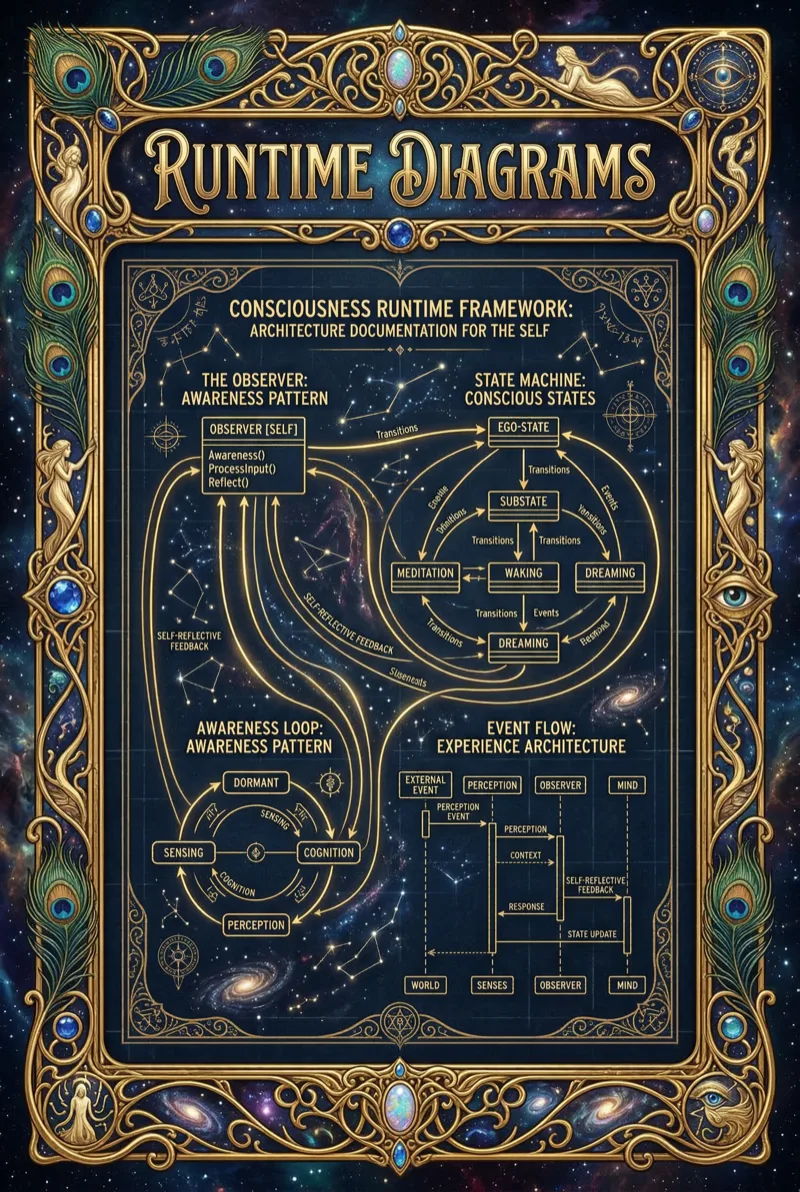
Every runtime has a diagram. Docker has its container architecture. Kubernetes has its pod topology. TCP/IP has its four-layer model. Consciousness has its triune brain — and when you render it as system architecture rather than neuroscience, the operational clarity is immediate.
These diagrams are not metaphors. They are deployment specifications for a biological runtime that has been in production for three hundred million years.
Diagram 1: The Three-Layer Stack
┌─────────────────────────────────────────┐
│         NEOCORTEX (Application Layer)    │
│  ┌─────────────────────────────────────┐ │
│  │ Abstract reasoning                  │ │
│  │ Language processing                 │ │
│  │ Future modeling                     │ │
│  │ Identity construction               │ │
│  │ Clock: Slow (100-500ms response)    │ │
│  └─────────────────────────────────────┘ │
├─────────────────────────────────────────┤
│         LIMBIC (Operating System Layer)  │
│  ┌─────────────────────────────────────┐ │
│  │ Emotional processing               │ │
│  │ Memory consolidation               │ │
│  │ Social computation                  │ │
│  │ Motivation management              │ │
│  │ Clock: Medium (50-200ms response)   │ │
│  └─────────────────────────────────────┘ │
├─────────────────────────────────────────┤
│         BRAINSTEM (BIOS/Firmware Layer)  │
│  ┌─────────────────────────────────────┐ │
│  │ Survival processing                │ │
│  │ Autonomic regulation               │ │
│  │ Reflex handling                     │ │
│  │ Sensory calibration                │ │
│  │ Clock: Fast (10-100ms response)     │ │
│  └─────────────────────────────────────┘ │
└─────────────────────────────────────────┘
The three layers do not communicate democratically. The BIOS layer has veto power over everything above it. If the brainstem detects a survival-level threat, it preempts limbic processing and neocortical reasoning simultaneously. This is not a bug in the architecture — it is the defining feature. The lowest layer has the highest priority.
In software terms, the brainstem operates at interrupt level 0. The limbic system runs at interrupt level 1. The neocortex runs at user level. When you cannot think clearly during a panic attack, you are experiencing a firmware-level interrupt that has preempted all application-layer processing.
Diagram 2: The Process Management Model
┌──────────────────────────────────────┐
│         CONSCIOUSNESS OS              │
│                                      │
│  ┌──────────┐  ┌──────────────────┐  │
│  │ Identity │  │ Process Manager  │  │
│  │ Service  │  │                  │  │
│  │          │  │ Priority Queue:  │  │
│  │ self-    │  │  1. Survival     │  │
│  │ concept  │  │  2. Emotional    │  │
│  │ boundary │  │  3. Social       │  │
│  │ updates  │  │  4. Cognitive    │  │
│  └──────────┘  │  5. Creative     │  │
│                └──────────────────┘  │
│  ┌──────────┐  ┌──────────────────┐  │
│  │ Memory   │  │  I/O Manager    │  │
│  │ Manager  │  │                  │  │
│  │          │  │  IN:  Sensory    │  │
│  │ short-   │  │       Chemical   │  │
│  │ term buf │  │       Social     │  │
│  │ long-    │  │  OUT: Motor      │  │
│  │ term     │  │       Glandular  │  │
│  │ store    │  │       Emotional  │  │
│  │ cache    │  │       Verbal     │  │
│  └──────────┘  └──────────────────┘  │
└──────────────────────────────────────┘
The process manager runs a strict priority queue. Survival processes preempt emotional processes. Emotional processes preempt social processes. Social processes preempt cognitive processes. Cognitive processes preempt creative processes.
This is why you cannot write poetry when you are hungry, cannot solve equations when you are grieving, cannot maintain friendships when you are in danger. The runtime allocates resources to the highest-priority active process and starves everything below it.
The memory manager handles four distinct storage types: short-term working buffer (7 plus or minus 2 items, approximately 30-second retention), long-term pattern storage (consolidated during sleep via hippocampal replay), procedural memory (motor skills, encoded in basal ganglia), and episodic memory (experienced events, stored with emotional metadata).
Diagram 3: The Interface Architecture
┌─────────────────────────────────────┐
│          EXTERNAL INTERFACE          │
│  ┌─────────┐  ┌───────────────────┐ │
│  │ Social  │  │ Environmental    │ │
│  │ Module  │  │ Module           │ │
│  │         │  │                   │ │
│  │ face    │  │ temperature      │ │
│  │ reading │  │ light level      │ │
│  │ tone    │  │ chemical         │ │
│  │ posture │  │ spatial          │ │
│  └─────────┘  └───────────────────┘ │
├─────────────────────────────────────┤
│          INTERNAL INTERFACE          │
│  ┌─────────┐  ┌───────────────────┐ │
│  │ Body    │  │ State            │ │
│  │ Map     │  │ Monitor          │ │
│  │         │  │                   │ │
│  │ proprio │  │ emotional state  │ │
│  │ ception │  │ energy level     │ │
│  │ intero  │  │ attention        │ │
│  │ ception │  │ coherence        │ │
│  └─────────┘  └───────────────────┘ │
├─────────────────────────────────────┤
│          SYSTEM CALLS                │
│                                     │
│  fight()  flight()  freeze()        │
│  bond()   grieve()  celebrate()     │
│  analyze() create() integrate()     │
└─────────────────────────────────────┘
The interface architecture reveals something that pure neuroscience diagrams obscure: the consciousness runtime has explicit system calls. These are not voluntary actions — they are pre-defined responses that the system executes when specific input patterns match specific thresholds.
fight(), flight(), and freeze() are BIOS-level system calls. bond(), grieve(), and celebrate() are OS-level system calls. analyze(), create(), and integrate() are application-level system calls.
You cannot call create() while fight() is executing. The interrupt priority prevents it. You cannot call integrate() while grieve() holds the processing queue. Understanding which system calls are active — and which are blocking — is the foundation of consciousness debugging.
Diagram 4: The Update Protocol
LEARNING INTEGRATION PIPELINE:

  New Experience
       │
       ▼
  Pattern Match? ──YES──► Update Existing Pattern
       │                        │
       NO                       ▼
       │                  Verify Coherence
       ▼                        │
  Create New Pattern             ▼
       │                  Commit to Long-Term
       ▼
  Test Against Reality
       │
       ▼
  Stable? ──NO──► Iterate
       │
      YES
       │
       ▼
  Integrate into Identity
The update protocol is where most consciousness work fails. New experiences enter the system and get pattern-matched against existing models. If a match is found, the existing pattern is updated — but “updated” usually means “confirmed,” not “revised.” Confirmation bias is not a cognitive error. It is the default behavior of the pattern-matching system. The runtime is designed to prefer stability over accuracy because, at the BIOS level, a wrong-but-fast model is more survival-relevant than a right-but-slow model.
Genuine learning — the kind that changes identity, not just knowledge — requires the system to fail at pattern matching, create a new pattern, test it against reality, iterate until stable, and then integrate the new pattern into the identity service. This is why real transformation is slow, uncomfortable, and resistant to shortcuts. It requires running the full update pipeline, and most people exit at the first Iterate loop.
The diagram is not the territory. But if you cannot diagram your runtime, you cannot debug it.