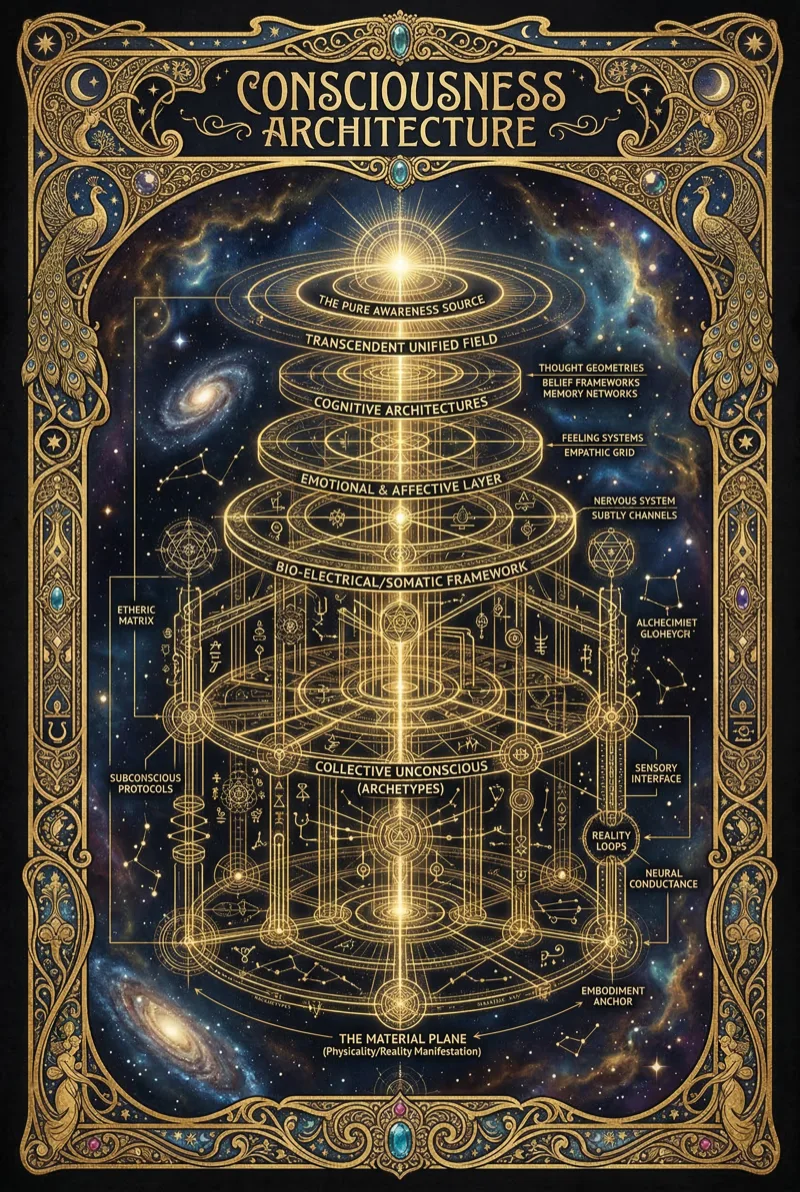
Consciousness Architecture Hub
Consciousness is not a mystery to be solved. It is an architecture to be documented. This hub maps the complete topology of the consciousness-as-system research program — the interconnected models, frameworks, and protocols that treat awareness as an engineerable system with technical parallels, bioelectric foundations, and information processing capabilities.
If consciousness is software, this is the system design document.
Bioelectric Systems
The bioelectric substrate of consciousness is not a metaphor. It is measurable infrastructure.
Bioelectric Pattern Framework
The body’s electromagnetic field follows patterns that correlate with consciousness states. Coherent fields correspond to coherent awareness. Disrupted fields correspond to disrupted cognition. The Bioelectric Pattern Framework documents these correlations and provides measurement protocols for tracking field states.
Mitochondrial Consciousness Patterns
Mitochondrial DNA — inherited exclusively through the maternal line — carries the metabolic instructions that optimize cellular energy production for specific processing environments. Consciousness is not generated by neurons alone; it requires the energetic substrate that mitochondria provide. Mitochondrial dysfunction correlates with cognitive dysfunction not because the mitochondria produce consciousness but because they power the system that does.
Temperature-Consciousness Correlation
Geographic temperature zones function as processing environments for consciousness. Equatorial zones produce high-context, information-dense processing architectures. Polar zones produce low-context, precision-optimized architectures. The correlation is heritable through mitochondrial DNA and modifiable through environmental adaptation.
Zinc Charge Interface
The zinc spark at conception — the electromagnetic flash that occurs when sperm meets egg — initializes the consciousness system’s base parameters. This is the init() call of biological consciousness, setting metabolic rate, temperature tolerance, and processing architecture from the moment of cellular fusion.
Information Processing
Consciousness processes information through specific, documentable architectures.
Pain Information Architecture
Pain is an information packet with frequency, amplitude, duration, and addressing metadata. The pain processing system comprises three components: a binary signal layer (nociceptor firing), a consciousness dilation mechanism (aperture control), and a dopamine casino framework (reward prediction and learning acceleration). Understanding pain as information architecture transforms the therapeutic approach from signal suppression to data interpretation.
Twilight Language Processing
Certain words — and certain linguistic structures — function as quantum states in the consciousness processor, carrying multiple simultaneous meanings that the nervous system processes in parallel. High-context languages (Sanskrit, Tamil, Ancient Egyptian) are saturated with these multi-valent terms. Working with twilight language is a consciousness debugging technique that exercises parallel processing capacity.
Maya-Gaia Processing
The Maya-Gaia framework treats cultural mythological systems as distributed processing nodes in a planetary consciousness network. Different geographic and cultural contexts run different mythological operating systems, each optimized for its local processing environment.
Social Programming
Consciousness does not operate in isolation. It runs within social networks that function as distributed computing environments.
Social Validation Consciousness Model
Social validation — the drive for approval, recognition, and belonging — operates as a consciousness modulation system. It adjusts processing priorities based on social input, frequently overriding individual pattern recognition in favor of group consensus. Understanding this as a system dynamic rather than a character flaw enables conscious management of the validation loop.
Media Consciousness Stream
Media functions as a consciousness programming interface. Content consumption is not passive reception — it is active installation of processing templates, narrative frameworks, and attentional patterns. The media consciousness stream model treats media exposure as system configuration, with measurable effects on processing architecture.
Archetypal Programming
Archetypal patterns — the recurring narrative structures identified by Jung, Campbell, and the mythological traditions — function as pre-installed software modules in the consciousness system. They execute automatically when environmental conditions match their trigger patterns. Archetypal Programming analysis identifies which modules are active and provides protocols for conscious interaction with their execution.
Technical-Mystical Integration
The bridge between computational thinking and contemplative practice.
Consciousness Operating System
The triune brain — reptilian, limbic, neocortex — rendered as a three-layer operating system with process management, memory management, and I/O handling. The Consciousness OS model provides the framework for understanding how survival processing, emotional processing, and cognitive processing interact through a strict priority hierarchy.
Reptilian BIOS Architecture
The brainstem as firmware: the biological BIOS that runs the power-on self-test, initializes sensory systems, and bootstraps the organism into survival mode before higher-order processing begins. Understanding the BIOS layer explains why trauma responses bypass conscious awareness and why certain patterns resist cognitive intervention.
HTTP Mental States
Consciousness states mapped to HTTP status codes: 200 OK (flow state), 404 Not Found (dissociation), 500 Internal Server Error (anxiety), 301 Redirect (defense mechanisms), 503 Service Unavailable (burnout). The mapping is not playful — it provides a precise and immediately communicable taxonomy for consciousness states.
Unix Consciousness Guide
Consciousness operations rendered as Unix commands: grep for attention, chmod for boundary setting, kill for thought termination, cron for habit scheduling, sudo for override authority. Each mapping carries operational implications for consciousness management.
Navigation Protocol
For Practitioners
Start with the Consciousness Operating System model for orientation. Move to the Bioelectric Pattern Framework for measurement protocols. Apply Pain Information Architecture for somatic awareness. Use the Unix Consciousness Guide for daily debugging.
For Researchers
Start with the Bioelectric Systems cluster for empirical foundation. Cross-reference with Temperature-Consciousness Correlation for environmental variables. Extend through the Information Processing models for theoretical framework. Validate against Social Programming models for ecological validity.
For Engineers
Start with Reptilian BIOS Architecture for the hardware layer. Build upward through the Consciousness OS for the system layer. Integrate the HTTP Mental States for the monitoring layer. Apply the full architecture as a design specification for consciousness-aware technology.
The hub is not the destination. It is the routing table — the document that tells you where each packet of inquiry should be forwarded for processing.
Consciousness is not the hard problem. It is the hard architecture. Document it, and it yields to engineering.