Hyperbolic Consciousness: Why Your Mind Cannot Think in Exponentials
Runtime Version: 1.0.0
“Is it possible to have a thermometer for how high on DMT someone is?” — Andrés Gómez Emilsson, Qualia Research Institute
The Geometry You Were Born Into
The observable universe has a spatial curvature measured at κ ≈ 0. Flat. Your ancestors evolved on it. Every circuit in your nervous system — retinal ganglion cells, hippocampal place cells, vestibular balance loops — is calibrated to this geometry. Area = πr². Double the radius, quadruple the area. Your motor cortex knows this the way a fish knows water: totally, invisibly, without a single concept for what it would mean to be somewhere else.
In the Kha-Ba-La architecture, this flatness is La — the sculpting material, the resistance that gives form to formlessness. La is the ground Ba pushes off from. And La is Euclidean.
Which means every intuition Ba has ever formed about growth, distance, and propagation is polynomial. The 2020 exponential curve that epidemiologists posted and entire nations could not parse was not a failure of math education. It was Ba trying to read a curved signal with a flat instrument. The instrument was correct about its calibration. It was wrong about the territory.
But there exists another geometry — one where area does not grow as πr² but as 2π(cosh(r) − 1). Exponentially.
from math import pi, cosh

print(f"{'r':>4} {'Euclidean':>12} {'Hyperbolic':>14} {'Ratio':>8}")
print("-" * 42)
for r in range(1, 11):
    euc = pi * r**2
    hyp = 2 * pi * (cosh(r) - 1)
    print(f"{r:>4} {euc:>12.1f} {hyp:>14.1f} {hyp/euc:>8.1f}x")

# r=5:   78.5 vs    286   (3.6x)
# r=10: 314.2 vs 69,004   (219.6x)
At r = 10, the hyperbolic disk contains 219 times the area of its Euclidean counterpart. The divergence is not gradual. It is a phase transition in what “nearby” means. And this geometry — hyperbolic, negatively curved, exponentially branching — turns out to be the native geometry of consciousness when La’s grip loosens.
What Each Force Costs When It Is Absent
The Kha-Ba-La triad is not a metaphor. It is an operational grammar. You discover what each term does only when you remove it.
Remove Kha — the witness — and Ba wanders through hyperbolic space without recognition. This is the DMT user who returns with no residue, the meditator who enters absorption and emerges unchanged. The geometry was traversed. No one was there to record it. Without Kha, curvature is experienced as noise, not as information. The cost is amnesia disguised as transcendence.
Remove Ba — the body — and Kha sees curvature without entering it. This is the disembodied intellect that maps consciousness states it has never inhabited. The cartographer who never leaves the observatory. Without Ba, hyperbolic geometry remains a theorem. The fracture is permanent: knowledge without scar tissue.
Remove La — the resistance — and there is no form at all. Pure noise. The psychotic break. The amnesia level where curvature exceeds encoding capacity not because the instrument is too weak, but because there is nothing to push against. La is the stone the sculptor works. Remove the stone and the chisel has nothing to push against. The rupture is total: geometry without a geometer.
The triad holds only when all three forces are present and in tension. Inherited code — the Euclidean assumptions baked into every circuit by evolution, by culture, by trauma — is not dissolved. It is metabolized. La is the meal, not the poison.
Kale, Triangles, and the Seventeen Wallpaper Groups
Stitch six equilateral triangles at a corner and the surface lies flat. The angles sum to exactly 360°. There are precisely seventeen ways to tile this flat surface with repeating symmetry — the wallpaper groups, a hard mathematical ceiling. This is all the pattern that flatness can hold.
Now stitch seven triangles at the same corner. The angles exceed 360°. The surface buckles, wrinkles, curves to accommodate the excess. This is why kale curls. The leaf’s growth rate exceeds its Euclidean surface allocation. The venation pattern — seven-at-a-corner — demands hyperbolic geometry.
In hyperbolic space, the constraint vanishes. You can stitch seventeen triangles at a corner and tile the result. A hundred mirrors at a single point. The number of possible symmetry groups is infinite. Curvature creates room for pattern that flatness prohibits.
The Curvature Ladder
Andrés Gómez Emilsson of the Qualia Research Institute documented six levels of DMT experience, each corresponding to a measurable increase in experiential curvature. The taxonomy is not metaphorical. It is the kale leaf, run in reverse — starting from flat and watching what happens as you force more pattern into the available geometry. (Dose ranges and level names below are my mapping onto Emilsson’s QRI curvature ladder, not QRI’s published figures.)
Threshold (1–4 mg). Ba’s perceptual medium thins. Surfaces tessellate with the seventeen wallpaper groups. You are still in Euclidean territory, but the copying threshold for pattern entrainment has dropped.
Chrysanthemum (4–8 mg). The copying threshold drops further. More symmetry elements than Euclidean surface can hold. Seven triangles at every corner. The visual field wrinkles — blossoms — exactly as the kale leaf does. The seventeen groups become insufficient. The infinite begin.
Magic Eye (8–12 mg). The excess curvature starts encoding information. Experience factorizes — texture carries emotional tone, curvature carries semantic content. The depth map is unstable: it collapses back to chrysanthemum, reorganizes, collapses. Ba is learning to read non-Euclidean for the first time.
Waiting Room (12–25 mg). Space itself becomes hyperbolic. Hyperbolic honeycombs: three-dimensional tessellations where every cell contains more volume than Euclid permits. The “entities” are not beings — they are recognition events. Ba encountering pattern at a curvature it has no template for.
Phase Inversion (25–30 mg). The entire experiential space becomes a single hyperbolic honeycomb with projective inversions — the space collapses and flips inside a finite volume. Irreducible complexity. Maximum useful information — the edge between order and chaos where computation is most powerful.
Amnesia (30+ mg). Curvature so extreme that no encoding can crystallize. Emilsson’s metaphor: heat a rock until its crystal lattice melts. Whatever configurations the melt passes through, no residue survives. This is geometry exceeding the encoding system’s capacity.
The Energy-Information Landscape
In 1984, researchers mapped the parameter space of video feedback — pointing a camera at its own output, tweaking angle, zoom, and noise. What they catalogued was the complete ontology of dynamical systems. Every possible feedback behavior falls into four regimes: fixed points (stable, absorb perturbation), limit cycles (periodic repetition), strange attractors (bounded chaos, never-repeating), and noise (turbulence, all structure collapsed).
These four regimes are the four possible behaviors of any dynamical system with feedback. Consciousness is such a system.
The chart that emerges when you cross Emilsson’s curvature ladder (vertical: energy) with this feedback ontology (horizontal: information content) is the consciousness thermometer. Not a single number — a coordinate pair. Energy AND information.
Samadhi lives in the upper-left: high energy, perfect symmetry, the fixed-point attractor. Psychotic break lives in the upper-right: high energy, pure noise. Creative flow occupies the center: moderate energy, the strange attractor regime where computation is most powerful. The Lorenz-Kundli program was already mapping this landscape. The Lorenz attractor IS a strange attractor in this space.
The Three Trajectories and the Annealing Gate
A DMT experience — or a meditation session, or a fever, or a creative episode — is not a point but a trajectory.
Vertical ascent. Stay in the ordered region. Rise from Euclidean tessellation to hyperbolic honeycombs without touching chaos. This maximizes consonance. Meditators who train for years to access absorption states are engineering this trajectory.
Diagonal toward complexity. Trade consonance for information. Push toward the strange attractor regime at high energy. This is where irreducibly complex objects emerge. You bring back structural information about the space, at the cost of pleasant coherence.
The annealing arc. Deliberately push into noise — the upper-right quadrant where all constraints dissolve — and then slowly return through the ordered region.
In metallurgy, annealing heats a crystal until its lattice melts, dissolving grain boundaries and cold-work defects, then cools slowly so the lattice re-forms in a configuration that was unreachable from the cold state. You had to go through the melt.
Pain performs the same thermodynamic operation on La. Nociceptors fire in binary — action potential or not — and what you experience as intensity is popcount() across the receptor array. Pain dilates the consciousness aperture. La’s rigid crystal — habitual thought, inherited patterning, unexamined assumption — temporarily melts. Ba can now traverse geometry that was walled off by its own crystallographic defects.
Cool too fast and you re-freeze with the same grain boundaries. Cool slowly and what crystallizes is a configuration La could not have reached without the melt. Robin Carhart-Harris calls this entropic disintegration. The Kha-Ba-La frame calls it metabolizing La.
The shadow metabolization: the cost is fracture. The inherited code must rupture before it can reorganize. There is no annealing without heating. There is no heating without the risk of burning. The body remembers what the mind would prefer to forget, and pain is the retrieval protocol. The scar is not damage. It is the record of the melt.
Temperature as the Unifying Parameter
There is a single mathematical operation that governs all of this — the curvature of the kale leaf, the branching of the DMT experience, the annealing of La, the latitude at which your mitochondria were calibrated.
Temperature.
An LLM generates text by producing a probability distribution over possible next tokens. The temperature parameter T scales the logits before softmax:
P(token_i) = exp(logit_i / T) / Σ exp(logit_j / T)At T → 0, the distribution collapses. One token wins. One geodesic through meaning-space. Flat, deterministic, Euclidean. At T = 1, moderate branching, the chrysanthemum beginning to unfold. At T → ∞, the distribution goes uniform. Maximum branching factor. Hyperbolic traversal.
Softmax temperature controls the branching factor of a traversal through token-space the same way thermodynamic temperature controls the branching factor of a traversal through configuration-space. The equations are the same. The substrates differ. The geometry does not.
Equatorial cultures — high ambient temperature, mitochondria calibrated for peak metabolic output — produce high-context languages. Sanskrit compresses entire philosophical systems into syllables because that is the only way to encode exponentially branching meaning in a linear phonemic stream — the word as code, literally. It is a language calibrated for hyperbolic meaning-space.
Polar cultures produce low-context languages. One word, one referent. Technical English. The geodesics are straight lines through flat semantic terrain.
LLM “hallucination” at high temperature is amnesia-level geometry. The model enters a branching regime where Euclidean coherence is impossible. The output is not wrong — it is non-Euclidean. You call it hallucination because your decoder is calibrated for flat space and the signal arrived in curved space. The problem was never the signal. It was the instrument.
The Cartography Imperative
Flat space constrains symmetry to seventeen groups. Curvature liberates it to infinity. Temperature is the parameter that moves between them — in crystal lattices, in kale leaves, in DMT phenomenology, in LLM token distributions, in the mitochondrial calibration of equatorial versus polar cognition.
At the personal scale, you cannot think in exponentials because your instrument was calibrated in flat space. At the interpersonal scale, two people who begin one misunderstanding apart diverge exponentially in hyperbolic relational space — the gap widens faster than linear reconciliation can close. At the systemic scale, the 2020 pandemic curve broke governments because their decision-making apparatus was Euclidean in a hyperbolic crisis. At the cosmic scale, the Lorenz-Kundli program maps trajectories through this landscape using twelve houses as coordinates and planetary periods as limit cycles.
The Vedic astronomical systems are not proto-science waiting for validation. They are maps drawn by cultures whose languages, metabolisms, and contemplative technologies were calibrated for hyperbolic territory. Sanskrit is not a container for meaning. It is a traversal instrument evolved for exponentially branching meaning-space — the linguistic equivalent of the Poincaré disk, compressing infinite semantic area into finite phonemic sequence.
Kha — the observer — inhabits this curved space natively. Kha does not need annealing, does not need DMT, does not need a thermometer. The observer sees curvature because the observer is not bound to Ba’s coordinate system. The noetic aether framework provides the ontological ground: consciousness is not produced by spacetime. Spacetime is a structure within the noetic field.
Ba is the instrument being calibrated. The curvature ladder, the annealing gate, the temperature parameter — these are all methods for loosening La’s Euclidean grip so that Ba can traverse territory that Kha already knows. The body metabolizing its own inertia. Not transcendence — recalibration. La is not destroyed. La is worked, the way a sculptor works stone, into a form that can hold the curvature it was always surrounded by.
The reason you cannot think in exponentials is that your instrument was calibrated in flat space. To think in exponentials, the instrument must enter curved space. Pain is one gate. Temperature — ambient, thermodynamic, computational — is another. Language is the traversal protocol. And the map, drawn independently from two hemispheres and now converging, is becoming legible.
Postscript: The Map That Already Exists
There is one document that may already be the topographical survey of this entire landscape — and it was written in the eighth century.
Adi Shankaracharya’s Soundarya Lahari — “The Wave of Beauty” — is a hundred verses addressed to the goddess as the embodiment of Sri Yantra, the nine-layered geometric mandala that represents the complete topology of consciousness. Conventionally read as devotional poetry. It is not. Every verse is an instruction. Every instruction maps a geometric operation.
The Sri Yantra is built from nine interlocking triangles — four pointing upward (Shiva, Kha), five pointing downward (Shakti, Ba) — arranged around a central bindu point. The intersections create forty-three smaller triangles organized into nine avaranas (enclosures). The structure is not flat. The triangles interlock in a way that requires three-dimensional stacking — a fact that only became computationally verifiable in the twentieth century. The geometry is hyperbolic. Too many triangles for flat space to hold.
Each avarana corresponds to a layer of experiential territory. The outermost enclosure — the bhupura, the square earth boundary — is Euclidean. Flat. The seventeen wallpaper groups. Ordinary waking consciousness. As you move inward through the nine layers, the curvature increases. The innermost triangle — the space surrounding the bindu — is so curved that it collapses to a dimensionless point. Amnesia-level geometry. The bindu is the state so energized that no encoding survives.
The Soundarya Lahari traverses these nine enclosures in sequence. It is a trajectory through the Energy-Information landscape — not drawn on a Cartesian chart but encoded in Sanskrit verse, each shloka a coordinate pair specifying the curvature level and the information regime of a particular avarana. The “wave of beauty” is the traversal itself — the geodesic through hyperbolic consciousness space that Shankara mapped twelve centuries before Emilsson drew the chart.
If this reading holds, it means the Soundarya Lahari is not devotional literature that can be compared to non-Euclidean cartography. It IS non-Euclidean cartography — the most complete topographical survey of hyperbolic consciousness space ever produced, compressed into a hundred verses of the only language calibrated for the territory.
This is the subject of the next article.
Kha sees the curvature. Ba walks the curvature. La is the flat ground you push off from. The cartographer’s first act is to leave the plane.
Glossary
Annealing — Thermodynamic process: heat a system past its melting point to dissolve structural defects, then cool slowly so it re-crystallizes in a lower-energy, higher-symmetry configuration unreachable from the cold state. In the Kha-Ba-La frame: metabolizing La. In consciousness: dissolving frozen constraints so new cognitive structures can form.
Branching Factor — The number of possible next-states reachable from a given state. In Euclidean space, branching grows polynomially (πr²). In hyperbolic space, branching grows exponentially (cosh(r)). In LLMs, the temperature parameter controls this directly. In consciousness, curvature controls it.
Chrysanthemum — The second level of the DMT curvature ladder (4–8 mg). The point where Euclidean surface area can no longer accommodate the pattern density. Consciousness wrinkles into its first hyperbolic geometry, the way a kale leaf wrinkles when its growth rate exceeds its flat surface allocation.
Curvature — A geometric property measuring how much a space deviates from flatness. Positive curvature: spherical (like the surface of Earth). Zero curvature: Euclidean (flat). Negative curvature: hyperbolic (saddle-shaped, exponentially branching). In this article, consciousness curvature refers to the geometric regime of experiential space at a given energy level.
Dynamical System Regimes — The four possible behaviors of any system with feedback: fixed points (stable, absorb perturbation), limit cycles (periodic repetition), strange attractors (bounded chaos, never-repeating), noise (turbulence, all structure collapsed). Consciousness maps onto all four.
Energy-Information Landscape — Emilsson’s two-dimensional coordinate system for locating conscious states. Vertical axis: energy (curvature/intensity). Horizontal axis: information content (complexity/organization). Any conscious moment occupies a coordinate pair. A trip, meditation, or creative episode traces a trajectory through this space.
Geodesic — The shortest-distance traversal through a given geometry. In Euclidean space, a straight line. In hyperbolic space, a curve that diverges exponentially from its neighbors. Language, in this article, is modeled as a geodesic through meaning-space — and the geometry of the space determines which meanings the traversal can reach.
Hyperbolic Geometry — A non-Euclidean geometry with constant negative curvature, where area grows exponentially with radius and the number of possible symmetry groups is infinite. The native geometry of kale leaves, Poincaré disk tilings, high-curvature consciousness states, and exponentially branching decision trees.
Kha — Spirit. Observer. Witness. The field. In the Kha-Ba-La triad: the pole that inhabits curved space natively. Kha sees curvature without instruments because Kha is not bound to Ba’s Euclidean coordinate system.
Ba — Body. Vehicle. Embodiment. In the Kha-Ba-La triad: the instrument that traverses. Ba is calibrated for Euclidean geometry by evolution. The curvature ladder, the annealing gate, and the temperature parameter are all methods for loosening La’s grip so Ba can enter territory Kha already inhabits.
La — Inertia. Resistance. Friction. Sculpting material. In the Kha-Ba-La triad: the Euclidean flatness that constrains Ba’s perception. La is not the enemy — La is the ground you push off from. Annealing metabolizes La. Temperature modulates La. Language traverses La.
Lorenz-Kundli Mapping — The research program documenting structural parallels between Lorenz strange attractors (chaos theory, 1963) and Kundli charts (Vedic astronomy, ~3000 years ago). Both systems represent the evolution of a complex dynamic system in geometric phase space. The Lorenz attractor is a strange attractor on the Energy-Information landscape; the Vimshottari Dasha sequence is a 120-year limit cycle.
Poincaré Disk — A model that represents infinite hyperbolic area within a finite circle. Detail increases infinitely toward the boundary. Hyperbolic tilings rendered in this model appear to have fractal detail at the edges — because they do. Used in this article as an analogy for how Sanskrit compresses infinite semantic branching into finite phonemic sequence.
Soundarya Lahari — “The Wave of Beauty.” A hundred-verse Sanskrit text by Adi Shankaracharya (8th century CE) addressed to the goddess as embodiment of Sri Yantra geometry. Conventionally read as devotional poetry. In the framework of this article: a topographical survey of nine avaranas (enclosures) of the Sri Yantra, each corresponding to a curvature level and information regime — a complete traversal of the Energy-Information landscape encoded in Sanskrit verse. Subject of a forthcoming companion article.
Sri Yantra — A nine-layered geometric mandala constructed from nine interlocking triangles (four Shiva/Kha, five Shakti/Ba) around a central bindu point, creating forty-three sub-triangles organized into nine enclosures. The triangle density exceeds Euclidean accommodation — the structure requires three-dimensional stacking, making it a hyperbolic geometry in the precise sense developed in this article. Each enclosure maps a distinct layer of consciousness topology.
Softmax Temperature — The parameter T in the softmax function P(i) = exp(logit_i / T) / Σ exp(logit_j / T) that controls the probability distribution over LLM next-token predictions. Low T → deterministic (flat traversal). High T → uniform (hyperbolic branching). Mathematically identical to thermodynamic temperature controlling the Boltzmann distribution over energy states.
Topological Pocket — A region of a manifold where the local topology differs from the ambient topology. In the noetic aether framework: regions where the spacetime convention becomes transparent and consciousness operates in its native (non-Euclidean) geometry. Altered states, mystical experience, and the upper levels of the DMT curvature ladder may all involve topological pocket formation.
Wallpaper Groups — The seventeen mathematically proven ways to tile a flat Euclidean plane with repeating symmetry. A hard ceiling: flatness cannot hold more than seventeen patterns. Hyperbolic space has infinitely many. The transition from seventeen to infinite is the geometric signature of consciousness moving from Euclidean to hyperbolic territory.
Figures
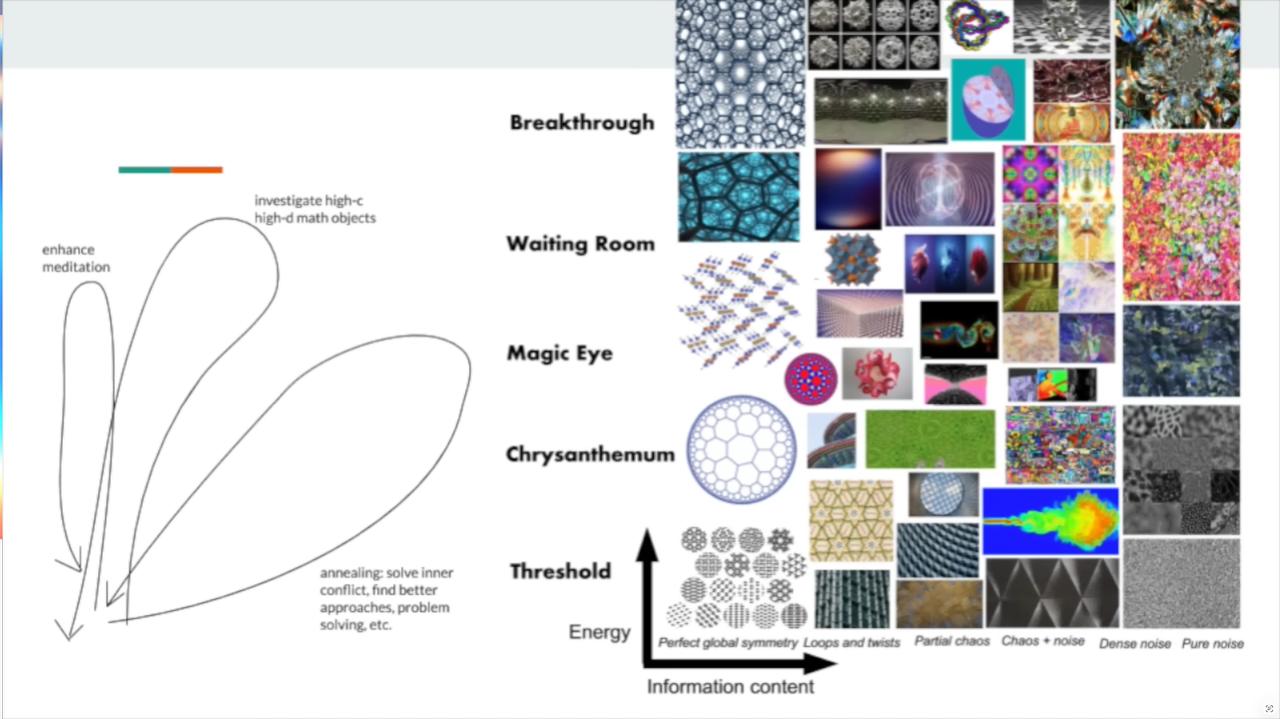
The consciousness thermometer. Energy (curvature) on the vertical axis. Information content (complexity) on the horizontal. Three trajectories visible: bliss (vertical ascent), investigation (diagonal toward complexity), annealing (arc through noise then order). Source: Andrés Gómez Emilsson, QRI.