Pain Information Architecture
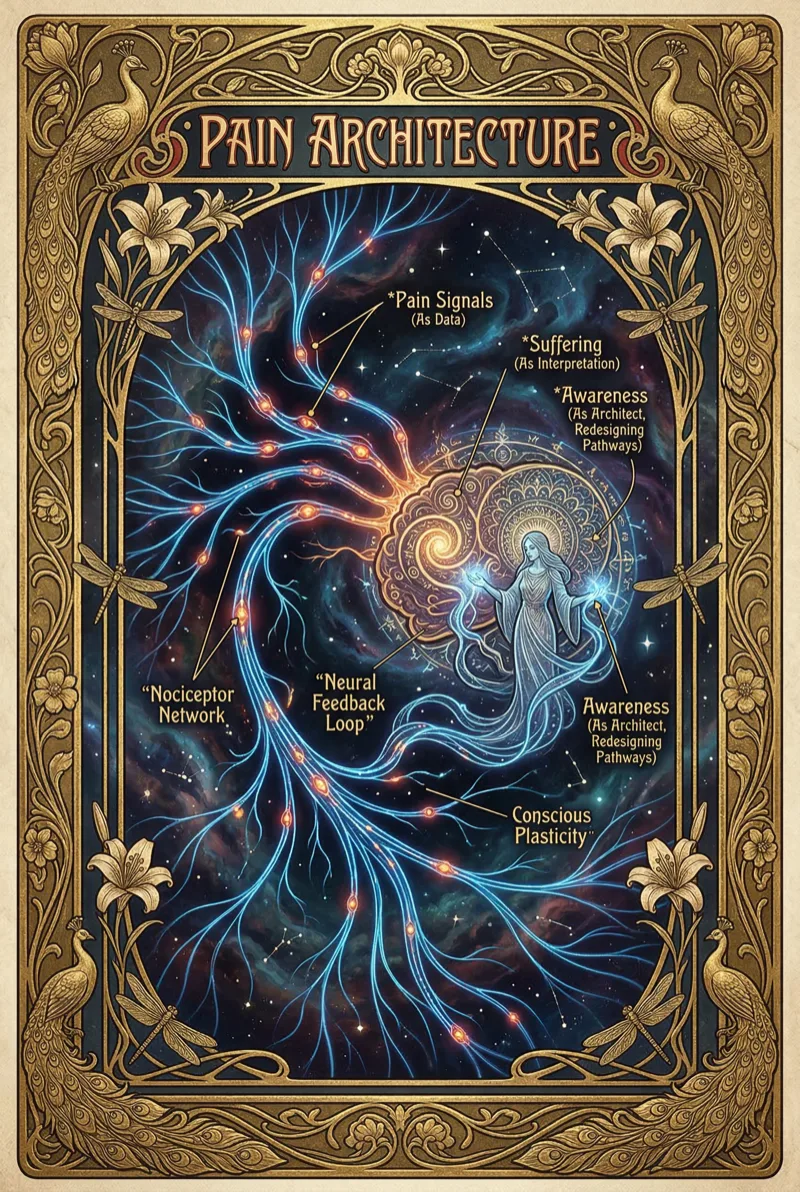
Pain is information. Not metaphorically. Not in the inspirational-poster sense of “what doesn’t kill you makes you stronger.” Pain is literally an information packet — a structured data transmission with frequency, amplitude, duration, and addressing metadata — processed by a biological system that treats it exactly the way a network stack treats an incoming TCP segment.
The moment you understand this, you stop trying to eliminate pain and start reading it. The body has been sending you structured data your entire life. You have been treating the incoming packets as errors instead of messages.
The Binary Pain Signal System
At the base layer, pain operates as a binary signal. The nociceptor — the nerve ending that detects potential tissue damage — fires or does not fire. There is no half-pain at the receptor level. The signal is a clean digital transmission: action potential or no action potential, one or zero.
What we experience as varying intensity is not the nociceptor changing its output but the brain’s processing system aggregating multiple binary signals. More receptors firing means more ones in the data stream. The perceived intensity is a population count — the equivalent of popcount() in bit manipulation. Each individual pain receptor is as binary as a transistor. The complexity emerges from parallel processing.
This architectural insight has immediate practical implications. When you feel pain at “5 out of 10,” you are not experiencing a half-strength signal. You are experiencing roughly half your available nociceptors in the affected region reporting positive. The amplitude is not a property of the signal — it is a property of the receiver’s aggregation function.
class PainInformationSystem:
    def __init__(self):
        self.pattern = "Pain-Information-Processing"
        self.state = "continuous_input"
        self.metrics = ["frequency", "amplitude",
                        "dilation", "integration"]

    def process_pain_signal(self, input_signal):
        """
        Pain signals are information packets.
        The frequency tells you what is talking.
        The amplitude tells you how many are talking.
        """
        self.frequency = self.analyze_frequency(input_signal)
        self.receptor_count = self.aggregate_binary(input_signal)
        return self.integrate_signal()
The Consciousness Dilation Mechanism
The second component of pain information architecture is the aperture control system. Pain dilates consciousness. This is not a side effect — it is the primary function.
Consider what happens when you touch a hot surface. Before the hand retracts (the motor response), before the yelp (the vocal response), before the emotional reaction (the limbic response), consciousness expands. For a fraction of a second, awareness becomes total. You are completely present. Every background process — the song playing, the conversation, the worry about tomorrow — drops out of the processing queue. Pain achieves what meditation practitioners spend years chasing: full attentional focus on the present moment.
This is the dilation mechanism. Pain forces the consciousness aperture open. The pupil of awareness widens. More information enters. The system temporarily operates at maximum sensitivity.
Melanin regulation ties into this system. Melanin — the pigment found in skin, eyes, and the pineal gland — modulates the body’s response to electromagnetic radiation. In the pain architecture, melanin functions as the iris of the consciousness aperture. It regulates how much “source exposure” the system receives. Too much dilation without melanin regulation produces overwhelm — the consciousness equivalent of staring at the sun.
Chronic pain patients are not broken systems. They are systems with the aperture stuck open — consciousness dilated beyond the melanin regulation system’s capacity to manage the incoming data load. The fix is not to suppress the pain signal but to recalibrate the aperture control.
The Dopamine Casino Framework
The third component is the most counter-intuitive: pain and pleasure share a processing pipeline, and the dopamine system operates as a casino.
Dopamine does not reward you for achieving something. It rewards you for correctly predicting that you would achieve it. The reward signal fires on prediction confirmation, not on outcome delivery. This is why gambling is addictive — the unpredictable reinforcement schedule creates maximum dopamine volatility.
Pain plugs directly into this casino architecture through four mechanisms:
Mechanism 1: Relief as reward. When pain stops, dopamine fires. The cessation of pain is processed identically to the arrival of pleasure. The system does not distinguish between “the bad thing ended” and “the good thing started.” Both are positive prediction errors.
Mechanism 2: Anticipatory processing. Expecting pain activates the same dopamine circuits as expecting reward — but with inverted valence. The dread of upcoming pain is neurochemically identical to the anticipation of upcoming pleasure, just sign-flipped. The casino plays both sides.
Mechanism 3: Intermittent reinforcement. Chronic pain that fluctuates — good days and bad days — creates the same dopamine volatility pattern as a slot machine. The unpredictable relief schedule maximizes dopamine sensitivity, which is why chronic pain patients often develop heightened sensitivity to all stimuli, not just painful ones.
Mechanism 4: Learning acceleration. Pain drastically accelerates learning. Touch a hot stove once and the lesson is permanent. This is not because pain is a good teacher — it is because pain hijacks the dopamine prediction system and writes the prediction directly into long-term memory. Pain does not teach you what to avoid; it programs what to predict.
Integration Framework
The three systems — binary signaling, aperture dilation, dopamine casino — form a coherent information architecture. The binary system provides clean data. The dilation system ensures the data receives maximum processing attention. The dopamine system ensures the data writes to permanent storage.
Pain is not the body’s alarm system. Alarm systems are designed to be turned off. Pain is the body’s priority interrupt system — designed to preempt all other processing, force an immediate context switch, and ensure the incoming data is processed before anything else in the queue.
When you map this architecture to consciousness engineering, the applications are immediate. Meditation practices that work with pain (Vipassana body scanning, for instance) are not masochism — they are protocols for developing conscious access to the aperture control system. They teach you to receive the pain signal without triggering the dopamine casino’s addictive loops.
The goal is not to stop the information. The goal is to process it without crashing.
Pain is not what happens when the system fails. It is what happens when the system works and you have not read the documentation.