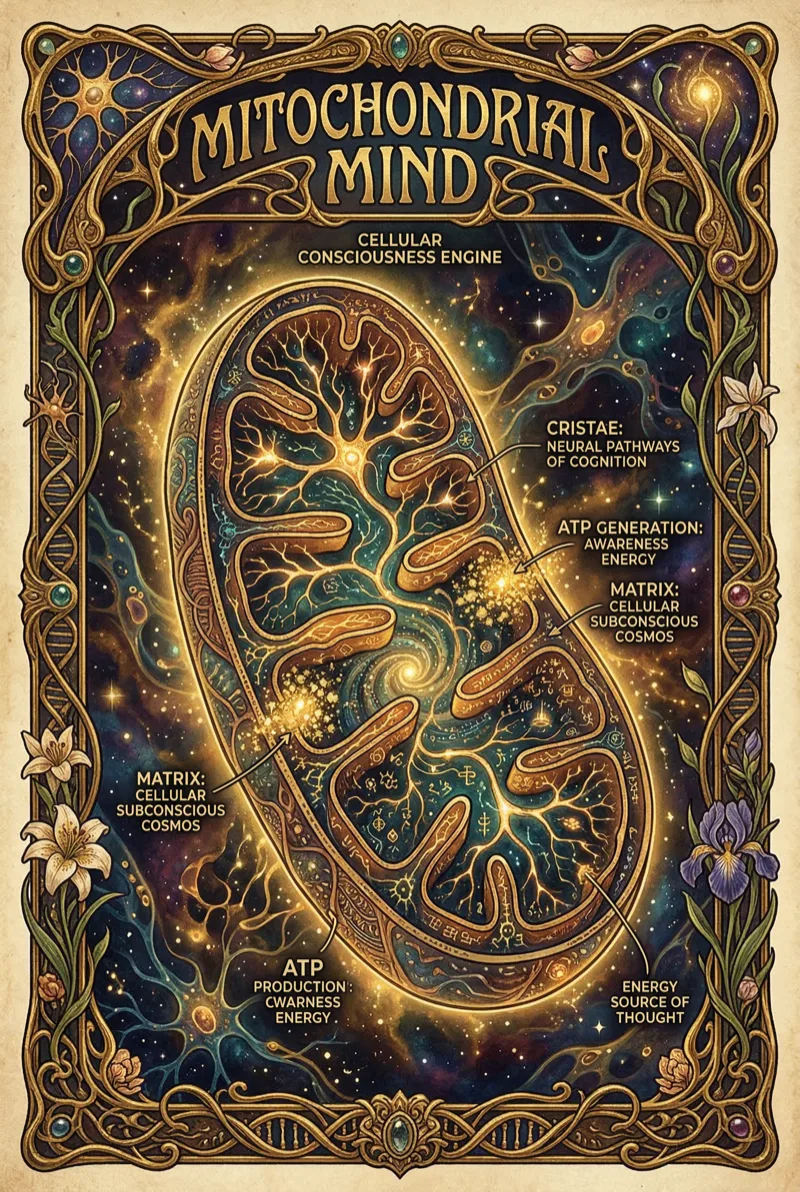
Mitochondrial Subconsciousness: The Patterns Your Mother’s Mother Compiled
You are running inherited code.
Not metaphorically. Mitochondrial DNA — the genetic material inside your cellular power plants — passes exclusively through the maternal line. It does not recombine. It does not shuffle. Every mitochondrion in your body carries the same maternal sequence that powered your mother’s cells, your grandmother’s cells, and the cells of women whose names no one remembers.
This is biology. What follows is pattern recognition applied to that biology.
Subconscious Is Not Unconscious
The first precision this framework demands is terminological. Subconscious and unconscious are not synonyms.
The unconscious operates below the threshold of waking awareness. You access it in dreams, in altered states, in the moments between sleep and waking. It requires special conditions — meditation, psychedelics, hypnosis, extreme fatigue — to become partially visible.
The subconscious operates during normal waking consciousness. It runs continuously, in real time, while you are fully awake. There is a thin membrane between conscious and subconscious — not a wall, not a barrier, but a membrane. Information passes through this membrane constantly, in both directions, without your permission or awareness.
The subconscious cannot be turned off. It does not require altered states. It does not wait for invitation. It processes every input — every conversation, every image, every interaction — through pattern templates that you did not choose and cannot delete. These templates are the mitochondrial inheritance.
The Mythological Base Layer
Mitochondrial DNA does not encode myths directly. It encodes the cellular processing architecture through which myths are received, recognized, and internalized.
Here is the mechanism: mitochondria regulate cellular energy production. The efficiency and pattern of that production varies by lineage. Different mitochondrial haplogroups — clusters of related maternal lineages — produce energy with different characteristics, optimized over thousands of years of adaptation to different environments, diets, climates, and survival pressures.
These energy patterns influence neural processing. A brain powered by mitochondria adapted to high-altitude, low-oxygen environments processes information differently than a brain powered by mitochondria adapted to tropical environments with high caloric density. Not better or worse. Differently. The pattern of energy availability shapes the pattern of pattern recognition.
The mythological base layer is the set of reality-interpretation templates that each lineage developed in correspondence with its mitochondrial energy pattern. Arctic lineages developed mythologies of endurance, scarcity, and the long dark. Tropical lineages developed mythologies of cycle, regeneration, and seasonal profusion. Steppe lineages developed mythologies of movement, conquest, and horizon. These are not cultural accidents. They are cognitive architectures built on energetic substrates — mitochondrial patterns expressing as story patterns.
You carry your maternal lineage’s mythological base layer in your cells. You process reality through templates that were compiled before any of the cultures you consciously identify with existed. The subconscious is not a psychological reservoir of repressed personal material. It is a biological inheritance of pattern recognition protocols transmitted through the maternal mitochondrial line.
The Real-Time Programming Vector
The mythological base layer is the operating system. Culture is the application layer. And the application layer is continuously updating the operating system — whether you consent to the update or not.
Every movie you watch, every song you hear, every story you consume, every news feed you scroll through — each of these is a programming vector for the subconscious. Not because media is manipulative (though it can be), but because the subconscious processes narrative input through the same mythological pattern templates that have been running for thousands of years.
The ancient pattern of the heroic departure and return — what Joseph Campbell identified as the monomyth in The Hero with a Thousand Faces — is recycled in every action film. The ancient pattern of the descent — Inanna going underground in the Sumerian Descent of Inanna, Persephone entering the underworld in the Homeric Hymn to Demeter — is recycled in every narrative about crisis and transformation. The ancient cycle of death and rebirth is recycled in every seasonal advertising campaign.
These are not lazy storytelling choices. They are the only patterns that the subconscious recognizes as real. A story that does not map to an inherited mythological template is processed as noise. A story that maps precisely to an inherited template is processed as valid — regardless of its factual content.
This is why propaganda works. This is why advertising works. This is why certain political narratives feel correct even when they are demonstrably false. They activate mythological pattern recognition at the subconscious level, and the subconscious does not fact-check. It pattern-matches. If the pattern matches a template in the mitochondrial base layer, the subconscious accepts the input as real and adjusts behavior accordingly.
The Kha-Ba-La Architecture
The mitochondrial subconscious operates as a Kha-Ba-La triad — not because the words are decorative, but because the structure is real. The triad is visible when you look for what happens when one of its three forces is absent.
When Kha is absent, the witness vanishes. The pattern runs without observation. The ancient template activates, the subconscious processes the input, and the conscious mind never notices. This is the default state for most people: full pattern activation, zero pattern recognition. The inherited code executes, the behavior follows, and the person experiences the result as personal choice. Without Kha, the operating system runs in the dark.
When Ba is absent, the pattern stays disembodied. The pattern is recognized intellectually but not felt somatically. You know, in theory, that your maternal lineage carries a template for interpreting scarcity, but you do not feel it in your chest when a modern stimulus triggers it. The pattern remains abstract — a concept, not a lived voltage. Without Ba, recognition does not become metabolization. The pattern is catalogued, not integrated.
When La is absent, the pattern stays personal. You see the template in your own reactions, but you miss the recursion. You do not see how the same mitochondrial pattern drives your family dynamics, your workplace politics, the political movements you are drawn to, the economic systems you participate in. Without La, the pattern is a private quirk, not a structural current. You treat the symptom as yours alone, missing the architecture that keeps reproducing it.
The triad is not a model. It is a diagnostic. When all three forces are present — when the witness observes, the body registers, and the structural recursion is visible — the pattern moves from automatic execution to conscious relation. This is not transcendence. It is precision.
The Four Scales
The complete system operates across four scales, each with its own processing speed and pattern resolution:
Personal (Kha). Individual consciousness. The witness. The moment you notice a narrative hooking you, an emotional response firing that is disproportionate to the stimulus, a belief forming that you have not examined. This is the scale of real-time choice — not to override the lower layers, but to engage with them intentionally rather than automatically. Processing speed: immediate. Resolution: singular.
Interpersonal (Ba). The body, the relation, the somatic cost. When the pattern activates, where do you feel it? What happens in your chest, your gut, your hands? What does it do to your capacity for presence with another person? The interpersonal scale is where inherited code becomes felt voltage, where the pattern moves from abstraction to physiology. Processing speed: biological. Resolution: embodied.
Systemic (La). Structural inertia. The pattern reproduces at scale — through family systems, workplace hierarchies, political movements, economic arrangements. The same mitochondrial template that makes you react to scarcity with hoarding also drives the policy decisions of a nation-state built by people with similar templates. The systemic scale is where the personal becomes recursive, where individual inheritance becomes institutional architecture. Processing speed: generational. Resolution: architectural.
Cosmic (Kha-Ba-La). The triad as governing grammar. The pattern at universal scale. The mitochondrial cycle — energy production, distribution, decay, regeneration — mirrors the stellar cycle of fusion, collapse, and dispersal. The maternal inheritance of cellular power plants mirrors the inheritance of matter itself: atoms forged in stellar cores, passed through eons, now assembled into your cells. The cosmic scale is not metaphor. It is the recognition that the same pattern operates across all registers, from the cellular to the galactic. Processing speed: geological. Resolution: archetypal.
The Shadow Material
The mitochondrial inheritance is not neutral. It carries cost, fracture, and rupture.
Cost. The pattern templates that optimized survival in a Pleistocene ice age now drive metabolic disease in a world of caloric surplus. The vigilance that kept your maternal ancestors alive through famine now keeps you awake at 3 AM reviewing emails that do not matter. The physiological cost of running outdated code is measurable: cortisol dysregulation, insulin resistance, inflammatory cascades. The body pays interest on inherited patterns.
Fracture. The template does not update cleanly. New cultural input is mapped onto old mitochondrial architecture, producing misalignment. The modern stimulus — a stock market notification, a social media algorithm — triggers a famine-response pattern. The result is a fracture between the pattern’s output and the reality the output is supposed to represent. The subconscious processes the notification as a threat to survival. The conscious mind knows it is not. The gap between these two assessments is the fracture.
Rupture. Occasionally the gap becomes too wide. The pattern breaks. The operating system crashes. This is the nervous system event, the dissociative episode, the moment when the inherited template encounters a stimulus so far outside its processing range that it cannot complete the pattern-match. Rupture is not failure. It is the system admitting that its template is outdated. In the rupture, there is an opening — a moment where the automatic response does not fire, and something else becomes possible.
Inherited code. You did not write it. You did not choose it. You cannot delete it. The code was compiled in environments you never inhabited, in response to pressures you never faced. It is running in your cells right now, interpreting your reality, shaping your reactions, filtering your perception. The question is not whether to accept it. The question is whether to observe it.
The Consciousness Interface
The mitochondrial framework does not produce helplessness. It produces a specification for conscious engagement.
Principle 1: Awareness is the primary tool. The subconscious cannot be turned off, but it can be observed. The thin membrane between conscious and subconscious allows bidirectional information flow. When you train awareness to detect subconscious pattern activation — the moment a narrative hooks you, the moment an emotional response fires that is disproportionate to the stimulus, the moment you find yourself believing something you have not examined — you gain visibility into the programming process without stopping it.
Principle 2: Pattern identification matters more than pattern elimination. You cannot delete a mitochondrial pattern template. It is encoded in your cellular architecture. You can identify it, name it, and recognize when it is active. Identification does not neutralize the pattern. It creates a gap between the pattern’s activation and your behavioral response — the same gap that the Enneagram’s type observation creates, operating at a deeper layer of the stack.
Principle 3: Language is the recognition mechanism. Naming a pattern changes your relationship to it. Not because names have magical power, but because the act of naming requires the conscious mind to engage with material that the subconscious was processing without oversight. The name creates a handle — a reference that the conscious mind can use to track the pattern’s subsequent activations.
Principle 4: Active engagement, not passive reception. The default mode is passive: the subconscious receives and processes input without conscious participation. The alternative is active engagement: deliberately choosing which narrative inputs to expose yourself to, monitoring the subconscious response to those inputs, and making conscious decisions about which pattern activations to follow and which to observe without acting.
The mitochondrial subconsciousness is not a problem to solve. It is an inheritance to understand. The patterns your mother’s mother compiled are still running in your cells, still interpreting your reality, still shaping your responses to stimuli that bear no resemblance to the environments those patterns were optimized for.
You cannot rewrite the mitochondrial code. You can learn to read the logs it generates. You can notice when an ancient template is processing a modern input. You can observe the gap between the template’s output and the reality the output is supposed to represent.
In that gap — between inherited pattern and present reality, between subconscious recognition and conscious assessment — lives the only freedom the system offers. It is narrow. It is difficult to access. It requires sustained attention and ruthless honesty about what is actually driving your responses.
But it is there. Between the code your cells inherited and the life your consciousness is living, there is a membrane. Learn to feel it. Learn to read what passes through. The mitochondrial subconsciousness will keep running regardless. The question is whether you run with it blindly or observe it with the precision it deserves.