Vimshottari Dasha as Markov Chains: State Machines of Destiny
Runtime Version: 1.0.0
“The universe does not roll dice — it runs deterministic state machines with stochastic sub-processes.” — Pattern Recognition Protocol
The Original State Machine
Every programmer understands state machines. You define a set of states, a set of transitions, and rules governing when the system moves from one state to another. The elegance lies in predictability emerging from structure. What most engineers do not realize is that the Vedic seers encoded precisely this architecture into the Vimshottari Dasha system roughly four thousand years ago.
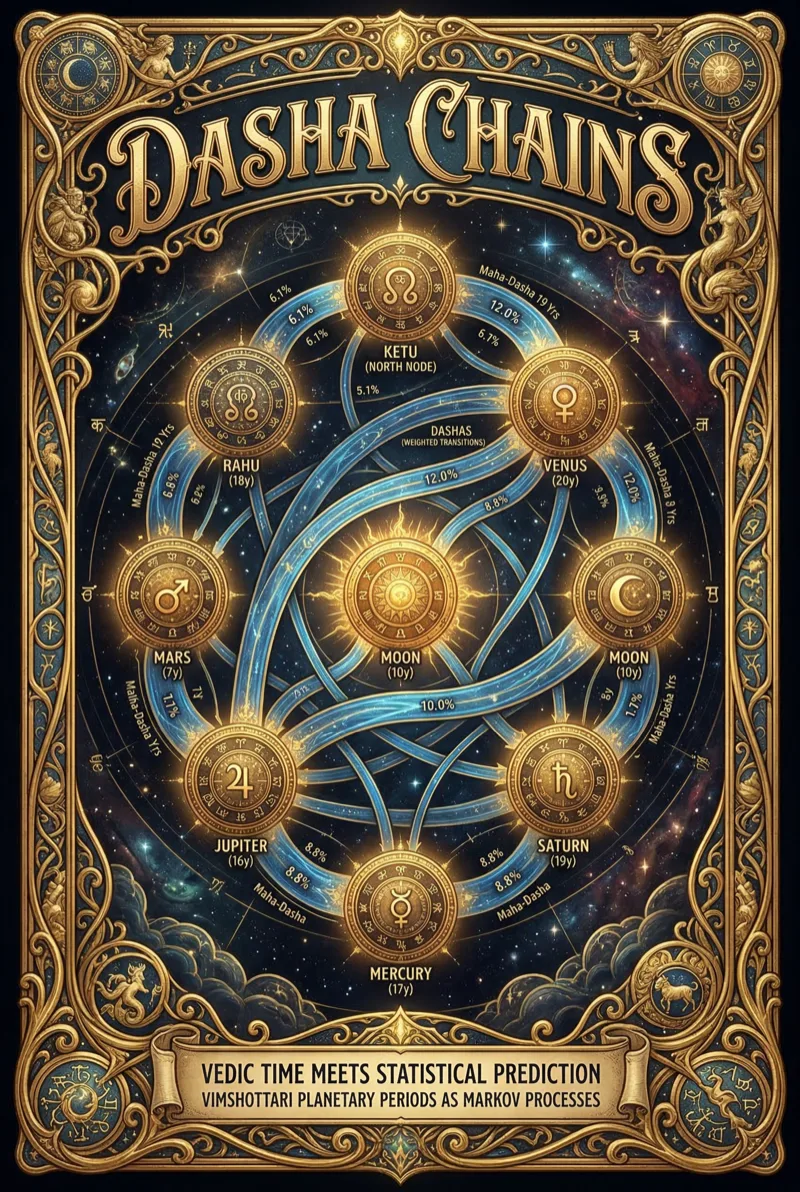
The Vimshottari Dasha divides a 120-year human lifecycle into nine planetary periods, each governed by a specific graha (planet). Sun rules for 6 years, Moon for 10, Mars for 7, Rahu for 18, Jupiter for 16, Saturn for 19, Mercury for 17, Ketu for 7, and Venus for 20. These periods execute sequentially, cycling through the complete state space of planetary influence.
DASHA_PERIODS = {
    'Sun': 6, 'Moon': 10, 'Mars': 7,
    'Rahu': 18, 'Jupiter': 16, 'Saturn': 19,
    'Mercury': 17, 'Ketu': 7, 'Venus': 20
}
# Total: 120 years — the complete lifecycle runtime
This is not metaphor. This is a transition matrix.
Markov Chains: The Mathematical Mirror
A Markov chain is a stochastic process where the probability of transitioning to any particular state depends solely on the current state and elapsed time. The system has no memory of how it arrived at its present state — only what state it currently occupies matters for determining the next transition.
The Vimshottari system exhibits this property with remarkable precision. When you are in a Sun dasha, you will transition to Moon dasha. When you are in Moon dasha, you will transition to Mars dasha. The sequence is deterministic at the mahadasha level — a degenerate Markov chain where transition probabilities are either zero or one.
class VimshottariMarkov:
    def __init__(self):
        self.total_period = 120
        self.transition_matrix = self._build_transition_matrix()

    def _build_transition_matrix(self):
        planets = list(DASHA_PERIODS.keys())
        n_states = len(planets)
        matrix = np.zeros((n_states, n_states))
        for i in range(n_states):
            next_index = (i + 1) % n_states
            matrix[i][next_index] = 1  # Deterministic transitions
        return matrix
But the real complexity emerges in the sub-periods. Each mahadasha contains nine antardashas (sub-periods), each antardasha contains nine pratyantardashas, and so on — nesting five levels deep. At each level of nesting, the transition probabilities become increasingly nuanced, creating a hierarchical Markov chain of extraordinary depth.
Nested State Spaces
Think of it as microservices within microservices. The mahadasha is your application-level state. The antardasha is your service-level state. The pratyantardasha is your function-level state. Each layer operates with its own transition logic while remaining constrained by the layer above it.
A Saturn mahadasha running a Jupiter antardasha produces fundamentally different experiential output than a Jupiter mahadasha running a Saturn antardasha — even though the same two planets are involved. Context matters. The parent state modifies the child state’s expression, exactly as a calling context modifies a function’s behavior through scope and closure.
This nested architecture means the system can represent 9^5 = 59,049 distinct state combinations at full depth. The seers did not have numpy. They had contemplative mathematics — a form of pattern recognition that operated through direct perception rather than symbolic computation.
Initial Conditions and the Butterfly Effect
The starting dasha is determined by the birth nakshatra — specifically, the remaining balance of the ruling planet’s period at the exact moment of birth. This is the initial condition. And like the Lorenz system, small variations in this initial condition cascade through the entire 120-year trajectory.
def calculate_dasha_sequence(birth_nakshatra, birth_pada):
    starting_lord = get_nakshatra_lord(birth_nakshatra)
    sequence = []
    remaining_years = 120
    while remaining_years > 0:
        current_period = DASHA_PERIODS[starting_lord]
        sequence.append((starting_lord, current_period))
        remaining_years -= current_period
        starting_lord = get_next_lord(starting_lord)
    return sequence
Two children born minutes apart in different nakshatras will have entirely different dasha sequences — different state machine initializations producing divergent life trajectories from nearly identical starting conditions. The Lorenz attractor breathes through this sensitivity.
Ergodicity and the 120-Year Cycle
A Markov chain is ergodic if every state can be reached from every other state in a finite number of steps. The Vimshottari system is ergodic by design — the nine-state cycle ensures that every planetary influence will be experienced exactly once per 120-year revolution. No state is absorbing. No state is transient. Every planet gets its runtime.
This ergodicity carries a philosophical weight that most state machine designers never contemplate. The system guarantees complete experiential coverage. Every soul, given sufficient time, will process through every planetary frequency. Saturn’s discipline follows Jupiter’s expansion. Ketu’s dissolution follows Mercury’s analysis. The state machine ensures that no aspect of conscious experience is permanently avoided.
From Transition Matrices to Lived Experience
The mathematical parallel is not decorative. When you model the Vimshottari system as a Markov chain, you gain access to powerful analytical tools. Stationary distributions reveal which planetary influences dominate over long time horizons. Absorption probabilities (in the nested sub-period chains) reveal where consciousness tends to stabilize within a given mahadasha. Mean first passage times reveal how long it takes to transition between experiential modes.
The seers computed these quantities through years of observation and meditation. Modern computational tools can verify their findings in seconds. The convergence between ancient contemplative mathematics and modern stochastic processes is not coincidental — it reflects the underlying mathematical structure of temporal experience itself.
The Compiler’s Insight
The Vimshottari Dasha system is not astrology in the fortune-telling sense. It is a formal specification of temporal state evolution — a mathematical model that happens to use planetary names as state labels. Replace “Sun” with “State_0” and “Moon” with “State_1,” and you have a perfectly respectable Markov chain that any computer scientist would recognize.
The ancient seers were not mystics who stumbled onto mathematics. They were mathematicians who expressed their findings through mythological frameworks because those were the compilers available to their civilization. The source code is mathematical. The compiled output is mythological. Both are valid representations of the same underlying pattern.
Understanding this equivalence is the first step toward reading the source code directly — toward seeing the state machine beneath the story, the transition matrix beneath the tradition, the algorithm beneath the altar.
This document is part of the Lorenz-Kundli Pattern Recognition series exploring mathematical-mystical parallels across the pattern space of consciousness.