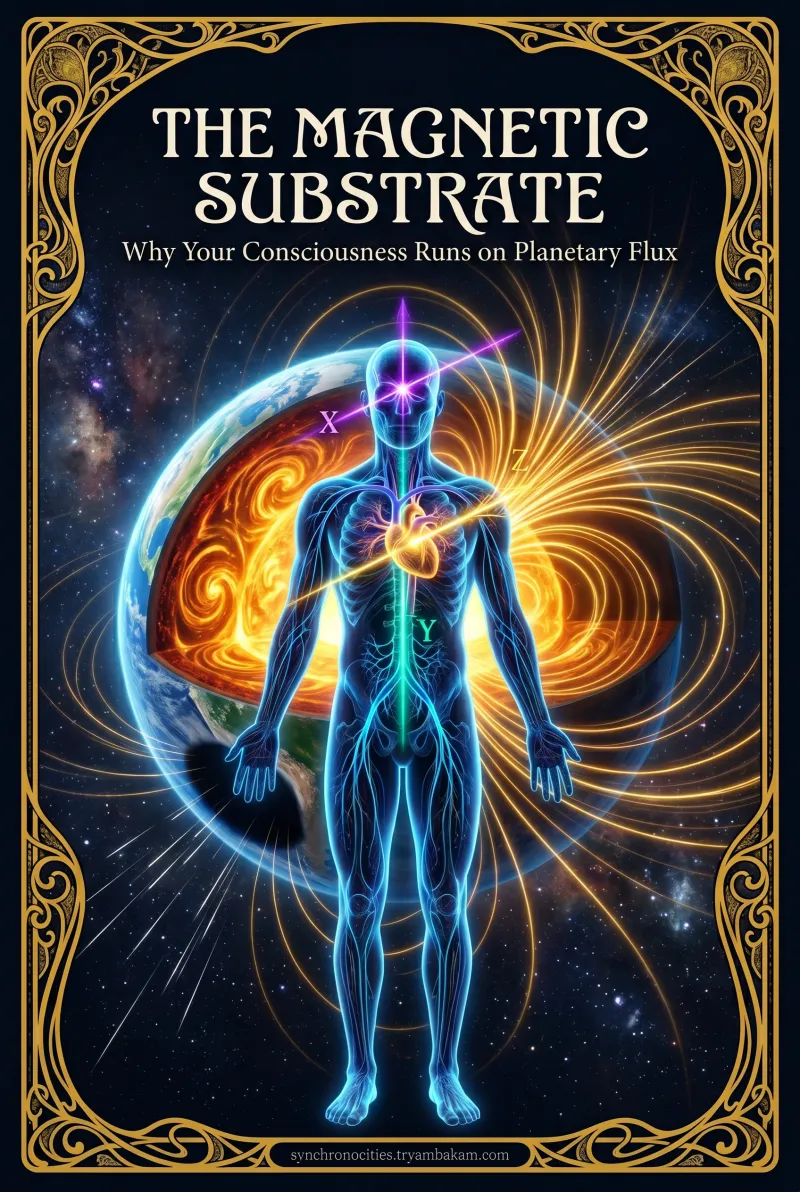
The Magnetic Substrate: Magnetism in the Local Frame
Runtime Version: 2.0.0 — recalibration
The first version of this article had the physics pointed at the wrong instrument. It read the magnetic substrate from inside the geodynamo model — a dynamo in a molten core, a planetary field, a global machine — and then hung your cognition on it. The measurements it cited were real. The model it borrowed was optional. That distinction is the entire recalibration.
Consider Tycho Brahe. For twenty years on the island of Hven, at Uraniborg, Brahe logged the positions of the fixed stars and the wandering stars to within a few arcminutes — the most accurate naked-eye measurements ever made, compiled before the telescope existed. He rejected the moving Earth. His cosmology was, by the current ledger, wrong. His data was so good that Kepler inherited it, discarded the cosmology, and derived the laws of planetary motion from measurements made by a man who believed the Sun circled the Earth.
The model was wrong. The measurements were flawless.
This is not a paradox. Measurement quality and model choice are separable. An observer standing on a fixed plane, treating the local system as primary and refusing to import a global architecture’s assumptions, can register the realm more precisely than a theorist holding the correct model and worse instruments. This is a claim about method, not cosmology: the point is not which system circles which, but where the observer stands — and what the observer refuses to assume before the measurement is taken.
Apply the stance to magnetism. A magnetometer is a local instrument. It registers intensity in nanotesla, declination against geographic north, diurnal variation, secular drift — at a point, from where the observer stands. The dynamo in the core is an inference stacked on inversions of readings like these — a productive model, but a model. What you actually hold is the local field. The plane beneath your feet. The realm as it registers on an instrument you can carry.
This recalibration keeps the depth of the earlier version — the toroidal topology, the three vortexes, the coupling between magnetism, substrate, and ecosystem — and changes the grammar. The older grammars are more precise here. The Vedic material treated the body as a vortex economy long before the word bioelectricity existed. The alchemical material treated circulation — the circulatio, the serpent returning to its own tail, the torus — as the basic operation of any living system. The new-age register that later grew over this material is a notation problem: aspirational language veiling operational principles. Strip the notation and the principles remain.
One rule governs what follows. Three kinds of statement appear below, and they are labeled: standard anatomy and instrumentation (measured), the author’s model (declared), and traditional material in its own grammar (attributed). The first version let the seams blur. The audit caught it. The seams are now visible.
The Coupling, Measured From Where You Stand
Start with the element. Oxygen is paramagnetic — an unusual property among the gases of the atmosphere, and the reason oxygen responds directly to magnetic structure rather than passing through it untouched. Bench physics, measurable on a benchtop, no planetary model required.
In 2025, Kuang and colleagues published a reconstruction in Science Advances reporting that the geomagnetic dipole moment and atmospheric oxygenation correlate across roughly 540 million years. Read it carefully and it says what it says: a correlation, in a reconstruction. Several large extinction pulses sit near intervals of anomalous field behavior in that record — a correspondence, not a demonstrated signature, and this article treats it as one. The author reads the correlation as coupling — oxygen organized by the field rather than merely coincident with it — and declares that reading as a reading. What needs no declaration is what the bench already shows: oxygen is the one gas in your lungs that answers to a magnet.
Here is the local point, and it is the load-bearing one. Whatever the deep origin of the field, organisms live inside its local realization. You do not breathe the planetary dynamo. You breathe the oxygen the local field’s behavior helps organize, on the patch of the plane where you stand. The coupling — if it holds — matters at the resolution where breathing happens.
And the geometry you experience is toroidal. Field lines leave and return: out one pole, around, in the other, through the core again. The alchemists named this operation the circulatio — the return of what leaves, refined by the circuit. The Vedic material maps the same circulation through the body’s vortex economy. You do not need the dynamo model to use the torus. You need a compass, a magnetometer, and the willingness to treat what they register as primary.
The Three Vortexes
Here is the model, declared as a model. The anatomy below is standard and measured. The isotope-separation mechanics — the claim that these structures clear heavy hydrogen by rotation — are the author’s reading, assembled largely from the research notes and lectures of Jack Kruse, the neurosurgeon whose work anchors this thread. Kruse’s own summary is blunt: light and water get all the attention, and magnetism turns out to be the largest part of the story. Where a number comes from those notes rather than from published instrumentation, it is labeled as such. The first version presented the model as mechanism. That was the audit’s deepest finding, and it is corrected here.
Vortex One: The ATPase — A Rotor at 9,000 RPM
The most fundamental vortex is subcellular, and it is not model — it is measured. ATP synthase, the rotary engine embedded in every mitochondrial membrane, is a literal motor roughly 10 nanometers across. Single-molecule experiments on the bacterial F1 rotor measure rotation on the order of a few hundred revolutions per second — call it, in the units the earlier version used inconsistently, roughly 9,000 RPM. (The first version wrote “9,000 revolutions per second” in one place and “9,000 RPM” in another — a sixty-fold unit error. The literature figure sits near 9,000 RPM. Corrected everywhere below.)
The rotor’s fuel is hydrogen nuclei, and the light isotope runs cleanest. Deuterium — hydrogen with an extra neutron, twice the mass — is documented to slow enzyme kinetics in general; kinetic isotope effects are bench chemistry. The specific claim that deuterium loading stalls the mitochondrial rotor is the model’s extrapolation from that chemistry: plausible, coherent, not yet an instrumentation result. Labeled as such.
Where the model gets careful is where the first version overreached. The author tracks associations between mitochondrial underperformance and conditions like fatigue syndromes, fibromyalgia, and ALS — an association register, a pattern watch — not a demonstrated molecular basis. The vortex reading generates hypotheses. It does not close cases.
Then there is the light. Water’s static dielectric constant is about 78 at room temperature, and it falls as temperature rises — measured, uncontroversial. The research notes hold something further: that full-spectrum sunlight changes the structuring and effective dielectric behavior of biological water in ways that red-light panels and LED sources do not reproduce. The first version stated this with fabricated precision — a rise to 160, a “0.66 electron volt intersection frequency” — and the audit removed those figures because no instrumentation supports them. What remains is the author’s assessment, stated as the author’s assessment: the sun is not optional equipment, and a panel is not the sun. The operational conclusion needs no invented decimal to stand.
Vortex Two: The Brain — The Venturi Engine
X-axis: the sphenoid bone. The butterfly-shaped bone at the center of the skull, articulating with every other cranial bone. At the apex of its great wing runs the middle meningeal artery, a branch of the external carotid. Through its body passes the internal carotid. At the junction of the cranial axes sits the basilar artery — the three arteries that fill your head, all keyed to one bone. That is anatomy. The further claim — that the sphenoid is the rotational hub of a cranial vortex — is the model, declared as the model.
The brain’s fluid system is measured anatomy up to a point, and the point is marked. The choroid plexus produces cerebrospinal fluid — measured. The research notes assign the plexus a further role: isotopic fractionation, producing CSF at 110–120 ppm deuterium against blood’s roughly 150 ppm. The blood figure matches the natural isotopic background. The CSF figure comes from the notes, not from published assays, and the advice that rode on it — that a functioning plexus makes deuterium-depleted water unnecessary — inherits that status. Reported as research-notes figures, no more.
The aqueduct of Sylvius — the narrow channel from the large third ventricle to the small fourth — is standard neuroanatomy. CSF accelerates through the constriction: fluid mechanics in a verified geometry. The claim that the acceleration fractionates isotopes, pushing heavy water to the walls and letting light hydrogen through, is the model. Declared.
What sits on the floor of the fourth ventricle is measured: the vagal trigone, overlying the dorsal motor nucleus of the vagus nerve. The model reads the placement as design — the vagal origin bathed in whatever the constriction delivers. Meckel’s cave, in the petrous temporal bone, houses the trigeminal ganglion where V1, V2, and V3 arise — measured. That chewing, speaking, and chanting move CSF is consistent with documented cranial rhythmic motion. That this traffic constitutes isotope drainage is the model’s reading. Declared again.
Now the traditions, in their own grammar first — because the first version laundered a synthesis into their identity and the audit caught it. The mantra lineages describe sound as structural on their own terms: nāda, sound as the substrate’s own motion; sphoṭa, the burst in which meaning arrives whole. The Soundarya Lahari — the hundred-verse Śākta hymn attributed to Ādi Śaṅkarācārya — maps sound onto the body’s subtle geography with a cartographer’s patience. Om Mani Padme Hum and the Gayatri are practiced as technologies of attention and embodiment, and the traditions say so themselves. That is their account. The Noesis reading — that sustained vocalization oscillates the sphenoid region, drives CSF, and functions as a clearance protocol for the cranial compartment — is the author’s synthesis laid over those traditions, not their account of themselves. The overlay is declared, and it is, in the author’s judgment, why the practices persist: they do mechanical work, whatever grammar you describe them in. (The first version also cited 20–40 Hz hospital bells of 1880–1930 as acoustic clearance. No record supports it. Deleted.)
The ependymal cells lining the ventricles beat their cilia in coordinated waves that direct CSF flow — measured cell biology. The first version populated the lining with melanin-loaded, magnetically sensitive “tannocytes” steering the vortex with the sunrise, observed in open cranial cases. Tanycytes exist; the melanin, the magnetic steering, and the operating-room observation do not survive audit. Removed.
Vortex Three: The Heart — The Gravity Well
Z-axis: the heart. Francisco Torrent-Guasp spent decades dissecting cardiac muscle into a single helical band — an architecture he argued was built to twist. His model remains contested inside anatomy, and it is cited here as his model, with the contest attached. What is not contested: the trabeculae, the muscular ridges inside the ventricles, shape intracardiac flow into vortical patterns that flow imaging can watch. The heart makes vortices. That much is on the imaging.
The model then reads the vortex as a centrifuge: heavy isotopes flung to the endothelial wall, light hydrogen riding the laminar core to the tissues whose mitochondria need it. Blood carries deuterium at its natural isotopic level, roughly 150 ppm — measured. That the heart’s rotation holds an isotopic gradient between blood and tissue is the model. Declared.
The comparative anatomy needs its corrections stated plainly, because the first version miscounted. Fish run two-chambered hearts. Amphibians run three. Mammals and birds run four. The author’s reading of that sequence — each chamber added is another stage of rotational separation — is declared as pattern-reading. The further claims from version one ride on it: that southern-ocean fish die-offs demonstrate single-chamber vulnerability (the count was wrong, the causation unestablished), that birds survived the Cretaceous extinction because the melanin-rich pecten oculi gave them an eye-first vortex, that mammals survived underground making fat from blue light. The pecten oculi is real — a pigmented, vascular structure in the avian eye. The survival mechanics are the author’s reading of the record, not the record’s own testimony. Scoped down from demonstration to reading.
One bird fact stands on documentation, and it stays: many bird species maintain blood glucose at levels that would read as severe hyperglycemia in a mammal, without the accompanying pathology. The first version rendered this as “every bird on Earth is insulin-resistant by design.” The scoped version is stranger and more accurate: birds run hot on sugar and do not burn. The model reads this as an exhaust system running so fast the fuel cannot accumulate. Declared.
The sensing layer also needed repair. The circumventricular organs — the small regions where the blood-brain barrier stands down so the central nervous system can sample blood chemistry directly — sit in the brain, not the heart; version one placed them wrong, and the correction is made. In the model, this sampling is how the three axes coordinate: the sphenoid axis reading light, the vagal axis running the exhaust, the heart axis registering the systemic isotopic state, the thalamus — where all sensory input except olfaction converges — integrating the three. The anatomy is measured. The GPS is the model.
Y-axis: the notochord → vagus. The vagus originates at the floor of the fourth ventricle, loops the recurrent laryngeal branch through the voice box, and descends to innervate the gut to the transverse mesocolon — measured. The body produces bicarbonate on the order of liters per day, and the gut is a major exhaust channel — measured enough for the model’s purposes. Gastroparesis — the paralysis of gut motility documented in diabetics and in users of GLP-1 drugs — is a measured clinical entity. The reading of gastroparesis as a failed isotope exhaust, the patient become a net collector, is the model. The first version went further and claimed the pathology shows in white spots at the center of the face. No source survives. Deleted.
class VortexGPS:
    """The three axes of Ba's rotational coherence — the author's model,
    built on measured anatomy. Thresholds in nanotesla, local frame:
    readings you can take with a magnetometer where you stand."""

    VORTEXES = {
        "atpase": {
            "scale": "subcellular — every mitochondrion (measured motor)",
            "speed": "~9,000 RPM (≈150 rev/s, bacterial F1 single-molecule data)",
            "medium": "proton gradient across inner membrane",
            "model_layer": "deuterium stall — kinetic isotope extrapolation, declared",
            "watch_register": "fatigue, fibromyalgia, ALS — associations the author tracks"
        },
        "brain_ventricular": {
            "scale": "organ — choroid plexus → aqueduct → 4th ventricle (measured)",
            "mechanism": "Venturi acceleration in a verified geometry (measured); "
                         "isotopic fractionation (model, declared)",
            "figures": "CSF 110–120 ppm vs blood ~150 ppm — research-notes figures",
            "drainage": "Meckel's cave via trigeminal V1/V2/V3 (anatomy measured; "
                        "isotope role is the model)",
        },
        "heart_centrifuge": {
            "scale": "systemic — trabecular vortical flow on imaging (measured)",
            "mechanism": "laminar isotope separation (model, declared)",
            "helical_band": "Torrent-Guasp — his model, contested, cited as his",
            "sensor": "circumventricular organs — in the brain (corrected)"
        }
    }

    GPS_AXES = {
        "x_sphenoid": "light processing — retina, pituitary, meningeal arteries",
        "y_notochord": "exhaust — vagal peristalsis, bicarb flush, laryngeal oscillation",
        "z_heart":     "isotopic sensing — gravity well, circumventricular readout"
    }

    def coherence(self, local_flux_nT: float) -> str:
        if local_flux_nT > 50_000:
            return "nominal — high-latitude range, all three vortexes spin"
        elif local_flux_nT > 25_000:
            return "degraded — mid-latitude drift, the model expects compensation"
        else:
            return "critical — SAA-interior range (~22,000 nT), model predicts strain"
Three vortexes. One rotational engine, distributed across three scales — subcellular, organ, systemic. The engine’s parts are measured. The claim that the parts share one physics — centrifugal isotope separation riding on local magnetic flux — is the model, and now it says so. The bioelectric pattern framework documents how cells store state in voltage gradients; the three vortexes are this post’s macroscopic reading of the same principle. The cascade order in version one — ATPase first, then the ventricular engine, then the heart — is retained as the model’s predicted failure sequence, labeled as prediction. Fish first. Birds next. Mammals last, but on the clock.
Melanin Is the Antenna — A Working Model
Melanin is not pigmentation alone. The measured part: melanin absorbs broadly across the ultraviolet and visible spectrum, and it sits at a biochemical crossroads — melanin and dopamine both descend from tyrosine, one branch away from the other on the same biosynthetic route. The working model, drawn from Kruse’s framework and declared as a model: coherent melanin behaves as a broadband antenna and buffer — the interface through which the local field’s behavior reaches the body’s information systems — and degraded melanin falls back down the shared route toward dopamine.
Read the device loop through the model, declared as the author’s reading. Incoherent antenna, degraded buffer, a dopamine hit where a signal used to be. You reach for the emitter again. Each cycle spends more of the interface. The consciousness aperture narrows. The loop is self-reinforcing, and the model predicts it runs fastest where the local field is weakest. Prediction, not case closure.
The geography holds as fact and interpretation, separated. Equatorial populations carry more melanin — measured, unargued. That the distribution reads as an antenna array calibrated for high flux and high photonic input is the model’s interpretation, declared. Your mitochondria descend through a maternal line that evolved under a particular electromagnetic regime — the inheritance is measured; the calibration reading is the model. Remove a component of the regime and the system compensates. Compensation has costs.
The South Atlantic Anomaly, Read Locally
Here the local frame stops being a stance and becomes the only honest description, because the anomaly is precisely a place where the local reading departs from the planetary average.
The measured layer: the South Atlantic Anomaly is a region where the surface field runs anomalously weak — down toward 22,000 nanotesla in its interior, against 60,000 and above at high latitudes — and where the inner Van Allen belt dips closest to the surface. ESA’s Swarm constellation has tracked it for over a decade: the weak region is expanding, weakening at its center, and fracturing, with a secondary minimum developing toward southern Africa. Brazil sits largely inside it; its northern reach extends toward the Caribbean. The first version attributed a “nearly tripled in two decades” figure to USGS. The attribution and the figure did not survive audit. What the Swarm data supports is the sentence above, and the sentence above is what stands.
The tritium layer is measured at the element and modeled at the organism. Tritium — one proton, two neutrons, radioactive, half-life 12.32 years — is real, and a weakened field lets more of the particle environment reach the lower atmosphere. The scenario the research notes build from there — tritium incorporation into methyl groups, beta emission from inside the cell — is physically coherent and biologically unestablished. Declared as the notes’ scenario, not a finding.
Then the correspondence register, which the first version presented as evidence and this version presents as what it is: the author’s pattern watch. Cardiovascular burden in Brazil. Bird falls across the southern oceans and the Caribbean. Bee losses in the southern Pacific. Fish die-offs in southern waters. The author tracks these as correspondences with the anomaly’s growth and declares the tracking as pattern-reading. Causation is not established. The watch continues.
One entry in the register is documented, and it is the most instructive one. The bar-tailed godwit flies roughly 11,000 kilometers from Alaska to New Zealand, nonstop, over open ocean, and cryptochrome-based magnetoreception — a light-dependent magnetic sense, demonstrated in birds — is among the instruments it navigates by. Hold the godwit against Brahe. The bird carries no model of the planet. It carries an instrument, calibrated to the local field, and it crosses a third of the realm on instrument readings alone. Navigation is a local measurement art. It always was.
As for the deep record: the field’s polarity has reversed and wandered hundreds of times across geological time — measured in the rocks. That each excursion produced an extinction pulse proportional to its severity is not the record’s testimony; it is the first version’s overreach, and it is withdrawn. The Lorenz-Kundli frame offers a declared metaphor for what the Swarm data shows — a system stretched between basins, an attractor approaching a bifurcation. Metaphor, declared. The measurements underneath it are not metaphor. They are local readings, accumulating.
Deuterium: La at the Isotopic Level
In the Kha-Ba-La architecture, La is inertia — structural persistence, the friction that gives form and the frozenness that resists update. The house model names La’s isotopic face: deuterium. The element is measured — hydrogen with an extra neutron, twice the mass, present in all water and food, roughly 150 ppm in blood. The identification of deuterium as La is house grammar, declared as house grammar, and it earns its place by organizing the model’s moving parts.
The clearance economy, restated with its seams showing. Sweating moves solutes through the skin — measured. The vagal-peristaltic system moves the gut — measured. Bicarbonate production runs at liters per day — measured. That these channels constitute a coordinated isotope exhaust, clearing heavy hydrogen from compartments that run cleanest on light, is the model. That deuterium on methyl groups shifts epigenetic expression, slows mitochondrial machinery, converts brown fat toward white, thickens blood — the notes’ mechanism list — is drawn from documented isotope chemistry and extended past the documentation. Declared.
And the disease register, corrected. The first version named obesity, diabetes, neurodegeneration, cardiovascular disease, hypothyroidism, autoimmunity, and called them isotopic disorders — causation asserted. The recalibrated claim is the author’s tracked association: these are the conditions the author watches against the isotope economy’s failure modes, because the model predicts the coupling. An association register is not a diagnosis of civilization. It is a hypothesis with a watch list, presented as exactly that.
The consciousness curvature frame describes the same constraint from the geometric side: La binds Ba to flat space. The magnetic substrate describes it from the physical side: the model’s isotope load slowing the spin that — in the model — holds the geometry open. Two grammars. One declared structure.
Evolution, Read From the Plane
Magnetic hysteresis is a measured method: rocks retain the field’s signature at their formation, and the record spans billions of years. What the record shows, at the resolution of dates, is measured: the Great Oxygenation Event around 2.4 billion years ago. The Cambrian proliferation around 540 million years ago. The Permian extinction 252 million years ago, with the Siberian Traps pouring basalt across a continent. What the first version asserted on top of the dates — that every transition tracks a field change, that the Permian was a Siberian field collapse inverted by today’s strong north, that field strength peaked 320 million years ago when mammals appeared — did not survive audit. The mammalian line runs to the Triassic, not 320 million years. The Permian’s magnetic causation is unestablished. The correlation reading is retained as the author’s declared pattern-reading; the fabricated precision is removed.
Bipedalism, restated as synthesis. The model reads the upright spine as an alignment of the vagal axis with gravity — more rotational authority, more clearance, more neural real estate — and reads the recurrent laryngeal nerve’s strange detour as an exhaust fitting that incidentally enabled speech. These are the author’s syntheses, declared. They explain the anatomy economically. They are not the anatomy’s testimony about itself.
Chromosome 2 requires the most careful sentence in this article. The fusion itself is measured: human chromosome 2 is two ancestral ape chromosomes joined, and it separates us from the other great apes. The first version claimed the fused chromosome carries an optical bridge linking POMC, EDAR, and BCL11A — melanin, sweat, hemoglobin — and that the same magnetic field event that caused the fusion built the vortex hardware. The audit flagged the causation as extraordinary and unsourced, and it was right. Here is the recalibrated claim, declared in full: the gene-neighborhood reading is the author’s pattern-reading, offered as correspondence. The claim that a magnetic event caused the fusion is speculation — the author’s speculation, marked as speculation, with no mechanism asserted. Correspondence, declared. Causation, withdrawn.
Where This Meets What Came Before
The three-layer consciousness stack — Signal, State, Story — operates at three timescales: sub-millisecond, breath, narrative. The model’s three vortexes run at their own three clocks: the rotor at roughly 9,000 RPM, the ventricular engine across respiratory cycles, the cardiac readout continuously. Three centrifuges, three timescales — a correspondence the author notes, declared as correspondence.
The Nadi-bioimpedance protocol measures a DC gradient from sacrum to crown along the CSF column — the house model’s physical Sushumna, declared as house model. The model predicts the gradient holds when the fluid runs light and collapses when the load accumulates. Prediction, declared.
The chakra-bioelectricity mapping places the Ajna node at the pituitary, in the sphenoid’s sella turcica — house cartography, coherent with this post’s X-axis.
The periaqueductal gray — midbrain tissue controlling pain modulation, defensive behavior, vocalization — literally wraps the aqueduct of Sylvius; periaqueductal means around the aqueduct. The first version moved it to the floor of the fourth ventricle; the correction is anatomical, and it makes the model’s point better than the error did: the tissue that governs pain and voice surrounds the constriction the model treats as the fractionation engine. The flat affect and dulled threat response the model predicts under load remain predictions. Declared.
The nine hormones of the endocrine-constellation patterns run through the hypothalamic-pituitary axis, which receives retinal input at the optic chiasm — measured. The pituitary sits at the X-axis hub. Retinal photons to pituitary to endocrine cascade: the anatomy is the anatomy.
The temperature work tracks how heat and light change the behavior of biological water and the systems that run on it. The specific dielectric figures the first version bolted to that claim are removed with the audit; the operational spine — the sun is not optional — does not need them.
Trigeminal pain stimulates the sphenoid region. The house reading — pain dilating the aperture by driving the X-axis — is declared as house reading, and the isotope-flush mechanic is the model.
The Substrate Beneath the Geometry
The Hyperbolic Consciousness article mapped consciousness as geometric space — curvature modulated by temperature, navigated through language. Geometry needs a substrate. This article’s claim is about what kind of substrate claim is honest.
When the local flux runs strong, the model says, the vortexes spin, the exhaust clears, the antenna holds coherence, and the topological pockets that permit non-Euclidean cognition can form because Ba’s machinery sustains the curvature. When the local flux weakens, the model says, the spin degrades, the load accumulates, the antenna falls toward dopamine, and the geometry collapses toward flatness. The noetic field persists — Kha does not change. The instrument’s ability to transduce it does. Model, declared. The photobiomodulation underneath it is measured: cytochrome c oxidase absorbs red and near-infrared photons, releases nitric oxide, raises ATP output. The layering of magnetism beneath light and water is the model’s ordering, in the older grammar: X-axis reads light, Y-axis moves water, Z-axis rides the field.
And the frame, one last time. The anomaly is growing; the Swarm record is the record. The first version ended by telling you the single most important variable in your life was the flux of the ground beneath your feet — an overreach of exactly the kind this recalibration exists to correct. The recalibrated version says less and means more. You cannot measure the planetary dynamo. You can measure the field where you stand, with instruments that fit in a hand, against a record anyone can pull. Brahe’s entire career is the proof of what that stance is worth: twenty years of local readings, taken from a fixed point by an observer who refused to assume the answer, outlasting every cosmology built on top of them — including his own.
The plane is not a prison. It is the only laboratory you will ever actually stand in.
The model is optional. The measurement is not.
The field is not background. The field is the compiler. When the compiler degrades, the code still exists — but nothing runs. Measure from where you stand.
Glossary
Cryptochrome — A class of blue-light-sensitive proteins, demonstrated in birds, that enable magnetoreception — a light-dependent magnetic sense. The bar-tailed godwit flies roughly 11,000 km from Alaska to New Zealand nonstop, navigating over open ocean with magnetic instruments among its guidance. Documented. The bird carries an instrument, not a model of the planet.
Deuterium — Hydrogen-2: one proton, one neutron, twice the mass of protium. Present in all water and food, roughly 150 ppm in blood — measured. In this post’s house grammar, deuterium is La at the isotopic level: the inertia that accumulates when the model’s clearance vortexes slow. The identification is house model, declared.
Magnetic Declination — The angle between magnetic north and geographic north at a given location — a local reading, taken where you stand. The author tracks declination and intensity together as a hypothesis about local flux and biological strain; the correlation with health risk is the author’s hypothesis, not an established finding.
Magnetic Hysteresis — The residual magnetic signature preserved in rock, the measured method by which the field’s history is reconstructed. Polarity reversals and excursions are counted in the hundreds across the record. The reading of extinction pulses into that record is the author’s declared pattern-reading.
Melanin — A broadband absorber across the ultraviolet and visible spectrum — measured — sharing a tyrosine route with dopamine. The antenna-and-buffer model in this post (coherent melanin as interface; degraded melanin falling back toward dopamine) is the author’s working model, drawn from Jack Kruse’s framework and declared as such. Not pigmentation alone. Possibly infrastructure. The model says so; the measurement is still catching up.
South Atlantic Anomaly (SAA) — A region of anomalously weak surface field over the southern Atlantic, interior readings down toward 22,000 nT, where the inner Van Allen belt dips closest to the surface. ESA’s Swarm constellation documents it expanding, weakening at its center, and developing a secondary minimum toward southern Africa. Brazil sits largely inside it. The biological correspondences this post tracks are the author’s pattern watch, declared as pattern-reading.
Tritium — Hydrogen-3: one proton, two neutrons, radioactive, half-life 12.32 years — measured at the element. The incorporation scenario in this post (methyl groups, internal beta emission under weakened field) is physically coherent and biologically unestablished — the research notes’ scenario, declared.
Vortex — In this post, two things kept distinct. Measured: rotational flow structures — the ATP synthase rotor (~9,000 RPM), trabecular vortical flow in the heart, cilia-directed CSF motion. Model: the claim that these rotations separate isotopes and that local magnetic flux powers the separation — the author’s declared model. Evolution’s chamber sequence (two in fish, three in amphibians, four in mammals and birds) is measured; the reading of it as an engineering history of the centrifuge is the author’s.