Advanced Vedic-Mathematical System Parallels: A Unified Field Guide
Runtime Version: 1.0.0
“The universe computes itself. Ancient and modern systems are two debuggers examining the same runtime.” — Pattern Recognition Protocol
The Six Parallels
Over the preceding articles in this series, we have examined six specific correspondences between Vedic astrological systems and modern mathematical frameworks. This article consolidates those parallels into a unified reference, revealing the architectural coherence that connects them.
The six mappings are not independent discoveries. They form a complete computational architecture — a system where temporal evolution, relational dynamics, state spaces, growth patterns, field strengths, and network connections each receive their own mathematical formalization while remaining integrated into a single coherent framework.
1. Vimshottari Dasha and Markov Chains
The Vimshottari Dasha system divides a 120-year lifecycle into nine sequential planetary periods with deterministic transitions. This is a degenerate Markov chain — a state machine where transition probabilities are binary (0 or 1 at the mahadasha level). The system becomes stochastic at nested sub-period levels, creating a hierarchical Markov chain with five levels of depth and 59,049 possible state combinations.
Core parallel: State transitions governed by probability matrices. Key insight: The initial state (determined by birth nakshatra) sets the entire chain’s trajectory — sensitive dependence encoded as a dasha system initialization parameter.
def graha_friendship_matrix():
    return np.array([
        [5, 4, 0, 5, 4, 0, 5, 4, 0],  # Sun
        [4, 5, 0, 4, 5, 0, 4, 5, 0],  # Moon
        # ... Complete 9x9 matrix
    ])
2. Graha Friendship Table and Cellular Automata
The 9x9 planetary relationship matrix defines three-state rules (Friend/Neutral/Enemy) that govern interaction dynamics between grahas. When applied iteratively to planetary configurations across the house grid, these rules produce complex emergent patterns from simple local interactions — the defining behavior of cellular automata.
Core parallel: Rule-based state evolution in a grid structure. Key insight: Asymmetric friendships (where A considers B a friend but B considers A neutral) create directed-graph dynamics richer than standard cellular automata.
3. Ashtakavarga and Hypercube Geometry
The Ashtakavarga system evaluates each house through eight binary assessments (seven planets plus the ascendant), creating an 8-dimensional binary state space with 256 possible vertices. This is an 8-dimensional hypercube. The Sarvashtakavarga total of 337 acts as a conservation constraint, restricting the accessible state space.
Core parallel: Binary state mapping onto hypercube vertices with conservation constraints. Key insight: Planetary transits that flip individual bindu values correspond to edge-traversals on the hypercube — single-bit operations in a quantum register analog.
4. Nakshatra System and Fibonacci Sequences
The 27 nakshatras with their four-pada subdivisions encode golden ratio proportions. The golden angle (137.5 degrees) applied to nakshatra positions generates a logarithmic spiral that recapitulates Fibonacci growth patterns found in biological systems from sunflower seeds to galaxy arms.
Core parallel: Golden ratio spiral encoding in angular division systems. Key insight: The pada proportional sequence mirrors the convergence of consecutive Fibonacci ratios toward phi, mapping qualitative elemental progression onto mathematical convergence.
5. Shadbala and Tensor Fields
The six-fold planetary strength calculation (positional, directional, temporal, motional, natural, aspectual) maps to a rank-3 tensor with diagonal components carrying primary strengths and off-diagonal components carrying interaction terms. This parallels the stress-energy tensor in physics.
Core parallel: Multi-dimensional force representation with component independence and interaction coupling. Key insight: The total Shadbala (scalar) is the tensor trace — it preserves magnitude but discards the directional information that the full tensor retains.
6. Bhava Aspects and Neural Networks
The 12-house system with aspect weights (full: 1.0, trine: 0.85, square: 0.75) defines a pre-trained neural network weight matrix. Planetary occupancies provide activation values. Forward propagation through the aspect matrix produces influence distribution patterns. Yogas function as attention mechanisms that modulate effective weights.
Core parallel: Weighted graph networks with pre-trained connection strengths and contextual attention modulation. Key insight: The bhava network is most naturally modeled as a Graph Neural Network, where message passing over the zodiac graph converges in two rounds due to the graph’s effective diameter.
The Integration Architecture
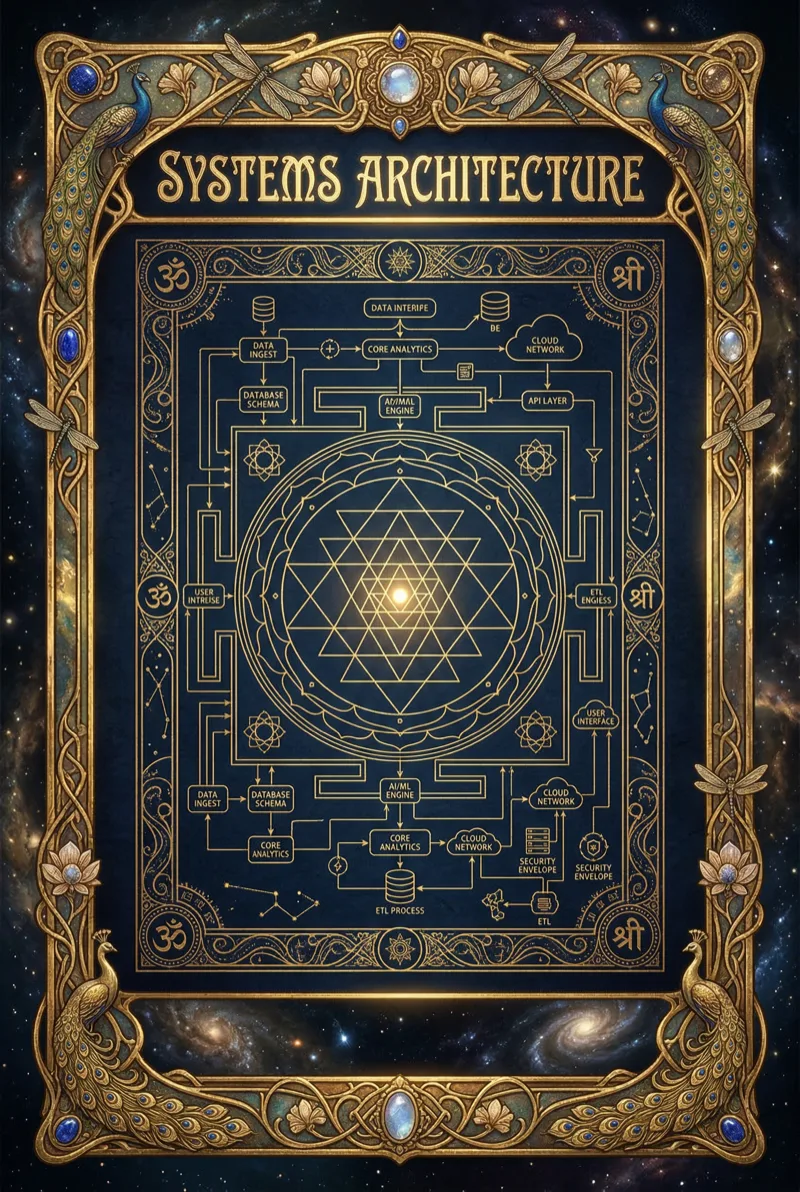
These six systems are not parallel tracks. They form an integrated architecture with three functional layers:
Time Evolution Layer
Vimshottari-Markov handles macro-temporal dynamics. Nakshatra-Fibonacci handles growth pattern evolution. Together, they describe when and how the system changes.
Relationship Layer
Graha-Cellular Automata handles planetary interaction dynamics. Bhava-Neural Networks handles house influence propagation. Together, they describe what interacts with what, and with what strength.
State Space Layer
Ashtakavarga-Hypercube handles binary state enumeration. Shadbala-Tensor handles continuous strength distribution. Together, they describe the complete configuration space within which the system operates.
class SystemIntegration:
    def __init__(self):
        self.time_systems = {
            'vimshottari': VimshottariMarkov(),
            'nakshatra': NakshatraFibonacci()
        }
        self.relationship_systems = {
            'graha': GrahaCellular(),
            'bhava': BhavaNeural()
        }
        self.state_systems = {
            'ashtakavarga': AshtakavargaHypercube(),
            'shadbala': ShadbalaTensor()
        }

    def integrate_patterns(self):
        patterns = {}
        patterns['temporal'] = self._integrate_time_systems()
        patterns['relationships'] = self._integrate_relationship_systems()
        patterns['states'] = self._integrate_state_systems()
        return patterns
Convergence as Evidence
The convergence between these ancient and modern frameworks is not a matter of creative interpretation. The mathematical structures are isomorphic — they share identical algebraic properties, symmetries, and computational behaviors. A Markov chain is a Markov chain whether its states are labeled “Sun dasha” or “State_0.” A hypercube is a hypercube whether its vertices represent bindu configurations or qubit states.
This convergence admits two interpretations. The deflationary interpretation: humans tend to see patterns everywhere, and with enough creative effort, any two systems can be mapped onto each other. The structural interpretation: the universe has a limited repertoire of mathematical architectures, and both ancient contemplatives and modern mathematicians discovered the same structures because those structures are real features of the systems they studied.
The structural interpretation gains force from the specificity of the parallels. It is one thing to say “Vedic astrology is mathematical.” It is another to identify exactly which mathematical framework each subsystem corresponds to, demonstrate the isomorphism at the level of state spaces and transition rules, and show that the six frameworks form a coherent integrated architecture with well-defined functional layers.
The seers and the mathematicians were examining the same runtime. They used different debuggers, different logging formats, different variable names. But the source code they examined was the same — the mathematical structure of temporal, relational, and configurational dynamics in complex systems. Recognizing this equivalence is not an act of mysticism or reductionism. It is pattern recognition at the highest level of abstraction.
This document is part of the Lorenz-Kundli Pattern Recognition series exploring mathematical-mystical parallels across the pattern space of consciousness.