Chaos Theory and Vedic Astrology: Strange Attractors in the Birth Chart
Runtime Version: 1.0.0
“Chaos is not disorder. It is order so complex that it appears random to observers locked in lower-dimensional projections.” — Phase Space Field Notes
Two Systems, One Architecture
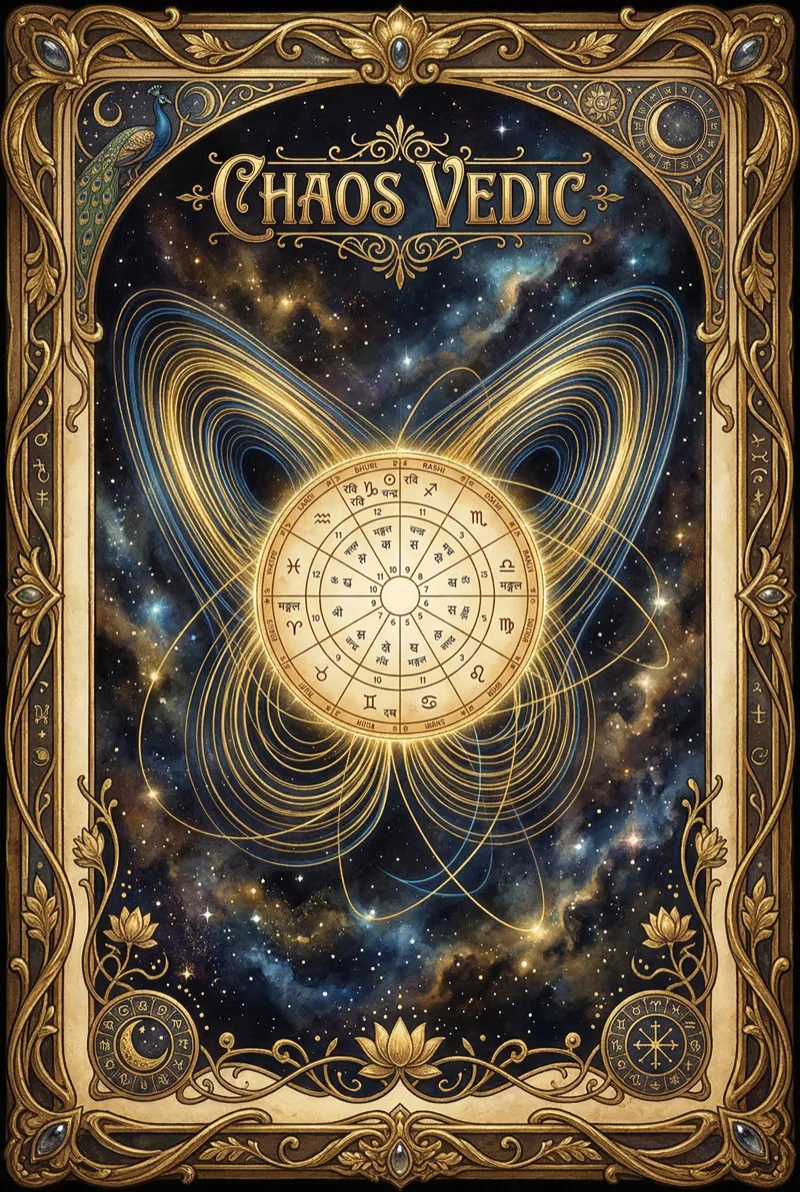
In 1963, Edward Lorenz discovered that a simplified model of atmospheric convection produced trajectories that never repeated yet never diverged beyond a bounded region of phase space. The trajectories traced a butterfly-shaped figure — the Lorenz attractor — that became the icon of chaos theory. The system was deterministic (no randomness in the equations) yet unpredictable (tiny changes in initial conditions produced radically different trajectories).
def lorenz_system(state, s=10, r=28, b=2.667):
    x, y, z = state
    dx = s * (y - x)
    dy = x * (r - z) - y
    dz = x * y - b * z
    return [dx, dy, dz]
Three variables. Three coupled differential equations. Three parameters. The resulting dynamics are infinitely complex — no trajectory ever exactly repeats — yet confined to a bounded structure with definite geometric properties.
The Kundli (Vedic birth chart) operates on identical principles. A birth chart is determined by the exact positions of nine grahas (planets) across twelve bhavas (houses) at a specific moment in time. The system is deterministic — celestial mechanics is Newtonian — yet the output is effectively unpredictable without precise knowledge of initial conditions. A difference of four minutes in birth time shifts the ascendant by one degree, potentially changing the entire house structure.
Phase Space Mapping
Phase space is the mathematical space where each point represents a complete state of the system. For the Lorenz system, phase space is three-dimensional (x, y, z). For the Kundli system, phase space is high-dimensional — each graha’s longitude, latitude, and speed contributes dimensions, yielding a phase space of approximately 27 dimensions for nine grahas with three coordinates each.
The critical insight is that both systems, despite operating in high-dimensional phase spaces, produce trajectories confined to lower-dimensional attracting structures. The Lorenz attractor is a two-dimensional manifold embedded in three-dimensional space — it has a fractal dimension of approximately 2.06. The Kundli attractor, if one could compute it, would be a lower-dimensional manifold embedded in 27-dimensional phase space — the set of all astronomically possible planetary configurations, which is a vanishingly small subset of all mathematically possible configurations.
class KundliSystem:
    def __init__(self):
        self.houses = range(1, 13)
        self.d_charts = range(1, 61)

    def map_to_phase_space(self, graha_positions):
        # Transform celestial positions to phase space
        pass

    def analyze_pattern_coherence(self):
        # Track pattern stability and evolution
        pass
Sensitivity to Initial Conditions
The hallmark of chaotic systems is sensitive dependence on initial conditions — the butterfly effect. Two trajectories starting from nearly identical points diverge exponentially over time. The Lorenz system has a Lyapunov exponent of approximately 0.9, meaning nearby trajectories separate by a factor of e^(0.9t) over time t.
The Kundli system exhibits the same sensitivity, formalized in the concept of muhurta — the precise moment of birth. Vedic tradition insists on birth time accuracy to within a few minutes because the entire house structure can shift with small temporal changes. This is not superstition; it is a practical acknowledgment of sensitive dependence on initial conditions in a chaotic system.
The divisional chart system (D-charts) amplifies this sensitivity. The D-1 (rashi) chart divides the zodiac into 12 segments. The D-9 (navamsha) divides it into 108 segments. The D-60 (shashtiamsha) divides it into 720 segments. Each higher division magnifies the initial condition sensitivity, exactly as examining a Lorenz trajectory at finer temporal resolution reveals increasingly complex structure.
Scale Invariance and Self-Similarity
Fractals — the geometric objects generated by chaotic systems — exhibit self-similarity across scales. Zoom into the Lorenz attractor and you find the same butterfly pattern at every magnification level. The large-scale structure is recapitulated at small scales, a property called scale invariance.
The D-chart system is the Vedic implementation of scale invariance. The D-1 chart shows the large-scale life pattern. The D-9 shows the same pattern at finer resolution, specifically focused on dharmic purpose and partnerships. The D-10 shows career patterns. The D-60 shows the finest resolution — karmic patterns from previous incarnations.
Each D-chart is a different magnification of the same underlying phase space trajectory. The patterns are self-similar — themes that appear in the D-1 chart reappear with greater specificity in higher divisional charts. A malefic planet in the seventh house of the D-1 chart (relationship challenges at the coarse scale) will typically correspond to specific malefic configurations in the D-9 chart (the fine-scale relationship dynamics that produce those challenges).
The Strange Attractor of Consciousness
The Lorenz attractor has a peculiar property: trajectories circle one lobe for a while, then unpredictably switch to the other lobe, then switch back. The timing of switches is deterministic but practically unpredictable — it depends on the exact position within the attractor, which is sensitive to initial conditions.
Human consciousness exhibits the same switching behavior. Periods of stability in one mode of experience (career focus, relationship focus, spiritual focus) give way to apparently sudden switches to other modes. The Vimshottari Dasha system models these switches as planetary period transitions — deterministic timing derived from birth conditions, producing life-phase changes that feel unpredictable from inside the experience.
The attractor basin — the set of initial conditions that converge to a particular attractor — defines the set of all possible life patterns. Not all birth times produce all possible lives. The attractor constrains the phase space, channeling the trajectory through a specific geometric structure. Free will operates within the attractor, but the attractor itself is defined by initial conditions.
Pattern Coherence Across Scales
The deepest parallel between Lorenz and Kundli systems is pattern coherence — the preservation of information across scales and time. The Lorenz attractor maintains its butterfly shape regardless of how long the system runs. Individual trajectories may wander, but the aggregate pattern is stable. Similarly, a birth chart’s fundamental patterns persist throughout life, even as specific experiences (individual trajectory segments) vary enormously.
def analyze_field_coherence(lorenz_data, kundli_data):
    # Compare pattern stability
    # Track information preservation
    # Measure interface efficiency
    pass
This coherence is what makes both systems useful for prediction. You cannot predict where a Lorenz trajectory will be at a specific future time (sensitive dependence prevents this), but you can predict the geometric structure it will inhabit. You cannot predict specific life events from a birth chart, but you can predict the patterns, themes, and developmental arcs that will characterize a life.
Reading the Attractor
Both chaos theory and Vedic astrology are technologies for reading attractors — for perceiving the geometric structure that constrains and channels dynamic evolution. The Lorenz equations generate the attractor computationally. The birth chart generates it observationally. The mathematical content is the same: a deterministic system with sensitive initial conditions, bounded trajectories, scale-invariant structure, and pattern coherence across time.
The seers who developed Jyotish were chaos theorists. They lacked differential equations but possessed something arguably more powerful: the ability to perceive phase space structure directly, through sustained contemplative attention to patterns in nature and human experience. Their charts are phase portraits. Their dashas are trajectory segments. Their yogas are attractor basins. The formalism is different. The mathematics is the same.
This document is part of the Lorenz-Kundli Pattern Recognition series exploring mathematical-mystical parallels across the pattern space of consciousness.