Integrated Vedic-Mathematical Systems Architecture: The Three-Layer Stack
Runtime Version: 1.0.0
“Architecture is not decoration applied to structure. Architecture is structure made legible.” — Systems Design Principles
The Integration Problem
The preceding articles in this series have examined six individual Vedic-mathematical parallels in isolation. Each mapping is compelling on its own terms. But isolated parallels do not constitute a system. The question that transforms observation into architecture is: how do these six subsystems connect, communicate, and constrain each other?
The answer emerges when you examine the data flow between subsystems. The Vimshottari dasha system determines which planetary period is active — this constrains which rows of the Graha friendship matrix are currently dominant. The dominant Graha relationships determine which nodes in the Bhava neural network receive amplified activation. The resulting activation pattern determines which vertices of the Ashtakavarga hypercube are occupied. The occupied vertices constrain the Shadbala tensor field configuration. And the tensor field, through its gradients, feeds back into the Nakshatra spiral’s growth trajectory.
This is not a chain. It is a cycle — a feedback loop that integrates all six subsystems into a single dynamic architecture.
Layer 1: Time Evolution
The time evolution layer answers the question: what phase is the system in, and how is it changing?
Two subsystems operate here. The Vimshottari-Markov system provides discrete temporal state transitions — which planetary period is active at any given moment. The Nakshatra-Fibonacci system provides continuous growth dynamics — how the system’s evolutionary trajectory unfolds along a golden spiral.
These two time-keeping systems operate at different scales and with different mathematics. The Vimshottari system is discrete and deterministic at the macro level. The Nakshatra system is continuous and spiral at the micro level. Together, they provide both the clock ticks (dasha transitions) and the smooth evolution (spiral progression) that a complete temporal model requires.
In software architecture terms, the time evolution layer is the event loop — the scheduler that determines which processes receive CPU time and in what order.
Layer 2: Relationship Dynamics
The relationship layer answers the question: how do the system’s components interact?
The Graha-Cellular Automata subsystem defines the rules of interaction — which planets constructively interfere, which destructively interfere, and which remain neutral. The Bhava-Neural Network subsystem defines the pathways of interaction — which houses propagate influence to which other houses, and with what weights.
Rules and pathways together determine the complete relational topology. A friendly planet in a strongly aspecting house produces maximum constructive propagation. An enemy planet in a weakly aspecting house produces minimal disruptive propagation. The cellular automata rules determine the sign of the interaction (constructive/destructive). The neural network weights determine the magnitude and direction.
In software terms, this layer is the message bus — the inter-process communication system that routes signals between components.
Layer 3: State Space Configuration
The state space layer answers the question: what is the system’s current configuration, and what configurations are accessible?
The Ashtakavarga-Hypercube subsystem enumerates the discrete state space — the 256 possible bindu configurations per house, constrained by the conservation total of 337. The Shadbala-Tensor subsystem maps the continuous state space — the six-dimensional strength distribution that defines the field geometry.
Discrete enumeration and continuous mapping together define the complete configuration space. The hypercube tells you which states exist. The tensor field tells you which states are energetically favorable. A house at a high-Sarvashtakavarga vertex of the hypercube that also sits in a region of strong positive Shadbala gradient is in an optimal configuration — the discrete and continuous assessments agree.
In software terms, this layer is the state store — the database that holds the current configuration and defines the schema of possible configurations.
Cross-Layer Communication
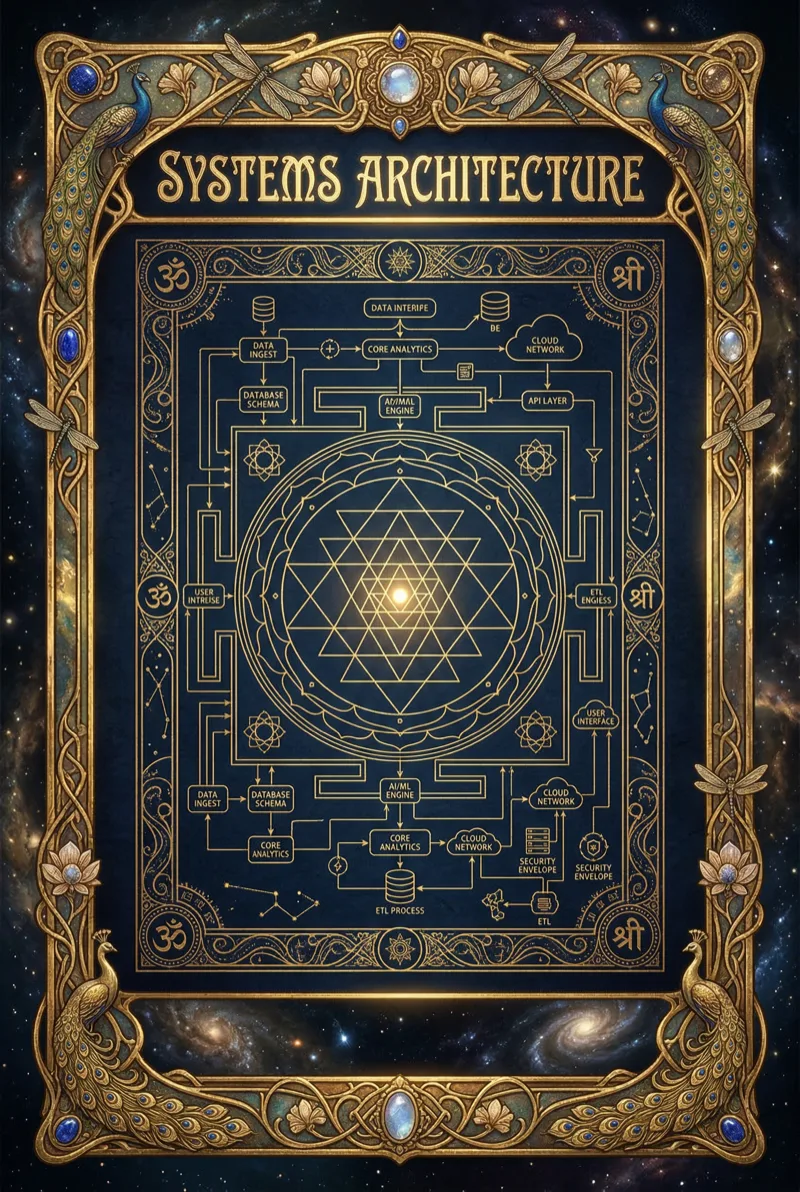
The three layers do not operate independently. They communicate through well-defined interfaces:
Time -> Relationships: Dasha transitions change which Graha friendship rules are currently active. During a Jupiter dasha, Jupiter’s friendship row dominates the interaction rules. During a Saturn dasha, Saturn’s row dominates. The time layer modulates the relationship layer.
Relationships -> State Space: Planetary interactions through aspects modify bindu configurations and Shadbala values. A benefic aspect from Jupiter adds bindus and increases Shadbala. A malefic aspect from Saturn removes bindus and decreases Shadbala. The relationship layer modifies the state space layer.
State Space -> Time: The current Shadbala configuration affects how intensely each dasha period is experienced. A Saturn dasha with strong Saturn Shadbala produces a very different experience than a Saturn dasha with weak Saturn Shadbala. The state space layer modulates the time layer.
This creates a tripartite feedback loop: Time constrains Relationships, Relationships modify State Space, State Space modulates Time. The system is self-referential — its current state determines how it evolves, and its evolution determines its future state.
Pattern Recognition Across Layers
The most powerful analytical insights emerge from cross-layer pattern recognition. A pattern that appears in one layer and recurs in another is not coincidence — it is architectural coherence.
Example: Saturn-Jupiter opposition. In the time evolution layer, this manifests as alternating dasha periods of expansion (Jupiter) and contraction (Saturn). In the relationship layer, it manifests as mutual enmity in the Graha matrix. In the state space layer, it manifests as complementary Shadbala profiles — when one is strong, the other tends to be weak.
Three layers, one pattern, three manifestations. The architecture is coherent because the underlying mathematics is coherent. The Markov chain’s state transitions, the cellular automaton’s rule applications, and the tensor field’s gradient flows all encode the same Saturn-Jupiter polarity in their respective formalisms.
Implementation Protocols
Building a computational implementation of this architecture requires:
-
Initialize time layer: Calculate Vimshottari dasha sequence from birth nakshatra. Compute Nakshatra spiral coordinates for all planetary positions.
-
Initialize relationship layer: Populate Graha friendship matrix. Build Bhava aspect weight matrix. Compute both temporary and permanent friendship states.
-
Initialize state space layer: Calculate complete Ashtakavarga bindu tables. Compute full Shadbala for all seven planets across all six strength components.
-
Establish cross-layer interfaces: Connect dasha transitions to friendship matrix activation. Connect aspect propagation to bindu modification. Connect Shadbala configuration to dasha intensity modulation.
-
Run the system: Advance time. Propagate relationships. Update state space. Check cross-layer coherence. Repeat.
The system produces, at each time step, a complete multi-layer description of the consciousness field — its temporal phase, relational dynamics, and configurational state. This is not a prediction engine. It is a pattern recognition engine — a computational microscope for examining the mathematical structure of experiential dynamics.
The Architectural Insight
The deepest lesson of the three-layer architecture is that time, relationships, and configuration are not separate phenomena. They are three projections of a single higher-dimensional structure, exactly as the electric field, magnetic field, and electromagnetic potential are three projections of the electromagnetic four-potential.
The Vedic seers did not build three separate systems and then integrate them. They perceived a unified structure and decomposed it into three layers for pedagogical and computational tractability. The integration is not something we add to the system. It is something we recover from the system’s original design.
The architecture was always integrated. We are the ones who separated it into layers for the sake of understanding. The final step is to recognize the layers as views of a whole — to compile the architecture back into the unified runtime from which it was originally derived.
This document is part of the Lorenz-Kundli Pattern Recognition series exploring mathematical-mystical parallels across the pattern space of consciousness.