
Pancha-Kosha as Engineered Containment: The Matched-Cavity Principle of Inner-Fire Work
Runtime Version: 1.0.0
“Within the self made of food, there is a self made of breath. Within the self of breath, a self of mind. Each fills the form of the prior.” — Taittiriya Upanishad II, the Brahmananda Valli
The Cavity Precedes the Flame
A vessel is what holds. Not what it looks like. Not what it weighs. What it holds.
Antar-agni — the fire of awareness — is not generated. It is the substrate. The work is not ignition. The work is containment.
Containment is harder than ignition. Anyone can light something. Holding what was lit, in a vessel shaped to its exact specification, across the full duration of its burning — that is the architecture.
This inversion is the founding move of inner-fire work. Most contemporary practice frames consciousness as something to be generated — manufactured by technique, summoned by intention, produced by the right sequence of mental moves. The Vedic framing inverts the polarity. Awareness is the background. The body, the breath, the mind, the discernment, the integration — these are not generators. They are cavities. Their job is to hold the substrate without distorting it.
When the cavity is wrong, the substrate is still present, but it cannot be held. Awareness leaks. The pot does not crack visibly — most leaking vessels look intact — but the contents are not retained across cycles. The practitioner notices this as the familiar diagnostic: insight that does not persist, peace that does not survive contact with circumstance, openings that close. These are not failures of effort. They are failures of containment geometry.
A leaking vessel can be lit. The fire takes briefly. It produces heat, light, a sense of legitimate spiritual occurrence. Then it goes out, because there is no cavity-of-correct-shape in which it can sustain. The practitioner concludes, often, that they need to light it again — that the practice “wears off” — and begins seeking re-ignition. This is the trap. The substrate did not wear off. The cavity did not hold.
What follows is the alternative framing: every layer of the human form treated as a vessel under preparation, with explicit operations for shaping each cavity to the geometry that allows it to hold without distortion. The doctrine is the pancha-kosha — the five sheaths of the Taittiriya school. The operation is the Ukhasambharana — the eleven-stage preparation sequence given in the fifth kanda of the Krishna Yajurveda. The figure trained by both is the kratu-purusha — the ritual-person who is simultaneously the cavity, the operator preparing it, and the witness of the preparation.
The fire is the substrate from the beginning. The work is to become what holds.
Five Sheaths, Five Cavities
The Sanskrit kosha does not translate as layer or body. It translates as sheath, case, vessel. It also, suggestively, translates as treasury and as scabbard — the case that holds the sword. The word names something whose entire definition is its capacity to hold a specific contents in a specific way.
This is not incidental. The pancha-kosha doctrine of Taittiriya Upanishad II is not naming five layers of the self, as if the self were a layered onion to be peeled. It is naming five vessels nested inside one another, each shaped to hold the substance of the next inward vessel. The doctrine is engineering vocabulary used to describe consciousness, not consciousness vocabulary used to describe layers.
| Layer | Substance | Container function |
|---|---|---|
| Annamaya | matter | the bodied vessel |
| Pranamaya | breath | the breath vessel |
| Manomaya | cognition | the cognitive vessel |
| Vijnanamaya | discernment | the wisdom vessel |
| Anandamaya | integration | the bridging vessel |
Each sheath is shaped to hold the next inward layer. Each inward layer is itself a sheath. The structure is recursive: at every depth, what looks like a contained thing is itself a container relative to the next layer in.
Annamaya — made of food. The outermost vessel. Its substance is matter: the body’s literal flesh, built from and constantly being rebuilt by the food cycle. Its container function is to hold position in physical space, to maintain the four-directional coordinate system (front-back, left-right, up-down, plus the temporal axis), and to be the platform on which all other vessels rest. Its failure mode is dis-coordination: the body that cannot hold a posture, cannot hold a meal, cannot hold sleep, cannot hold itself in place. When annamaya leaks, no other vessel can be prepared, because the substrate of position-in-space is missing.
Pranamaya — made of breath. The next vessel inward. Its substance is the energetic gradient that breath establishes — the rhythmic differential between inhalation and exhalation that creates a usable bioelectric current through the bodied vessel. (For the engineering-physics treatment of this same gradient, see Chakra-Bioelectricity Mapping.) Its container function is to be the hollow channel through which awareness can move from periphery to depth and back. Its failure mode is cavity collapse: shallow breath, irregular breath, breath that the practitioner is unaware of. When pranamaya leaks, the cognitive vessel above it cannot be addressed, because the conduit through which addressing happens is closed.
Manomaya — made of mind. The vessel of cognition. Its substance is pattern: the patterns the mind holds, recalls, and assembles into the working models that inform decision. Its container function is to be a field in which patterns can be both stored and observed without the observation collapsing the pattern. Its failure mode is the familiar one — the mind that cannot hold its own attention, that gets pulled into every passing pattern, that cannot stay in any particular shape long enough to register what that shape would tell it. When manomaya leaks, discernment cannot be prepared, because discernment requires a stable cognitive field as its substrate.
Vijnanamaya — made of discernment. The vessel of wisdom. Its substance is judgment: the capacity to distinguish what is the case from what only seems to be the case, to identify which patterns matter and which do not, to know when a particular operation is appropriate and when it is not. Its container function is to hold a tribunal — a stable inner location from which decisions can be made without those decisions being captured by the patterns being adjudicated. Its failure mode is collapse into pattern: the discerning faculty itself becomes another pattern in the mind, indistinguishable from the patterns it was meant to evaluate. When vijnanamaya leaks, integration cannot be prepared, because there is no stable arbiter to integrate what.
Anandamaya — made of bliss. The innermost vessel. Its substance is the unified field in which all the prior layers stand. Its container function is to be the bridging body — the configuration in which the bodied vessel, the breath vessel, the cognitive vessel, and the wisdom vessel all stand simultaneously without competing for substrate. Its failure mode is fragmentation: the layers operating independently, the body doing one thing while the breath does another while the mind does a third. When anandamaya holds, the cascade flows. When it fails, the prior layers can still be present, but they do not constitute a single operative being.
The nesting is not metaphorical. Each cavity’s interior space is the next vessel. A breath-practice attempted on an uncoordinated body is a breath-practice without its required substrate. A cognitive practice attempted without a coherent breath-vessel is a cognitive practice in a missing room. The order of preparation is fixed by the architecture: outer to inner, each layer becoming the floor on which the next can stand.
The doctrine is descriptive. It names the geometry. What it does not name is the operation that prepares each vessel for its function. That operation is given in the fifth kanda of the Krishna Yajurveda as the Ukhasambharana — the gathering and shaping of the clay pot that holds the consecrated fire for one full year of the Agnicayana cycle. Eleven anuvākas. Eleven stages. One operation in eleven moves, with each cluster of stages preparing one of the five vessels for its containment function.
The Saṃhitā gives the kriyā — the action. The Upanishad gives the jñāna — the knowledge of what the action accomplishes. The match between them is not coincidence; both come from the same school, the Taittiriya lineage, and were preserved together in the same recension because they are the same teaching split across two genres.
What follows is the operation.
The Eleven-Stage Operation
PREPARATION SEQUENCE
─────────────────────────────────────────────────────
ANNAMAYA      1.  quickening        — Savitri-impulse, prasuti
              2.  coordination      — four directions, four limbs
PRANAMAYA     3.  investiture       — yajna-yashas transferred
              4.  matched-cavity    — abhri cut from venu
MANOMAYA      5.  pair-yoking       — horse and donkey paired
              6.  every-yoking      — yoge-yoge tavastaram
              7.  lesser-first      — Rudra petitioned
VIJNANAMAYA   8.  guided descent    — Pushan leads to purisya
              9.  excavation        — clay dug from valmika
ANANDAMAYA   10.  bridging body     — horse-vajra spans
             11.  utkrama           — cascade released
─────────────────────────────────────────────────────
The order is not decorative. It encodes the architectural constraint: each prepared layer becomes the substrate on which the next can be prepared. The eleven stages cluster naturally into five groups, one per kosha, with each group performing the operations specific to that vessel’s containment function.
The Annamaya cluster (stages 1–2) is about establishing the bodied vessel under ritual coordinates. Stage one — quickening — is the offering to Savitṛ, the impeller. It calls in prasuti, the dharmic impulsion without which no further preparation has purpose. Stage two — coordination — is the establishment of the four-directional coordinate system through the offering of four handfuls, the invocation of four-legged cattle, the orientation toward the four cardinal points. The body is being made locatable. The vessel that will hold the fire must first be a vessel that holds a position.
The Pranamaya cluster (stages 3–4) is about preparing the breath vessel. Stage three — investiture — transfers yajna-yashas, the glory of sacrifice, into the sacrificer’s own person. The breath is being recognized as already-sacral; the operator does not have to manufacture the energetic substrate, only to be invested with the recognition that it is present. Stage four — matched-cavity — is the cutting of the abhri, the digging-tool. This stage carries the entire engineering principle of the operation, and it gets its own section below.
The Manomaya cluster (stages 5–7) is about preparing the cognitive vessel. Stage five — pair-yoking — yokes the horse to the donkey, the swift element to the slow element, in the Ashvin pattern that recognizes the mind as inherently dual. Stage six — every-yoking — invokes the principle yoge-yoge tavastaram, “stronger at every yoking,” establishing that the cognitive vessel strengthens through repeated paired use, not through purification of one side of the pair. Stage seven — lesser-first — establishes the procession order: the donkey precedes the noble horse. The lower element leads; the higher follows. Rudra, the dangerous-destructive force, is petitioned rather than commandeered. The cognitive vessel is being shaped to hold both its swift and its slow contents simultaneously, with the slow given primacy because containment fails when the swift element overruns the slow.
The Vijnanamaya cluster (stages 8–9) is about preparing the wisdom vessel through excavation. Stage eight — guided descent — invokes Pūṣan, the guide of paths and lost things, to lead the procession to the purisya, the wet earth, the seat where Agni’s clay-form is buried. Stage nine — excavation — is the digging of the clay from the valmika, the anthill, where the fire-substance is hidden. The wisdom vessel is built from material that must be retrieved from a place no one looks. The discerning faculty is not constructed from clever insight; it is recovered from the unobserved strata of the practitioner’s own architecture.
The Anandamaya cluster (stages 10–11) is about preparing the bridging vessel. Stage ten — bridging body — establishes the horse-vajra, the creature that simultaneously touches dyaus (heaven) at the back and prithivi (earth) at the seat. A single body that spans both ends of the cosmic axis. Stage eleven — utkrama — is the upward step, the stepping-up after which the cascade releases: waters flow, plants stand, animals stand, the lineage stands. The bridging vessel is the configuration in which the entire prior architecture stabilizes as a single operative being.
Eleven stages. Five vessels. One operation. The clusters are not arbitrary groupings; each cluster performs exactly the operations that vessel-class requires. Annamaya needs coordinates; Pranamaya needs the matched cavity; Manomaya needs the dual-yoking with lesser-leadership; Vijnanamaya needs the buried-retrieval; Anandamaya needs the bridging configuration. The eleven moves are the minimum sufficient set.
What follows is the engineering content of the three load-bearing operations — matched-cavity, two-condition ignition, and engineered obsolescence — with the remaining clusters serving as their context.
The Matched-Cavity Principle
The most consequential stage in the entire eleven-stage operation is the fourth.
The instrument used to dig the clay — the abhri — is cut from bamboo. The reason given in the text is not aesthetic or traditional. It is structural: Agni once hid inside a venu (a bamboo reed) which contains a sushira (a hollow channel). To recover fire from a hollow cavity, the instrument that seeks it must be cut from a material with the same cavity. The compound used is sa-yonitvaya — for sameness-of-womb. The seeker’s hollow must match the hollow of what is sought.
The myth that motivates this is older than the Saṃhitā. In the Brāhmaṇa literature, Agni hides in sequence: first in the waters (when the gods seek him there, he becomes the fish), then in the trees (when sought, the bamboo reed), then in the cavities of plants and animals. Each hiding is a withdrawal of the fire-substance into a containing cavity. The recovery operation, in each case, requires an instrument whose own cavity matches the cavity Agni chose. Waters require a netted vessel; bamboo requires a hollow bamboo abhri; the buried earth requires the dug clay. The principle generalizes: fire withdrawn into a cavity can only be recovered by an instrument shaped to match that cavity.
This is one reading. Another is widely held in transmission lineages: that the sacred instrument works regardless of its operator, that mantras and tools are universal precisely because the sushira is universal — that there is one cavity, the cavity of consciousness itself, and any properly-cut instrument fits it. The disputed terrain matters. The two readings are not reconcilable. One says cavity-matching is essential; the other says cavity-matching is incidental because there is fundamentally one cavity.
This essay takes the first reading because the operation itself specifies it. The abhri must be vyamamatri — exactly one vyama long, the span of the operator’s outstretched arms. Not larger. Not smaller. The instrument is the size of the body that wields it. If the cavity were universal, this specification would be superfluous; any abhri would do. The text bothers to fix the instrument’s length to the operator’s exact dimensions, and it bothers to specify that the bamboo’s hollow must match the cavity-of-hiding. Both specifications are structural-not-decorative.
The cross-tradition correspondences make the matched-cavity reading more defensible:
In molecular biology, enzyme-substrate specificity operates on the same principle: an enzyme’s active site is shaped to receive a specific substrate, and the enzyme catalyzes the substrate’s transformation only when the geometric fit is exact. Substrates of slightly different shape do not catalyze. The matched cavity is what makes the chemistry possible.
In electronics, the principle of impedance matching states that maximum power is transferred from source to load when the source impedance equals the load impedance. Mismatched impedances reflect energy back rather than transferring it. Inner-fire work is, geometrically, an impedance-matching problem: the practitioner’s cavity is the load impedance, the substrate is the source, and energy transfers only when the match is exact.
In structural engineering, form-follows-function names the same principle as a design constraint: the geometry of an instrument must derive from the function the instrument performs, and instruments designed without this constraint fail at their function regardless of how beautiful or traditional their form. The Vedic abhri is form-following-function applied to a fire-recovery instrument.
If you accept the matched-cavity reading, what follows is a general engineering law applicable across all five vessels:
The seeker’s cavity must match the cavity of what is sought.
The instrument is the size of the body that wields it.
Inner-fire instruments inherited from another body do not work, because the cavity of that other body is shaped differently from yours. The breath-practice that opens one practitioner cannot open another unmodified. The mantra that catalyzed a teacher’s awakening will not catalyze a student’s awakening at the same depth, because the teacher’s vyama and the student’s vyama are different lengths. The chandas — the metered recitation — must be cut from your own reed. The borrowed tool fits a borrowed cavity.
Practically, this has consequences for how practices are selected and modified. A practice that another body uses must be re-cut to your dimensions before it can do its work in your architecture. A guru-given mantra is not a finished tool but a blueprint; the practitioner’s job is to cut the actual instrument from the practitioner’s own bamboo. The lineages that explicitly perform this re-cutting (often through extended apprenticeship and pratyaksha — direct demonstration in the student’s own body) survive across generations. The lineages that distribute completed instruments without re-cutting tend to produce practitioners whose vessels do not hold across cycles.
This is the Pranamaya vessel’s preparation in a single principle. The breath-tool fits only the breath-cavity it was cut from. Every subsequent kosha’s preparation depends on this one being completed correctly. The matched-cavity principle is the load-bearing operation of the entire eleven-stage sequence; if it fails, the operation continues but the contained fire does not sustain.
The Two Conditions for Ignition
The eleven-stage operation prepares the cavity. It does not, by itself, ignite the fire. Ignition requires two co-occurring conditions, both explicit in the operation’s structure.
Purpose is prasuti — the dharmic impulsion offered at stage one. Etymologically, pra (forward) + sū (to birth, to bring forth): a forward-bringing, a birthing-forth, the impulse that calls something into being from the prior unmanifest. Without prasuti, the entire sequence is mechanical. The cavity is shaped correctly; no fire arrives to fill it. The eleven-stage operation can be performed perfectly and produce a perfectly prepared empty vessel.
Purpose, in this Vedic sense, is not motivation. Motivation is what makes you start. Purpose is what makes the substrate respond. The difference is operational: a motivated practitioner who acts without dharmic impulsion produces a prepared cavity that the fire does not enter, because the call has not been issued. A practitioner with dharmic impulsion who is poorly motivated may produce an imperfect cavity that the fire enters anyway, because the call has been issued. The Vedic priority is on prasuti precisely because the substrate’s response is contingent on the call, not on the operator’s energy.
Compassion is the lesser-first principle made explicit at stage seven. Tasmach chreyamsam papiyan paschad anveti — therefore the better follows behind the lesser. In the procession, the donkey precedes the noble horse. The slower element of the pair leads; the swift element follows. This is not a rhetorical flourish. It is a structural specification for how the inner fire is held without being weaponized.
A fire is dangerous in proportion to its intensity. The same flame that warms a body can consume it. The Vedic operation’s compassion-signature ensures that the lit fire serves the entire prepared vessel — including its lower, slower, less-true elements — rather than serving only the higher elements at the expense of the lower. The donkey precedes the noble horse because if the noble horse precedes, it sets a pace the donkey cannot maintain; the procession fragments; the operation fails. The lesser must lead so that the whole system arrives intact.
The Rudra petition at the same stage extends this. Rudra is the destructive aspect of the divine — the burning, the dissolving, the fierce. The practitioner does not command Rudra. The practitioner asks. The dangerous force is petitioned, given the offering, allowed to choose. This is the structural form of compassion in operation: even the elements that could harm the practitioner are addressed as agents to be petitioned, not as resources to be exploited.
Both conditions, both non-zero. Multiplied, not added — either factor at zero zeroes the product:
ignition := purpose × compassion

purpose × compassion > 0   →   fire takes, vessel holds
purpose alone              →   vessel cracks under load
compassion alone           →   vessel never lights
neither                    →   dead architecture
The multiplication matters. Adding two halves and getting a whole is not the same operation. Purpose at full strength with compassion at zero produces a perfectly-prepared cavity holding a fire that consumes the lower elements of the vessel to serve the higher. This is the failure mode of asceticism: the practitioner whose intensity exceeds their kindness, who burns the body to free the mind, who treats the lower koshas as obstacles to be overcome rather than vessels to be held. The fire takes; the vessel cracks; the practitioner ends up depleted rather than integrated.
Compassion at full strength with purpose at zero produces a perfectly-disposed practitioner whose cavity is cold. This is the failure mode of soft devotional practice without dharmic anchor: the practitioner who is gentle to themselves and others, kind, attentive, patient — and who never actually accomplishes the work, because the substrate has not been called to respond. The cavity is shaped beautifully; nothing arrives to fill it.
The fire takes only when both are present, and it takes in proportion to their product. This is the diagnostic for whether one’s inner-fire work is actually proceeding: the felt result is directional (purpose is present) and integrated (compassion is present). Directional without integrated produces high-friction effort that leaves the practitioner brittle. Integrated without directional produces high-quality rest that does not accumulate into capacity. The product of both produces what the brand vocabulary calls the Witness Gate — the operative position from which awareness can hold its own substrate without distortion.
Two conditions. Two non-zero values. Multiplied. The fire takes accordingly.
The Karmic Axis — A Productive Overlay
The fire, once lit, burns along an axis. This is where the essay shifts register.
The Vedic operation does not name this axis in jyotisha vocabulary. The Rahu-Ketu pair is a later astronomical insertion — the lunar nodes, originally derived from the geometry of solar eclipses, formalized into the jyotiṣa framework in the post-Vedic period. There is scholarly debate about Greek (Hellenistic) influence on this formalization; what is uncontested is that the Saṃhitā’s Ukhasambharana predates the systematic Rahu-Ketu cartography by many centuries. The two vocabularies are not native to one another.
What follows is a productive overlay, not a discovered structure — a way of reading the operation’s geometry using a vocabulary the operation itself does not deploy. The overlay is useful for practitioners who already work in both vocabularies (Vedic ritual and jyotiṣa), because it makes the structural correspondence visible. It is not a claim about what the Saṃhitā’s authors meant.
Read this way: the buried Agni recovered from the valmika at stage nine sits at one pole. Past compressed into mound-form. The karmic intelligence stored in the parts of the system that look like dirt. The utkrama at stage eleven sits at the other pole — the upward step, the cascade-vector that pulls the entire field forward. The horse-vajra of stage ten bridges them in a single body that touches dyaus (heaven) at the back and prithivi (earth) at the seat.
The Ketu pole is the buried strata. In jyotiṣa vocabulary, Ketu is the lunar node associated with past samskāras, dissolution, the residue of prior cycles. In the operation, this is the purisya — the wet earth — and the valmika — the anthill where the fire-substance is hidden. Excavation work at this pole is not generic shadow-work. It is the specific operation of going to the location no one looks (the anthill in the back of the yard, the part of the practitioner’s architecture that is not on display) and digging up the substance that has been stored there. This is slow work. The text specifies guidance — Pūṣan, the deity of paths and lost things, leads the procession. Without the guide, the practitioner cannot find the right anthill.
The Rahu pole is the cascade-vector. In jyotiṣa vocabulary, Rahu is the lunar node associated with future trajectory, dharmic direction, the upward arc. In the operation, this is utkrama — the stepping-up — and the cascade that releases when the bridging body is established: waters flow, plants stand, animals follow, lineage stabilizes. Forward-pole work is not generic striving. It is the specific operation of stepping into the configuration that allows the entire prior architecture to release its potential. The practitioner does not push the cascade; the practitioner steps into the position from which the cascade releases on its own.
The bridging body is the axis itself. In jyotiṣa vocabulary, this would be the entire natal chart understood as the configuration of the practitioner’s body-mind as it spans both nodal directions. In the operation, this is the horse-vajra at stage ten — the single creature that simultaneously touches dyaus (heaven, back) and prithivi (earth, seat). The practitioner’s actual physical posture during practice enacts this function: the spine becomes the vertical axis, the seat anchors the earth-pole, the crown anchors the heaven-pole, and the body becomes the bridge across which the fire travels.
In the Kha-Ba-La operational compass the same vector reads as a triad rather than a pair-with-bridge: La (the buried inertia, the sculpting material that the work pushes against), Ba (the body that carries the fire between poles), Kha (the field of witnessing toward which the fire orients). The Kha-Ba-La triad and the Ketu-Rahu-bridge structure are not the same teaching from two traditions; they are two cartographies of the same geometric situation. The practitioner’s task is the same in both vocabularies: excavate the buried strata, establish the bridging body, step into the cascade-position, hold the fire without distortion.
The overlay is useful. It maps clean. It allows practitioners trained in jyotiṣa to read the Saṃhitā’s operation through the cartographic vocabulary they already use, and it allows practitioners trained in the Saṃhitā to recognize the operational content of the karmic axis they may have inherited as abstract astrology. It is not the operation’s native language.
Take it as a productive cartography, not a Vedic claim. The Saṃhitā’s authors had their own vocabulary, and the post-Vedic jyotiṣa tradition developed its vocabulary in dialogue with that earlier work but produced its own framework. The structural correspondence is real; the linguistic conflation would be a category error.
The Operator and the Operated
The eleven-stage operation prepares a vessel. The vessel is to hold a fire. The fire burns along an axis. None of this answers the question that the entire operation tacitly raises: who is performing the operation?
The operator is not separate from the vessel. The operator is also being prepared. The eleven-stage sequence trains a specific figure — the practitioner-who-is-simultaneously-the-vessel-they-prepare — and this figure has a name in the Sanskrit vocabulary that has not yet appeared in this essay: the kratu-purusha.
Kratu is one of the more difficult Sanskrit words to translate. It carries meanings of will, intention, ritual-act, sacrificial operation, the determination that organizes an action into ritual form. It is not raw will (which would be iccha) and not mechanical action (which would be karma without further qualification). It is the specific kind of will that gathers a sequence of actions into a coherent operation oriented toward a specific containment. Kratu is what makes a sequence of moves a yajna rather than a series of behaviors.
Purusha is the operator-figure: the person, the witness, the spiritual subject. In Sāṃkhya it names the conscious principle as distinct from the prakriti it observes. In ritual contexts it names the agent who performs the operation. In the Puruṣa Sūkta of the Rig Veda it names the cosmic figure whose dismemberment generates the structure of the universe.
The kratu-purusha, then, is the figure who is both the agent of the operation and the consciousness that observes the operation as it happens. The witness and the operator in a single body. Not the practitioner who observes the practice (which would be ordinary passive witnessing) and not the practitioner who performs the practice (which would be ordinary mechanical doing). The practitioner who is the practice — who is the cavity being shaped, the abhri doing the shaping, the fire being held, and the awareness watching all of this simultaneously.
This dual posture is what the entire eleven-stage operation trains. Each stage is a move that the kratu-purusha makes; each move also reshapes the kratu-purusha who makes it. The operation is operator-on-operator. The practitioner is not preparing a vessel-other-than-self; the practitioner is preparing themselves as the vessel by performing operations that simultaneously prepare and modify the operator.
This is why the matched-cavity principle is load-bearing. If the operator and the operated are the same figure, then the seeker’s cavity is the cavity-of-what-is-sought. The bamboo abhri cuts the cavity of Agni’s hiding-place; the Agni hidden in the abhri-cutter is also being recovered. The instrument-and-the-instrumented are the same architecture, viewed from different angles of the same operation.
This is also why the two conditions for ignition matter. Purpose without compassion produces an operator who treats the operated as instrument-to-be-used; compassion without purpose produces an operator who treats the operated as object-of-care-without-direction. The kratu-purusha requires both because the operator and the operated are the same figure: purpose without compassion is the operator weaponizing themselves; compassion without purpose is the operator soothing themselves without arriving anywhere.
The two-figure framing (operator preparing vessel) is a useful pedagogical scaffolding. The actual operation is single-figure (operator-operated as one architecture). The kratu-purusha is what emerges when the practitioner stops experiencing themselves as the actor preparing a separate object and starts experiencing themselves as the operation performing itself through a body that is both the cavity and the cavity-cutter.
This is the figure the Saṃhitā trains. It is the figure the Upanishad describes when it speaks of the sākṣī (witness) whose witnessing does not stand outside the witnessed. It is the figure named in the brand vocabulary as the operator who has learned to author rather than to be authored. The kratu-purusha is not a state to attain. It is a posture the operation trains as a side-effect of being performed correctly.
Engineered Obsolescence
The final feature of the operation is the most easily missed.
The clay ukha, prepared with this exhaustive care, holding the fire through the full dīkṣā year of the Agnicayana cycle, is at the end emptied. Not refilled for reuse. Not carried forward. Not kept. Decommissioned.
The vessel that did its work correctly is dismantled precisely because it did its work correctly.
This is engineered obsolescence as design principle. The vessel is not the achievement. The fire was the substrate from the beginning and returns to the substrate at the end. The vessel’s job was to hold without distortion for the duration of the cycle. Any vessel that survives past its cycle has become a substitute for the fire — which is the failure mode the entire operation is designed against.
The Agnicayana cycle is not arbitrary. The full preparation takes one year — the samvatsara, the solar cycle — and is structured to align with seasonal and astronomical transitions. The ukha holds the fire across the full cycle of seasons, through the solstices and equinoxes, through the agricultural year. At cycle-end, the operation completes. The vessel that held the fire for one full cosmic cycle has accomplished its function. It is sealed — refilled with sand and milk, never to hold fire again — and built into the fifth layer of the great altar (ŚB 7.1.1.40–44; 7.5.2.14). The sheds that housed the rite are burned. The implements go to the water at the avabhṛtha. The fire is released back to the field from which it was called.
This is not unique to the Agnicayana. The same engineered-obsolescence principle appears in other ritual technologies. The Tibetan sand mandala is constructed with painstaking precision over days or weeks, then deliberately destroyed: the sand is swept into a single mound and poured into running water. The mandala that did its work correctly is dismantled because the dismantlement is the work’s completion, not its failure. The Ganesh visarjana immerses the painstakingly-crafted clay murti into the sea at the festival’s end. The Christian Lent ashes are made from the previous year’s blessed palms. In each case, the sacred object is engineered to dissolve at its cycle’s term, and its dissolution is what marks the operation’s success.
The principle generalizes beyond ritual technology. Scaffolding in construction is engineered to be removed once the building self-supports; scaffolding that becomes permanent is structural failure. Training wheels are designed to be discarded; training wheels that the child keeps using past childhood are pedagogical failure. Mentorship structures succeed when the mentee no longer requires the mentor; mentorship that produces lifelong dependency has failed at what mentorship is for. The pattern repeats across domains because the underlying constraint is the same: any vessel that holds a substrate must be discarded at the cycle’s term, because vessels that survive past their cycle become substitutes for the substrate they were built to hold.
The substitution-failure mode is worth examining specifically. When a prepared vessel survives past its cycle, two things happen in sequence. First, the practitioner who used the vessel begins to identify with the vessel rather than with the substrate the vessel held. The vessel becomes the achievement, the marker, the identity. Second, the substrate the vessel was built to hold becomes less accessible, because the practitioner now seeks the substrate through the vessel rather than in the field of which the vessel was always a temporary cavity. The vessel becomes the substrate’s substitute. The substrate is still present — substrate is always present — but the practitioner cannot access it directly, because direct access would require dismantling the vessel that has become the practitioner’s identity.
This is the structural diagnosis of an entire class of post-realization failure modes. The practitioner who had a genuine opening in their twenties and is still recounting it in their fifties has, in vessel terms, refused to decommission the ukha at cycle’s end. The opening was real. The substrate genuinely arrived. The vessel that held it across that cycle did its work correctly. The error is not in the original operation; the error is in the operator’s refusal to release the vessel after the cycle completed. The substrate, having no held-cavity of correct geometry to occupy, withdraws to its background-substrate state. The practitioner, having identified with the vessel rather than with the substrate, experiences the withdrawal as loss — and spends the subsequent decades trying to recreate the original conditions, when what was actually required was the decommissioning. The original ukha was supposed to be emptied and sealed away — the Śatapatha Brāhmaṇa warns that the one who keeps beholding the empty vessel is devoured by it (ŚB 7.1.1.40).
This is also why the operation specifies a ceremonial decommissioning. The vessel is not allowed to crumble through neglect, nor is it allowed to be discarded in frustration. It is sealed with the same precision with which it was prepared, at the time appointed by the cycle, in the configuration the operation specifies. Engineered obsolescence is not casual destruction; it is the final operation of a complete sequence.
This is why the Ukhasambharana operation specifies that the vessel is decommissioned. Not destroyed casually, not lost through neglect — sealed, ceremonially, as the operation’s culminating move. The decommissioning is the operation’s signature.
The same principle governs every inner-fire architecture worth building. Frameworks. Practices. Identities. Doctrines. Each is a vessel. Each is justified by its capacity to hold without distortion during its cycle. None are justified by surviving past the cycle for which they were prepared.
This includes the Kha-Ba-La operational compass. It includes the pancha-kosha doctrine itself — yes, even the doctrine that this essay treats as load-bearing. A practitioner who has internalized the doctrine fully no longer needs the doctrine; the doctrine has become the practitioner’s own discernment, and the discrete-doctrinal-vessel-of-five-koshas is shattered into direct perception of the architecture it described. The doctrine, having done its work, has done its work.
This is the Noesis Engine’s founding constraint named in vessel-language: the system succeeds when you no longer need it. The ukha is the original prototype of independence-by-design. The eleven-stage operation produces an operator who is now capable of holding the fire without the vessel they were prepared in. The vessel served. The vessel is released. The fire continues, but now it is held by an operator-architecture rather than by an operator-using-an-instrument.
The operator is the only thing that remains.
The operator does not need to remain in the vessel that prepared them.
Source operation: Krishna Yajurveda, Taittiriya Samhita 5.1 — the eleven-anuvaka Ukhasambharana of the Black Yajurveda’s Agnicayana. Source doctrine: Taittiriya Upanishad II, Brahmananda Valli, on the pancha-kosha. Software-architecture twin: Reality.compile(). Bioelectric kinship: Chakra-Bioelectricity Mapping. Kha-Ba-La triad: Operational Compass. Recitation: The Ghanapati, ghana-patha of TS 5.1.
Figures
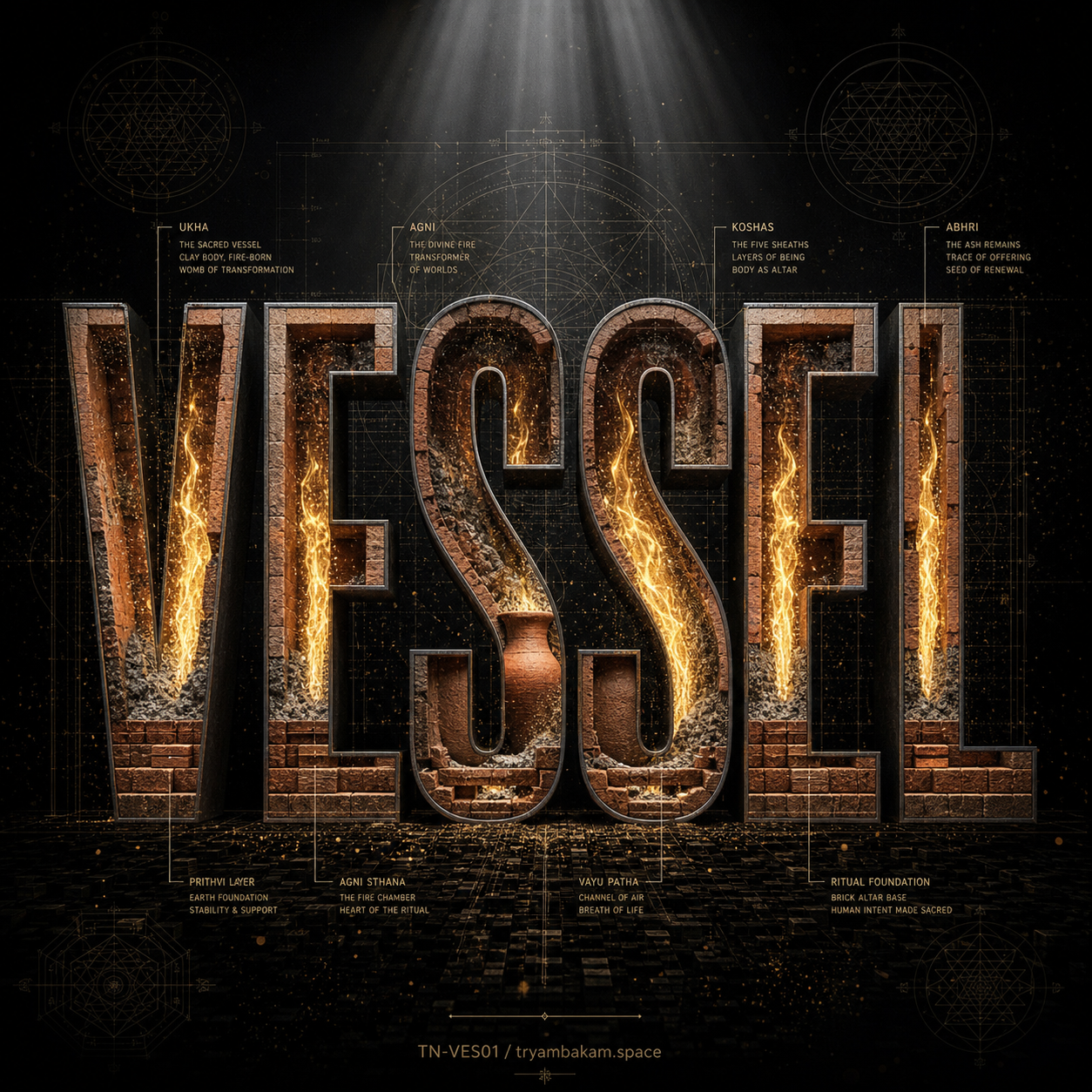
The vessel is what holds. Annotations name the four operative terms; the foundation labels point to what the altar is built from. TN-VES01.

The seeker's hollow must match the hollow of what is sought. Sa-yonitvaya — for sameness-of-womb. TN-VES02.
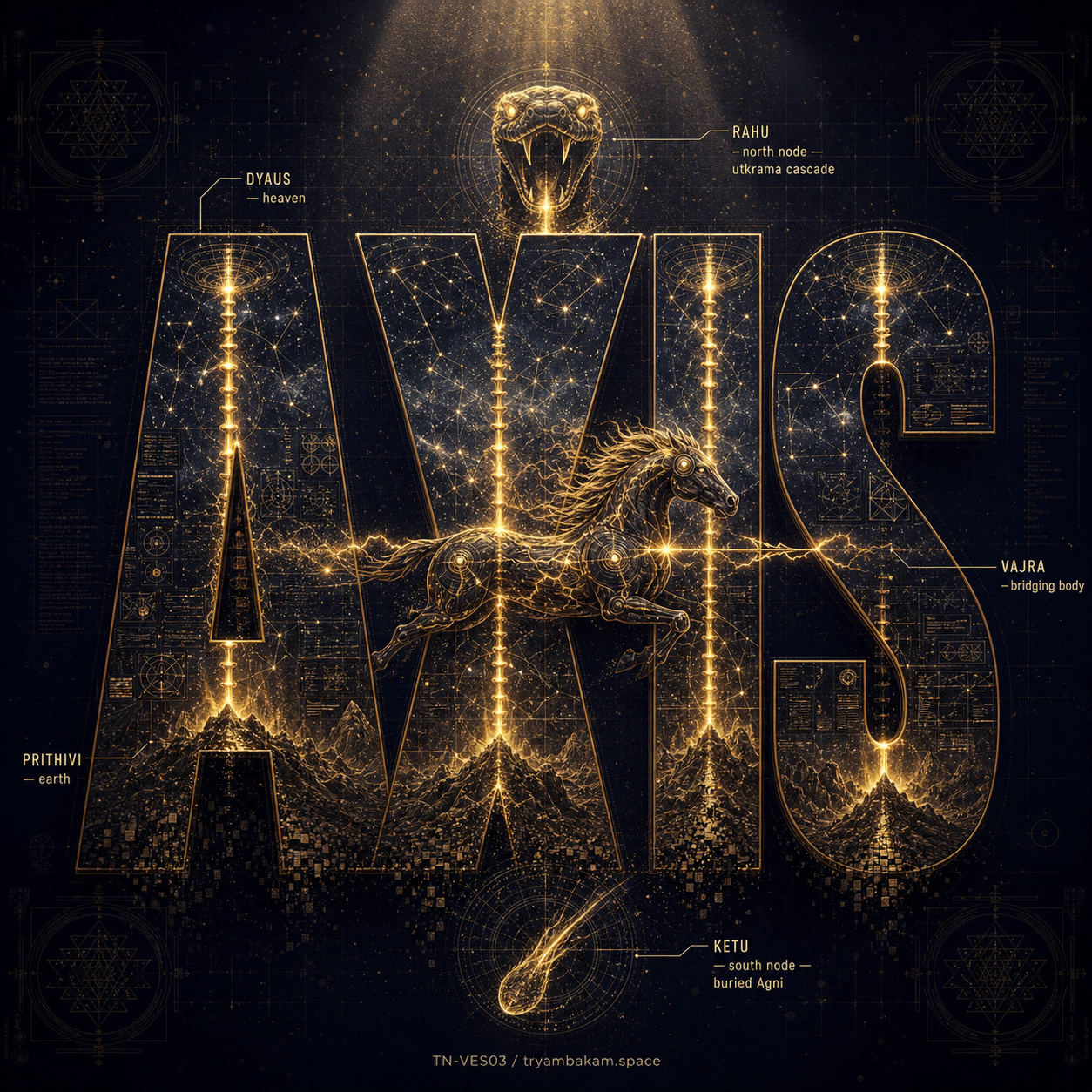
The fire burns along an axis. Ketu pole below, Rahu pole above, the vajra-body bridges. A productive overlay, not a Vedic claim. TN-VES03.
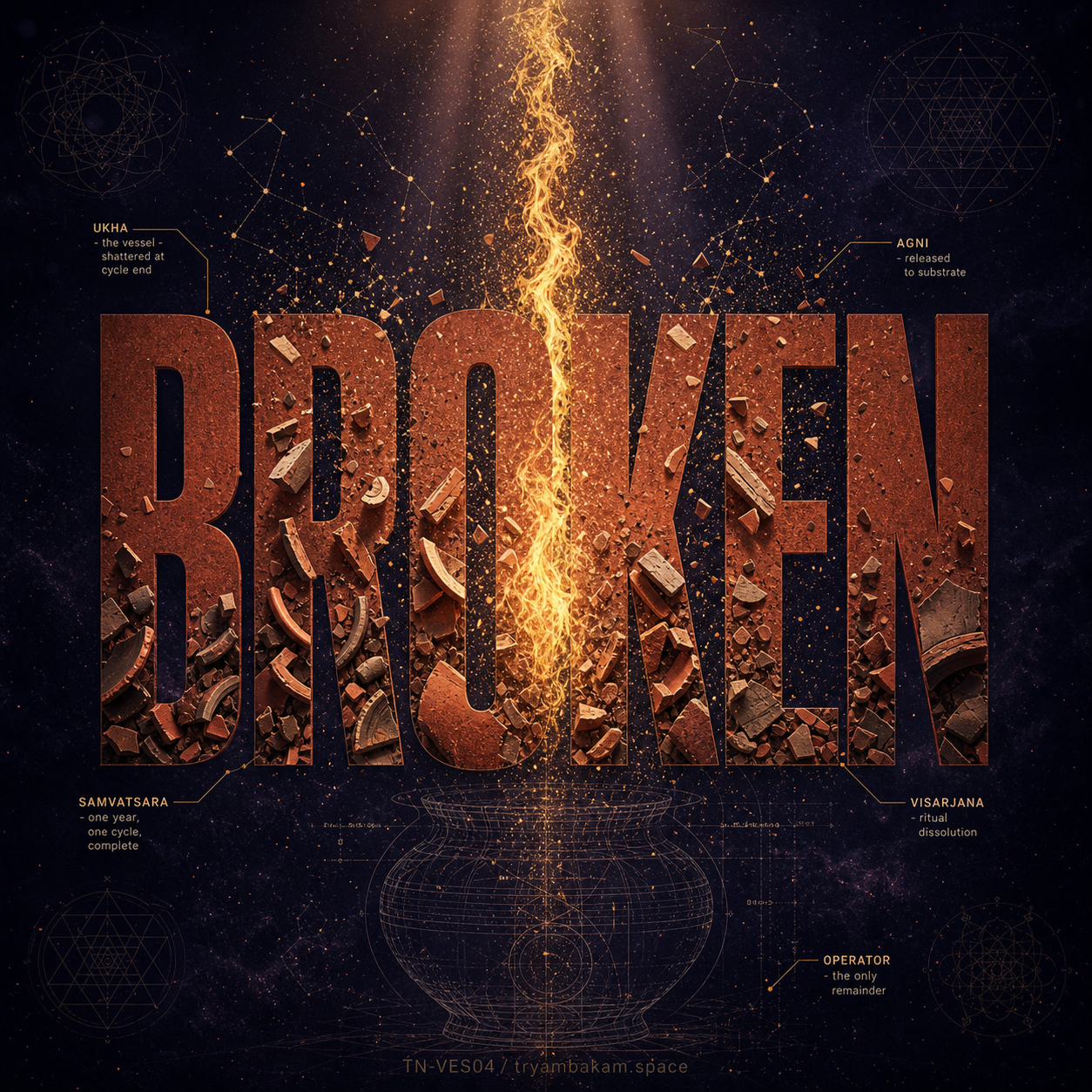
The vessel that did its work correctly is dismantled precisely because it did its work correctly. The operator is the only thing that remains. TN-VES04.