Ashtakavarga as Hypercube Geometry: Eight Dimensions of Bindu Space
Runtime Version: 1.0.0
“The difference between a square and a cube is one dimension. The difference between perception and understanding is seven more.” — Geometric Meditation Notes
Binary States in Sacred Mathematics
The Ashtakavarga system is one of the most computationally intensive techniques in Vedic astrology. For each of seven planets (Sun through Saturn), the system evaluates whether each of twelve houses receives a benefic point (bindu) or not. A bindu is binary — present or absent, 1 or 0. This produces a 7x12 matrix of binary values, a data structure that any computer scientist would recognize as a bit field.
But the “ashta” in Ashtakavarga means eight. The system operates in eight-fold division, and when you examine its deep structure, you find an eight-dimensional binary state space — a hypercube.
class AshtakavargaSystem:
    def __init__(self):
        self.planets = ['Sun', 'Moon', 'Mars', 'Mercury',
                        'Jupiter', 'Venus', 'Saturn']
        self.houses = range(1, 13)
        self.bindu_states = [0, 1]

    def calculate_bindus(self, birth_chart):
        bindu_map = np.zeros((len(self.planets), 12))
        for planet in range(len(self.planets)):
            for house in self.houses:
                bindu_map[planet][house-1] = self._get_bindu_state(
                    planet, house, birth_chart
                )
        return bindu_map
Each planet contributes a binary assessment of each house. The Sarvashtakavarga — the aggregate score — sums these assessments, producing values between 0 and 7 for each house. A house with 7 bindus has all seven planets declaring it benefic. A house with 0 bindus has universal malefic assessment. The total across all houses always equals 337 — a mathematical invariant that the seers discovered through exhaustive computation.
The Hypercube Mapping
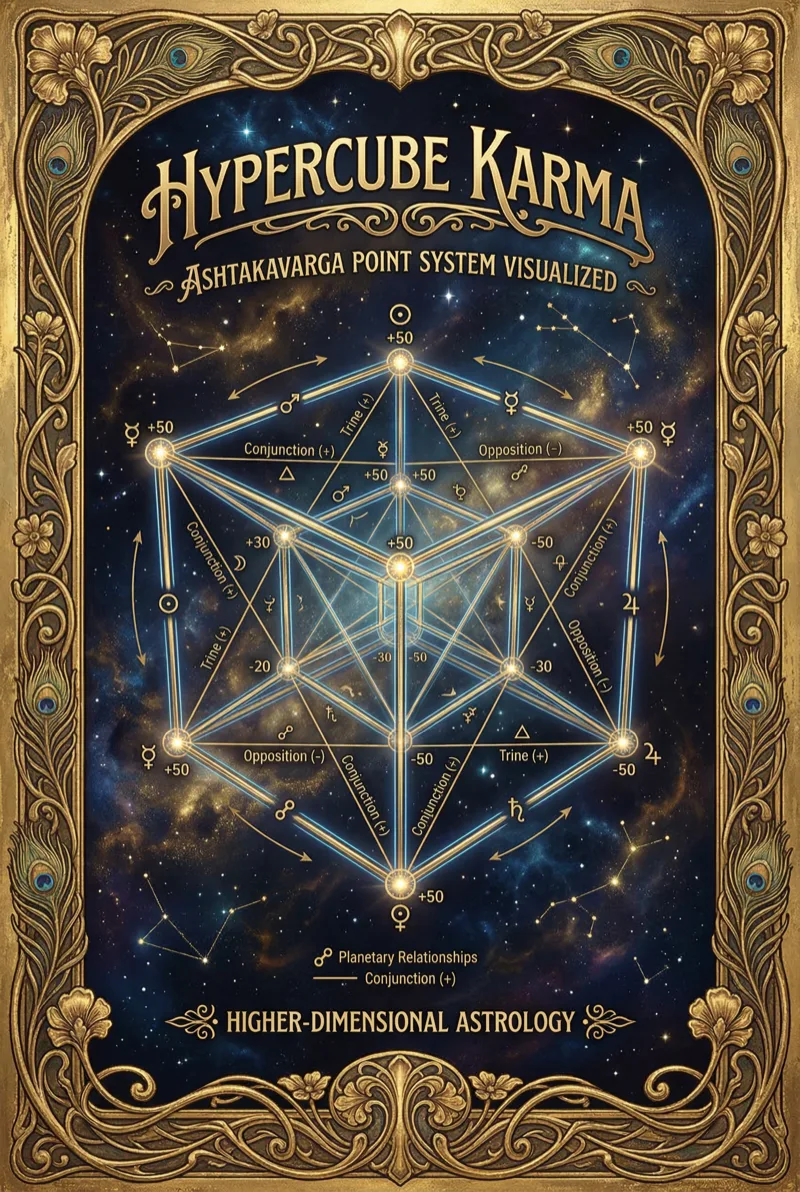
An 8-dimensional hypercube has 2^8 = 256 vertices, each representing a unique combination of eight binary values. The Ashtakavarga system, with its eight contributing factors per house evaluation, maps naturally onto this structure.
class HypercubeMapping:
    def __init__(self, dimensions=8):
        self.dimensions = dimensions
        self.vertices = 2**dimensions  # 256 vertices
        self.edges = dimensions * 2**(dimensions-1)  # 1024 edges

    def map_bindus_to_vertices(self, bindu_map):
        vertex_states = np.zeros(self.vertices)
        for i in range(self.vertices):
            binary = format(i, f'0{self.dimensions}b')
            vertex_states[i] = self._calculate_vertex_state(
                binary, bindu_map
            )
        return vertex_states
Each house in the birth chart occupies a specific vertex on the hypercube, determined by which planets grant it bindus. Moving from one vertex to an adjacent vertex (changing a single bit) corresponds to one planet switching its assessment from benefic to malefic, or vice versa. The geometry of the hypercube thus encodes the topology of planetary influence.
Edges as Transitions
In a hypercube, two vertices are connected by an edge if and only if they differ in exactly one dimension. In Ashtakavarga terms, two house states are adjacent if exactly one planet’s assessment differs between them. This creates a natural distance metric: the Hamming distance between two bindu configurations tells you how many planetary assessments must change to transform one house’s state into another’s.
def generate_hypercube_transitions(bindu_states):
    dim = len(bindu_states)
    transitions = []
    for i in range(2**dim):
        current = format(i, f'0{dim}b')
        neighbors = []
        for j in range(dim):
            neighbor = list(current)
            neighbor[j] = '1' if current[j] == '0' else '0'
            neighbors.append(''.join(neighbor))
        transitions.append((current, neighbors))
    return transitions
This transition structure has direct implications for prediction. When a transiting planet changes its relationship to a house, it flips one bit in the house’s bindu configuration, moving it to an adjacent vertex on the hypercube. The trajectory through hypercube space during a transit sequence traces a path through the vertices — a walk on the hypercube graph.
Quantum Computing Parallels
The parallel to quantum computing is not merely aesthetic. A qubit exists in a superposition of |0> and |1> states until measured. A bindu, in its pre-calculated form, exists in a superposition of benefic and malefic assessments until the planetary positions are fixed. The act of calculating the Ashtakavarga for a specific birth chart is analogous to measuring a quantum system — collapsing the superposition of possible bindu configurations into a definite state.
An 8-qubit quantum register has exactly 256 basis states — the same number as the vertices of an 8-dimensional hypercube. Quantum gates that flip individual qubits perform exactly the same topological operation as planetary transits that flip individual bindu values. The seers were working in quantum state space without the hardware.
The Sarvashtakavarga total of 337 functions as a conservation law — a constraint that limits which vertices on the hypercube are physically realizable. Not all 256^12 possible configurations of twelve houses on a 256-vertex hypercube are valid. The conservation constraint dramatically reduces the accessible state space, exactly as conservation laws in physics restrict the set of physical states.
Symmetry and Dimensional Reduction
The hypercube possesses extraordinary symmetry. Its symmetry group has 2^8 * 8! = 10,321,920 elements — rotations and reflections that map the hypercube onto itself. These symmetries correspond to invariances in the Ashtakavarga system: certain rearrangements of planetary bindus leave the Sarvashtakavarga total unchanged.
Dimensional reduction techniques from machine learning can be applied to Ashtakavarga data. Principal Component Analysis on a dataset of birth charts’ bindu configurations reveals that the effective dimensionality is typically much lower than eight — most of the variance is captured by two or three principal components. This suggests that the eight-dimensional hypercube contains lower-dimensional attracting manifolds, structures that concentrate most charts into a few characteristic patterns.
The seers identified these patterns empirically. A house with a Sarvashtakavarga score above 28 is considered strong. Below 25 is considered weak. These thresholds correspond to regions of the hypercube where specific symmetry properties hold — vertices where the majority of dimensions are in the benefic state.
Traversing the State Space
When a Vedic astrologer evaluates a birth chart using Ashtakavarga, they are performing a geometric operation. They are locating twelve points on an eight-dimensional hypercube, computing distances between them, identifying clusters and outliers, and assessing the overall topology of the configuration.
The chart is not a flat wheel with planets placed on it. It is a twelve-point constellation in eight-dimensional space, projected down into the two-dimensional house diagram for human comprehension. The Ashtakavarga calculation recovers the higher-dimensional information that the flat projection discards.
This is the perennial challenge of consciousness: we inhabit a high-dimensional state space but perceive through low-dimensional projections. The Ashtakavarga system is a technology for recovering lost dimensions — for seeing the hypercube that the circle conceals.
This document is part of the Lorenz-Kundli Pattern Recognition series exploring mathematical-mystical parallels across the pattern space of consciousness.