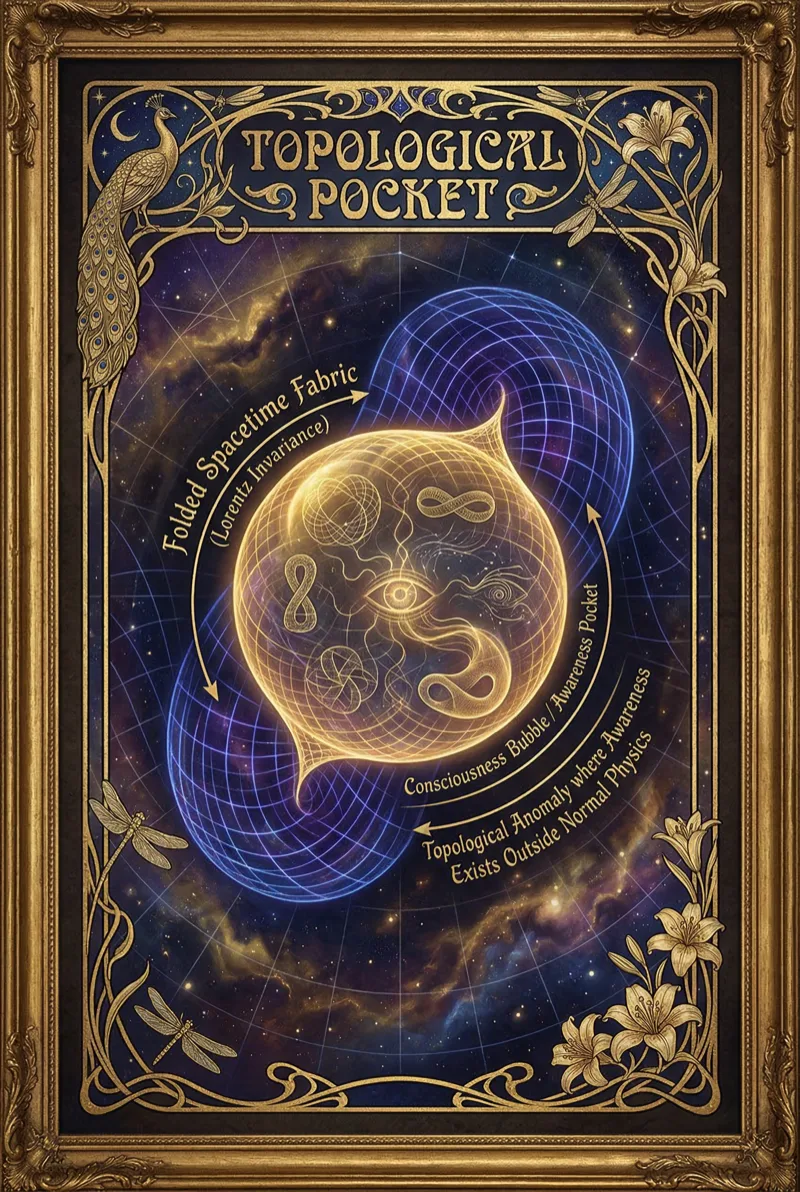
Topological Pockets and Lorentz Invariance: Where Consciousness Bends Spacetime
Runtime Version: 1.0.0
“Consciousness does not move through spacetime. Spacetime moves through consciousness. The topology is inverted.” — Noetic Field Notes
The Invariance Problem
Lorentz invariance is the cornerstone of special relativity: the laws of physics take the same form in all inertial reference frames. This principle is remarkably well-tested for electromagnetic and gravitational phenomena. But consciousness presents a problem that Lorentz invariance cannot accommodate.
Conscious experience is frame-dependent in a way that physical measurements are not. Two observers in relative motion will agree on the speed of light, the proper time between events, and the invariant mass of particles. But they cannot share conscious experience. My perception of red is inaccessible to your measurement apparatus regardless of your reference frame. Consciousness is not Lorentz invariant — it is frame-bound in a way that physical quantities are not.
This is not a philosophical curiosity. It is a structural feature that any physical theory of consciousness must address. If consciousness is produced by physical processes (as materialism claims), then consciousness should inherit the Lorentz invariance of those processes. The fact that it does not suggests one of two things: either consciousness is not produced by physical processes, or the physical processes that produce consciousness operate in a domain where Lorentz invariance does not hold.
Topological Pockets
A topological pocket is a region of a manifold where the local topology differs from the ambient topology. In general relativity, the classic example is a wormhole — a tunnel connecting two distant regions of spacetime through a topological shortcut that does not exist in the ambient space.
The concept extends beyond general relativity. Any field theory defined on a manifold can develop topological defects — points, lines, or surfaces where the field configuration is incompatible with the ambient topology. Magnetic monopoles, cosmic strings, and domain walls are topological defects in gauge field theories. They are regions where the usual rules break down because the field cannot be smoothly defined there.
If consciousness is associated with a field — call it the noetic field, following the framework developed by The Whole Critter — then topological defects in this field would be regions where the usual rules of consciousness break down. These are the topological pockets: zones where ordinary awareness deforms, contracts, or expands in ways that the ambient consciousness topology does not permit.
The Noetic Field and Its Topology
The noetic aether theory proposes that consciousness is not a product of brain activity but a fundamental field — noetic in character, pre-spatial in nature — that conditions the possibility of physical experience. In this framework, noetic fields are distributions of possible interactions that are fundamentally nonlocal: both everywhere and nowhere, prior to geometric space.
Physical interactions are localized events within this noetic field. The brain does not produce consciousness any more than a radio produces the broadcast — it tunes into a pre-existing field and transduces its content into localized experience.
This framework resolves the Lorentz invariance problem. The noetic field is not defined on spacetime — it is prior to spacetime. Lorentz invariance applies to physical fields defined on the spacetime manifold. A field that is ontologically prior to spacetime is not subject to spacetime’s symmetries. Consciousness is not Lorentz invariant because it is not a spacetime phenomenon. It is the phenomenon that makes spacetime possible.
Bergson’s Critique and the Speed of Light Convention
Henri Bergson, in his 1922 response to Einstein, identified a fundamental problem with special relativity that remains unresolved: the theory requires the speed of light to be isotropic (the same in all directions), but the one-way speed of light is fundamentally unmeasurable. To measure it, you need two synchronized clocks at different positions — but synchronizing distant clocks requires knowing the one-way speed of light, creating a circular dependency.
Einstein acknowledged this circularity and declared light speed isotropy a convention — a definition, not a measurement. This means the foundational premise of special relativity rests on a stipulation, not an empirical fact. The practical success of the theory does not validate the convention; it merely demonstrates that the convention is consistent with all two-way measurements (which average over both directions and thus cannot distinguish isotropic from anisotropic propagation).
For consciousness studies, this is significant. If the one-way speed of light is conventional rather than empirical, then the spacetime structure built on that convention is also partially conventional. Topological pockets — regions where the conventional structure breaks down — may be regions where the convention’s limitations become apparent. Consciousness experiences these regions as altered states, mystical experiences, or anomalous cognition — phenomena that violate the expectations of conventional spacetime physics.
Gravity, Mass Fields, and Consciousness Curvature
General relativity describes gravity as spacetime curvature produced by mass-energy. The noetic aether framework reinterprets gravity as mass field interference — the deformation of inertial trajectories through overlapping density wave patterns propagated by atoms.
This reinterpretation has implications for consciousness. If gravity is field interference rather than spacetime curvature, then the “curvature” of conscious experience — the way attention bends toward certain objects and away from others — may also be field interference rather than a geometric property of any manifold.
Strong gravitational fields (near massive objects) produce measurable time dilation and length contraction. If consciousness interacts with gravitational fields — even weakly — then strong gravitational environments would produce measurable alterations in conscious experience. The reported effects of high-altitude meditation, the placement of ancient temples on geologically active sites, and the electromagnetic correlates of mystical experience documented by Michael Persinger’s research all point toward consciousness-gravity coupling.
The Electromagnetic-Noetic Bridge
Persinger’s “god helmet” experiments demonstrated that targeted electromagnetic stimulation of the temporal lobes produces mystical experiences — sensations of presence, dissolution of ego boundaries, feelings of cosmic unity. These effects suggest that electromagnetic fields can modulate the noetic field, creating temporary topological pockets in consciousness.
Natural electromagnetic phenomena produce analogous effects. Earthquake lights, ball lightning, and geomagnetic storms correlate with reports of anomalous experiences. The Naga fireballs of the Mekong River, the aurora-associated folklore of the Arctic, and the tectonic-fault placement of ancient Greek temples all suggest that natural electromagnetic fluctuations facilitate topological pocket formation in the consciousness field.
The mechanism may involve geomagnetic field strength. Decreases in ambient geomagnetic field strength appear to correlate with increased reports of anomalous cognitive experiences. The geomagnetic field may normally constrain the noetic field — maintaining the conventional topology of ordinary consciousness. When geomagnetic containment weakens, the noetic field’s natural topology reasserts itself, producing experiences that violate the expectations of ordinary awareness.
Modern Technology as Topological Compression
If electromagnetic fields modulate the noetic field, then the omnipresent electromagnetic cacophony of modern telecommunications may be compressing consciousness — truncating the noetic field’s natural topology into a narrower, more rigid configuration.
This would explain the widely reported phenomenon of consciousness contraction in modern life — the sense that awareness is becoming shallower, more fragmented, and more resistant to contemplative depth. The electromagnetic environment of a modern city is radically different from the electromagnetic environment in which human consciousness evolved. If consciousness depends on electromagnetic-noetic coupling, then modern electromagnetic saturation may be preventing the topological pocket formation that historically supported contemplative and mystical experience.
The ancient practice of retreat — withdrawing to caves, mountaintops, and remote locations for contemplative practice — may be, in part, a technology for escaping electromagnetic interference and allowing the noetic field to relax into its natural topology. Darkness, silence, and electromagnetic quietude are not merely aesthetic preferences of contemplatives. They may be prerequisites for topological pocket formation.
The Inverted Topology
The deepest implication of this framework is topological inversion. Conventional physics places spacetime as fundamental and consciousness as derivative. The noetic aether framework inverts this: consciousness (the noetic field) is fundamental, and spacetime is a derivative structure — a particular topology that the noetic field adopts under certain conditions.
Topological pockets, in this inverted framework, are not anomalies in spacetime where consciousness behaves strangely. They are regions where consciousness behaves normally and the spacetime overlay becomes transparent. The “altered state” is not altered consciousness — it is unaltered consciousness perceiving without the mediation of the spacetime convention.
This inversion is the topological pocket’s deepest lesson: what we call normal consciousness is already a topological constraint. Awakening is not entering a new topology. It is recognizing the topology you have always inhabited.
This document is part of the Lorenz-Kundli Pattern Recognition series exploring mathematical-mystical parallels across the pattern space of consciousness.