Nakshatra Divisions and Fibonacci Sequences: The Golden Ratio in Lunar Mansions
Runtime Version: 1.0.0
“Nature does not count. It grows. The spiral is not a formula — it is a verb.” — Field Notes on Organic Mathematics
The 27-Fold Division
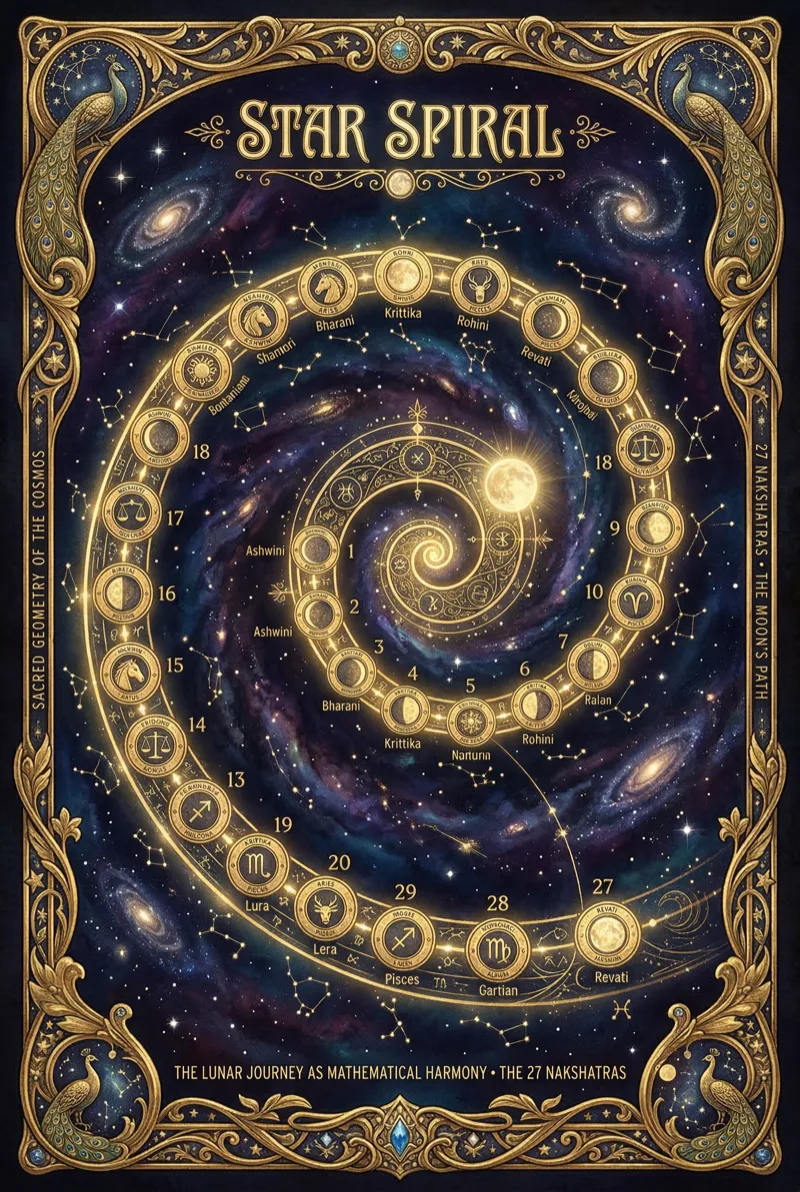
The Vedic sky is divided into 27 nakshatras — lunar mansions that partition the ecliptic into segments of 13 degrees and 20 minutes each. Each nakshatra subdivides into four padas (quarters), yielding 108 total divisions across the full 360-degree circle. These numbers — 27, 4, 108, 360 — are not arbitrary. They are nodes in a mathematical structure that connects directly to Fibonacci sequences and the golden ratio.
class NakshatraSystem:
    def __init__(self):
        self.total_nakshatras = 27
        self.padas_per_nakshatra = 4
        self.total_degrees = 360
        self.degrees_per_nakshatra = 360 / 27  # 13.333...

        self.phi = (1 + 5**0.5) / 2  # 1.618033988...
        self.golden_angle = 360 / (self.phi**2)  # 137.507...
The golden angle — 137.507 degrees — is the angular separation that produces optimal packing in biological systems. Sunflower seeds, leaf arrangements (phyllotaxis), and pinecone spirals all follow this angle. It is the angle at which each successive element achieves maximum distance from all previous elements, preventing overlap and ensuring efficient resource distribution.
The nakshatra system’s 13.333-degree division produces a ratio of 360/13.333 = 27, and 27 is the cube of 3. The pada division produces 108, which equals 27 times 4, and 108 is a number that appears with suspicious frequency across contemplative traditions — 108 beads on a mala, 108 Upanishads, 108 energy lines converging at the heart chakra. The mathematical substrate of these repetitions is Fibonacci-adjacent.
The Spiral Mapping
When you plot nakshatra positions using the golden angle as the angular increment, a spiral emerges. Not the flat circle of the zodiac wheel, but a logarithmic spiral — the same spiral that governs galaxy arms, nautilus shells, and hurricane formations.
class SpiralMapping:
    def __init__(self, nakshatra_system):
        self.ns = nakshatra_system
        self.spiral_points = []

    def generate_spiral_points(self, revolutions=27):
        points = []
        for i in range(revolutions):
            theta = i * self.ns.golden_angle
            r = self.ns.phi ** (i / 8)
            x = r * math.cos(math.radians(theta))
            y = r * math.sin(math.radians(theta))
            points.append((x, y))
        return points
The growth factor phi ** (i/8) ensures that the spiral expands at a rate governed by the golden ratio. Each successive nakshatra occupies a position on this spiral that is both angularly and radially distinct from all previous positions. The resulting pattern is a Fibonacci spiral with 27 points — a structure that encodes both cyclical (angular) and progressive (radial) information simultaneously.
Pada Proportions and Fibonacci Ratios
The four padas within each nakshatra are not merely equal quarter-divisions. In traditional interpretation, each pada carries a different elemental quality and karmic weight. When you examine the proportional relationships between consecutive Fibonacci numbers, a pattern emerges that maps onto these qualitative distinctions.
def calculate_pada_proportions(self):
    fib_sequence = self.generate_fibonacci(8)
    proportions = []
    for i in range(len(fib_sequence) - 1):
        ratio = fib_sequence[i+1] / fib_sequence[i]
        proportions.append(ratio)
    return proportions
# Ratios: 1.0, 2.0, 1.5, 1.667, 1.6, 1.625, 1.615...
# Converging to phi: 1.618033988...
The early Fibonacci ratios oscillate around phi, alternately overshooting and undershooting before converging. The four padas of each nakshatra exhibit an analogous oscillation — the first pada is fiery and initiating (overshoot), the second is earthy and stabilizing (undershoot), the third is airy and distributing (closer approach), and the fourth is watery and dissolving (near convergence). The qualitative sequence mirrors the mathematical convergence of Fibonacci ratios toward the golden mean.
Celestial Longitude as Spiral Position
Given a planet’s celestial longitude, we can map it simultaneously to its nakshatra position (angular) and its spiral position (radial), producing a coordinate that encodes both cyclical and evolutionary information.
def map_nakshatra_to_spiral(longitude):
    nakshatra_index = longitude // (360 / 27)
    pada_index = (longitude % (360 / 27)) // (360 / 108)

    theta = nakshatra_index * golden_angle
    r = phi ** (nakshatra_index / 8)

    return {
        'nakshatra': int(nakshatra_index) + 1,
        'pada': int(pada_index) + 1,
        'spiral_coords': (
            r * math.cos(math.radians(theta)),
            r * math.sin(math.radians(theta))
        )
    }
This dual-coordinate system resolves a fundamental limitation of circular zodiacal representation. On a circle, Aries 1 degree and Pisces 29 degrees are adjacent — separated by just 2 degrees. But experientially, they represent vastly different phases of development. On the Fibonacci spiral, they occupy positions separated by 27 revolutions of growth — the full evolutionary distance of the entire nakshatra sequence. The spiral encoding preserves what the circle collapses.
Natural System Integration
The Fibonacci-nakshatra connection extends beyond abstract mathematics into observable natural systems. Biological growth follows Fibonacci patterns because the golden angle prevents any two successive growth points from exactly overlapping — each new leaf, seed, or branch receives maximum light and space. The nakshatra system similarly distributes 27 observation points across the ecliptic such that no two nakshatras share identical planetary rulership or elemental quality.
The Vimshottari Dasha system (explored in the previous article) assigns planetary rulers to nakshatras in a sequence that cycles through all nine grahas three times across the 27 nakshatras: 27 = 9 x 3. This triple cycling creates a harmonic relationship between the nakshatra spiral and the dasha state machine — the spiral’s geometry constraining the state machine’s initial conditions.
Crystal formation follows similar logic. The lattice angles that produce stable crystal structures are constrained by geometric packing efficiency — the same efficiency that the golden angle optimizes. Protein folding, too, produces spiral structures (alpha helices) whose pitch angles reflect Fibonacci proportions. The nakshatra system is not imitating nature. It is implementing the same mathematical principle that nature implements.
The Recursive Insight
The deepest parallel between nakshatras and Fibonacci sequences is recursion itself. A Fibonacci number is defined in terms of the two preceding Fibonacci numbers. A nakshatra’s significance is defined in terms of its relationships to adjacent nakshatras — its planetary ruler, its placement in the dasha sequence, its elemental progression relative to neighbors. Neither system is self-contained; each element derives its meaning from its position within a recursive structure.
This recursion produces self-similarity across scales. The four padas within a nakshatra recapitulate the four-element cycle. The three cycles of nine nakshatras recapitulate the three gunas. The 27 nakshatras within the zodiac recapitulate the 27 days of the lunar month. Pattern within pattern within pattern — the fractal signature of a Fibonacci-governed system.
The seers did not discover the golden ratio and then apply it to astronomy. They observed the sky, observed nature, and recognized the same spiral operating at every scale. The nakshatra system is their notation for that recognition — a coordinate system for the universal spiral.
This document is part of the Lorenz-Kundli Pattern Recognition series exploring mathematical-mystical parallels across the pattern space of consciousness.