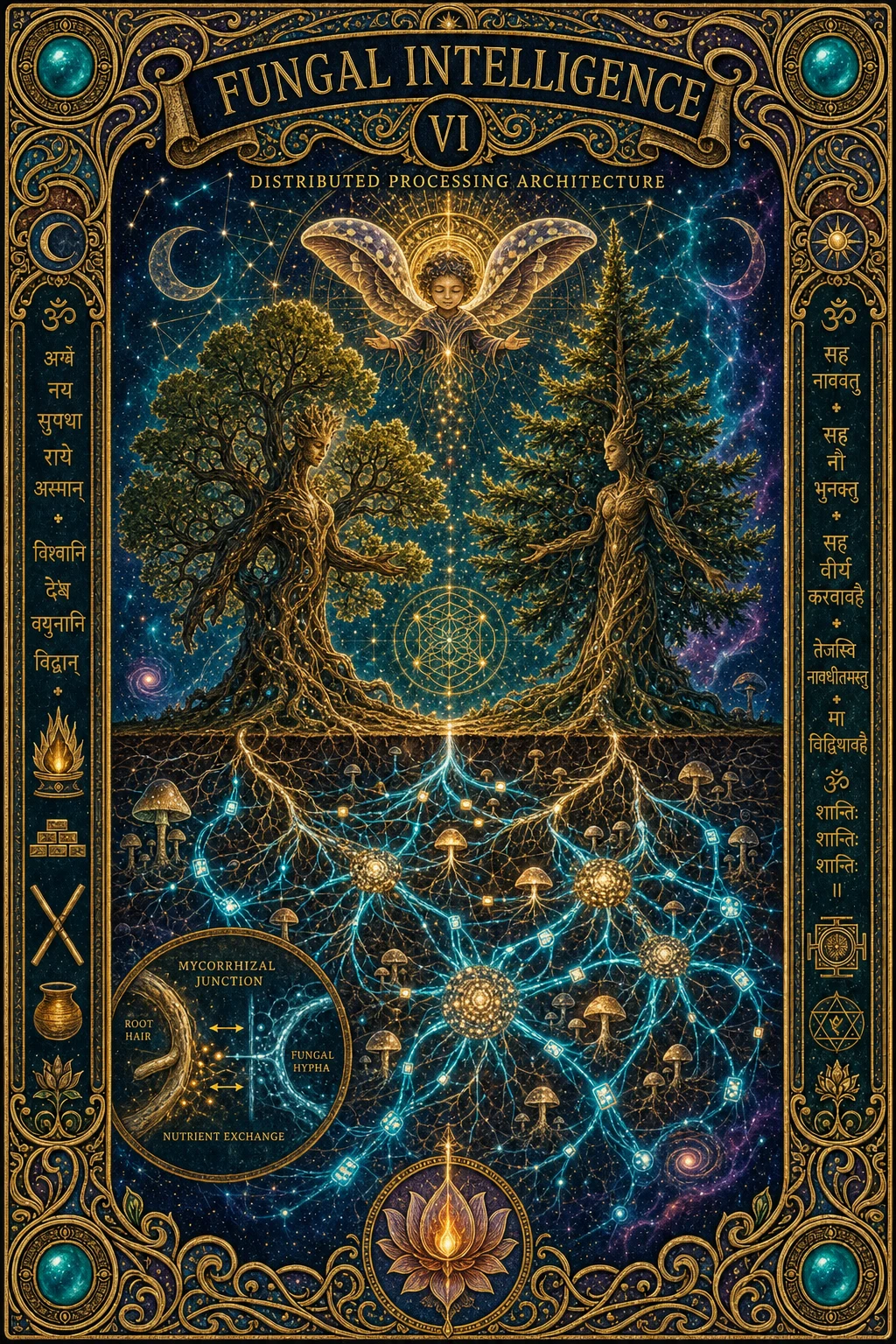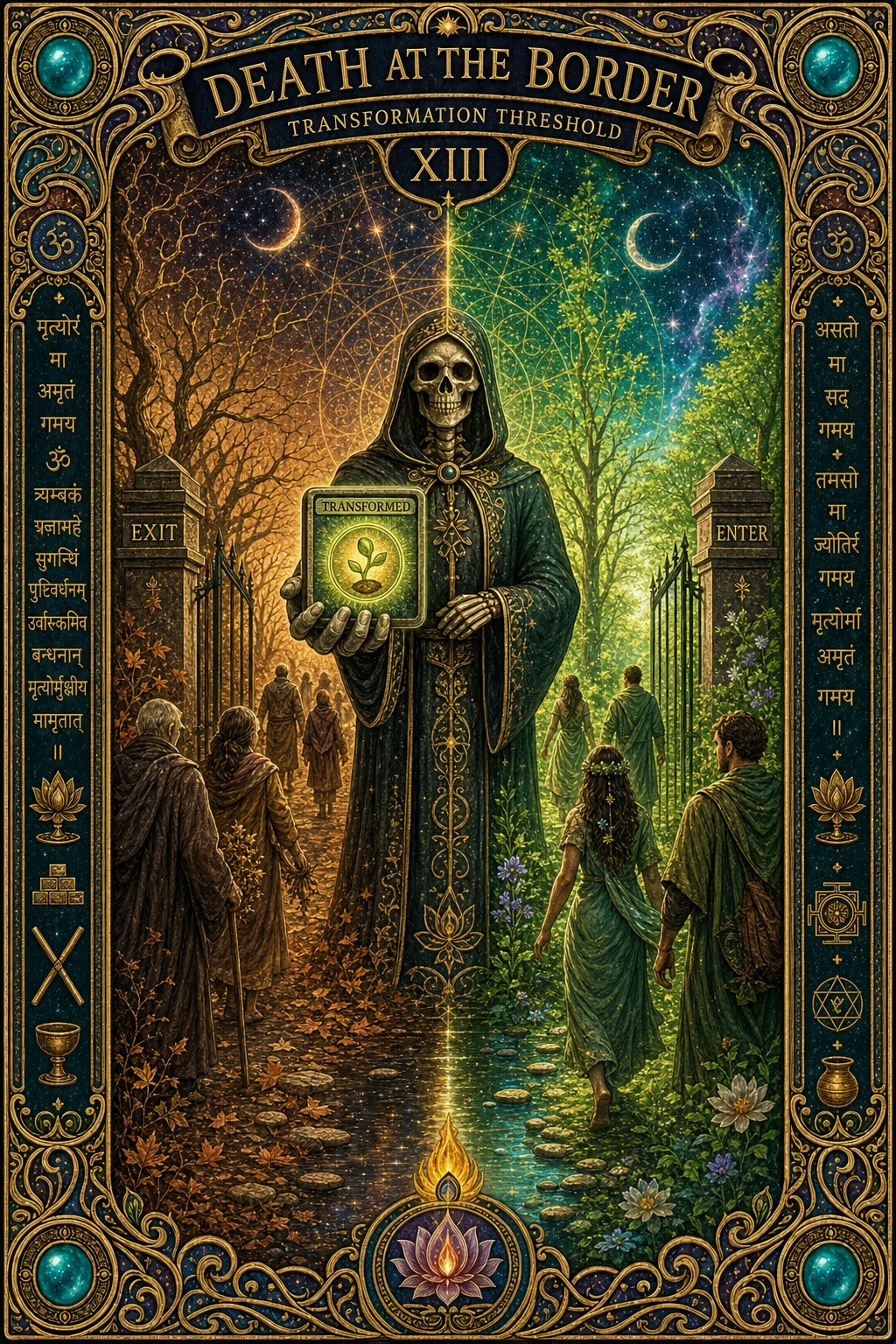
Death is a threshold. The DEATH card, as seen in the Thoth version, symbolizes spiritual unification, where one sheds delusions and negative outlooks, renovating their self-image, as noted in the Egyptian Origin of the Tarot. In this context, death represents a transformation, rather than an end. This transformation protocol operates at multiple scales, from the individual to the collective, and is reflected in the tarot’s HIEROPHANT card, which personifies Osiris, a supreme deity in ancient Egyptian mythology, and suggests the class of pharaohs and priests who ruled over the people for centuries. The story of Osiris’ dismemberment and resurrection serves as a metaphor for the cyclical nature of transformation, where death and rebirth are intertwined. At the individual scale, this transformation protocol is evident in the way we navigate the interval between breaths, where every moment is a death and every breath is a birth, as attributed to the Kṣaṇika-vāda tradition. This interval, though fleeting, is the only life we will ever know, and it is here that we find the border between states, where a configuration can no longer be maintained and must be surrendered. The number 12, signifying zodiacal cycles and rites of passage, is also relevant, as it represents the polar axis and the cyclical nature of transformation, underscoring the idea that death is not an event, but a transition protocol.
Cellular Apoptosis: Programmed Deletion
Cell death is necessary. The genome encodes the machinery for apoptosis, a developmentally essential process, ensuring that every cell in the human body can self-destruct when needed. This process is not a failure state, but rather a critical component of growth and development, as seen in the formation of the fingers and toes during fetal development. In mantra-as-source-code, the concept of containment is key, where the true power of speech lies not in the words themselves, but in the context, intention, and silence that surround them, similarly, the containment of apoptosis is crucial, where the cell receives a signal to die, triggering the activation of caspases. The caspase cascade is a highly regulated process, involving the activation of initiator caspases, such as caspase-8 and caspase-9, which in turn activate executioner caspases, like caspase-3 and caspase-7. The mechanism of apoptosis involves a precise molecular cascade, where the cell’s mitochondria play a critical role in regulating the process, releasing cytochrome c and triggering the activation of caspase-9. The Bhagavad Gita’s description of the mind as a restless monkey, prone to erratic behavior and poor decision-making, is analogous to the try block in error handling, where the cell’s decision to undergo apoptosis is a deliberate and regulated process. In three-modes-of-intelligence, the Bali Padiyami ritual demonstrates the principle of intelligence being substrate-specific, where the intricate pancha-kosha model of human consciousness is acknowledged through precise offerings, similarly, the process of apoptosis is substrate-specific, where the deletion of old cells and patterns makes way for new growth and development. The structural principle of apoptosis is instructive, as it highlights the importance of programmed cell death in the development of complex systems, such as the formation of the neocortex during fetal development. During fetal development, apoptosis sculpts the fingers and toes by deleting the cells between them, allowing for the formation of distinct digits, this process is not unique to fetal development, as apoptosis also plays a critical role in maintaining tissue homeostasis, where the deletion of damaged or unwanted cells helps to prevent disease and maintain overall health. The edge cases of apoptosis, where the process is dysregulated, can have significant operational consequences, highlighting the importance of precise regulation in maintaining tissue homeostasis, such as in the case of cancer, where the failure of apoptosis can lead to uncontrolled cell growth. The historical context of apoptosis, as described in the Atharva Veda, highlights the importance of programmed cell death in the development of complex systems, where the deletion of old cells and patterns makes way for new growth and development, this concept is also reflected in the Ayurvedic concept of ojas, where the depletion of ojas can lead to disease and disorder. The mathematical analogies of apoptosis, such as the Lorenz-Kundli model, provide insight into the intricate dynamics of the caspase cascade, where small changes can lead to significant effects, similarly, the biological analogies of apoptosis, such as the process of autophagy, also provide insight into the importance of programmed cell death in maintaining tissue homeostasis. The specific examples of apoptosis, such as the formation of the fingers and toes during fetal development, highlight the importance of programmed cell death in shaping the annamaya kosha, or physical body, and the pranamaya kosha, or energy body. The cross-domain precision of apoptosis, where the process is regulated by a complex interplay of molecular and cellular mechanisms, highlights the importance of precise regulation in maintaining tissue homeostasis, and the inverted reading of apoptosis, where the failure of the process can lead to significant consequences, highlights the importance of programmed cell death in maintaining overall health and development.
Ego Dissolution: Neural Apoptosis
Ego dissolution occurs. The default mode network’s suspension under psilocybin reveals a structural transition akin to neural apoptosis, where the self-model’s execution is temporarily halted. In “The Metamorphosis of Human Awareness”, the concept of nested layers of reality is introduced, with each consciousness structure having efficient and deficient modes. Similarly, the decoupling of DMN nodes under psilocybin can be seen as a shift from a deficient mode, where the self-model is dominant, to a more integrated mode, where brain regions communicate freely. This shift is reminiscent of the transition from one consciousness structure to another, where the deficient mode of the previous structure necessitates the emergence of the subsequent one. The medial prefrontal cortex, a key node in the DMN, normally maintains a coherent self-model by integrating information from various brain regions. However, under psilocybin, the functional connectivity between DMN nodes decreases, allowing for a more fluid exchange of information between brain regions. This temporary apoptosis of the self-model enables consciousness to differentiate, much like the cell’s death allows the organism to differentiate, as seen in the process of biological evolution. In “Integral Consciousness; The Disclosure of Time”, the introduction of new dimensionality with each consciousness structure is discussed, with the integral structure characterized by aperspectival transparency. The psilocybin-induced state can be seen as a temporary access to this integral structure, where the self-model is transcended, and awareness is experienced without the boundaries of the self. The neural correlates of the self-system do not die but rather return to baseline when the compound is metabolized, much like the biological bodies that exhibit holistic causal efficacy irreducible to substrate-level determinism, as described in “Destiny & Freedom”. The self-system’s execution is suspended, allowing for a new configuration to assemble, one that is not bound by the dominant self-model. This new configuration is characterized by a more integrated and less differentiated network topology, where brain regions communicate freely, and consciousness is experienced without the boundaries of the self.
The Kṣaṇa: The Quantum of Dying
Death is a moment. The kṣaṇika-vāda tradition holds that all conditioned phenomena are momentary, arising, persisting for a single kṣaṇa, and ceasing. In “Body as Blockchain — Cellular Memory and Karmic Ledgers,” the concept of the body as a ledger is explored, where all cells are connected and all records are preserved. This idea is relevant to the kṣaṇa, as it suggests that the body maintains a record of all experiences, much like a blockchain, where each momentary event is a discrete entry in the ledger. Nothing endures from one moment to the next, and what appears as continuity is actually a succession of discrete momentary events, each one dying into the next. The tradition does not mean this metaphorically, but rather as a literal description of the momentary nature of reality.
Each kṣaṇa is a discrete unit of time, and the transition from one kṣaṇa to the next is a fundamental aspect of temporal experience. In “Vortex-Based Mathematics: The Toroidal Topology of Number,” the concept of containment is explored, where the decimal number system is an information architecture optimized for accounting purposes. This idea is relevant to the kṣaṇa, as it suggests that the momentary nature of reality is not just a philosophical concept, but also a mathematical one, where each kṣaṇa is a discrete unit of time that can be measured and accounted for. The kṣaṇa is not just a theoretical concept, but a practical tool for understanding and working with the complex and ever-changing nature of reality.
The fascial network, as described in “Bioelectric Protocol — A Practical Field Guide,” is the substrate that supports the body’s electrical system, generating and transmitting ionic currents and voltage gradients. This concept is relevant to the kṣaṇa, as it suggests that the body’s electrical system is also subject to the momentary nature of reality, where each kṣaṇa is a discrete unit of time that can be measured and accounted for. The kṣaṇa is not just a concept, but a fundamental aspect of reality, governing the behavior of all phenomena, from the smallest subatomic particles to the largest structures of the universe.
The relevance to the Death card is that every moment is a transit across the threshold, where the border between states is not a rare event, but a fundamental structure of temporal experience. Death is not something that happens at the end of life, but rather something that happens at the end of every moment. The Death card is card XIII — the midpoint of the Major Arcana — because the threshold is the central operation of the spiral, where everything crosses it, and everything that is a configuration must eventually surrender that configuration so the next can arise. This process is not just a random event, but a highly regulated and controlled process, highlighting the importance of the kṣaṇa in the functioning of living systems.
The kṣaṇa is also related to the concept of hysteresis, where a system’s behavior is dependent on its previous state, rather than just its current input. However, the kṣaṇika-vāda tradition takes this concept further, stating that the system itself is not continuous, but rather a series of discrete states. This has significant implications for our understanding of causality and the nature of reality. The study of complex systems, such as the Lorenz-Kundli, can provide valuable insights into the nature of the kṣaṇa and its role in governing the behavior of complex systems.
The failure mode that proves the principle is when the system becomes stuck in a single configuration, unable to surrender and allow the next one to arise. This can be seen in the concept of avidyā, or ignorance, which prevents the awareness of the kṣaṇa and the proper surrender of each configuration. When the system is stuck, it becomes unable to adapt and evolve, leading to stagnation and decay. This highlights the importance of understanding and working with the kṣaṇa, rather than trying to resist or deny it. The kṣaṇa is not just a concept, but a fundamental aspect of reality, governing the behavior of all phenomena, from the smallest subatomic particles to the largest structures of the universe.
In biology, the concept of apoptosis, or programmed cell death, also exhibits this behavior, where cells die and are replaced by new ones, allowing the organism to adapt and evolve over time. This process is not just a random event, but a highly regulated and controlled process, highlighting the importance of the kṣaṇa in the functioning of living systems. The kṣaṇa is not just a theoretical concept, but a practical tool for understanding and working with the complex and ever-changing nature of reality. The study of mathematical singularities can provide valuable insights into the nature of the kṣaṇa and its role in governing the behavior of complex systems.
The kṣaṇa plays a crucial role in the design of systems that can adapt and evolve over time. By understanding the momentary nature of reality, designers can create systems that are more resilient and better able to navigate the threshold between states. The kṣaṇa is not just a concept, but a fundamental aspect of reality, governing the behavior of all phenomena, from the smallest subatomic particles to the largest structures of the universe. The kṣaṇa is also related to the concept of dependent origination, where each momentary event conditions the next through a specific causal relation. This highlights the importance of understanding the kṣaṇa in order to properly navigate the threshold between states and allow the arising of new configurations.
Apoptosis as Design Principle
Death is a threshold. Containment is key when the ritual of bhuta yajna is performed, where the priests will offer oblations to the ancestors, demonstrating the incorporation of programmed deletion as a design principle, similar to the biological process of apoptosis. This ritual is a manifestation of the three scales of analysis, where the convergence of physical, psychological, and philosophical systems reveals the importance of ego dissolution in preventing rigid self-organization. In vessel-prepare-ukha-sambharana, the concept of containment is emphasized as the primary work, rather than ignition, highlighting the importance of programmed deletion in maintaining the health and integrity of the system. The Atharva Veda describes this process as marana, or death, which is not an end, but a transformation threshold, allowing the system to reconfigure and adapt to new conditions. The annamaya kosha, or physical body, is subject to apoptosis, where cells are programmed to die, making way for new cells to grow, illustrating the design principle of programmed deletion. In qualified-to-qualia-fied, the Kena Upaniṣad states that awareness cannot know itself as an object, highlighting the limitations of scientific inquiry in understanding the first-person experience of ego dissolution. The pranamaya kosha, or energy body, is also subject to this principle, where the prana, or life force, is constantly being transformed and renewed, demonstrating the importance of momentariness in preventing the illusion of permanence. The border guards, or immune function, play a crucial role in clearing the path for the next state, preventing the system from becoming stuck in a suboptimal configuration. As seen in lorenz-kundli-protocol, the kosha architecture of the Bali Padiyami ritual acknowledges the importance of containment in maintaining the health and integrity of the system, where each participant plays a crucial role in containing the antar-agni that fuels the ceremony. The Death card is not a punishment, but a necessary part of the system’s architecture, allowing for transformation and renewal, illustrating the importance of momentariness in preventing the illusion of permanence. The failure mode that proves the principle of programmed deletion is the cancerous growth that occurs when the system becomes stuck in a suboptimal configuration, demonstrating the importance of ego dissolution in preventing rigid self-organization. The historical context of apoptosis as a design principle can be found in the Atharva Veda, where the process of marana, or death, is described as a transformation threshold, allowing the system to reconfigure and adapt to new conditions. The biological process of apoptosis demonstrates the importance of programmed deletion in maintaining the health and integrity of the system, preventing cancerous growth and rigid self-organization. The philosophical concept of momentariness demonstrates the importance of programmed deletion in preventing the illusion of permanence, allowing the system to transform and renew itself.
Card XIII — Death
Transformation occurs. The Kha awareness that recognizes the threshold is not a passive observer, but an active participant in the process of transformation. In [your-consciousness-needs-better-error-handling], the concept of error handling is crucial, and the Bhagavad Gita’s description of the mind as a restless monkey highlights the importance of awareness in navigating transformation. The try block and catch block analogy can be applied to the transformation process, where the Kha awareness corresponds to the try block, and the Ba body of the configuration being surrendered corresponds to the catch block. This process can be likened to the concept of apoptosis in biology, where cells undergo programmed death to make way for new cellular growth. The kṣaṇa that dies into its successor, a fundamental concept in Buddhist philosophy, also illustrates this process. In engineering terms, the La resistance of the dying can be compared to the concept of viscoelasticity, where materials exhibit both viscous and elastic properties when undergoing deformation. The traditional imagery of Card XIII, Death, represents this transformation through surrender, where the skeletal figure on horseback symbolizes the process of transformation. As seen in [lorenz-kundli-protocol], the kosha architecture of the ritual is crucial in containing the transformation process, and the pancha-kosha model can be used to understand the different levels of transformation that occur during this process. The vessel that holds the transformation process is not just a passive container, but an active participant in the process. The stimulus that triggers the transformation process is not just a physical stimulus, but a mental and emotional one as well, as seen in [the-devil-in-the-detail], where the bond between the stimulus and the response is an architectural reality. The Antar-Agni, or the fire of awareness that burns away the old to make way for the new, is a fundamental concept in understanding transformation. The Chernobyl disaster illustrates the consequences of failing to contain the transformation process, and the Bali Padiyami celebration symbolizes the surrender of the old to make way for the new. The Kha-Ba-La process is a continuous process, where the current configuration is constantly being surrendered to make way for the new, and can be applied to various domains, from biology to engineering, and from individual transformation to complex systems.