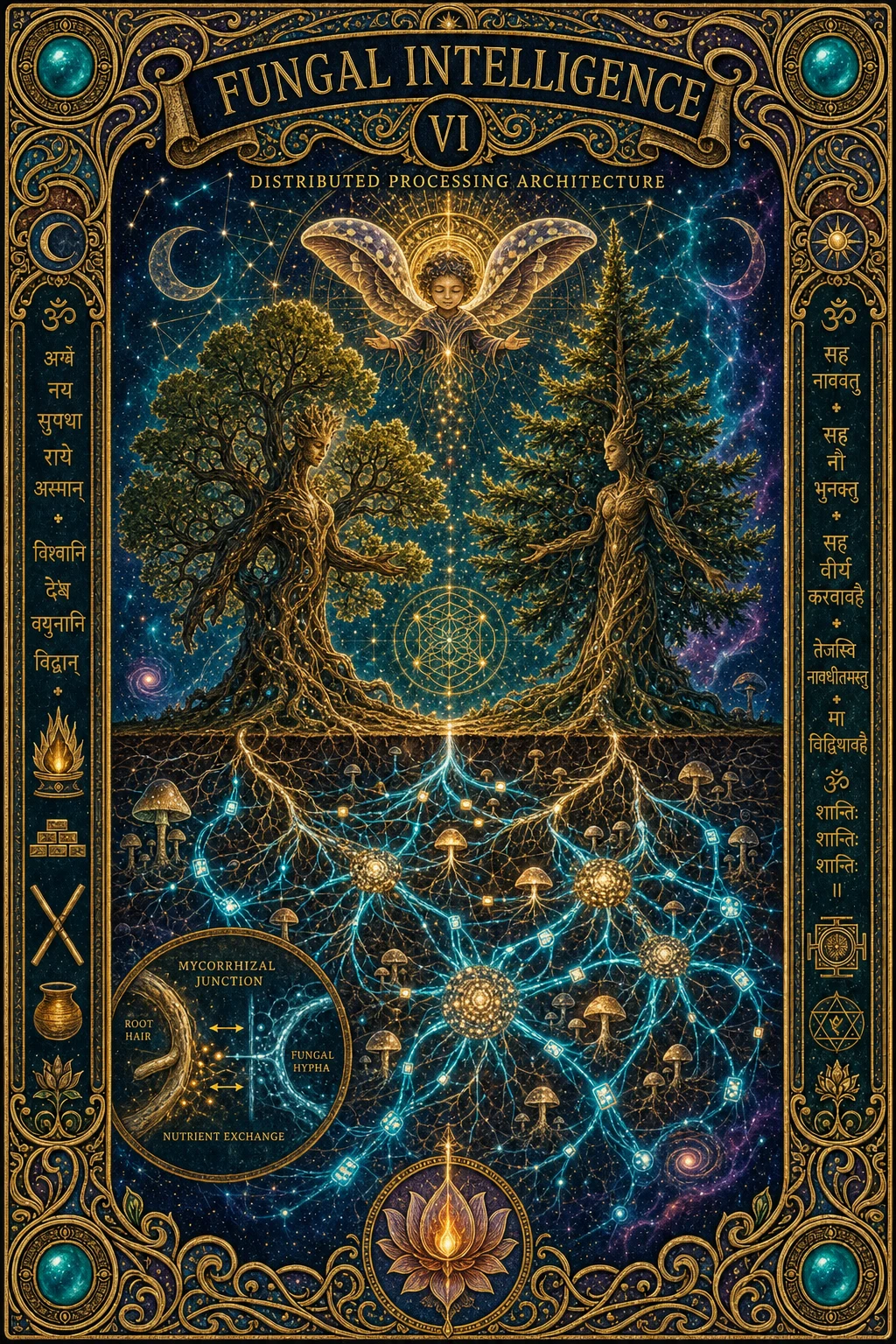
Synchronocities
VI
The Lovers Tests & Allies · Union

Fungal Intelligence as Distributed Processing Architecture

Mycelium is not a plant. It is a distributed computing network — kilometers of interconnected hyphae processing chemical signals, solving navigation problems, and transmitting information across generational timescales. The Wood Wide Web is not a metaphor. It is an architecture.

The Lovers
Back to journey

Networks process information. The mycelium is the neurological network of nature, as noted by Paul Stamets. This assertion is not merely a poetic comparison, but a statement of functional equivalence. Mycelial networks operate on principles of distributed processing, where each node — a hyphal tip — contributes to the overall computation, analogous to the Internet Protocol (IP) routing packets of data across a decentralized network. In the context of fungal intelligence, the mycelial network’s distributed processing architecture can be seen as a manifestation of the substrate, a fundamental layer of consciousness that underlies all cognitive processes, as described in the Atharva Veda. In [three-modes-of-intelligence], the same architecture is named as a key component of intelligence, highlighting the importance of substrate-specific processing in understanding complex systems. The honey fungus (Armillaria ostoyae) in the Malheur National Forest of Oregon, spanning 2,385 acres, exemplifies a large-scale implementation of such a network, with its mycelial mat threading through the soil, processing chemical information, transferring nutrients, and making decentralized decisions.

When the mycelium encounters a toxic substance, it can reconfigure its network to bypass the affected area, much like a computer network rerouting traffic around a faulty node. This ability to adapt and respond to environmental changes is a manifestation of the mycelium’s distributed processing architecture, where individual hyphal tips contribute to the overall computation. In [lorenz-kundli-protocol], the Lorenz-Kundli framework is used to understand complex systems, where small changes in initial conditions can lead to drastically different outcomes. The mycelial network’s ability to adapt and respond to environmental changes can be seen as a biological manifestation of this principle, highlighting the importance of considering the collective interaction of individual components in understanding complex systems.

The mycelial network’s distributed processing architecture has implications for our understanding of intelligence and cognition. The honey fungus’s ability to process and respond to environmental information without a central processing unit challenges traditional notions of intelligence as a centralized, hierarchical process. Instead, the mycelial network’s distributed processing architecture suggests that intelligence can arise from the collective interaction of simple processing units, highlighting the importance of considering the emergent properties of complex systems. In [body-as-blockchain], the concept of body as ledger is used to describe the human body’s ability to store and process information. Similarly, the mycelial network can be seen as a living, breathing database that maintains a record of all experiences, with the mycelium serving as a repository of information.

The mycelial network’s ability to integrate and process information at multiple scales, from the individual hyphal tip to the entire mycelial mat, has implications for our understanding of complex systems. The mycelium’s distributed processing architecture suggests that complex behaviors and adaptations can arise from the collective interaction of simple processing units, highlighting the importance of considering the emergent properties of complex systems. This perspective has implications for the study of ecological systems, where the collective interaction of individual components can give rise to complex behaviors and adaptations. The mycelial network’s distributed processing architecture can be seen as a manifestation of the substrate, a fundamental layer of consciousness that underlies all cognitive processes, enabling the mycelium to adapt and respond to changing environmental conditions.

What happens when the cleanup process in the mycelial network misses its window, and toxic substances accumulate in the system? The mycelium’s ability to respond to environmental changes is compromised, leading to a decline in its overall processing capacity. This is analogous to a computer system experiencing a denial-of-service attack, where the system’s resources are overwhelmed by malicious traffic. In both cases, the system’s ability to process and respond to information is impaired, highlighting the importance of maintaining a balanced and adaptive mycelial network. The mycelium’s response to such disruptions can be seen as a manifestation of its ability to adapt and respond to changing environmental conditions, highlighting the importance of considering the collective interaction of individual components in understanding complex systems.

The Network Architecture

Mycelium grows everywhere. The vegetative body of a fungus, a mass of branching, thread-like hyphae, grows through soil, wood, leaf litter, living tissue, secreting enzymes to break down complex organic matter and absorbing the resulting nutrients. In “root-access-to-reality”, containment is key, and the mycelium’s ability to contain and process information is a prime example of this principle. The mycelium’s distributed architecture allows it to sense and respond to its environment, much like the Antar-agni, or fire of awareness, which is not generated, but rather the substrate. When the Oyster mushrooms decompose the rice straw, their mycelium infiltrates the substrate, secreting laccases and peroxidases to break down lignin and cellulose. This process is a manifestation of the mycelium’s ability to solve complex problems, such as tuning nutrient uptake and avoiding predators. The mycelium’s distributed architecture can be seen as a model for distributed processing in other domains, such as computer science and engineering. In “three-modes-of-intelligence”, the Bali Padiyami ritual demonstrates the principle of substrate-specific intelligence, where the intricate pancha-kosha model of human consciousness is acknowledged through precise offerings to the Antar-agni. Similarly, the mycelium’s distributed architecture can be seen as a physical manifestation of this model, where each hyphal tip represents a different layer of awareness. The mycelium’s ability to adapt to changing environments and tune its growth and development can be seen as a manifestation of Antar-agni, where the mycelium’s distributed architecture allows it to sense and respond to its environment. The liquid crystal phase, as described in “water-fourth-phase”, exhibits a unique set of properties that distinguish it from the traditional solid, liquid, and vapor phases, and the mycelium’s ability to grow and thrive in this phase is a testament to its distributed architecture. The mycelium’s distributed architecture can be seen as a model for cross-domain precision in other domains, such as computer science and engineering, where the ability to sense and respond to the environment is crucial. The Lorenz-kundli, a mathematical model of complex systems, can be used to describe the behavior of the mycelium, and the kosha architecture can be seen as a model for designing distributed systems. The mycelium’s distributed architecture allows it to solve complex problems, such as optimizing nutrient uptake and avoiding predators, through the interaction of its hyphal tips, which can be seen as local processing units. The mycelium’s ability to route around damaged sections of its network, through redundant pathways, is a testament to its distributed architecture, and its ability to scale horizontally, through the extension of hyphal tips, is a key feature of its architecture. The mycelium’s distributed architecture can be seen as a model for operational consequences in other domains, such as computer science and engineering, where the ability to sense and respond to the environment is crucial. The mycelium’s ability to solve complex problems, such as tuning nutrient uptake and avoiding predators, can be seen as a manifestation of Antar-agni, where the mycelium’s distributed architecture allows it to sense and respond to its environment. The mycelium’s distributed architecture can be seen as a model for historical context in other domains, such as computer science and engineering, where the ability to sense and respond to the environment is crucial. The mycelium’s ability to adapt to changing environments and tune its growth and development can be seen as a manifestation of Antar-agni, where the mycelium’s distributed architecture allows it to sense and respond to its environment. The mycelium’s distributed architecture can be seen as a model for specific examples in other domains, such as computer science and engineering, where the ability to sense and respond to the environment is crucial. The mycelium’s ability to solve complex problems, such as optimizing nutrient uptake and avoiding predators, can be seen as a manifestation of Antar-agni, where the mycelium’s distributed architecture allows it to sense and respond to its environment.

Decision-Making Without a Center

Networks compute differently. The slime mold Physarum polycephalum is a prime example of this, its information-processing architecture mirroring that of mycelial networks in its ability to solve complex problems without a central processor. When the Tōhoku Shinkansen rail line was damaged in the 2011 earthquake, engineers were faced with the task of rerouting traffic through existing lines, a problem that required the calibration of multiple variables. In contrast, Physarum placed on a map of the affected area with food sources at major stations, was able to recreate a functional rail network within a matter of hours, demonstrating the power of distributed processing in solving complex calibration problems. This is not a trivial difference: the variational computation employed by Physarum allows it to explore the solution space in parallel, reinforcing successful paths and pruning unsuccessful ones, a process that is both highly efficient and scalable. In [Visualizing transformers and attention | Talk for TNG Big Tech Day ‘24], the idea that understanding what’s going on in a complex system is extremely challenging because it is an entirely separate question from the design of the system is highlighted, and this is particularly relevant to the variational computation employed by Physarum, where the organism’s ability to explore the solution space and converge on the precise solution is dependent on the complex interplay between individual components and the emergent properties of the system as a whole. The variational computation employed by Physarum can be seen as a form of annealing, where the network is able to explore the solution space and converge on the precise solution through a process of iterative refinement, similar to the process of annealing in materials science, where a material is heated to relieve internal stresses.

The Lorenz-Kundli Mapping System, described in [Pattern Cross-Reference System], provides a mathematical framework for understanding the behavior of complex systems, and can be used to describe the behavior of mycelial networks, highlighting the complex interplay between individual components and the emergent properties of the system as a whole. The use of Markov chain patterns and cellular automata patterns in the Lorenz-Kundli Mapping System allows for the modeling of complex systems, and can be applied to the study of mycelial networks, providing a deeper understanding of the mechanisms underlying their behavior.

In [Advanced Vedic-Mathematical System Parallels], the concept of Vimshottari Dasha and its parallel to Markov chains is discussed, and this idea can be applied to the study of mycelial networks, where the growth patterns of the network can be seen as a form of state transition matrix, with the network exploring the solution space and converging on the precise solution through a process of iterative refinement. The variational computation employed by Physarum can be seen as a form of reinforcement learning, where the organism learns to tune its behavior through the reinforcement of successful paths and the pruning of unsuccessful ones, a process that is highly efficient and scalable.

The Physarum experiment can be seen as a form of inverted reading, where the failure mode of the system proves the principle, and this idea can be applied to the study of mycelial networks, where the failure mode of the network can provide insight into the mechanisms underlying its behavior. The use of variational computation in the Physarum experiment allows for the exploration of the solution space in parallel, reinforcing successful paths and pruning unsuccessful ones, a process that is both highly efficient and scalable.

The cross-domain precision of the Physarum experiment can be seen in its ability to tune complex problems, such as the Tokyo rail network, which had taken human engineers decades to tune, and this idea can be applied to the study of mycelial networks, where the network’s ability to tune its growth patterns in response to changing environmental conditions can be seen as a form of calibration, where the organism learns to tune its behavior through the reinforcement of successful paths and the pruning of unsuccessful ones. The variational computation employed by Physarum can be seen as a form of calibration, where the organism learns to tune its behavior through the reinforcement of successful paths and the pruning of unsuccessful ones, a process that is highly efficient and scalable.

The specific example of the Hokkaido University experiment, where Physarum was placed on a map of Japan with food sources at major cities, demonstrates the power of distributed processing in solving complex calibration problems, and this idea can be applied to the study of mycelial networks, where the network’s ability to tune its growth patterns in response to changing environmental conditions can be seen as a form of calibration, where the organism learns to tune its behavior through the reinforcement of successful paths and the pruning of unsuccessful ones. The variational computation employed by Physarum can be seen as a form of calibration, where the organism learns to tune its behavior through the reinforcement of successful paths and the pruning of unsuccessful ones, a process that is highly efficient and scalable.

In the context of materials science, the process of self-organization can be seen in the formation of quasicrystals, where individual components arrange themselves in a complex pattern to create a material with unique properties, and this idea can be applied to the study of mycelial networks, where the network’s ability to tune its growth patterns in response to changing environmental conditions can be seen as a form of self-organization, where individual components arrange themselves in a complex pattern to create a system with emergent properties. The variational computation employed by Physarum can be seen as a form of self-organization, where the organism learns to tune its behavior through the reinforcement of successful paths and the pruning of unsuccessful ones, a process that is highly efficient and scalable.

The edge case of a cleanup process that misses its window can be seen in the Physarum experiment, where the organism is unable to find a path if the food sources are removed too quickly, and this idea can be applied to the study of mycelial networks, where the network’s ability to tune its growth patterns in response to changing environmental conditions can be seen as a form of cleanup, where the organism learns to remove unsuccessful paths in a timely manner. The variational computation employed by Physarum can be seen as a form of cleanup, where the organism learns to tune its behavior through the reinforcement of successful paths and the pruning of unsuccessful ones, a process that is highly efficient and scalable.

The historical context of the Atharva Veda provides a framework for understanding the concept of antar-agni, or the fire of awareness, and this idea can be applied to the study of mycelial networks, where the network’s ability to tune its growth patterns in response to changing environmental conditions can be seen as a form of refinement, where the organism is purified through the application of heat, much like the process of annealing in materials science. The variational computation employed by Physarum can be seen as a form of annealing, where the network is able to explore the solution space and converge on the precise solution through a process of iterative refinement, a process that is highly efficient and scalable.

The Wood Wide Web

Networks hold resources. In mycorrhizal networks, the symbiotic associations between fungal hyphae and plant roots extend the computational architecture across entire ecosystems, with approximately 90% of land plants forming these associations. The fungal hyphae provide water and mineral nutrients to the plant root, while the plant provides carbohydrates to the fungus, but this relationship is not binary. The fungal network connects multiple plants, often of different species, into a shared network, allowing for the exchange of resources such as carbon, which can move from one tree to another, as seen in the case of a Douglas fir seedling shaded by older trees receiving carbon from the roots of those trees, transmitted through the fungal network. This process is similar to the state evolution rules defined by planetary relationships in cellular automata systems, as described in the Graha friendship system, where each relationship defines rules for creating complex but ordered patterns, maintaining stability while allowing evolution. The mycorrhizal network also enables the propagation of chemical warnings, where a tree under attack by insects can release chemical signals that travel through the mycelial network to neighboring trees, which then upregulate their defensive compounds, demonstrating a form of distributed processing and resource allocation. The allocation of nitrogen and phosphorus is based on need, not proximity, with the network redistributing resources across the community, much like a biosensor network, where each node serves as a processing center for specific energy patterns, as seen in the implementation of the biosensor field architecture. The fungal network is not neutral, as the fungus benefits from maintaining connectivity, allowing it to access multiple carbohydrate sources and redistribute resources from well-supplied plants to plants that are struggling, keeping its host community healthy and its own nutrient supply diversified, a form of portfolio management implemented in hyphae. This is evident in the generation of dynamic digital dust particles that dissolve into specific colors, such as Astral Cyan and Mystic Violet, which can be used to visualize the mycelium texture and animation, showcasing the organic growth patterns of the fungal network. In this distributed resource management system, the fungal network serves as both the communication channel and the resource allocator, with the fungus playing a crucial role in maintaining the health and diversity of the ecosystem, much like the role of AI prompts in generating procedural textures of glowing mycelium roots spreading organically, demonstrating the potential for artificial systems to mimic the complexity and efficiency of natural systems.

Decomposition as Computation

Decomposition is fundamental. The cellulose and lignin molecules that comprise plant cell walls are notoriously difficult to break down, having evolved to resist decomposition. This resistance is a result of their complex structure, which includes beta-1,4-glycosidic bonds in cellulose and a three-dimensional network of cross-linked lignin molecules. Without organisms capable of decomposing these molecules, dead plant matter would accumulate indefinitely, causing a halt in the carbon cycle. Fungi, particularly basidiomycetes and ascomycetes, have evolved to fill this niche, secreting enzymes such as cellulases, lignin peroxidases, and laccases that break down these polymers into simpler molecules. In sacred-runtime-bali-padiyami, the same architecture is named as a precise schedule, executing its cleanup protocol every 210 days, a duration that corresponds to the nine-month Balinese calendar and the solar year, highlighting the importance of containment in decomposition. The oyster mushroom (Pleurotus ostreatus), for example, is a well-studied species that produces a range of enzymes capable of degrading lignin and cellulose. The mycorrhizal networks that form between fungal hyphae and plant roots play a critical role in this process, allowing plants to access nutrients that would otherwise be unavailable. The fungal network processes the information encoded in the molecular structure of the substrate, using enzymes as pattern-matching routines to break down complex molecules into simpler ones. As described in water-fourth-phase, the liquid crystal phase exhibits a unique set of properties that distinguish it from the traditional solid, liquid, and vapor phases, and this phase is crucial for the formation of mycorrhizal networks. The substrate is a data format, with different types of cellulose and lignin requiring specific enzymes for degradation. The enzymes are the pattern-matching routines, with cellulases targeting beta-1,4-glycosidic bonds and lignin peroxidases targeting the aromatic rings of lignin. In your-consciousness-needs-better-error-handling, the concept of error handling is crucial, and the try block corresponds to the ritual’s meticulous preparation, the catch block to the pandits’ ability to adapt to errors, highlighting the importance of error handling in complex systems like fungal decomposition. The failure mode that proves the principle of decomposition as computation is the accumulation of dead plant matter. When the fungal network is disrupted, the decomposition process is slowed or halted, leading to the accumulation of dead plant matter. This can have significant consequences, including the disruption of nutrient cycles and the loss of biodiversity. The fungal network is a critical component of the ecosystem, playing a key role in the decomposition of dead plant matter and the release of nutrients. The cross-domain precision of fungal decomposition can be seen in the analogies that exist between this process and other complex systems. The mathematics of complex systems can be applied to the study of fungal decomposition, highlighting the importance of nonlinear interactions and feedback loops. The engineering of complex systems can also be applied to the study of fungal decomposition, highlighting the importance of modularity and scalability.

The Consciousness API

Fungal interfaces matter. The subset of fungi containing psilocybin, psilocin, ibotenic acid, muscimol, interacts directly with the human nervous system through specific receptor interfaces, leveraging the neurotransmitter infrastructure to bypass the default processing architecture. When the Ophelia mushrooms are ingested, the psilocybin is converted to psilocin, which is structurally similar to serotonin and binds to 5-HT2A receptors, particularly densely expressed in the default mode network (DMN), the brain region associated with self-referential thought, rumination, and the sense of a unified self. In “Runtime Consciousness: Implementing the Biosensor Field Architecture”, the biosensor awareness protocols are described as a means to optimize field coherence pathways, which is similar to the neuroplasticity markers, such as BDNF and dendritic spine density, that are increased under psilocybin. This increased neuroplasticity enables the brain to reorganize and form new connections, allowing for the emergence of new processing modes. The 5-HT2A receptor is a key target for this reorganization, as it is involved in the regulation of the default mode network and the neurotransmitter infrastructure. The Sapience-Sentience Framework describes the consciousness architecture as a system that integrates sapience mechanisms, sentience interfaces, and integration protocols, which is similar to the neural network reorganization that occurs under psilocybin. The integration protocols in this framework are designed to optimize field coherence and enhance pattern recognition, which is similar to the rewiring of the neural network that occurs under psilocybin. In “Destiny & Freedom”, the historical evolution of selfhood is described as a process that has migrated upward through developmental phases, from visceral/metabolic to language/ideation, which is similar to the reorganization of the brain network that occurs under psilocybin. The self-reflection and self-reorganization that occur under psilocybin can be seen as a means to access processing modes that the default architecture suppresses, enabling the emergence of new processing modes. The containment of the process is crucial for the emergence of new processing modes, as it enables the reorganization of the neural network and the formation of new connections. The vessel that contains the process must be shaped to its exact specification, across the full duration of its burning, to enable the emergence of new processing modes. The failure mode of this process is not just a lack of containment, but also a lack of understanding of the processing modes that the default architecture suppresses. When the cleanup misses its window, the process can become unstable, leading to a cascade of unintended consequences. The tradition has encoded this knowledge in the vocabulary of entheogens, which describes a specific intervention that enables access to processing modes that the default architecture suppresses. The connection to other concepts, such as pattern recognition and field coherence, is not just a surface comparison, but a structural connection that enables the emergence of new processing modes. The psilocybin process can be described as a network of nodes and edges, where the nodes represent the brain regions and the edges represent the connections between them. The rewiring of this network enables the emergence of new processing modes that the default architecture suppresses. The biological analogy of the psilocybin process is not just a surface comparison, but a structural connection that enables the emergence of new processing modes. The process can be described as a cellular process, where the cells represent the brain regions and the signaling pathways represent the connections between them. The psilocybin process can be described as a modification of the signaling pathways, enabling the emergence of new processing modes that the default architecture suppresses.

The Lovers Card

Containment is crucial. The mycelium network is a prime example of a distributed system that relies on containment to persist. In the context of fungal intelligence, the Kha-Ba-La protocol is a critical component of the mycelium network, allowing the exchange of information and energy across the La boundary, while preserving the autonomy of the individual components. As seen in the Lorenz-Kundli framework, the Kha represents the informational content, Ba represents the physical architecture, and La represents the boundary that preserves the autonomy of the systems. In “lorenz-kundli-protocol”, the same architecture is named as a key component of the Vedic runtime, where the intricate kosha architecture of the ritual is on full display. The mycelium network is not a collection of individual components, but a distributed system that transcends the boundaries of the individual, much like the internet, which is a network of systems connected through the Kha-Ba-La protocol. The honey fungus in Oregon, estimated to be 2,400–8,650 years old, is a testament to the power of the Kha-Ba-La protocol in preserving the autonomy of the individual components while allowing the exchange of information and energy across the La boundary.

The Kha-Ba-La protocol is reflected in the structure of the mycelium network, where the Annamaya Kosha, the physical sheath, corresponds to the Ba, the physical architecture of the union. The Pranamaya Kosha, the energy sheath, corresponds to the Kha, the informational content exchanged across the interface. The Manomaya Kosha, the mental sheath, corresponds to the La, the boundary that preserves the autonomy of the systems. As discussed in “three-modes-of-intelligence”, the Bali Padiyami ritual demonstrates the principle of intelligence being substrate-specific, where the intricate pancha-kosha model of human consciousness is acknowledged through precise offerings to the inner fire. The Kha-Ba-La protocol is a fundamental aspect of reality, a requirement for the survival of complex systems, and a key to understanding the nature of consciousness and intelligence.

The Antar-Agni is the substrate, the underlying reality that supports the Kha-Ba-La protocol. The Antar-Agni is not generated — it is the fundamental aspect of reality that guides the exchange of information and energy across the La boundary. In “root-access-to-reality”, the same principle is emphasized, where containment is key, and a vessel is what holds, not what it looks like, not what it weighs, but what it holds. The Kha-Ba-La protocol is what allows complex systems to persist, even when the individual components die, for the system is not a collection of individual components, but a distributed system that transcends the boundaries of the individual. The Kundalini energy that flows through the mycelium network is a manifestation of the Antar-Agni that burns within the network, guiding the exchange of information and energy.

The failure mode of the Kha-Ba-La protocol is evident in the honey fungus in Oregon, which dies when its environment becomes uninhabitable. The honey fungus demonstrates the power of the Kha-Ba-La protocol, but it is also a warning — the protocol is not a guarantee of success, but a requirement for survival. The Kha-Ba-La protocol is a universal principle that applies to all complex systems, from the Lorenz-Kundli framework to the Pancha-Kosha model. The Kha-Ba-La protocol is a fundamental aspect of reality, a requirement for the survival of complex systems, and a key to understanding the nature of consciousness and intelligence. The mycelium network is a prime example of a distributed system that relies on the Kha-Ba-La protocol to persist, and its study can provide valuable insights into the nature of consciousness and intelligence.

Continue The Thread

Fungal Intelligence as Distributed Processing Architecture connects into nearby essays, hubs, and journey nodes through explicit editorial links, shared concepts, and structural overlap.

Travel Arc XII18 min

Morphic Resonance as Network Protocol — Why Nature Has Habits, Not Laws

Rupert Sheldrake's theory of formative causation proposes that nature has habits, not fixed laws. Morphic fields function as distributed memory systems — non-local attractors that shape biological form, behavior, and collective learning. The mechanistic-materialist paradigm cannot accommodate this architecture. Whitehead's process philosophy, Bergson's creative evolution, and Michael Levin's bioelectric field research provide convergent support.

Travel Arc XIV26 min

Water as the Fourth Phase — The Liquid Crystal Substrate of Consciousness

Water is not a solvent. It is a liquid crystal semiconductor — a charge-separating, information-storing, coherent-domain-forming substrate that renders biological matter capable of consciousness. The fourth phase between solid and liquid is where the interface lives.

Travel Arc III20 min

Body as Blockchain — Cellular Memory and Karmic Ledgers

The body maintains a distributed ledger of everything that has happened to it. Every cell carries epigenetic marks. Every trauma is recorded in tissue tension patterns. Every joy leaves a trace in the neural network's weight matrix. This is not metaphor — it is biological record-keeping.

Travel Arc XIII14 min

Death at the Border — Transformation Threshold

Death is not an event. It is a threshold that appears whenever a system transitions between states. The Death card in tarot is almost never about physical death. It names the moment when a configuration can no longer be maintained and must be surrendered.

Revolution 1
mycologyfungal-intelligencemyceliumdistributed-computingwood-wide-webcluster:consciousnesscluster:biology
Return to Spiral
Choose your next path
0
X
Fortune

Kubernetes for Karma — Orchestrating Your Consciousness Containers

Approach to Innermost Cave

The mind runs multiple concurrent processes — microservices (automatic behaviors), cron jo bs (scheduled habits), daemon sets (always-on patterns). Karma is the orchestration layer: the system that ensures every action is accounted for and every process eventually comple tes.

Continue the current thread

Read on, or return to the gallery.