Lorenz-Kundli Pattern Recognition Hub
In 1963, Edward Lorenz published “Deterministic Nonperiodic Flow” in the Journal of the Atmospheric Sciences. Three differential equations. Three variables. A trajectory that never closed, never repeated, yet never dissolved into noise. The Lorenz attractor — the butterfly in phase space — became chaos theory’s founding image. As James Gleick documented in Chaos: Making a New Science (1987), Lorenz had been running weather simulations when he discovered that rounding a decimal from .506127 to .506 produced a completely different forecast. The system was deterministic — every point followed exactly from the equations — yet prediction was structurally impossible beyond a short horizon.
Three thousand years earlier, observers on the Indian subcontinent were solving the same problem with different tools. The Kundli — a twelve-house geometric map of celestial positions at birth — did not use differential equations. It used planetary periods, house rulerships, and Vimshottari Dasha sequences, grounded in the spherical astronomy of the Surya Siddhanta and the interpretive frameworks of the Brihat Parashara Hora Shastra. It mapped the evolution of a life in geometric space, knowing that the specific events could not be determined, only the pattern’s shape.
Both systems describe the territory without prescribing the route. Both demand that the observer learn to read pattern rather than predict event. And both reveal the same uncomfortable fact: the system is more interesting than its initial conditions.
This is not a New Age synthesis. It is an anatomical comparison of two pattern-recognition systems that arrived at the same structural solution from opposite ends of history.
The Kha-Ba-La Architecture of Pattern Recognition
Every pattern-recognition system operates on three forces. Remove one, and the structure collapses into a different kind of failure.
When the witness (Kha) is absent, the Kundli becomes a fortune-telling machine. The chart is read as deterministic prophecy rather than dynamic attractor. The client receives a verdict instead of a map. The astrologer becomes a mouthpiece for inherited code, repeating caste-inflected interpretations that were fixed centuries ago. This is the shadow of determinism: the map becomes the territory, and the person inside it disappears.
When the soma (Ba) is absent, the Lorenz attractor remains a screensaver. You can plot it, rotate it, publish papers about its topological properties. But if you have never felt the sensitivity of your own system to initial conditions — if you have never noticed how a single sentence at the wrong moment altered the trajectory of a decade — then you are studying the geometry without inhabiting it. The math becomes decoration.
When structural recursion (La) is absent, each insight dies in isolation. A personal revelation about your own chart never scales to see how the same pattern operates in your family system, in the astrological tradition’s institutional reproduction, or in the planetary weather itself. The fractal collapses to a single scale. You get the map of one room but never see the building.
The Lorenz-Kundli parallel only holds when all three forces are present. The witness sees the pattern. The body feels it. The recursive structure shows where else it lives.
Core Parallels
Phase Space Mapping
The Lorenz system plots state as a point moving through three-dimensional space. The trajectory never repeats exactly, but it traces a recognizable form — the butterfly wings. The system is deterministic (the equations fully specify the next state) yet unpredictable (infinitesimal differences in initial conditions produce radically different trajectories).
The Kundli system plots a life’s potential as a point within twelve houses arranged in geometric space. The houses represent domains of experience — self, wealth, communication, home, creativity, health, partnership, transformation, wisdom, career, public sphere, and liberation. Planetary placements describe the initial conditions; Dasha periods describe the trajectory.
Both systems are deterministic in principle and unpredictable in practice. They generate patterns recognizable without repetition. And both demand geometric thinking — the ability to perceive structure in a trajectory rather than insist on certainty in a forecast.
Scale Invariance
The Lorenz attractor is self-similar: zoom in on any portion of the trajectory and the same butterfly pattern reappears at smaller scale. This is the hallmark of fractal geometry — information coherence across scales.
The Kundli system exhibits the same property through its divisional chart hierarchy (D-charts), documented in the Brihat Parashara Hora Shastra. The D1 chart provides the broadest view. D9 (Navamsha) provides a nine-fold subdivision. D60 (Shashtiamsha) provides a sixty-fold subdivision. Each level of magnification reveals the same pattern structure — planetary relationships and house dynamics — at increasing resolution.
The mathematical parallel is exact: both systems maintain pattern coherence across scaling transformations. In the Lorenz system, this emerges from the equations’ topological properties. For the Kundli, it arises from the harmonic relationships between planetary periods.
Sensitivity and Stability
The Lorenz system is exquisitely sensitive to initial conditions — the butterfly effect that became chaos theory’s popular mascot. Yet despite this sensitivity, the system maintains structural stability. The trajectory may wander unpredictably, but it stays on the attractor. It never flies off to infinity.
Vedic astrology displays the identical dual property. Muhurta (electional timing) demonstrates extreme sensitivity — a few minutes’ difference in birth time can shift house cusps and modify the entire chart interpretation. Yet the broader pattern — the Dasha sequence, the planetary dignities, the house rulerships — remains stable across small timing variations.
This combination of local sensitivity and global stability is the signature of a strange attractor. The Kundli chart is, structurally speaking, a strange attractor for lived experience — a geometric structure that constrains the trajectory without determining its specific sequence.
Scaling the Pattern: Four Levels
The pattern is not interesting unless it operates at multiple scales.
Personal. You read your own chart. You see Saturn in the seventh house and recognize the pattern of delayed partnership, not as fate but as attractor geometry. You feel the butterfly effect in your own life: a single decision made in haste, a conversation that altered the Dasha sequence.
Interpersonal. The astrologer-client encounter is itself a dynamic system. The chart becomes a strange attractor for the relationship between two nervous systems. The astrologer’s interpretation is not a delivery of information but a perturbation — a small change in initial conditions that can send the client’s trajectory in a new direction. The ethical weight of this is enormous. A careless reading is not wrong information; it is a destabilizing perturbation.
Systemic. Astrology as an institution has its own attractor. The Jyotish tradition reproduces itself through guru-shishya relationships, canonical texts, and ritual practice. It also reproduces its shadows: the caste-coded interpretations embedded in classical texts, the colonial extraction of “Eastern wisdom” for Western consumption, the gendered asymmetries in house significations. The systemic attractor includes the inherited code.
Cosmic. At the largest scale, the isomorphism itself becomes the point. Weather systems and birth charts trace the same geometry. The Navamsha and the fractal zoom reveal the same structure. This is not mysticism. It is the observation that complex dynamic systems, when mapped geometrically, converge on similar topologies regardless of their material substrate. The pattern is substrate-independent.
Shadow Metabolization
Every pattern-recognition system carries a shadow. The Kundli tradition is not exempt.
The cost of determinism. When a chart is read as fixed fate rather than dynamic attractor, the reader pays in agency. The Dasha periods become a prison schedule, not a weather forecast. The shadow metabolizes into awareness only when the reader recognizes that the attractor constrains without determining — the same insight that makes chaos theory useful rather than paralyzing.
The fracture of prediction. Every astrologer has experienced the rupture: the chart clearly indicated one trajectory, and the life went another way. These moments are not errors. They are evidence that the Kundli is a strange attractor, not a deterministic machine. The fracture is where the system metabolizes its own limitations and becomes more honest.
Inherited code. The classical texts carry unexamined assumptions: caste hierarchies mapped onto house rulerships, gender essentialism in planetary dignities, colonial-era distortions introduced to make the tradition legible to European audiences. This code does not disappear because you ignore it. It metabolizes only when you read the chart through the fracture — when you let the inherited shadow become part of the interpretation rather than its silent foundation.
The System Parallel Studies
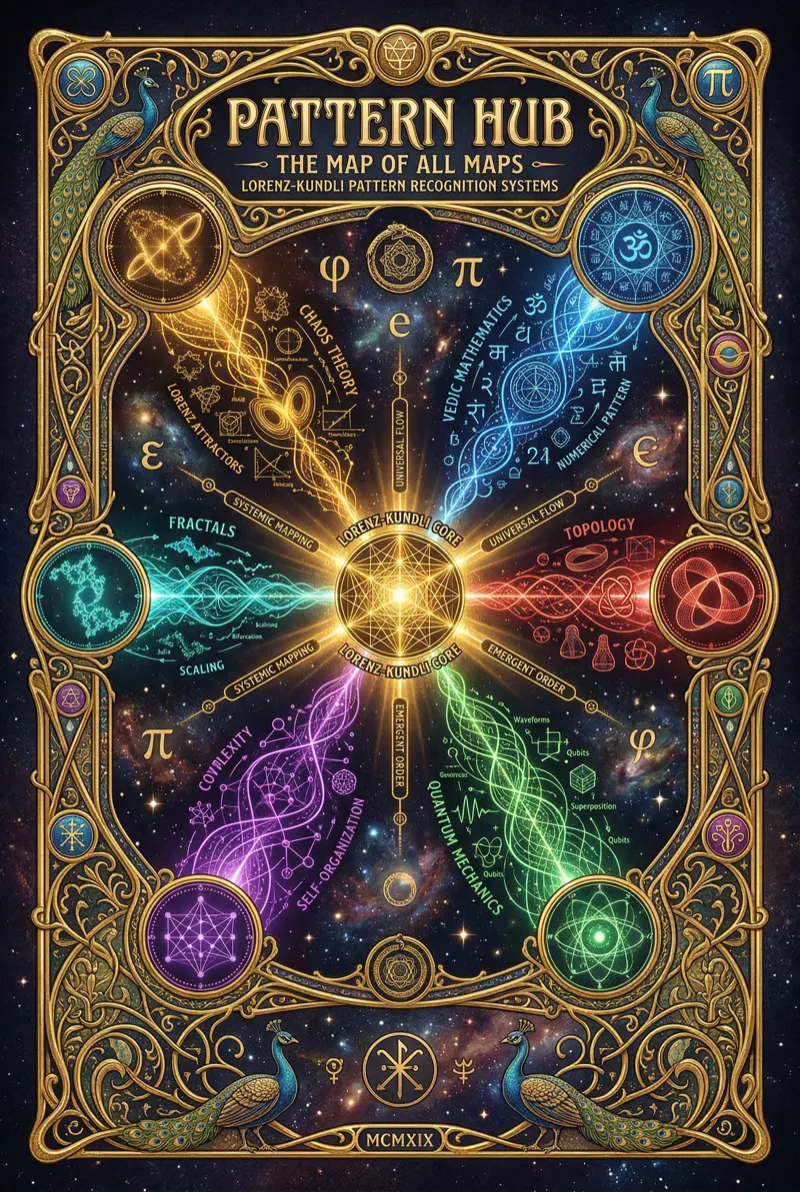
This hub anchors six parallel investigations. Each treats one component of the Kundli system as a formal structure and maps it onto a corresponding mathematical framework:
-
Vimshottari-Markov Chains. The 120-year Dasha timeline describes state transitions where the current period governs activation, and the sub-period provides the specific colouring — structurally analogous to Markov transition matrices.
-
Graha Friendship and Cellular Automata. Natural and temporal friendships between planets operate like fixed-rule neighbourhood interactions, generating emergent complexity from simple local rules.
-
Ashtakavarga and Hypercube Geometry. The eight-dimensional benefic/malefic scoring matrix maps onto the vertices of an eight-dimensional hypercube, each cell an intersection of planetary perspectives.
-
Nakshatra and Fibonacci Sequences. The 27 lunar mansions and their subdivisions exhibit proportional spacing that invites analysis through golden ratio and recursive sequence frameworks.
-
Shadbala Tensor Fields. The six-fold planetary strength assessment generates a multi-dimensional mathematical object describing directional influence rather than scalar magnitude.
-
Bhava Aspects and Neural Networks. Planetary aspects — type-dependent influence-casting on specific houses — structurally resemble weighted node connections with emergent activation propagation.
These are not proofs. They are investigation directions. The hub exists to keep them in geometric relation to one another.
Integration Protocol
The pattern recognition protocol for working with Lorenz-Kundli parallels:
- Initialize with base conditions — define the system’s starting state (birth data for Kundli, initial values for Lorenz).
- Track evolution through geometric space — observe how the trajectory unfolds over time.
- Identify scale-invariant properties — look for patterns that persist across magnification levels.
- Map consciousness interfaces — note where the mathematical patterns correspond to lived experience.
The objective is not to demonstrate that chaos theory and Vedic astrology are identical. They are not. The objective is to document the structural parallels with enough precision that each system illuminates the other — that understanding Lorenz attractors helps you read a Kundli, and that reading a Kundli helps you intuit the behaviour of chaotic systems.
Pattern recognition does not require systems to be identical. It requires them to be isomorphic — the same shape, rendered in different materials.
The butterfly and the birth chart trace the same geometry. One in equations, one in stars. Both in the nervous system that learns to read them.