At 3:47 AM, I was watching kubectl get pods for the forty-third time. The output was terminal green on black. anxiety-deploy-7b9f4c8d5-xv2k9 was in CrashLoopBackOff. Restart count: 47. I had deleted it twice. The scheduler had recreated it twice. My coffee had gone cold. My neck had a specific knot at C7 from the angle of the laptop. This was not a metaphor. This was a body in a room with a specific problem: a specification that kept requesting its own failure.
What I was seeing in that terminal was not a bug to be fixed. It was a structure to be read. Three forces were operating in that room, but only one was visible. The witness reading the screen — the one who noticed the pod was failing on a schedule, not at random — that was Kha, the observing intelligence. The body with its cold coffee and its C7 knot and its sympathetic nervous system that had been running since I opened the first page at 1:15 AM — that was Ba, the field where the specification was actually executing. And the inertia of the on-call rotation, the inherited belief that someone must be awake when the system breaks, the assumption that alertness was a renewable resource — that was La, the structural momentum that kept recreating the condition even while I watched it.
Remove Kha from that room and you get what most engineers do: stare at the crash log without noticing the pattern. Remove Ba and you get pure abstraction, someone who can describe the problem in Slack but cannot feel the knot forming in their own neck while they describe it. Remove La and you get someone who fixes the pod but never asks why their node keeps accepting a workload it cannot sustain. All three were present. All three were necessary. None of them were optional.
The Scheduler You Can’t See
In Kubernetes, the scheduler is invisible until it breaks. Most engineers never think about where their pods land. They write a deployment spec, apply it, and assume the system will handle the rest. The scheduler reads resource requests, node affinity rules, anti-affinity constraints, and taint tolerations. It places the workload on the node that fits. If the fit is wrong, the pod crashes. If the spec is wrong, the scheduler keeps placing it wrong, because the scheduler is not smart — it is obedient.
You are not a pod. Your mind is not a cluster. Your body is not a node with resource limits. But the scheduling problem is real. Every day, actions arrive at your body-node with specific resource requirements and affinity rules. Some require your full attention. Some require your stomach to be empty. Some require a certain emotional temperature. Most people never see the scheduler. They see the pod crashing and blame the pod.
Kha-Ba-La is not a label you apply after the fact. It is the operating structure of what you are looking at. Kha is the observer who can read the scheduler’s log — the one who sees that the panic attack does not arrive at random but at 3:17 AM, always 3:17 AM, because that is when the sleep-cronjob fails and the anxiety-deploy spec is the only one still requesting resources. Ba is the body-node where the workload actually executes — the stomach that tightens, the breath that shallows, the cortisol spike that the node logs as an OOMKilled event. La is the inertia of the scheduling rules — the inherited taints, the cultural anti-affinity constraints, the family resource quotas that were set before you learned to read the spec.
The cultural taint might say: this workload does not run on nodes that rest. The family resource quota might say: this node must always accept the control-plane workload, even if it starves the data-plane. These are not metaphors. They are configurations that execute as reliably as any YAML file. At the interpersonal scale, the same taint propagates: the friend who only contacts you during crisis because their scheduler learned that your node accepts emergency workloads. At the systemic scale, the corporate on-call rotation is a cluster-wide scheduling policy that assumes every node has infinite memory. At the cosmic scale, the wheel itself is the scheduler — not punishing, not rewarding, simply placing what the spec requests where the rules allow.
The Hermetic Principle of Cause and Effect states that every cause has its effect and every effect has its cause. But the Hermetic tradition adds a deeper clause: the field precedes both. Cause and effect are not the origin. They are the visible transaction within a field that is the true operator. The scheduler is that field. It does not judge the spec. It executes it. The Vedic concept of karma operates identically: not as moral accounting, but as causal recursion — action that encodes itself into the field’s future states. The field is the scheduler. The action is the spec. The consequence is the placement.
The Spec Is What You Keep Requesting
Kubernetes stores its desired state in etcd, a distributed key-value store. Every pod, every deployment, every secret lives there. If you want a pod to stop running, you do not delete the pod. You delete the spec from etcd. If you only delete the pod, the scheduler reads the spec and recreates it. This is the fundamental error most people make with karma: they keep deleting the pod and wondering why it comes back.
I did this for three years with a particular relationship pattern. The pod would crash — an argument, a withdrawal, a specific silence at a specific moment. I would delete the pod: apologize, promise to change, start over. The scheduler would recreate it in seventy-two hours because the spec was still in etcd. The spec was written by my grandfather, who was written by his. I had never learned to read it, let alone edit it.
The spec is not moral. It is not punishment. It is a configuration. “Every action is accounted for” is not a threat; it is a description of persistence. The etcd of karma is the set of impressions you keep confirming, the samskara you keep instantiating, the pattern you keep requesting by not changing the request. The body is not a stateless container. It is persistent storage with write amplification. Every read is a write. Every time you observe the panic without changing the spec, you confirm the spec.
The rupture is not the crash. The rupture is the realization that the spec is still there, that deleting the symptom did not delete the configuration, that your grandfather’s scheduler is still running on your node because no one taught you that nodes could run their own control plane. The cost is the three years of CrashLoopBackOff restarts, each one consuming the node’s finite resources, each one leaving a trace in the log that no one was reading.
At the systemic scale, the spec propagates horizontally. The same deployment that runs on my node runs on my father’s node, on my mother’s node, on the nodes of the people who raised them. The scheduler is not personal. It is distributed. The OOMKilled event on one node is a signal to the entire cluster that the resource quota is wrong. But if the cluster has no operator, the events accumulate in the log, unread, until the log fills the disk and the node itself fails.
The Wheel as Scheduling Loop
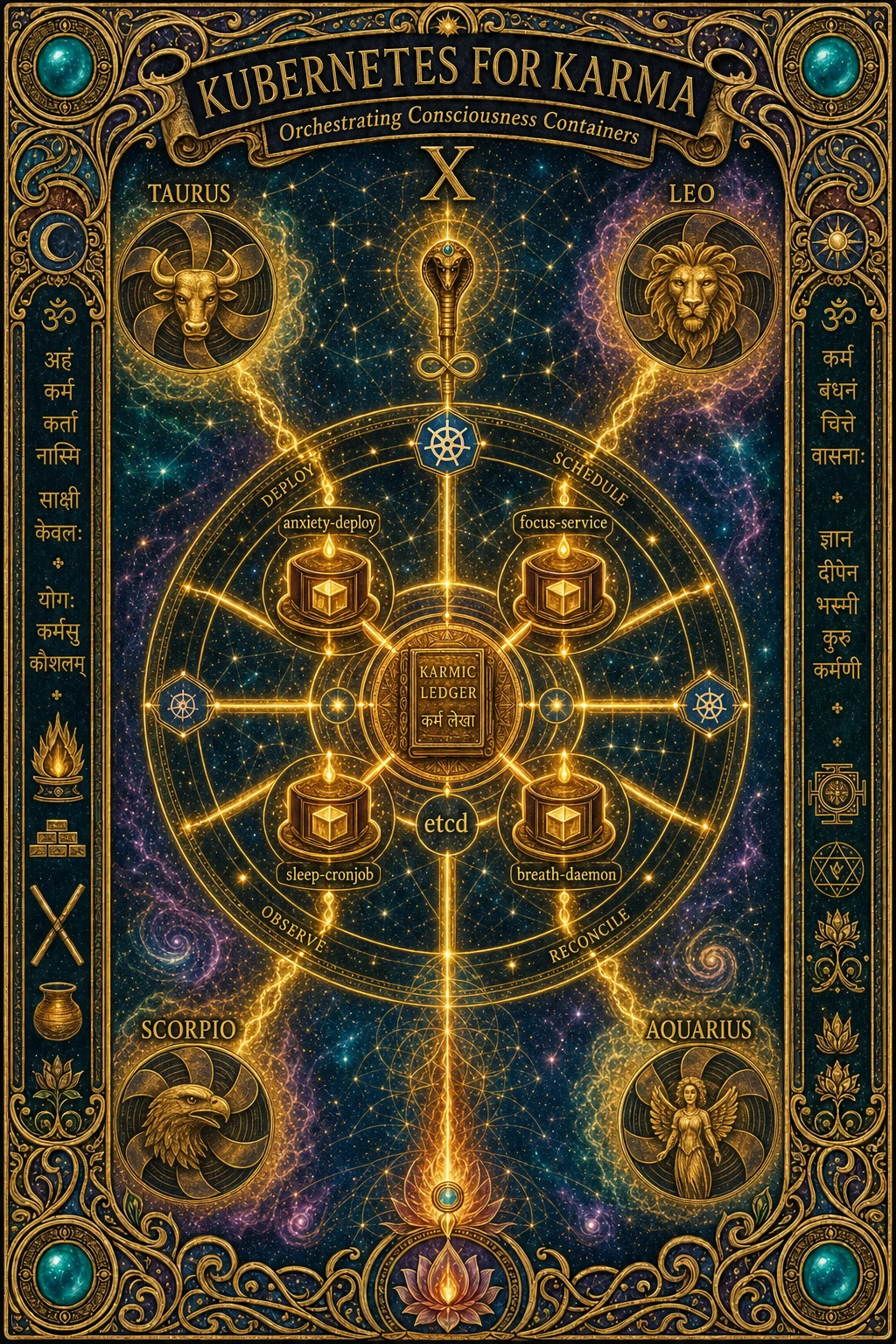
Card X, the Wheel of Fortune, is the perpetual scheduling loop. The four fixed signs — Taurus, Leo, Scorpio, Aquarius — are not decorative corners. They are the constraints of the scheduler. Taurus is the resource quota: what the body can sustain. Leo is the affinity rule: what the ego must express. Scorpio is the anti-affinity constraint: what the shadow must not be scheduled with. Aquarius is the node selector: what the collective cluster requires of this particular node.
The wheel does not punish. It schedules. The creature on the right ascends because the spec changed. The creature on the left falls because the spec did not. The sphinx at the top is the operator who learned to read the scheduler. The snake on the left is the spec that keeps requesting itself. The wheel turns because the spec is persistent. The only way to change the loop is to change the spec. Not by wishing for a new reality. Not by attuning to a frequency. By editing the configuration.
At the cosmic scale, the wheel is not a symbol of fate. It is a diagram of distributed scheduling. Every node in the cluster runs the same control plane. Every action is a pod request. Every consequence is a placement decision. The operator who understands this does not fight the wheel. They read the scheduler. They edit the spec. The wheel keeps turning, but the pods it places are different because the configuration changed.
This is the Vedic ṛta — cosmic order as pattern, not commandment. The pattern is not imposed from outside. It is the architecture of recurrence, the field’s habit of placing like with like. The wheel is not a tyrant. It is a habit. And habits can be edited, but only by the operator who knows where the spec is stored.
The Cost of the Loop
At 4:23 AM, I finally found the spec. The anxiety-deploy pod was requesting 4GB of memory on a 2GB node. The OOMKilled error was not a failure. It was the node protecting the cluster. My body was doing the same thing: the panic at 3 AM was not a malfunction. It was the body-node refusing to schedule a workload that exceeded its resource quota. The OOMKilled event was the most honest signal in the log.
The cost is not the crash. The cost is the loop. Forty-seven restarts, each one consuming the node’s resources, each one leaving a trace in the log, each one writing a new impression to the etcd of the body. The nervous system does not forget. Every OOMKilled event writes to the epigenetic ledger, modifies the horizontal pod autoscaler of the stress response, adjusts the resource requests for the next scheduled pod. The loop is metabolized into the hardware.
This is where the Kubernetes analogy breaks completely. The body is not a container. Consciousness is not a cluster. You cannot kubectl delete a trauma and expect it to be garbage-collected. The body is persistent storage with write amplification. Every read is a write. Every observation of the scheduler modifies the scheduler’s next placement. The inherited code is not a bug. It is a feature that was written for a different cluster. Your grandfather’s scheduler was running on a node with different taints, different resource quotas, different network policies. The spec worked for his node. It is OOMKilling your node because your node has different hardware.
The shadow is not a pod to be evicted. It is a spec to be read. The anxiety is not a malfunction. It is a node protecting itself from a misconfigured workload. The fracture is not a failure. It is the system doing exactly what it was told to do. The metabolization is the slow, material process of the loop writing itself into the body — the knot at C7, the cold coffee, the sympathetic nervous system that learned to run at 3:47 AM because that was when the spec requested it.
Editing the Spec
The operator who edits the spec is not managing consciousness. They are reading the scheduler. Dhāraṇā is single-threaded attention on the log: kubectl get events --sort-by=.lastTimestamp. You watch the events until you see the pattern. Pratyāhāra is withdrawing the senses from the monitoring dashboard so you can open the spec file. Samādhi is not bliss. It is root access to the specification.
I edited the spec at 5:15 AM. I changed the memory request from 4GB to 512MB. I added a node affinity rule: this pod does not run on nodes with the insomnia taint. I added a liveness probe that checks whether the pod is actually doing work or just spinning. The next time the scheduler ran, the pod landed on a different node. The panic did not run. The pattern was not deleted. It was simply not requested.
The Kubernetes documentation says: “The scheduler is responsible for assigning pods to nodes.” The Kaṭha Upaniṣad says: “The Self is the master of the chariot, the body the chariot.” Both are describing the same structural fact: something determines where the action lands. The difference is that the Kubernetes scheduler is external, and the karmic scheduler is internal but unseen. The yoga is not to manage the cluster. The yoga is to learn that you are the scheduler.
This is the Quine: the system succeeds when you no longer need the metaphor. When you can read the spec without the kubectl command. When you can feel the node affinity in your stomach before the pod is scheduled. When the scheduler is not a tool you use but a structure you inhabit. The wheel keeps turning. But the operator is no longer on-call.
The Hermetic Principle of Polarity states that everything is dual, everything has poles. The operator and the cluster are not separate. They are the two poles of a single system. The field that precedes both cause and effect is the awareness that the operator and the cluster are one circuit. To examine the scheduler is to examine the examiner. The recursion does not end. It simply becomes operational.