Pattern Cross-Reference System: Navigating the Knowledge Graph
Runtime Version: 1.0.0
“A single pattern in isolation is a curiosity. The same pattern appearing across three domains is a law. Across six, it is architecture.” — Cross-Domain Pattern Analysis
The Problem of Fragmented Knowledge
Modern knowledge is fragmented by discipline. Mathematics, astronomy, philosophy, and contemplative traditions each maintain their own journals, conferences, vocabularies, and validity criteria. A mathematician publishing on Markov chain theory will never cite the Vimshottari Dasha system. A Jyotish scholar analyzing planetary periods will never reference transition probability matrices. Both are studying the same structure. Neither knows the other exists.
This fragmentation is not merely inconvenient — it is epistemologically crippling. Patterns that span multiple domains remain invisible to specialists in any single domain. The cross-reference system exists to make these trans-domain patterns visible, navigable, and actionable.
Architecture of the Cross-Reference System
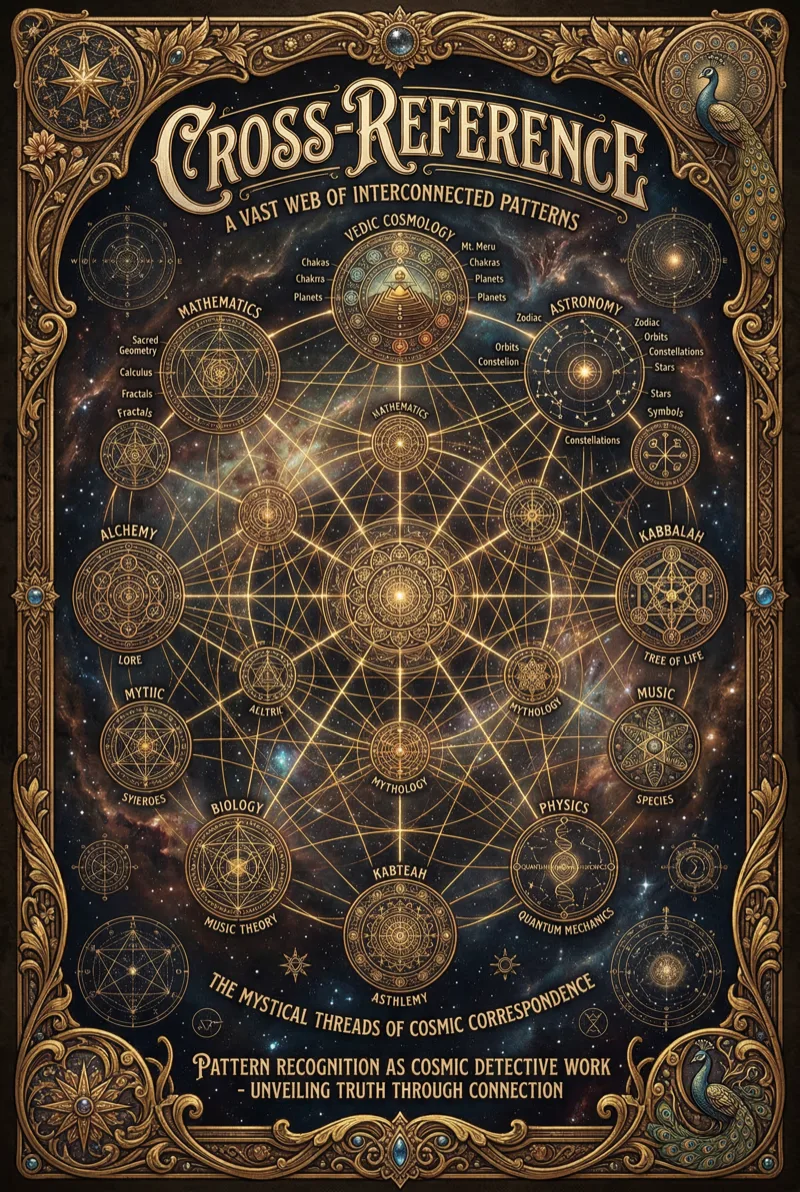
The system organizes knowledge into four primary domains, each containing multiple pattern categories:
Domain 1: Mathematical-Spiritual Patterns
This domain houses the six Lorenz-Kundli parallels that form the core of this article series:
- Vimshottari-Markov: Temporal state evolution
- Graha-Cellular Automata: Relational rule dynamics
- Ashtakavarga-Hypercube: Binary state geometry
- Nakshatra-Fibonacci: Growth spiral mathematics
- Shadbala-Tensor: Multi-dimensional field theory
- Bhava-Neural Network: Weighted graph propagation
Each parallel connects a Vedic system (spiritual/contemplative origin) to a mathematical framework (formal/computational origin). The cross-references between them trace data flow: the Vimshottari system constrains which Graha relationships are active, which modifies the Ashtakavarga bindus, which repositions the system on the Nakshatra spiral, which adjusts the Shadbala tensor field, which modulates the Bhava network weights.
Domain 2: Historical Knowledge Patterns
Historical patterns trace the transmission, preservation, and rediscovery of knowledge across civilizations and catastrophic reset events.
Key pattern categories include:
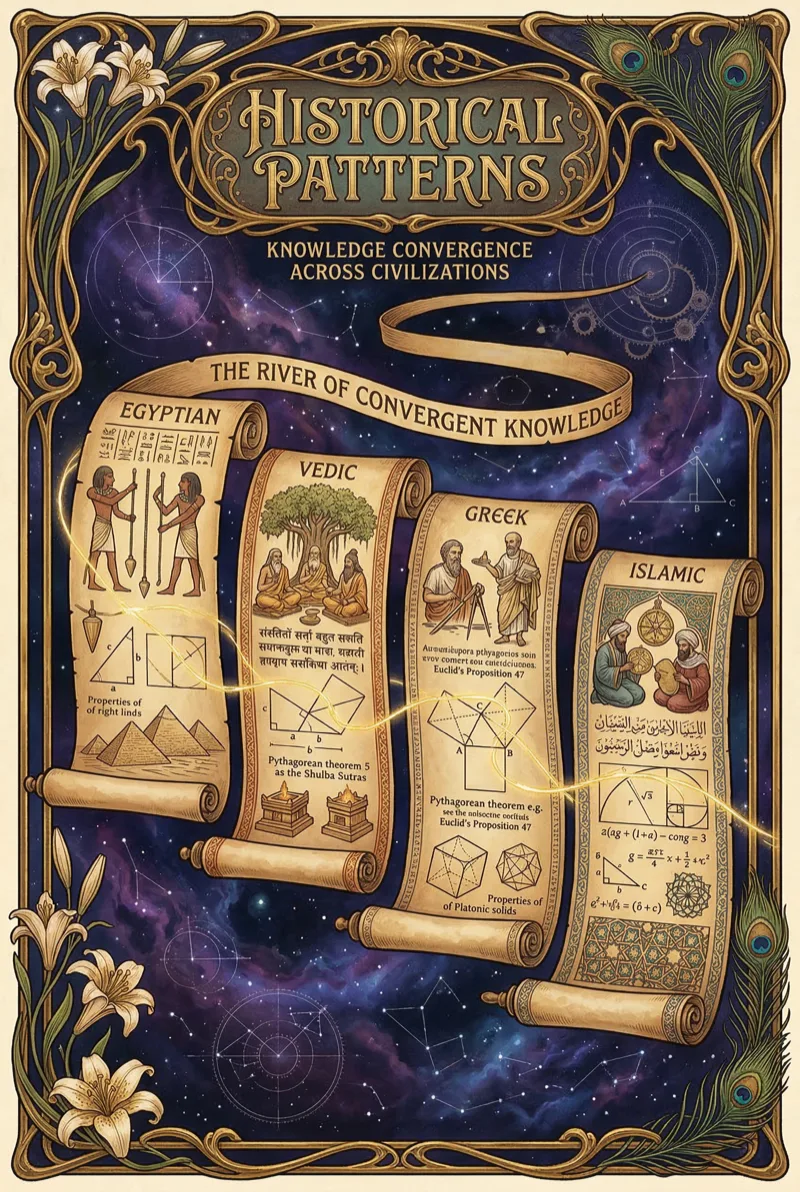
- Cross-civilization knowledge transmission: How mathematical concepts appear independently in Vedic, Greek, Chinese, and Mesoamerican traditions
- Catastrophe and renewal cycles: How knowledge systems respond to civilizational disruption
- Technology preservation patterns: How practical knowledge (astronomy, medicine, metallurgy) persists through cultural collapse
- Consciousness evolution patterns: How contemplative technologies develop and propagate across traditions
The historical patterns provide temporal depth to the mathematical-spiritual parallels. The Vimshottari-Markov correspondence is more significant when you recognize that Markov chain theory (1906) and the Vimshottari system (approximately 1500 BCE) are separated by over three millennia yet describe identical mathematical structures. This temporal gap rules out direct influence and implies independent discovery of a common underlying pattern.
Domain 3: Consciousness Architecture Patterns
This domain maps the structural patterns of consciousness itself — the architecture of awareness, attention, and experience.
Key subcategories include:
- Bioelectric patterns: How electromagnetic field dynamics in the body correlate with consciousness states
- Information processing patterns: How sensory data, memory, and cognition follow computational architectures
- Integration protocols: How disparate information streams merge into unified conscious experience
The consciousness patterns connect to the mathematical-spiritual domain through the Lorenz-Kundli mapping itself. If consciousness is a dynamical system (which neuroscience increasingly confirms), then the Lorenz attractor’s phase space structure describes possible consciousness states, and the Kundli chart maps the initial conditions that select among those states.
Domain 4: Technical-Mystical Integration Patterns
This domain contains frameworks for bridging technical (computational, engineering) and mystical (contemplative, spiritual) knowledge systems.
Key frameworks include:
- Sacred Runtime / Ancient Debugging: Software engineering metaphors applied to consciousness development
- Reality Compilation: Source code / compiled code metaphors for understanding the relationship between formal structure and lived experience
- Pattern Recognition Protocols: Systematic methods for identifying cross-domain correspondences
Cross-Domain Connections
The power of the cross-reference system emerges from its connections between domains:
Mathematical to Spiritual
- Fibonacci sequences in natural growth patterns correspond to sacred geometry in contemplative traditions
- Chaos theory dynamics correspond to Vedic astrology’s description of life evolution
- Tensor field mathematics corresponds to consciousness field theories
Technical to Mystical
- System architecture design principles correspond to cosmological ordering principles
- Debugging protocols correspond to spiritual purification practices
- Information processing models correspond to consciousness development stages
Historical to Contemporary
- Ancient knowledge systems correspond to modern technical frameworks
- Civilizational pattern cycles correspond to technology adoption curves
- Traditional contemplative practices correspond to contemporary neuroscience findings
Navigation Workflows
The cross-reference system supports three primary navigation workflows:
Discovery Workflow
Start with a known pattern in one domain. Query the cross-reference system for correspondences in other domains. Evaluate the structural similarity of each correspondence. Integrate the strongest correspondences into a multi-domain understanding.
Integration Workflow
Start with two patterns from different domains. Identify their shared mathematical structure. Build a formal mapping between them. Test the mapping’s predictive power — does understanding one pattern generate non-obvious insights about the other?
Historical Analysis Workflow
Start with a contemporary pattern. Search historical records for prior instances. Map the transmission pathway — how did this pattern travel between cultures? Identify what was preserved, what was lost, and what was independently rediscovered.
The Meta-Pattern
The cross-reference system itself exhibits a pattern: knowledge structures that appear disconnected at the surface level reveal deep structural connections when examined through the lens of mathematical formalism. This is the meta-pattern — the pattern that describes why patterns connect.
The meta-pattern has a simple explanation: the universe has a finite repertoire of mathematical structures. Feedback loops, oscillators, attractors, conservation laws, symmetry groups, and optimization surfaces recur across every domain because they are the building blocks from which complexity is constructed. Any system of sufficient complexity will exhibit these structures, regardless of whether it is a planetary orbit, a neural circuit, a market dynamic, or a contemplative practice.
The cross-reference system does not create connections between domains. It reveals connections that were always present but obscured by disciplinary boundaries. The boundaries are human constructs. The connections are mathematical facts. The cross-reference system removes the constructs and exposes the facts.
Maintenance and Expansion
A cross-reference system is only as valuable as its currency. New patterns must be integrated as they are discovered. Existing connections must be validated as new evidence emerges. Dead links must be pruned. Bidirectional references must be maintained.
The system follows three expansion guidelines: new patterns must connect to at least one existing category, cross-domain connections must be documented with explicit structural justification, and implementation examples must accompany theoretical correspondences. Theory without implementation is speculation. Implementation without theory is engineering. The cross-reference system requires both.
Patterns connect across domains. Recognition enables integration. Cross-references reveal hidden relationships. This document is part of the Lorenz-Kundli Pattern Recognition series.