Historical Knowledge Patterns: Ancient Algorithms Across Civilizations
Runtime Version: 1.0.0
“The best code survives its authors. The best patterns survive their civilizations.” — Legacy Systems Analysis
The Persistence Problem
Software engineers understand code rot — the gradual degradation of codebases as dependencies change, requirements shift, and original developers leave. Yet some code persists for decades. The Unix epoch. The TCP/IP stack. The C standard library. These systems survive because they encode patterns fundamental enough to remain relevant across technological generations.
Ancient knowledge systems exhibit the same selective persistence. The Vedic mathematical frameworks discussed in this series — Vimshottari Dasha, Ashtakavarga, Shadbala — have survived for over three millennia. Not as museum artifacts but as living computational systems used daily by millions of practitioners. What makes knowledge persist across civilizational reset events? The answer is structural: knowledge persists when it encodes patterns that are features of reality rather than features of the culture that discovered them.
Cross-Civilizational Pattern Emergence
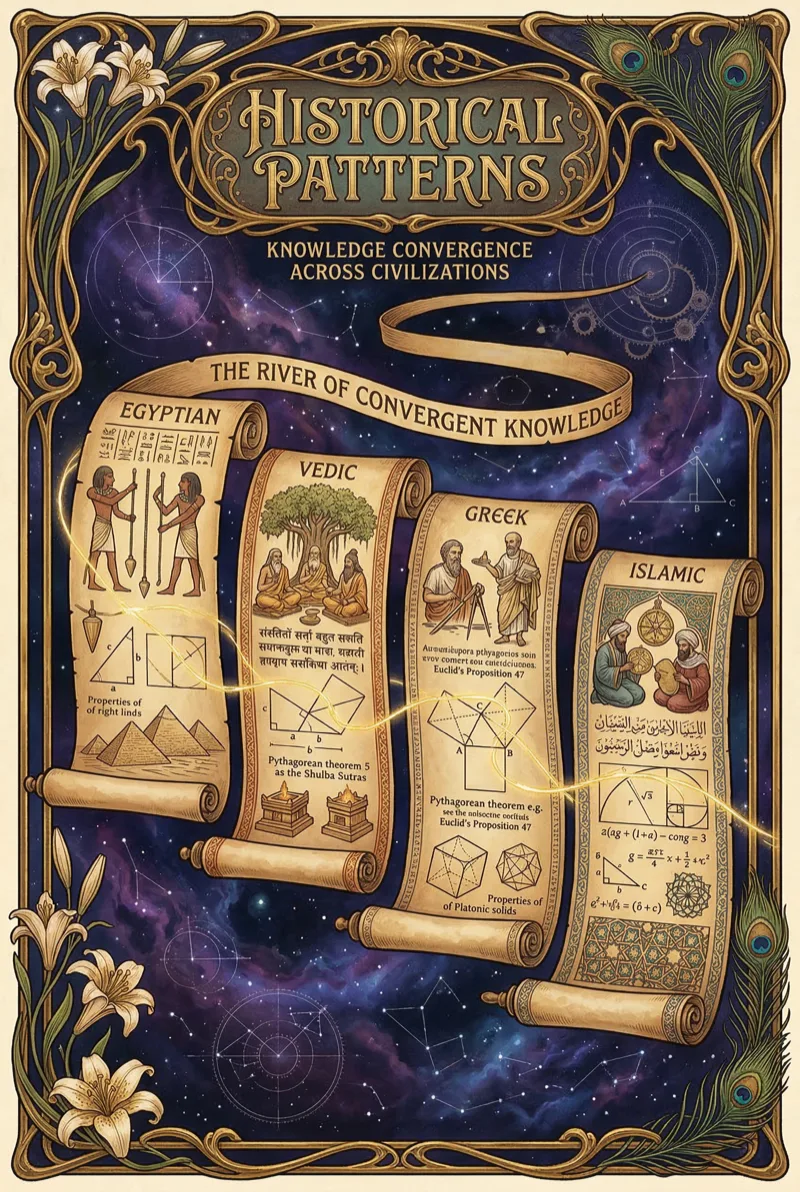
The most compelling evidence for the reality of mathematical patterns is their independent emergence across unconnected civilizations. When the same structure appears in Vedic India, classical Greece, Mayan Mesoamerica, and ancient China without evidence of cultural transmission, the pattern itself — not cultural diffusion — is the parsimonious explanation.
Fibonacci and the Golden Ratio
The Fibonacci sequence was formalized by Leonardo of Pisa in 1202 CE, but the underlying proportions appear in the Vedic Chandahshastra (Pingala’s treatise on Sanskrit prosody, approximately 200 BCE), where they enumerate the possible metric patterns of syllables. The golden ratio appears independently in Greek geometry (Euclid’s Elements, 300 BCE), Egyptian pyramid proportions (2560 BCE), and the Vedic nakshatra division system.
State Transition Mathematics
Markov chain theory was formalized by Andrey Markov in 1906, but state transition logic pervades ancient systems. The Chinese I Ching (approximately 1000 BCE) encodes 64 hexagram states with defined transition rules. The Vedic Vimshottari system (approximately 1500 BCE) encodes 9 planetary states with deterministic transitions. Both systems represent phenomena as sequences of discrete states governed by transition rules — the mathematical core of Markov chain theory.
Multi-Dimensional State Spaces
The Ashtakavarga’s eight-dimensional binary state space has structural parallels in the I Ching’s six-line binary hexagram system (2^6 = 64 states) and in the Mayan calendar system’s interlocking cycles that generate a state space of 18,980 unique day-configurations (the Calendar Round). Each system uses multi-dimensional combinatorics to enumerate possible states, then constrains the accessible state space through conservation rules.
Catastrophe and Knowledge Preservation
Civilizations collapse. Libraries burn. Lineages end. Yet mathematical knowledge persists with remarkable fidelity across these catastrophic discontinuities. The mechanism is structural resilience — mathematical patterns are harder to corrupt than narrative content because they are self-verifying.
A historical narrative can be gradually distorted through retelling — names change, dates shift, motivations are reinterpreted. A mathematical relationship cannot be distorted without producing computational errors that are immediately detectable. The Ashtakavarga total of 337 is a checksum: if transmission errors corrupt the bindu calculation rules, the total will deviate from 337, and practitioners will know the system has been corrupted.
const knowledgeSystem = {
    core: "Ancient wisdom traditions",
    patterns: [
        "Catastrophic cycles",
        "Advanced civilizations",
        "Earth energy systems",
        "Consciousness technologies"
    ],
    integration: {
        technical: "Modern scientific parallels",
        mystical: "Ancient wisdom systems",
        synthesis: "Runtime of God framework"
    }
}
This self-verifying property explains why mathematical knowledge survives catastrophes that destroy literary, philosophical, and historical knowledge. The Vedic mathematical systems persisted through the collapse of the Indus Valley civilization, through the Vedic migration, through centuries of foreign rule, because their internal consistency made corruption detectable and correction possible.
Technology Transmission Patterns
How does mathematical knowledge actually travel between cultures? Three transmission mechanisms are historically documented:
Direct Lineage Transmission
Teacher to student, generation after generation. The Vedic gurukula system preserved the Dasha and Ashtakavarga calculations through oral transmission for centuries before they were written down. The fidelity of oral mathematical transmission is remarkably high when the content is algorithmic — procedures are easier to memorize accurately than prose because each step depends on the previous step.
Trade Route Diffusion
Mathematical knowledge travels with merchants. The Arabic numeral system (originally Indian) traveled westward through trade routes to reach Europe. Astronomical calculation methods traveled eastward from Babylon to India and westward from India to the Islamic world. The Fibonacci sequence itself entered European mathematics through Fibonacci’s exposure to Indian mathematical methods via Arabic scholarship in North Africa.
Independent Rediscovery
The most philosophically significant transmission mechanism is no transmission at all. When two unconnected civilizations develop structurally identical mathematical frameworks, the knowledge was not transmitted — it was independently discovered. This implies that the mathematical structures are objective features of reality accessible to any sufficiently attentive observer.
The Lorenz-Kundli parallels strengthen the case for independent rediscovery. Edward Lorenz knew nothing of Vedic astrology. The Vedic seers knew nothing of differential equations. Yet both discovered systems with sensitive dependence on initial conditions, scale-invariant structure, and bounded chaotic trajectories. The pattern is real. The discovery was convergent.
Consciousness Technologies
The most fragile category of ancient knowledge is consciousness technology — practices for modifying awareness, perception, and cognition. Unlike mathematical knowledge, consciousness technologies are difficult to self-verify (the verification requires the modified state of consciousness that the technology produces) and difficult to transmit (verbal descriptions of altered states are notoriously unreliable).
Yet consciousness technologies also persist across civilizations: meditation practices in India, contemplative prayer in Christianity, dhikr in Sufism, and shamanic trance induction across indigenous cultures worldwide. The convergence is structural — all these practices manipulate the same neurological and physiological systems (breath regulation, sensory reduction, attentional focus) to produce the same categories of altered states.
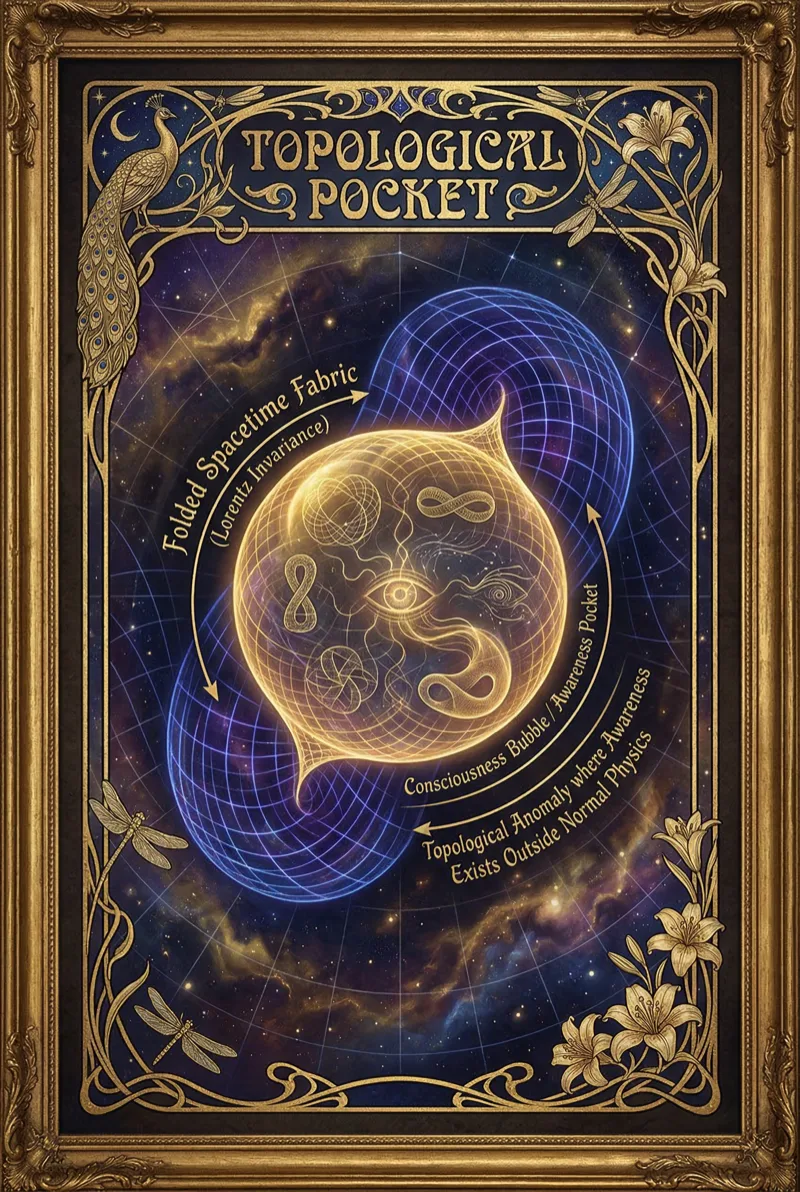
The Lorenz-Kundli framework provides a mathematical language for describing what these practices do: they navigate the phase space of consciousness, moving the system’s trajectory from one attractor basin to another. Meditation shifts the consciousness trajectory from the chaotic attractor of distracted thought to the periodic attractor of focused awareness. The mathematical description is culture-independent, providing a common framework for comparing consciousness technologies across traditions.
The Living Archive
Knowledge systems are not static archives. They are living codebases that evolve through use. The Vimshottari Dasha system as practiced today incorporates refinements accumulated over three millennia of continuous use — edge cases identified, calculation methods optimized, interpretive frameworks validated against observed outcomes.
This evolutionary refinement is the ultimate test of a knowledge system’s validity. Systems that encode real patterns accumulate predictive power over time. Systems that encode cultural artifacts lose relevance as culture changes. The persistence of Vedic mathematical frameworks across radical cultural transformations — from agrarian to industrial to digital societies — is strong evidence that they encode mathematical patterns rather than cultural preferences.
The patterns do not belong to any civilization. They belong to mathematics itself. Each culture that discovers them adds its own notation, terminology, and interpretive layer. But beneath the cultural surface, the same algorithms execute. The same state machines transition. The same attractors constrain. The same tensors transform. History preserves what is true.
This document is part of the Lorenz-Kundli Pattern Recognition series exploring mathematical-mystical parallels across the pattern space of consciousness.