Lorenz-Kundli Implementation: A Technical Framework in Python
Runtime Version: 1.0.0
“Theory without implementation is philosophy. Implementation without theory is hacking. Both are necessary.” — Engineering Meditation
System Architecture
The Lorenz-Kundli framework requires three computational subsystems: a Lorenz system simulator, a Kundli chart engine, and a pattern mapping layer that bridges them. Each subsystem has well-defined inputs, outputs, and interfaces.
The Lorenz Subsystem
The Lorenz system is three coupled ordinary differential equations with three parameters (sigma, rho, beta). The standard parameter values (sigma=10, rho=28, beta=8/3) produce the classic chaotic attractor.
def lorenz_system(state, s=10, r=28, b=2.667):
    x, y, z = state
    dx = s * (y - x)
    dy = x * (r - z) - y
    dz = x * y - b * z
    return [dx, dy, dz]
Integration requires a numerical solver — fourth-order Runge-Kutta is standard. The choice of time step matters: too large and the trajectory diverges from the attractor; too small and computational cost becomes prohibitive. A time step of 0.01 with 10,000 iterations produces a well-resolved attractor portrait.
from scipy.integrate import solve_ivp
import numpy as np

def generate_lorenz_trajectory(initial_state, t_span, dt=0.01):
    t_eval = np.arange(t_span[0], t_span[1], dt)
    solution = solve_ivp(
        lambda t, state: lorenz_system(state),
        t_span, initial_state, t_eval=t_eval,
        method='RK45'
    )
    return solution.y.T  # Shape: (n_timesteps, 3)
The output is a time series of three-dimensional coordinates tracing the trajectory through phase space. This trajectory never repeats (the system is aperiodic) yet always remains confined to the attractor (the system is bounded).
The Kundli Subsystem
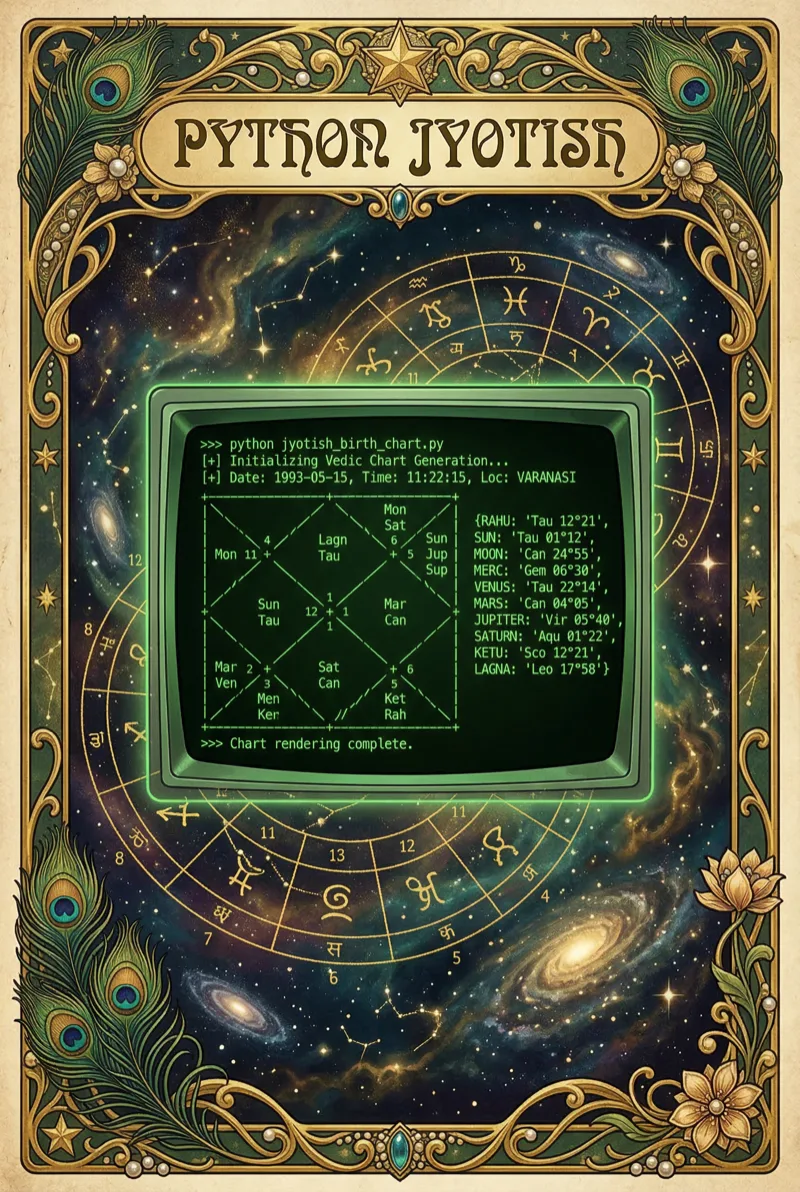
The Kundli engine takes a birth datetime and geographic coordinates as input and computes the positions of nine grahas across twelve bhavas. The computational core is celestial mechanics — ephemeris calculations that determine planetary longitudes at any given moment.
class KundliSystem:
    def __init__(self):
        self.houses = range(1, 13)
        self.d_charts = range(1, 61)

    def map_to_phase_space(self, graha_positions):
        """Transform 9 graha longitudes into phase space coordinates"""
        # Normalize longitudes to [0, 2*pi]
        normalized = [pos * np.pi / 180 for pos in graha_positions]
        # Project to 3D using trigonometric encoding
        x = sum(np.cos(pos) for pos in normalized) / len(normalized)
        y = sum(np.sin(pos) for pos in normalized) / len(normalized)
        z = sum(np.cos(2 * pos) for pos in normalized) / len(normalized)
        return np.array([x, y, z])

    def analyze_pattern_coherence(self):
        pass
The phase space projection is the critical operation. Nine graha longitudes define a point in nine-dimensional configuration space. We need to project this down to three dimensions for comparison with the Lorenz attractor. The trigonometric encoding preserves angular relationships while reducing dimensionality — similar to positional encoding in transformer architectures.
The Pattern Mapping Layer
The mapping layer connects Lorenz trajectories to Kundli configurations through three operations: geometric comparison, scale invariance detection, and field coherence analysis.
def detect_scale_patterns(data, scales):
    """Detect self-similar patterns at different scales"""
    patterns = []
    for scale in scales:
        resampled = data[::scale]
        # Compute local fractal dimension
        box_counts = []
        for epsilon in np.logspace(-2, 0, 20):
            n_boxes = count_boxes(resampled, epsilon)
            box_counts.append((epsilon, n_boxes))
        # Estimate dimension from log-log slope
        dim = estimate_fractal_dimension(box_counts)
        patterns.append({'scale': scale, 'dimension': dim})
    return patterns
Scale invariance detection uses box-counting to estimate fractal dimensions at different magnification levels. If the fractal dimension remains constant across scales, the pattern is self-similar — a signature of both Lorenz attractors and D-chart hierarchies.
Phase Space Integration
The core analytical operation maps each Kundli configuration to a point in the Lorenz phase space and asks: does the sequence of Kundli configurations over time trace a trajectory that resembles a Lorenz attractor?
def analyze_field_coherence(lorenz_data, kundli_data):
    """Compare pattern stability between systems"""
    # Compute Lyapunov exponents for both trajectories
    lorenz_lyapunov = compute_lyapunov(lorenz_data)
    kundli_lyapunov = compute_lyapunov(kundli_data)

    # Compare attractor dimensions
    lorenz_dim = compute_correlation_dimension(lorenz_data)
    kundli_dim = compute_correlation_dimension(kundli_data)

    # Compute mutual information
    mi = compute_mutual_information(lorenz_data, kundli_data)

    return {
        'lyapunov_ratio': kundli_lyapunov / lorenz_lyapunov,
        'dimension_ratio': kundli_dim / lorenz_dim,
        'mutual_information': mi
    }
The field coherence analysis compares three key properties: Lyapunov exponents (sensitivity to initial conditions), correlation dimensions (attractor geometry), and mutual information (shared structure between the two trajectories).
If the Lyapunov exponent ratio is close to 1, both systems exhibit similar sensitivity profiles. If the dimension ratio is close to 1, both attractors have similar geometric complexity. High mutual information indicates structural correspondence beyond chance.
Scale Transition Detection
The D-chart system provides a natural multi-scale framework. Each divisional chart represents the same data at a different resolution. Implementing scale transition detection means computing pattern properties at each D-chart level and tracking how they change.
def multi_scale_analysis(birth_data, d_charts=[1, 9, 10, 60]):
    """Analyze patterns across divisional chart scales"""
    results = {}
    for d in d_charts:
        chart = compute_d_chart(birth_data, d)
        phase_point = map_to_phase_space(chart)
        fractal_dim = estimate_local_dimension(phase_point)
        results[f'D-{d}'] = {
            'phase_point': phase_point,
            'fractal_dimension': fractal_dim,
            'pattern_coherence': compute_local_coherence(phase_point)
        }
    # Check scale invariance
    dimensions = [r['fractal_dimension'] for r in results.values()]
    scale_invariance = np.std(dimensions) / np.mean(dimensions)
    results['scale_invariance_coefficient'] = scale_invariance
    return results
A scale invariance coefficient near zero indicates that pattern structure is preserved across all D-chart levels — the system is truly fractal. A high coefficient indicates scale-dependent behavior — different D-chart levels reveal qualitatively different structures.
Implementation Considerations
Several practical challenges attend this implementation:
Ephemeris accuracy: The Swiss Ephemeris (via the swisseph Python library) provides planetary positions accurate to sub-arcsecond precision. This accuracy is necessary because the Kundli system is sensitive to initial conditions — birth time errors of minutes produce measurably different chart configurations.
Phase space projection bias: The trigonometric projection from nine dimensions to three necessarily discards information. The choice of projection matters. Different projections emphasize different relationships between grahas. A principled approach uses PCA to find the three-dimensional subspace that captures maximum variance in a dataset of many charts.
Statistical validation: Any apparent correspondence between Lorenz and Kundli trajectories must be tested against null models. Shuffled birth times, randomized planetary positions, and synthetic Lorenz trajectories with different parameters all serve as controls. The correspondence is meaningful only if it exceeds what random chance would produce.
Computational cost: Full Shadbala calculation for seven planets across six strength components, combined with Ashtakavarga computation for seven planets across twelve houses, combined with Lorenz trajectory generation at fine time resolution, produces a substantial computational load. Vectorized numpy operations and judicious caching of ephemeris lookups keep runtimes manageable.
The Implementation Gap
This framework is a scaffolding, not a completed building. The stub functions (pass blocks and placeholder calculations) indicate where empirical calibration is needed. The phase space projection needs optimization against real chart data. The fractal dimension estimates need validation against known attractor geometries. The coherence metrics need benchmarking against established dynamical systems analysis tools.
The framework’s value lies not in its current completeness but in its architectural clarity. It defines the interfaces between subsystems, specifies the data flow between layers, and establishes the analytical operations that will populate the stubs as research progresses. Good architecture makes implementation tractable. This architecture makes the Lorenz-Kundli pattern recognition program computationally tractable.
This document is part of the Lorenz-Kundli Pattern Recognition series exploring mathematical-mystical parallels across the pattern space of consciousness.