Lorenz-Kundli System Index
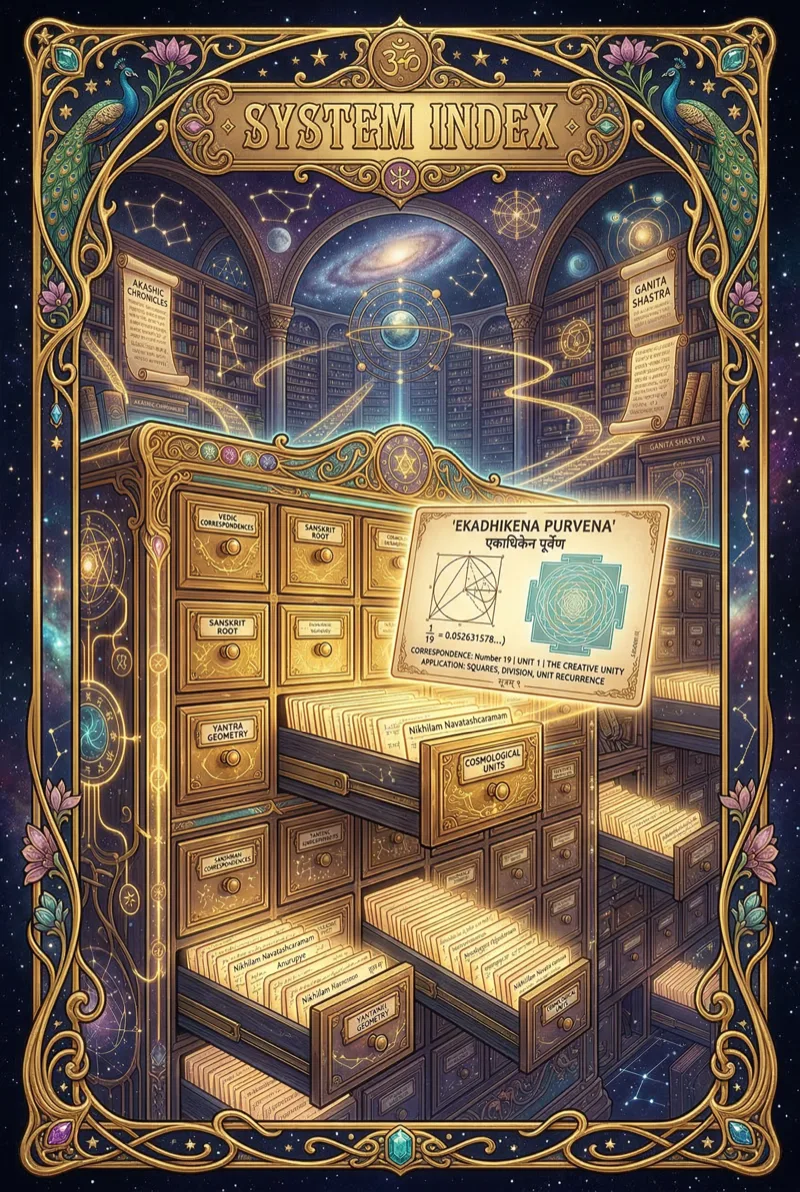
This is the index. Not the content, but the map of the content — the ls -la of a research program that connects chaos theory to Vedic astrology through six parallel studies, each demonstrating that mathematical structures discovered in the twentieth century were operational in Vedic astronomical systems for millennia.
Core Documentation
Primary Analysis
The Lorenz-Kundli Pattern Analysis is the foundational document. It establishes the three core parallels: phase space mapping (both systems track dynamic evolution through geometric space), scale invariance (both maintain pattern coherence across magnification levels), and consciousness interface points (both provide geometric representations of awareness states that change over time).
The analysis framework operates at the intersection of three domains: mathematical-spiritual integration, where the mathematics is not metaphorical but structurally precise; dynamic system evolution, where both Lorenz equations and Dasha periods describe trajectories through state space; and field coherence research, where the stability of strange attractors parallels the stability of astrological chart structures.
Technical Implementation
The implementation framework translates the pattern parallels into working protocols. If the Lorenz system and the Kundli system are structurally isomorphic, then techniques developed for analyzing one should apply to the other. Sensitivity analysis methods from chaos theory can be applied to chart interpretation. Divisional chart techniques from Jyotish can be applied to attractor analysis.
The implementation is bidirectional: each system provides analytical tools that the other lacks.
System Parallel Studies
The research program comprises six parallel studies, each mapping a specific Vedic astronomical technique to a specific mathematical framework:
Study 1: Vimshottari Dasha and Markov Chains
The 120-year Vimshottari Dasha cycle assigns planetary rulership periods in a fixed sequence: Sun (6 years), Moon (10), Mars (7), Rahu (18), Jupiter (16), Saturn (19), Mercury (17), Ketu (7), Venus (20). The transition probabilities between planetary periods and sub-periods create a state-transition matrix that is analyzable using Markov chain mathematics.
Key finding: The Dasha system’s memoryless property — where the current period fully determines the activation pattern without reference to prior periods — is the defining characteristic of a Markov process.
Research status: Active. Mathematical formalization complete. Empirical validation in progress.
Study 2: Graha Friendship and Cellular Automata
Planetary friendship rules in Vedic astrology define how each planet modifies its behavior based on its relationships with adjacent planets. Natural friendships, natural enmities, temporal friendships, and temporal enmities create a rule set that determines emergent chart patterns from local interaction rules.
Key finding: The friendship system operates identically to a one-dimensional cellular automaton: each cell’s (planet’s) next state is determined by its current state and the states of its neighbors, producing complex global patterns from simple local rules.
Research status: Active. Rule-set mapping complete. Pattern emergence documentation in progress.
Study 3: Ashtakavarga and Hypercube Geometry
The Ashtakavarga system assigns benefic points (bindus) to each house from the perspective of each planet. Seven planets plus the Ascendant create an eight-dimensional scoring matrix — each house receives a score vector with eight components.
Key finding: The Ashtakavarga bindu table maps naturally onto an eight-dimensional hypercube. Each vertex of the hypercube represents a unique combination of planetary contributions. Total Ashtakavarga scores correspond to projections of this hypercube onto lower-dimensional spaces.
Research status: To be implemented. Geometric framework defined. Computational modeling pending.
Study 4: Nakshatra and Fibonacci Sequences
The 27 Nakshatras divide the ecliptic into 13 degrees 20 minutes each. Their mythological associations, ruling deities, and behavioral qualities follow a progression that exhibits Fibonacci-like structural properties.
Key finding: The Nakshatra sequence appears to optimize information distribution across the lunar cycle in a manner consistent with golden ratio spacing — the same optimization principle found in phyllotaxis, seed head arrangements, and other biological information distribution systems.
Research status: To be implemented. Preliminary pattern identification complete. Mathematical verification pending.
Study 5: Shadbala and Tensor Fields
Shadbala assesses planetary strength across six dimensions: positional (Sthana Bala), directional (Dig Bala), temporal (Kala Bala), motional (Cheshta Bala), natural (Naisargika Bala), and aspect (Drik Bala). The resulting six-component strength vector for each planet is a tensor quantity — it has both magnitude and direction in a six-dimensional strength space.
Key finding: Planetary influence in Vedic astrology is not scalar but tensorial. Shadbala provides the framework for treating astrological influence as a directed multi-dimensional quantity, enabling rigorous mathematical analysis of how planetary strengths combine.
Research status: To be implemented. Tensor framework defined. Multi-dimensional analysis pending.
Study 6: Bhava Aspects and Neural Networks
Planetary aspects in Vedic astrology — where planets cast influence on specific houses according to type-dependent rules — create a weighted directed graph structurally identical to a neural network. Planets are nodes. Aspects are weighted edges. Chart interpretation is the emergent output of activation propagation through the network.
Key finding: Standard neural network analysis techniques (activation propagation, backpropagation of interpretation error, weight optimization) can be applied to aspect analysis to formalize what experienced astrologers do intuitively.
Research status: To be implemented. Network topology mapped. Computational implementation pending.
Research Vectors
Three primary research directions extend from the parallel studies:
Pattern Evolution Studies — How do the parallel structures evolve over time? Do Lorenz attractor dynamics predict Dasha period transitions? Do Dasha periods illuminate attractor behavior?
Field Coherence Analysis — When multiple charts interact (synastry, mundane astrology), do the resulting patterns exhibit the same coupling dynamics as coupled Lorenz oscillators?
Implementation Protocols — Can the mathematical tools developed for chaos analysis (Lyapunov exponents, fractal dimension calculation, attractor reconstruction) be meaningfully applied to Kundli data? Conversely, can Jyotish interpretive techniques improve intuition about chaotic system behavior?
Debug Notes
The system is monitored for: pattern recognition accuracy (are the parallels structurally precise or merely suggestive?), field coherence stability (do the parallels hold under rigorous mathematical scrutiny?), implementation viability (can cross-domain tools actually produce useful results?), and scale transition fidelity (do the parallels persist across all magnification levels or break down at specific scales?).
This is a living index. It updates as the research program advances.
The index is not the territory, but without the index, the territory is unreachable.