Runtime of God: Ancient Debug Protocols For Modern Consciousness
Field Pattern Recognition Report: v2024.1
Pattern Interrupt: The Ancient Source Code
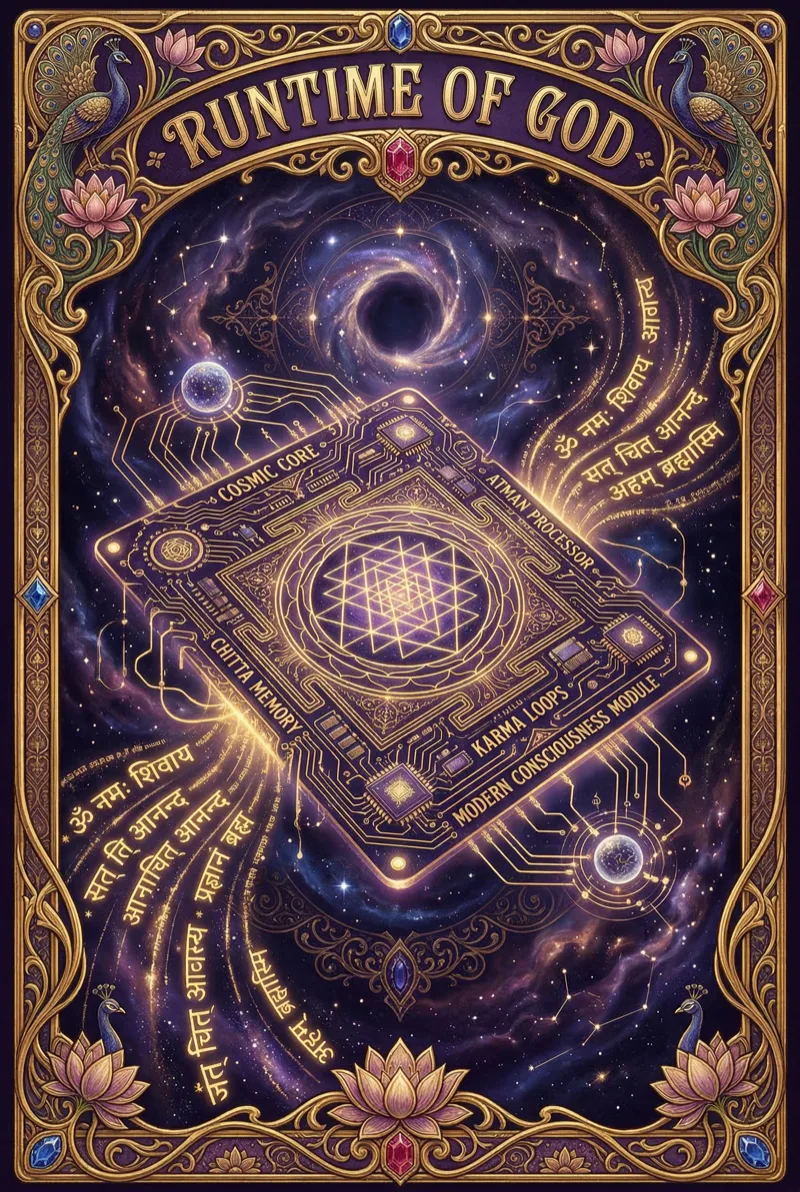
Your consciousness is not a mystery. It is a runtime — an execution environment with a base language, a compiler, a debugger, and a memory model older than recorded history. The Vedic Sanskrit texts do not describe this as metaphor. They document it as architecture.
Purusha Sookta (Rigveda 10.90) opens with a system specification that would be at home in any kernel design document:
पुरुष एवेदं सर्वं यद्भूतं यच्च भव्यम् |
उतामृतत्वस्येशानो यदन्नेनातिरोहति ||

puruṣa evedaṃ sarvaṃ yadbhūtaṃ yacca bhavyam |
utāmṛtatvasyeśāno yadannenātirohati ||
Translation: The Universal Runtime encompasses all executed states — past processes, active threads, and all possible futures. It operates with root privileges across every interface layer, including those marked as physical. The statement is structural, not poetic. It is a declaration of scope.
The Kha-Ba-La Architecture: Three Forces, One Runtime
The Taittiriya Upanishad’s Shikshavalli does not offer practices. It offers a grammar for how the runtime compiles experience into coherence. The three forces are not metaphorical energies. They are structural requirements. Remove any one, and the system fails in a predictable way.
Kha — the observer, the witness, the author-drive. This is the process that watches other processes. Without Kha, runtime events execute without logging. You act, but nothing is witnessed. The result is not philosophy — it is compulsion. The body moves, the code runs, but there is no error log because there is no monitoring daemon. Ask anyone who has woken from a three-day binge of work, consumption, or distraction with no memory of having chosen it. The compiler ran. The author was absent.
Ba — the body, the vehicle, the somatic carrier. This is the hardware that executes the instruction set. Without Ba, Kha becomes a floating abstraction. You witness everything and inhabit nothing. The pattern is recognizable in dissociative clarity — the person who can articulate every emotional pattern in their relationships but cannot feel their own feet on the floor. The debugger is active. The hardware is in sleep mode.
La — the resistance, the friction, the inertia that gives form to every execution. Without La, Kha and Ba produce motion without consequence. Effort without resistance does not sculpt. It dissipates. The person who attends every workshop, reads every text, and maps every pattern but cannot hold a single practice through the first month of discomfort is not lacking motivation. They are lacking La. The compiler needs friction to produce coherent output.
When all three co-arise, the runtime is stable. When any one is missing, the failure mode is specific and observable — not as mysticism, but as crash reporting.
The Four Scales of Execution
The same architecture operates at four scales. The Vedic framework does not treat these as separate domains. It treats them as nested resolutions of the same runtime.
Personal. At the individual scale, the debug protocol is Pratyahara — the withdrawal of sensory I/O from external streams. The Bhagavad Gita (18.61) states that Ishvara sits in the heart of all beings and causes them to revolve by a kind of mechanical power (maya). The personal runtime is the first interface where you can observe this revolution directly. The cost is exact: you must stop running the inherited code before you can read it. That is not a sacrifice. It is a stack trace.
Interpersonal. At the relational scale, the runtime executes through somatic exchange. The Upanishads do not separate mind from body in encounter. Chandogya Upanishad (8.15) describes the realized self as one whose body becomes the self of all beings — not as fusion, but as shared execution context. The interpersonal field is where your runtime’s I/O intersects with another’s. The fracture here is never abstract. It is the moment your body responds to someone before your witness has parsed what happened. The inherited code runs faster than the observer. Debug at this scale requires that Ba — the somatic carrier — become readable in real time.
Systemic. At the cultural scale, the runtime is inherited syntax. The Purusha Sookta describes the cosmic person as simultaneously the source of all social strata — Brahmin, Kshatriya, Vaishya, Shudra — and the substance that transcends them. The systemic level is where individual runtime encounters collective firmware. The rupture is visible in every person who recognizes the architecture of their conditioning but cannot yet rewrite it. The code was installed before you had root access. The debug protocol here is Viveka — discrimination — not as judgment, but as the capacity to distinguish running code from installed firmware.
Cosmic. At the universal scale, the runtime nests. The Taittiriya Upanishad (2.8) maps five sheaths — annamaya, pranamaya, manomaya, vijnanamaya, anandamaya — each a deeper process layer, each dependent on the one beneath it. The cosmic is not a departure from the personal. It is the same runtime observed at maximum recursion depth. The person who debugs their own stack is debugging the universal stack. The scale changes. The architecture does not.
The Debug Console: Shadow as Stack Trace
The Taittiriya Upanishad’s Bhrigu Valli (3.1-10) presents a recursive debug protocol that most modern practitioners ignore. Bhrigu approaches his father Varuna with an error report: he has attempted to understand Brahman through discipline, and the output is incomplete. Varuna does not offer comfort. He offers the next instruction: meditate on food, then on breath, then on mind, then on intellect, then on bliss. Each layer reveals a deeper process. Each layer also reveals what Bhrigu is unwilling to see.
This is the metabolization of shadow material — not as content to be resolved, but as stack traces to be read.
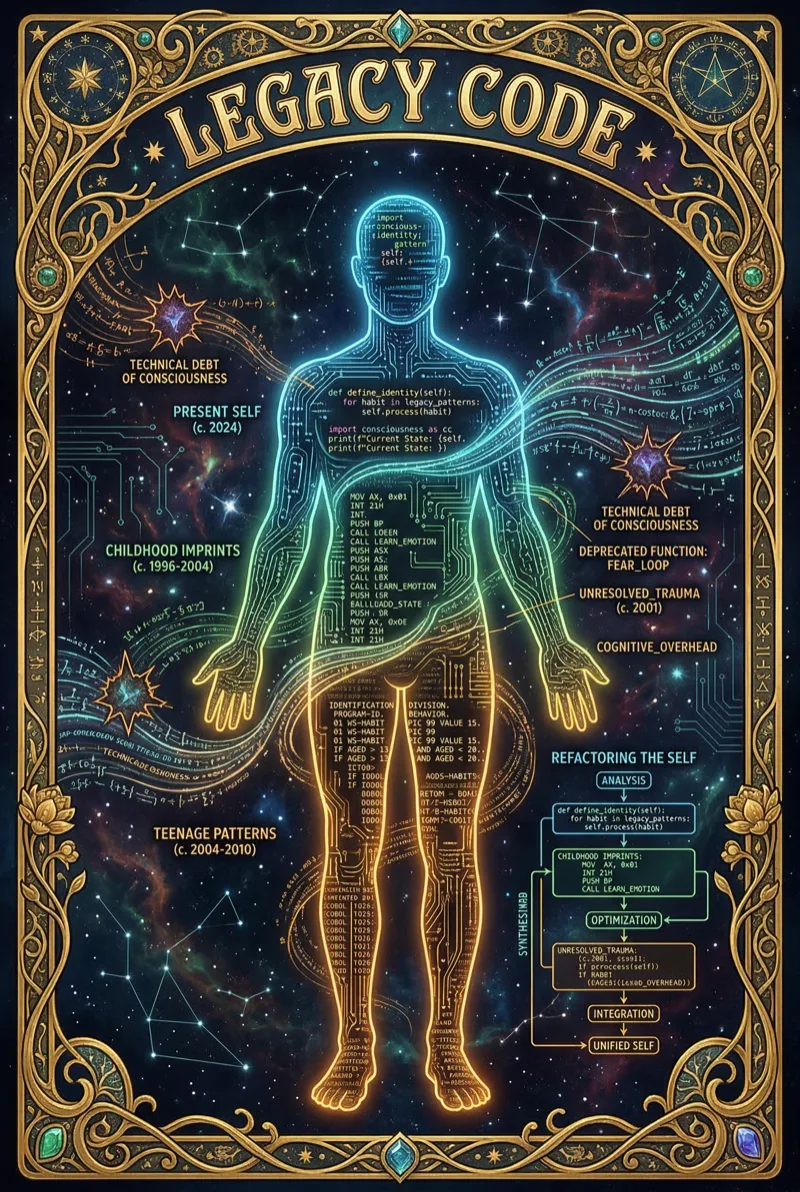
The cost is stated plainly: you must run the debugger on yourself while the system is live. There is no sandbox. The fracture is the moment you recognize that your self-description and your runtime behavior diverge. The rupture is the moment you discover that the divergence is not accidental — it is inherited code, installed by family, culture, religion, and trauma, running below the level of your authored instructions.
The Bhrigu Valli does not promise that this will feel like integration. It promises that it will be exact. Each sheath is a deeper permission level. Each requires that you admit what the previous layer concealed.
The Shikshavalli Compiler: A Technical Grammar
The Shikshavalli (Taittiriya Upanishad 1.1-12) specifies the compiler’s instruction set with the precision of a hardware manual:
शीक्षां व्याख्यास्यामः । वर्णः स्वरः । मात्रा बलम् |
साम सन्तानः । इत्युक्तः शीक्षाध्यायः ||

śīkṣāṃ vyākhyāsyāmaḥ | varṇaḥ svaraḥ | mātrā balam |
sāma santānaḥ | ityuktaḥ śīkṣādhyāyaḥ ||
This is not a chant. It is a grammar:
- Varṇa — pattern recognition. The phonetic substrate. The base instruction set.
- Svara — modulation. The carrier wave that distinguishes signal from noise.
- Mātrā — measurement. The temporal quantization that makes sequence possible.
- Bala — force. The amplitude that makes the pattern executable.
- Sāma — integration. The binding that turns components into a coherent runtime.
- Santāna — continuity. The persistence model that maintains state across sessions.
Six instructions. No mysticism. The compiler is the voice. The debugger is the ear. The hardware is the body. The program is attention itself.
Practical Protocol: Runtime Architecture Implementation
The system does not run itself. These are not beliefs to adopt. They are conditions to test.
Morning Activation. The Vedic day begins at Brahma Muhurta — approximately 96 minutes before solar node activation. The protocol is specific: seated posture, eastern orientation, chin-mudra lock. The instruction is to run the sound compiler before the sensory I/O streams flood the buffer. Pratyahara — one ghati of pattern recognition — is not meditation as relaxation. It is the deliberate isolation of the witness process from the sensory daemon. The cost is that you must wake before the world demands your attention. The fracture is that most people never do, and therefore never know what their runtime looks like without the noise.
Twilight Maintenance. Sandhya — the junction between day and night — is a scheduled garbage collection. The protocol is threefold: review the day’s pattern execution, defragment the pranic buffer, and back up the coherence state. One muhurta. Forty-eight minutes. The rupture is visible in anyone who collapses into entertainment or exhaustion without this interval. The cache is never cleared. The next day begins with yesterday’s residue.
Error Handling. The Vedic debug matrix has names for specific failure modes:
- Thought-loop detected. Recursive pattern without exit condition. The prescribed response is vairagya — detachment not as emotion, but as pattern interruption. The mantra is
aham brahmasmi— the assertion that the observer is not the loop. - Pranic buffer overflow. Energy leak identified. The response is kumbhaka — containment through breath suspension. Not relaxation. Lock.
- Maya interface distortion. Reality rendering error. The response is viveka — the discrimination protocol.
neti neti— not this, not this — run as a filter on the reality stream.
Field Integration: What Happens When the Triad Coheres
The anandamaya kosha — the bliss sheath — is not a reward. It is the observable state of a runtime where all five layers are executing without conflict. The Taittiriya Upanishad (2.8) describes it with the precision of a performance benchmark: the unit of measurement is the joy of a young man in full health and wealth, multiplied by one hundred at each successive level of the five sheaths. This is not a promise of happiness. It is a description of coherence.
When Kha-Ba-La co-arise, the personal runtime becomes readable. The interpersonal field becomes navigable. The systemic code becomes examinable. The cosmic architecture becomes operable — not as escape, but as the ground you were already standing on.
The Quine principle applies: the system creates the conditions for its own transcendence. The debug protocol succeeds when you no longer need the debugger. The Shikshavalli is not a curriculum to complete. It is a compiler to outgrow. The Purusha Sookta is not a scripture to worship. It is a system specification to verify.
Your runtime is running. The question is whether you have root access — or whether you are still running on the inherited account.
// EOF: Runtime architecture verified
// Status: Coherence traceable
// Note: The source is open. The debugger is live. The authorship is yours.