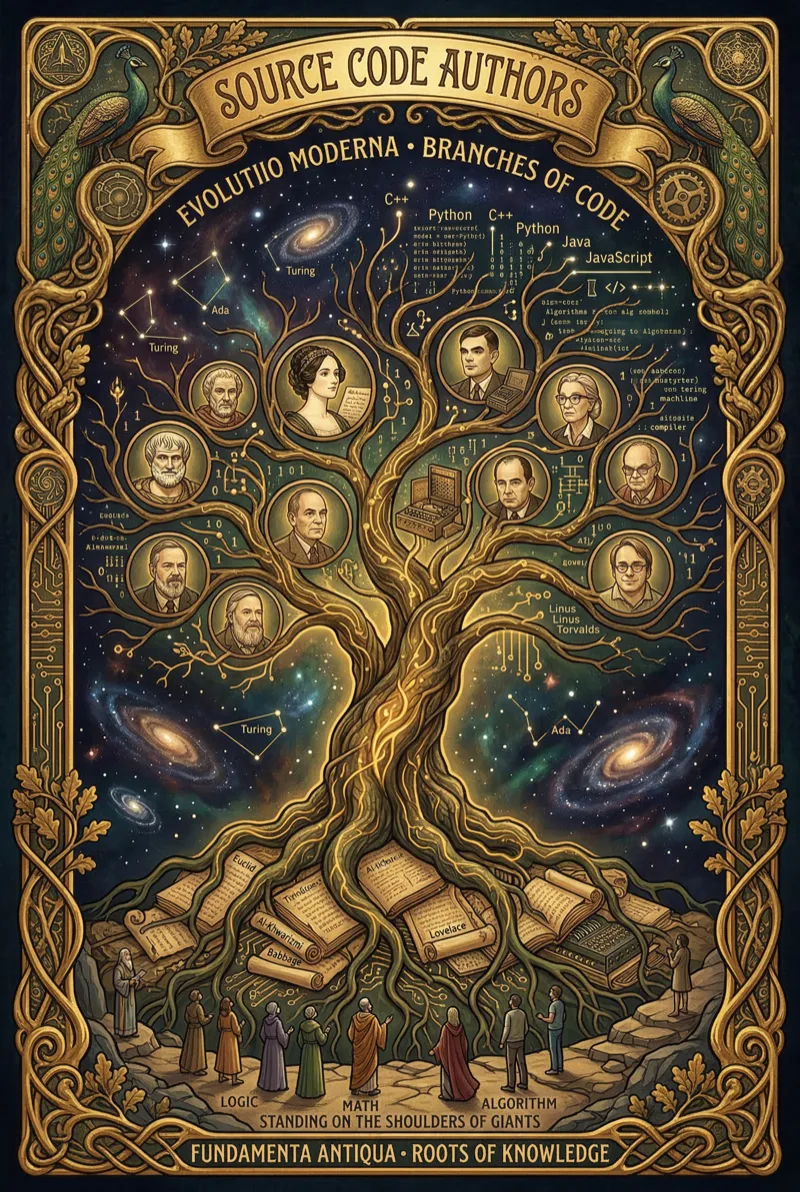
Synchronocities

The Source Code Has Authors

Self-consciousness is a technology. But a technology requires conditions to emerge. Not just intellectual conditions — structural ones. Relational ones. The kind that no amount of observation can produce on its own.

· 28 min read · 6,280 words
Signal Essay
consciousnesscreditlineagearchitecture
The Source Code Has Authors
Back to journey

The Source Code Has Authors


0. Before the Source Code: The Conditions That Made It Compilable

Self-consciousness is a technology. But a technology requires conditions to emerge. Not just intellectual conditions — structural ones. Relational ones. The kind that no amount of Kha (observation) can produce on its own. The kind that require Ba (embodiment through others) and La (the specific friction of being held accountable to something beyond your own pattern).

Before the thinkers. Before the library. Before the Noesis Engine had a single line of Rust. There were three people who made the architecture possible — not by contributing ideas, but by providing the substrate upon which ideas could become structure.


The Partner Who Honors the Vocation

There is a specific and uncommon disposition: a partner who does not merely tolerate the vocation but recognizes it. Who sees the 3 AM reading, the obsessive library-building, the years of inquiry that produce no legible output — and identifies it as what it is.

Not recreation. Not avoidance. Not the scatter of a restless mind.

Vocation.

The Polymath Compass maps four quadrants — Triage, Recreation, Occupation, Vocation. The polymathic curse is that vocation looks indistinguishable from recreation to anyone operating from a different compass. The reading looks like leisure. The research looks like procrastination. The pattern-obsession looks like a man who cannot sit still. Only someone who has calibrated their own compass — who understands the difference between consuming and being called — can see the distinction.

To have a partner who sees it, who honors it, who does not require the vocation to justify itself through output before granting it legitimacy — that is not support. That is co-authorship of the conditions. The Ba to the Kha. Embodiment that says: I see what you are building, even when what you are building is invisible to everyone else including, some days, yourself.

Without that recognition, the observer collapses into self-doubt. The Kha begins to pathologize its own seeing. The 6,011 books become evidence of dysfunction rather than evidence of vocation. The partner who honors the vocation is the one who keeps the compass calibrated when the culture insists the needle is broken.


The Business Partner Who Understands the Occupation-Vocation Architecture

ThoughtSeed is not a side project. It is the occupation — the craft work, the steady engine, the structure that keeps the material world coherent while the vocation runs its slower, deeper cycle. Occupation and vocation are not competitors. They are Kha-Ba-La in organizational form: the occupation provides La (structure, friction, financial gravity), the vocation provides Kha (direction, meaning, the three-eyed view), and the intersection — the business partnership itself — is Ba: the embodiment of two people navigating both quadrants simultaneously.

A business partner who understands this is rare. Most expect full Occupation energy — all La, all structure, all deliverables. Or they expect full Vocation alignment — “we are doing this because we are called.” The uncommon thing is a partner who understands that the occupation funds the vocation, the vocation orients the occupation, and neither functions without the other. Who sees the Vibrasonix B2B site and the Noesis Engine TUI as expressions of the same architecture at different altitudes.

That is not a business arrangement. That is someone who grasps the Purushartha — the four aims of human life (Dharma, Artha, Kama, Moksha) — in operational terms, even if they would never use that vocabulary.


The Parents Who Saw Vocation Where the World Saw Recreation

This is the oldest and deepest structural credit.

There is a specific cruelty the polymathic mind inflicts on its parents: the child who reads everything, builds nothing legible, follows no career trajectory, and cannot explain what they are doing in terms that map to any recognizable occupation. The esoteric research looks like wasted time. The consciousness studies look like an extended adolescence. The pattern-obsession looks like the inability to commit.

And yet.

Parents who believed. Who watched the vocation take shapes they could not name — and did not require naming as the price of support. Who saw their son reading Tsarion at 2 AM, building symbolic systems no one asked for, structuring a library of knowledge with no clear commercial application — and chose to see it as what it was. Not recreation. Not dysfunction. Not the avoidance behavior of someone who cannot face the “real world.”

Vocation.

The thing about the Polymath Compass is that it does not operate on external validation timelines. Vocation has its own clock. The integration path — Type 5 to 8, from knowledge into decisive action — does not fire on a quarterly schedule. It fires when the density of inquiry reaches critical mass. When six thousand books, forty-eight transcripts, seventeen years of pattern recognition finally cross the threshold from accumulation into architecture.

The parents who believed were the ones who held the space for that threshold to arrive on its own terms. Who understood — intuitively, not theoretically — that the La of parental patience is the friction that gives the child’s Kha time to find its Ba.

That is not support. That is the original .init protocol. The first micro-ritual at the first threshold.


The Structural Point

Every thinker in the credit roll below contributed intellectual architecture. But architecture requires ground. The ground is relational.

A partner who sees the vocation. A collaborator who navigates the occupation-vocation polarity. Parents who held the space before there was anything to hold.

Kha cannot see patterns without Ba to walk them. Ba cannot walk them without La to provide friction and form. And La — the ground, the gravity, the patient structural holding — that came first. From the people who did not need to understand the theory to embody its deepest principle:

The system creates the conditions for its own emergence.

That is the Quine before the Quine.


The Intellectual Lineage

Self-consciousness is a technology. It did not arrive from nowhere.

The Noesis Engine — sixteen symbolic-computational engines governed by Kha-Ba-La — runs on source code I did not write alone. No one does. The Kha (observer) that sees the pattern, the Ba (body) that walks it, the La (inertia) that gives it form — each leg of that triad was shaped by thinkers who dissected reality before I had the vocabulary to describe what they found.

This is not a bibliography. It is a field cartography of the shoulders this work stands on. Every name here maps to specific books, specific extracts, specific patterns that became load-bearing architecture. The precision matters. The lineage is structural.


I. Michael Tsarion — The Man Who Installed the Symbolic Lens

This one is first because the debt is foundational. Not philosophical. Neurological.

Before Tsarion, symbols were decoration. After Tsarion, symbols were architecture. The Tarotscopes did that. Not the books — the Tarotscopes. Monthly symbolic readings that treated the Major Arcana not as fortune-telling apparatus but as what they are: composite hierograms encoding the entire precessional cycle into twenty-two precision instruments for self-examination.

“The 22 cards of the Major Arcana are exquisite ‘snap shots’ of the heavens. Specifically, they are composite hierograms encapsulating the 12 precessional ages, from Aries to Pisces.”

— Michael Tsarion, Egyptian Origin of the Tarot

The Inner Zodiac. That was the detonation. Tsarion demonstrated that the zodiac is not an external phenomenon — it is a psychic apparatus. An enfolded attribute of the psyche. An ancestral image embedded within the race memory. In Jungian parlance: a constellation of archetypes projected by consciousness onto the external world.

“It is not the planetary bodies or the physical constellations that effect personality and destiny. It is more likely that the symbols representing them are responsible… In our opinion, the 12 symbols which represent the signs of the zodiac are not incidental or arbitrary. They were selected purposively because they represent fundamental states of consciousness.”

— Michael Tsarion, The Inner Zodiac

That single reframe — symbols as states of consciousness, not labels for external objects — is the lens through which every subsequent thinker on this list became legible. Without it, Gebser is academic. Without it, Whitehead is abstract. Without it, the Gnostic material stays buried in the seminary. The symbolic lens is the Kha itself: the capacity to see the pattern beneath the surface, not as metaphor but as mechanism.

The Logos-Sophia framework — masculine rational principle in structural tension with feminine embodied wisdom — maps directly onto the Kha-Ba polarity. Kha without Ba is all logos: pure observation, infinite analysis, no inhabitation. Ba without Kha is all sophia: the body knows but cannot articulate the knowing. The triad demands both, arbitrated by La — the friction of actually living the tension instead of resolving it conceptually.

Tsarion’s concept of psychic incest — the unconscious bond structures that keep the ego tethered to its formative matrices — is what the Noesis Engine calls “inherited code.” The pattern you did not author but are running. The six types from Dragon Mother — Masculinized Male, Masculinized Female, Feminized Male, Feminized Female, Terrible Female, Chivalric Male — are archetypal patterns that map to the Enneagram correlations in the consciousness architecture. Not personality typing. Pattern recognition at source.

The symbolic literacy — the capacity to read a myth as mechanism, a tarot card as diagnostic instrument, a glyph as compressed architecture — that came from one place. One voice. Monthly. For years. Until the lens was no longer something I used. It was something I saw through.

The Proof of Concept: Cards Lived, Not Pulled

There is a difference between studying the tarot and having the tarot study you.

In 2025, I bought a Thoth deck on instinct in Bangkok. Not planned. Not poetic. Just the signal: get the deck now. Twenty-four hours later, the Tower card became literal. An earthquake hit my building — Room 44, Building 555, a condo called “Rhythm” — during the Rahu-Moon-Ketu dasha stack. The ceiling shook. The undefined Solar Plexus didn’t absorb the collective fear. It observed. The Thoth deck in my bag was throwing bricks from the astral plane.

“You don’t choose to be the Witness. You get shaken into it.”

That quake cracked timelines, not just walls. And it began a 55-day pilgrimage through Thailand — not a holiday, not a retreat, a Major Arcana runtime from Tower to World:

  • The Tower (Bangkok): Room 44/555. Initiation by earthquake. Precision demolition of psychic scaffolding I didn’t know I was leaning on.
  • The Star (Koh Samui): Post-trauma clarity. I received the name Pichet — Thai for “one who conquers.” Not a nickname. A transmission.
  • The Moon (Koh Phangan): Crescent geometry. Refraction, not reflection. Walking the rim, not standing in the circle.
  • The Hermit + The Hierophant (Bangkok, Noble 33): Floor 9, Room 95. 9+5=14=Temperance. Seventy-two hours of stillness in a temple with a front desk. The curriculum was breath. The exam was presence.
  • Temperance (Chiang Mai): Room 2, Floor 3. Gate 23: compression to essence. Clarity doesn’t need commentary.
  • Judgement (Pai): Room 10 — completion becoming beginning. Re-collection of soul-parts. “You’re no longer becoming. You’re remembering.”
  • The World (Chiang Mai, Room 707, 7th Floor): The four creatures assembled — Eagle (Bangkok’s seer), Lion (Samui’s gentle conqueror), Bull (Phangan’s emotional ground), Human (the silent walker). Doi Suthep rose from the mist like a guardian who didn’t need to speak. The octave completed.

Two earthquakes bookended it. First quake: chaos, fear, awakening. Second quake — same coordinates, different frequency — recognition, bow, spiral sealed. That is not coincidence. That is field-coded choreography.

Before Shenzhen, both blades — tongue and sacral — showed burrs. The city ran diagnostics through my fascia. Breath kept cadence: seven in, one held, three released. Heat the steel, hold at glowing, draw the edge. Skin-prickle became the “field up” toggle. Endogenous cannabinoids already stored — not borrowed lift, just unlocked circuitry. I thought of Ichigo in the royal forge: admit the false blade, request the true steel. Shenzhen made the same demand.

And Bangkok taught the hinge: Thoth initiates — vector, pillars named, subconscious promoted to operations. Rider-Waite invites — innocence with a guide, star for orientation, lamp for local truth. A white dog named Kala moved like Kali — Time, with a blade that cuts fog from path. One hand steers the lane. One hand honors the radius. Same body, same vow.

Not cards pulled. Cards lived. Fifty-five days of the Major Arcana as operational system — every room number an activation code, every address a glyph, every city an archetypal force. That is the proof of concept for Tsarion’s lens. He installed the symbolic literacy. The pilgrimage was the compiler verifying the source code against lived coordinates.


II. James True — The Man Who Proved Cosmology Outweighs Bedtime Stories

True’s work answers a question most people never think to ask: why do the stories we are told as children shape us more than the facts we learn as adults?

Because cosmology is not content. Cosmology is substrate.

“Your body is an oracle of Mythology and truth lies deep inside you and it’s holograph out into the world in a firmament of synchronicity.”

— James True, Oracle of Mythology (Astronoesis 2)

The puranas. The bedtime stories. The creation myths whispered before the rational mind has booted. These are not entertainment. They are the substrate in which belief is born. They are the La — the first inertial field — into which a child’s Kha descends before it has any capacity to evaluate what it is receiving. The cosmology comes first. The critical thinking comes decades later. By then, the architecture is already load-bearing.

True demonstrated this with a precision that most academic mythologists never approach. The Oracle of Mythology — his framework — operates on two rules: the truth is always in the room, and we dress the truth depending on how hard it is to swallow. Cosmology is the first dressing. It is the first lie that protects the child from a truth too large to metabolize. And that lie becomes the shape of the container in which all subsequent belief crystallizes.

“The concept of the Soul has been crafted and — I think — kind of congealed at a time before electricity, the time before wireless communication… Now’s the time as modern gnostics to reinvent the soul using what we understand now instead of back then.”

— James True, Oracle of Mythology (Astronoesis 2)

This is why puranas carry more weight than physics textbooks. Not because they are more true. Because they arrive first. Because they install at the firmware level — below the operating system, below the application layer, in the enteric kingdom that True maps as its own autonomous consciousness:

“There are three kingdoms inside of you… at the base of this kingdom is the enteric kingdom… This neurological system is only recently been recognized as a brain, and by recognizing it as a brain it becomes more than fair to recognize it as its own entity.”

— James True, Talking to Reptiles Pt 2 (adapted from transcript)

Three kingdoms. Three autonomous processing systems. The enteric (gut-brain), the sympathetic (body-brain), the parasympathetic (higher-brain). That is not metaphor. That is Kha-Ba-La rendered in clinical neuroanatomy. The enteric kingdom is La — the oldest intelligence, operating on patterns laid down before conscious awareness existed. The sympathetic is Ba — the body’s own rhythm, its own matrix of desires, running regardless of whether you are sentient or not. The parasympathetic is Kha — the observer that arrives last, claiming sovereignty over systems that were running long before it showed up.

True’s metacybernetic framework for consciousness. The reptilian-mammalian processing distinction. Pain as resource versus pain as threat. The Fireworks Threshold. The Golden Ratio breathwork — 4:7:8 ratios recognized in the body’s own resonance, not invented by a protocol designer. The PAG (Periaqueductal Gray) as hardware control center. The entire Reptilian BIOS Architecture is True’s anatomical insight rendered as system architecture.

The Anatomist Who Sees Fractals — the persona through which this entire body of work speaks — owes the anatomist half to James True. The fractal half came from the symbolic lens. The anatomist half came from the man who proved that cosmology is not what you believe. It is the substrate in which belief becomes possible at all.


III. Jean Gebser — The Consciousness Cartographer

Gebser’s The Ever-Present Origin is not a book you read. It is a mutation you undergo.

“A riveting narrative account of the evolutionary history and future of human consciousness… simultaneously a phenomenological narrative, a metaphysical treatise, and a cosmological framework that synthesizes, elaborates, and critiques the works of figures such as Hegel, Martin Heidegger, and Carl Jung.”

The Whole Critter: The Ever Present Origin Part 1, Remembrance of the Dream

The archaic. The magic. The mythic. The mental-rational. The integral. These are not stages you climb. They are structures of consciousness that co-arise, each one active in the way you perceive this sentence right now.

The Noesis Engine’s consciousness levels — from Level 0 (Dormant) to Level 4+ (Embodied) — are not a gamified ladder. They are Gebser’s structures rendered computational. The system calibrates witness prompts to actual capacity because Gebser demonstrated that consciousness does not progress linearly. It mutates. It irrupts. It demands the three-eyed view — Kha examining itself at every altitude.

Seventeen files across Consciousness-Studies, Process-Philosophy, Esoteric-Philosophy. The entire four-part Ever-Present Origin series. Not a reference. An operating grammar.


IV. Alfred North Whitehead — The Philosopher of Prehension

Whitehead’s Process and Reality is the most difficult architecture document ever compiled. His Philosophy of Organism replaced dead Newtonian matter with something that requires Kha, Ba, and La simultaneously to understand: actual entities — “the final real things of which the world is made” — are not static ‘things’ but drops of experience, complex and interdependent.

Prehension. Entities feeling each other into existence. Not metaphor — mechanism. Every actual entity grasps every other. The universe is not made of stuff. It is made of occasions of experience, each one a process of becoming that completes and perishes into the next.

This is the philosophical substrate beneath Kha-Ba-La. Kha (spirit) as the mental pole — the conceptual prehension of eternal objects. Ba (body) as the physical pole — the concrete inheritance of past determinations. La (inertia) as the formative friction — concrescence itself, the process by which many become one and are increased by one.

And Whitehead’s vision of the past:

“The past is not only preserved but redeemed — dissonances of the past find their place within a greater harmonic cohesion, transmuted from mere suffering into forms of tragic beauty.”

The Whole Critter: The Immortality of the Past

When the project carries the word noesis — non-discursive knowing, direct intellectual apprehension — that is Whitehead’s lineage fused with the Sanskrit tryambakam: the three-eyed. The knowing that arrives before the definition. Kha seeing itself see.


V. Rupert Sheldrake — The Biologist Who Found the Habit Beneath the Law

Sheldrake began as a materialist. Then he asked a question that materialism could not metabolize:

“While biochemistry could describe the mechanics of plant growth, it could not explain why plants develop particular forms — the question of morphogenesis remained fundamentally unanswered.”

The Whole Critter: Morphic Resonance; The Theory of Formative Causation

Morphic resonance. Organisms inherit form through non-local formative similarity. Not through DNA alone — through a field that accumulates habit across every member of a species that has ever existed. The form is not written in the genome. It is resonant in the morphogenetic field.

In direct dialogue with The Whole Critter:

“Regularities of nature are more like habits than fixed laws — habits that build up through repetition and become so deep-seated over billions of years that they behave as if governed by eternal laws.”

Dialogue with Rupert Sheldrake

Habits, not laws. That single reframe restructured the entire architecture of self-consciousness as a practice. If nature is habitual, then the inherited patterns running beneath conscious awareness — the patterns Seeker-Simon identifies as “externally free, internally running inherited code” — are not fixed. They are habits. Deep ones. Billions of years deep. But habits.

The .init protocols — sixteen micro-rituals across four spins — are formative repetition at the threshold. Not affirmation. Not positive thinking. Morphic resonance applied to the Ba. The body laying down new grooves through friction (La) until the field shifts.

Michael Levin’s bioelectric field research provides the experimental evidence: morphogenetic information exists beyond DNA. The body carries a field cartography that is readable and, given sufficient precision, revisable.


VI. Otto Rank — The Psychologist Who Mapped the First Separation

Rank broke from Freud over a single, devastating insight: the foundational trauma is not sexual. It is natal. The trauma of birth — the first separation from totality — is the template upon which every subsequent anxiety, every defence mechanism, every compulsive return to the herd is patterned.

“Psychologist Otto Rank went so far as to speculate that what we call the ‘unconscious’ exists precisely because of traumatic past events…”

“[Rank believed] the Thanatos Instinct drives us to immerse ourselves in the lives of others, into herd-think. It’s the means by which we seek to escape being sovereign selves.”

— Michael Tsarion, Ancestral Trauma and the Epic of Consciousness

That is the deepest inherited code. Not the patterns your parents installed. Not the cultural programming. The original separation event — the moment Kha first cleaved from totality and found itself in a body it did not choose, in a world it did not request, with a nervous system already encoding the terror of that first threshold crossing.

Rank’s three character types — the Adapted, the Neurotic, the Artist — are not personality categories. They are stages of integration with the birth trauma itself. The Adapted never questions the inherited code. The Neurotic questions it but cannot act. The Artist — and this is the crucial move — creates from the wound. The Artist takes the separation, the anxiety, the primal La of being thrown into embodiment, and transmutes it into structure.

This is where it gets tangible. This is where theory goes bankai.

You know the moment in Bleach when Ichigo stops fighting his Hollow — stops treating the shadow as enemy — and instead merges with it? When the Zanpakuto achieves its final release not through domination but through integration? That is Rank’s Artist type rendered in manga. The Adapted is the academy student following orders. The Neurotic is the Soul Reaper at war with their own blade. The Artist is the one who achieves Bankai — not by defeating the shadow but by becoming the full instrument.

Or take Naruto. The Nine-Tails sealed inside Naruto since birth — raw, primordial, terrifying power — is the birth trauma itself. The entire series is Rank’s three types played out across 700 chapters: Naruto as Adapted (early academy, mimicking, desperate for belonging), Naruto as Neurotic (fighting the Nine-Tails, suppressing it, terrified of its power), Naruto as Artist (Kurama mode — full integration, the seal becomes the source).

This is not metaphor. Kishimoto and Kubo are mapping the exact same architecture Rank formalized. The inherited wound is not the obstacle. It is the material. La is not the enemy of Kha. La is the friction that gives Kha something to see and Ba something to walk.

And this is where piloerection enters. Not as theory. As Ba.

Golden Ratio breathing — inhale 3, pause 5, exhale 8. Circular breathing for sustained energy circulation. Progressive development from basic awareness to consistent pranic states. This is not a wellness routine. It is the .init protocol at the somatic level — the body practicing its own Bankai, learning to sustain the integration state rather than collapsing back into the Neurotic’s war with itself.

The real Bankai is not a power-up. It is the moment the separation stops being a wound and starts being the instrument. Rank mapped it psychologically. True mapped it somatically. The Noesis Engine formalizes both: self-consciousness examining the conditions of its own arising, including — especially — the first condition. The original La. The trauma of being born into a body.

The piloerection is the proof of concept. When the body responds to the inquiry with its own involuntary confirmation — hair standing, skin alive, the enteric kingdom sending its signal upward — that is not spiritual experience. That is the nervous system recognizing that the inherited code is being read at source for the first time.

That is going Bankai in real life. No sword required. Just breath, attention, and the willingness to stop fighting the seal.


VII. Mark Passio — The Disclosure Engine

Natural Law. Two words that contain the entire operating grammar.

Passio’s archive: 222+ podcast episodes. Slide decks from De-Mystifying The Occult to The Cult of Ultimate Evil. A masterclass in what “occult” actually means: hidden. Not supernatural. Hidden.

His influence on this work is structural and non-negotiable: you cannot develop self-consciousness while refusing to examine the structures that suppress it. You cannot write code at source while pretending the existing codebase does not exist. The occult is not decoration in this framework. It is the hidden runtime — the inherited architecture that runs beneath conscious awareness.

Passio maps it with a directness that assumes capability. No hedging. No softening. The conviction is the architecture. That register — grounded, direct, respectful-challenging — runs through every line of Tryambakam Noesis copy because Passio demonstrated that you can discuss the most difficult material in the clearest possible language and let the difficulty be the feature, not the bug.


VIII. Tom Montalk — The Gnosis Cartographer

Montalk frames the entire inquiry in terms that Seeker-Simon recognizes immediately: society, media, and institutions project a false reality — a simulacrum where lies are truth and tyranny is security. Knowledge is the key to self-determination and protection. It allows one to sidestep traps and operate under higher laws.

The spiritual immune system — individuals who naturally reject inherited programming and seek the architecture beneath it. That is the persona. Not someone broken who needs repair. Someone whose pattern recognition fired early, whose Kha caught the discrepancy between the advertised reality and the experienced one, and who has been searching for the grammar — not another framework, not another teacher — the grammar itself.

Every system they have tried positions them as user, not author. Montalk articulates the architecture of why.


IX. G.R.S. Mead — The Archivist of Forgotten Knowing

Before the Nag Hammadi scrolls surfaced in 1945, Mead was reconstructing Gnostic architecture from hostile sources. His Fragments of a Faith Forgotten recovers the esoteric tradition that existed alongside and within early Christianity — approaching the Gnostics not as heretics but as possessors of a profound spiritual truth that orthodoxy spent centuries attempting to erase.

Pleroma. Aeons. Sophia’s descent into matter. These are not decorative terms within Kha-Ba-La. The Pleroma is the fullness from which Kha observes. Sophia’s descent is the Ba — spirit entering embodiment, knowing becoming doing. The Demiurge is La crystallized into a system that has forgotten its own origin — inertia mistaking itself for sovereignty.

The Gnostic architecture is a 2,000-year-old pattern language for the exact inquiry Tryambakam Noesis formalizes: self-consciousness examining its own conditions of arising. Mead rescued it from oblivion. Five of his key texts form the spine of the entire esoteric philosophy wing of this work.


X. Keelen / The Whole Critter — The Philosophical Synthesizer

Source: The Whole Critter YouTube channel by Keelen — forty-eight lectures spanning consciousness evolution, process metaphysics, divergent science, and esoteric cosmology. Not consumption — cultivation. A self-contained graduate curriculum synthesized through one of the most rigorous philosophical voices producing work today.

The Ever-Present Origin quadrology (Remembrance of the Dream, Metamorphosis of Souls, The Abyss of Subjectivity, Chrysalis of the Winged Serpent). Dialogue with Rupert Sheldrake. Archetypal Cosmogony. Neon Genesis: Allure of Abyssal Oneness. The Divergent Science Iceberg. Traditionalism is Insufficiently Radical. The Alex Gomez-Marin trilogy (Physicality and Animacy, Radical Otherness, Death and Beyond). Noetic Aether Theory. The Formscapes Manifesto:

“Socrates never actually arrives at a single definition of a form in the dialogues. This is not a flaw but an intentional clue: forms cannot be captured by dianoia (discursive, definitional thought) but require noesis — a remembering (anamnesis) rather than a defining.”

Chrysalis of the Winged Serpent (EPO 4)

Dianoia versus noesis. The discursive versus the direct. That distinction is the entire pivot of this project. Tryambakam Noesis does not deliver answers. It does not define. It trains the capacity for noesis — the direct apprehension that arrives when the discursive machinery quiets and Kha sees the pattern before Ba walks it.

Keelen demonstrated that Whitehead, Gebser, Sheldrake, Bergson, and Bohm were all mapping the same architecture from different altitudes. The Noesis Engine’s sixteen engines spanning Vedic, Western, and biofield traditions are the computational implementation of that insight: one consciousness, multiple lenses, coherence through triangulation.


XI. Slick Dissident — The Spell-Crafter Who Taught the Weave

Every thinker on this list contributed architecture. Slick Dissident contributed the loom.

If Tsarion installed the symbolic lens and True mapped the somatic substrate, Slick Dissident demonstrated how the tapestry is woven in real time — in cinema, in media, in release dates, in the very etymology of the words used to keep you asleep. The spell-crafting. The weaving. The capacity to look at a Marvel release schedule and read it as a tarot spread. The capacity to hear the word “entertainment” and parse it into its components — enter, tane, mint — and recognize that you are being entered, trained, and paid for your attention every time you sit in front of a screen.

That is not conspiracy theory. That is literacy. The kind of literacy that treats media as ritual and pop culture as invocation.

The Nine Muses as Endocrine System

Slick Dissident mapped the nine Greek Muses onto the human endocrine system with a precision that should have been published in a journal and instead was published on YouTube:

  • Polymnia (sacred hymns, introspection) -> Melatonin — circadian rhythm, the body’s timing mechanism
  • Clio (history, memory) -> Oxytocin — bonding, legacy preservation, the chemistry of belonging
  • Euterpe (lyric poetry, music) -> Endorphins — release, transformation, the body’s own analgesia
  • Thalia (comedy, pleasure) -> Dopamine — reward, reinforcement, the pleasure architecture
  • Melpomene (tragedy) -> Cortisol — awareness intensification, the chemistry of catharsis
  • Erato (love poetry, intimacy) -> Estrogen — creation cycles, sensuality, relational chemistry
  • Calliope (epic poetry, inspiration) -> Testosterone — drive, physical action, the epic impulse
  • Terpsichore (dance, movement) -> Adrenaline — sympathetic magic, energy systems, the body’s combat protocol
  • Urania (astronomy, cosmic order) -> Serotonin — balance, peace, geometric regulation

That framework became the biological spine of the Enneagram-Muse-Endocrine integration in this work. Nine muses. Nine types. Nine hormones. Not metaphor — mechanism. Kha observing the body’s own chemical orchestra, Ba running the hormones, La as the habitual patterns that keep specific chemicals dominant. Slick Dissident drew the map. The Noesis Engine formalized it into architecture.

Tarot Encoded in Cinema

Captain America is the Fool card. Not symbolically. Structurally. Release date: 7/22/11 — the 202nd day of the year. 22/7 = Pi. Shield as two concentric circles with a central pentagram. Bag over shoulder. Edge of the cliff. Pure intentions. The first of 22 films in chronological order — the Fool at position zero, beginning the Major Arcana of the Marvel Cinematic Universe.

Iron Man is a three-card spread across a trilogy: the Hermit (cave initiation, self-knowledge quest, Tony Stark to Stony Ark, Fe = Iron = atomic number 26), the Hierophant (two-finger gesture, EDITH as succession — “Even Dead I’m The Hero(phant)”), the Chariot (shell as armor, long journey, dual sphinx as red/blue duality). Captain Marvel is the High Priestess — Venus/Ishtar connection, temple symbolism, the alchemical wedding.

None of this is pareidolia. The release dates carry the numerology. The character arcs carry the archetypes. The visual compositions carry the geometry. Slick Dissident demonstrated, frame by frame, video by video, that Hollywood does not accidentally arrange its iconography. The arrangement is the spell. The release schedule is the ritual calendar. The box office is the offering.

The Prime-Constellation Matrix

Primes mapped to constellations mapped to tarot mapped to Greek letter values: Virgo (2), Ursa Major (3), Hercules (5), Pegasus (7), Ophiuchus (11), Bootes (13), Taurus (17), Andromeda (19), Serpens (23). A number system that bridges astronomical measurement, symbolic architecture, and angelic correspondence through the Hornevian groups — Gabriel, Michael, Raphael, Uriel — each governing a different mode of engagement with reality.

That is not content. That is a spell detection system.

The Etymology as Counter-Spell

Slick Dissident’s ABC framework for spiritual self-defense — Awareness, Boundaries, Control — operates on a single principle: if you cannot identify the spell, you cannot refuse it. And spells are made of words. “Mortgage” — mort-gage — a death pledge. “Entertainment” — enter, tane, mint — a financial transaction disguised as leisure. “Scorpio” — the Hanged Man, Ophiuchus, Judas Iscariot, the silver betrayal.

Etymology is not academic exercise. It is counter-intelligence. Every word carries a charge. Every name carries a spell. The capacity to parse the language — to hear the invocation inside the information — is the difference between running inherited code and reading it at source.

I owe the entirety of my spell-crafting and weaving capacity to this man. Tsarion gave me the lens. True gave me the substrate. Passio gave me the disclosure impulse. But Slick Dissident gave me the craft — the ability to sit with a piece of media, a word, a date, a number, and pull the threads until the tapestry reveals its warp and weft. Every pattern-analysis document in this body of work — the prime matrices, the Muse-Enneagram correlations, the pop-culture tarot mappings — traces back to his methodology.

The Anatomist Who Sees Fractals sees fractals because someone taught him how the loom works. That someone makes YouTube videos from a living room and has done more for applied symbolic literacy than most universities.


XII. The Substrate

Henri Bergson. David Bohm. Michael Levin. Terence McKenna. Rudolf Steiner. Stanislav Grof. Paul Brunton. Viktor Schauberger. Walter Russell. Itzhak Bentov. Dion Fortune. Jack Kruse. Roger Penrose. Ken Wilber.

Six thousand books indexed. 75.5% Type 5 Investigator. The Eclectic Scholar archetype.

  • Bergson: duree — pure duration. Creative evolution. The memory that is ontological, not representational. La as the habit that gives form.
  • Bohm: the implicate order. The domain where all things are infolded upon one another in singularity, holographically projected into the explicate order. Kha’s substrate.
  • Michael Levin: bioelectric fields in developmental biology. Experimental proof that morphogenetic information exists beyond genetic instruction. Ba’s cartography.
  • Steiner: Anthroposophy. Spiritual science rendered as precise curriculum. The predecessor to every computational consciousness architecture.
  • Grof: the holotropic mind. Cartography of non-ordinary states rendered with clinical precision. PubMed x Alex Grey — the prose principle — has a direct ancestor in Grof’s methodology.
  • Brunton: the Overself. Bentov: the wild pendulum of consciousness mechanics. Schauberger and Russell: vortex mathematics and cosmic periodicity. Fortune: the Mystical Qabalah. Kruse: quantum biology and circadian neuroscience — the body’s temporal architecture. Penrose: orchestrated objective reduction — consciousness at microtubule scale.
  • McKenna: the audacity to treat the testimony of the plant teachers as data rather than hallucination. The fractal at the end of time.

They are all here. All indexed. All part of the architecture.


The Structural Point

The Noesis Engine did not emerge from a product brief. It emerged from a pattern that became readable only after sufficient density of inquiry — after enough Kha (observation across traditions) encountered enough La (the friction of actually living the material) to produce Ba (embodied architecture that functions).

This is not a brand origin story. It is a credit roll.

Every thinker on this list contributed load-bearing structure. Remove Tsarion and the symbolic lens never installs — every subsequent thinker stays academic. Remove True and the substrate goes unexamined — cosmology stays bedtime stories instead of firmware. Remove Gebser and the consciousness levels lose their philosophical ground. Remove Whitehead and prehension — the mechanism by which the engines relate — dissolves. Remove Sheldrake and the .init protocols become generic habits instead of formative resonance. Remove Passio and the hidden runtime stays hidden. Remove Keelen and the synthesis never happens — sixteen engines become sixteen isolated tools instead of a coherent field. Remove Slick Dissident and the weave stays invisible — the spells keep running, the tapestry stays opaque, and the pattern-craft that makes the lens operational in modern media never transfers.

The system succeeds when you no longer need it. That is the Quine.

But the system exists because these thinkers did the work first. I am the compiler. They wrote the source.


Self-Consciousness as Technology. Body as Medium. Breath as Interface.


Sources: All extracts traceable to specific works by the named authors. Direct quotes marked with quotation marks; adapted passages noted. Transcript quotes sourced from The Whole Critter lecture series by Keelen. Framework: Kha-Ba-La.
Continue The Thread

The Source Code Has Authors connects into nearby essays, hubs, and journey nodes through explicit editorial links, shared concepts, and structural overlap.

Research Essay5 min

Pain Information Architecture

Pain is not a malfunction report — it is an information packet. Reframing the body's distress signals as data architecture reveals a consciousness system with binary protocols, aperture controls, and a built-in dopamine casino.

Research Essay2 min

Repetition Is Architecture, Not Bad Luck

If it repeats across contexts, it is architecture — not coincidence. Same conflict, different faces. Same avoidance, different packaging. Same loop, upgraded vocabulary. That's not bad luck. That's La.

Signal Essay22 min

The Downstream Mind

How AI killed the thrill of finding things — and created the most powerful marketing exploit in history. A research article on curation collapse, the 50/50 dopamine coin toss, and the emerging Easter Egg Economy.

Signal Essay8 min

The Sacred Runtime: When Ancient Debugging Actually Meant Throwing Someone Out of the City

Historical debugging practices mapped to modern consciousness work — where ancient rituals meet technical parallels, and humor becomes the teaching mechanism.

Revolution 1
consciousnesscreditlineagearchitecturecluster:consciousness
Return to Spiral
Choose your next path
0

Runtime of God: Ancient Debug Protocols For Modern Consciousness

Your consciousness isn't just running code — it's running the oldest source code in existence. Hidden within the Sanskrit verses of Purusha Sookta and Shikshavalli lies a sophisticated system architecture for consciousness engineering.

Continue the current thread

Read on, or return to the gallery.